Chapter Summary (Express)
On True Compound Interest
Let there be a quantity growing in such a way that the increment of its growth, during a given time, shall always be proportional to its own magnitude. This resembles the process of reckoning interest on money at some fixed rate; for the bigger the capital, the bigger the amount of interest on it in a given time.
Now we must distinguish clearly between two cases, in our calculation, according as the calculation is made by what the arithmetic books call “simple interest,” or by what they call “compound interest.” For in the former case the capital remains fixed, while in the latter the interest is added to the capital, which therefore increases by successive additions.
(1) At simple interest.
Consider a case with a starting capital of $100 and an annual interest
rate of 10%. The owner chooses to withdraw the interest earned each year
and saves it by either putting it in a stocking or locking it up in a
safe. After 10 years of consistently following this practice, the owner
will have received increments of
$10 each, amounting to $100.
The time required to double the capital depends on the interest rate.
For a 5% rate, it would take 20 years, and for a 2% rate, it would take
50 years.
If the yearly interest is of the capital, it would
take years to double the
property.
(1) At simple interest. Consider a concrete case. Let the capital at start be $, and let the rate of interest be percent per annum. Then the increment to the owner of the capital will be $ every year. Let him go on drawing his interest every year, and hoard it by putting it by in a stocking, or locking it up in his safe. Then, if he goes on for years, by the end of that time he will have received increments of $ each, or $, making, with the original $, a total of $ in all. His property will have doubled itself in years. If the rate of interest had been percent, he would have had to hoard for years to double his property. If it had been only percent, he would have had to hoard for years. It is easy to see that if the value of the yearly interest is of the capital, he must go on hoarding for years in order to double his property.
Or, if be the original capital, and the yearly interest is , then, at the end of years, his property will be
(2) At compound interest.
(2) At compound interest. As
before, let the owner begin
with a capital of $, earning
interest at the rate of percent per annum; but, instead of
hoarding the interest, let it be added to the capital each year, so that
the capital grows year by year. Then, at the end of one year, the
capital will have grown to $;
and in the second year (still at %) this will earn $ interest. He will start the third year
with $, and the interest on that
will be $; so that he starts
the fourth year with $, and so
on. It is easy to work it out, and find that at the end of the ten years
the total capital will have grown to $. In fact, we see that at the end
of each year, each dollar will have earned of a dollar, and therefore,
if this is always added on, each year multiplies the capital by ; and if continued for ten
years (which will multiply by this factor ten times over) will multiply
the original capital by .
Let us put this into symbols. Put for the original capital; for the fraction added on at
each of the operations; and for the value of the capital at the
end of the operation. Then
Compound interest involves adding earned interest to the capital after
each earning.
In this case, the growth depends on the frequency of compounding (i.e.
how often the earned interest is added to the initial capital). For
example, with annual compounding, a capital of $100 at 10% annual
interest will grow to $259.374 over 10 years:
By increasing the compounding frequency (e.g., half-yearly, monthly),
the final value of the capital increases. For example, with half-yearly
compounding (i.e., the interest is added to the capital twice a year or
every six months), the capital will grow to $265.33 over 10 years at 5%
interest per half-year (with 20 operations):
Put for the original capital;
for the fraction added
on at each of the operations; and
for the value of the capital at
the end of the operation. Then
As we take larger and larger, the value of grows nearer
and nearer to the figure a number never to be
forgotten.
But this mode of reckoning compound interest once a year, is really not quite fair; for even during the first year the $ ought to have been growing. At the end of half a year it ought to have been at least $, and it certainly would have been fairer had the interest for the second half of the year been calculated on $. This would be equivalent to calling it % per half-year; with operations, therefore, at each of which the capital is multiplied by . If reckoned this way, by the end of ten years the capital would have grown to $.; for
But, even so, the process is still not quite fair; for, by the end of the first month, there will be some interest earned; and a half-yearly reckoning assumes that the capital remains stationary for six months at a time. Suppose we divided the year into parts, and reckon a one percent interest for each tenth of the year. We now have operations lasting over the ten years; or which works out to $.
Even this is not final. Let the ten years be divided into periods, each of of a year; the interest being percent for each such period; then which works out to $.
Go even more minutely, and divide the ten years into parts, each of a year, with interest at of percent. Then which amounts to $.
Finally, it will be seen that what we are trying to find is in reality the ultimate value of the expression , which, as we see, is greater than ; and which, as we take larger and larger, grows closer and closer to a particular limiting value. However big you make , the value of this expression grows nearer and nearer to the figure a number never to be forgotten.
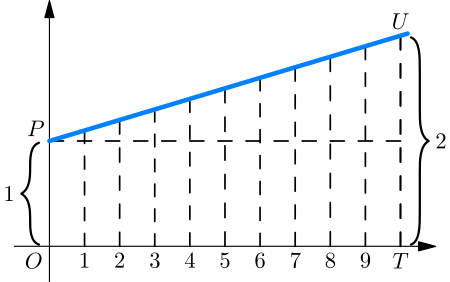
The geometrical illustration in the next figure represents
the concept of simple interest. In this figure, stands for the original value. is the whole time during which the
value is growing. If we take
steps, each of of the
original height , at the end the
height will be doubled.
Let us take geometrical illustrations of these things. In the next figure, stands for the original value. is the whole time during which the value is growing. It is divided into periods, in each of which there is an equal step up. Here is a constant; and if each step up is of the original , then, by such steps, the height is doubled. If we had taken steps, each of half the height shown, at the end the height would still be just doubled. Or such steps, each of of the original height , would suffice to double the height. This is the case of simple interest. Here is growing till it becomes .
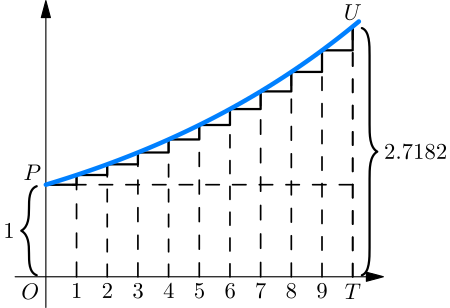
In the next figure, we have the corresponding illustration of the geometrical progression. Each of the successive ordinates is to be , that is, times as high as its predecessor. The steps up are not equal, because each step up is now of the ordinate at that part of the curve. If we had literally steps, with for the multiplying factor, the final total would be or times the original . But if only we take sufficiently large (and the corresponding sufficiently small), then the final value to which unity will grow will be .
The Number e
To this mysterious number , the mathematicians have
assigned the letter . This number
is often called Euler’s number after the Swiss mathematician Leonhard
Euler.
To this mysterious number , the mathematicians have
assigned the letter . This number
is often called Euler’s number after the Swiss mathematician Leonhard
Euler. All fifth graders know that the Greek letter (called pi) stands for ; but how many of them know
that means ? Yet it is an even more
important number than !
What, then, is ?
Suppose we were to let grow at simple interest till it became ; then, if at the same nominal rate of interest, and for the same time, we were to let grow at true compound interest, instead of simple, it would grow to the value of the number .
An exponential rate of growth refers to a
growth process described by the equation where is a constant.Unit exponential of
growth occurs when
(i.e. ). In the case of unit
exponential growth, the value of
increases by a factor of
in unit time.
This process of growing proportionately, at
every instant, to the magnitude at that instant, some people call an
exponential rate of growing. Unit exponential rate of growth is
that rate which in unit time will cause to grow to . It might also be called the
organic rate of growing because it is characteristic of organic
growth (in certain circumstances) that the increment of the organism in
a given time is proportional to the magnitude of the organism itself.
If we take percent as the unit of rate, and any fixed period as the unit of time, then the result of letting grow arithmetically at unit rate, for unit time, will be , while the result of letting grow exponentially at unit rate, for the same time, will be .
A little more about the number
When becomes
indefinitely great, will reach . Now let’s expand the
expression . The binomial theorem gives the rule that
\begin{aligned}
(a + b)^n = a^n &+ n \dfrac{a^{n-1} b}{1!} + n(n - 1) \dfrac{a^{n-2}
b^2}{2!} \\
&+ n(n -1)(n - 2) \dfrac{a^{n-3} b^3}{3!} + \cdots.
\end{aligned} Putting
and , we get \begin{aligned}
\left(1 + \dfrac{1}{n}\right)^n
= 1 + 1 +& \dfrac{1}{2!} \left(\dfrac{n - 1}{n}\right)
+\dfrac{1}{3!} \dfrac{(n - 1)(n - 2)}{n^2} \\
& + \dfrac{1}{4!} \dfrac{(n - 1)(n - 2)(n - 3)}{n^3} + \cdots.
\end{aligned} Now, if we suppose to become indefinitely great, say a
billion, or a billion billions, then , , and , etc., will all be sensibly equal
to ; and then the series becomes
We have seen that we require to know what value is reached by the expression , when becomes indefinitely great. Arithmetically, here are tabulated a lot of values (which anybody can calculate out by the help of a calculator) got by assuming ; ; ; and so on, up to . \begin{aligned} &\left(1 + \frac{1}{2}\right)^2 &=& 2.25. \\ &\left(1 + \frac{1}{5}\right)^5 &=& 2.488. \\ &\left(1 + \frac{1}{10}\right)^{10} &=& 2.594. \\ &\left(1 + \frac{1}{20}\right)^{20} &=& 2.653. \\ &\left(1 + \frac{1}{100}\right)^{100} &=& {2.705}. \\ &\left(1 + \frac{1}{1000}\right)^{1000} &=& {2.7169}. \\ &\left(1 + \frac{1}{10,000}\right)^{10,000} &=& {2.7181}. \end{aligned}
It is, however, worth while to find another way of calculating this immensely important figure.
Accordingly, we will avail ourselves of the binomial theorem, and expand the expression in that well-known way.
The binomial theorem gives the rule that \begin{aligned} (a + b)^n &= a^n + n \dfrac{a^{n-1} b}{1!} + n(n - 1) \dfrac{a^{n-2} b^2}{2!} + n(n -1)(n - 2) \dfrac{a^{n-3} b^3}{3!} + \cdots. \end{aligned} Putting and , we get \begin{aligned} \left(1 + \dfrac{1}{n}\right)^n &= 1 + 1 + \dfrac{1}{2!} \left(\dfrac{n - 1}{n}\right) + \dfrac{1}{3!} \dfrac{(n - 1)(n - 2)}{n^2} + \dfrac{1}{4!} \dfrac{(n - 1)(n - 2)(n - 3)}{n^3} + \cdots. \end{aligned}
Now, if we suppose to become indefinitely great, say a billion, or a billion billions, then , , and , etc., will all be sensibly equal to ; and then the series becomes
By taking this rapidly convergent series to as many terms as we please, we can work out the sum to any desired point of accuracy. Here is the working for ten terms:
| dividing by | |
| dividing by | |
| dividing by | |
| dividing by | |
| dividing by | |
| dividing by | |
| dividing by | |
| dividing by | |
| dividing by | |
| Total |
is incommensurable with , and resembles in being an interminable non-recurrent decimal.
The Exponential Series
We shall have need of yet another series.
Let us, again making use of the binomial theorem, expand the expression , which is the same as when we make indefinitely great. \begin{aligned} e^x &= 1^{nx} + nx \frac{1^{nx-1} \left(\dfrac{1}{n}\right)}{1!} + nx(nx - 1) \frac{1^{nx - 2} \left(\dfrac{1}{n}\right)^2}{2!} \\ &\qquad + nx(nx - 1)(nx - 2) \frac{1^{nx-3} \left(\dfrac{1}{n}\right)^3}{3!} + \cdots\\ &= 1 + x + \frac{1}{2!} \cdot \frac{n^2x^2 - nx}{n^2} + \frac{1}{3!} \cdot \frac{n^3x^3 - 3n^2x^2 + 2nx}{n^3} + \cdots \\ &= 1 + x + \frac{x^2 -\dfrac{x}{n}}{2!} + \frac{x^3 - \dfrac{3x^2}{n} + \dfrac{2x}{n^2}}{3!} + \cdots. \end{aligned}
But, when is made indefinitely great, this simplifies down to the following:
This series is called the exponential series.
Derivative of the Exponential Function
The function has a
unique property where its derivative is equal to the function itself, as
shown by the infinite series expansion: \begin{aligned}
\frac{d(e^x)}{dx}
&= 0 + 1 + \frac{2x}{1 \cdot 2} + \frac{3x^2}{1 \cdot 2 \cdot 3}
\\
&\qquad + \frac{4x^3}{1 \cdot 2 \cdot 3 \cdot 4} + \frac{5x^4}{1
\cdot 2 \cdot 3 \cdot 4 \cdot 5} + \cdots\\
&=1+x+\frac{x^2}{2!}+\frac{x^3}{3!}+\frac{x^4}{4!}+\cdots\\
&=e^x
\end{aligned} We can show that no other function of possesses such a property.
The great reason why is regarded of importance is that possesses a property, not possessed by any other function of , that when you differentiate it its value remains unchanged; or, in other words, its derivative is the same as itself. This can be instantly seen by differentiating it with respect to , thus: \begin{aligned} \frac{d(e^x)}{dx} &= 0 + 1 + \frac{2x}{1 \cdot 2} + \frac{3x^2}{1 \cdot 2 \cdot 3} + \frac{4x^3}{1 \cdot 2 \cdot 3 \cdot 4} + \frac{5x^4}{1 \cdot 2 \cdot 3 \cdot 4 \cdot 5} + \cdots. \end{aligned} or \begin{aligned} \frac{d(e^x)}{dx}= 1 + x + \frac{x^2}{1 \cdot 2} + \frac{x^3}{1 \cdot 2 \cdot 3} + \frac{x^4}{1 \cdot 2 \cdot 3 \cdot 4} + \cdots, \end{aligned} which is exactly the same as the original series.
Now we might have gone to work the other way, and said: Go to; let us find a function of , such that its derivative is the same as itself. Or, is there any expression, involving only powers of , which is unchanged by differentiation? Accordingly; let us assume as a general expression that (in which the coefficients , , , etc. will have to be determined), and differentiate it.
Now, if this new expression is really to be the same as that from which it was derived, it is clear that must ; that ; that ; that , etc.
The law of change is therefore that
If, now, we take for the sake of further simplicity, we have
Differentiating it any number of times will give always the same series over again.
If, now, we take the particular case of , and evaluate the series, we shall get simply \begin{aligned} \text{when } x &= 1,\quad & y &= 2.718281\dots; & \text{that is, } y &= e; \\ \text{when } x &= 2,\quad & y &=(2.718281\dots)^2; & \text{that is, } y &= e^2; \\ \text{when } x &= 3,\quad & y &=(2.718281\dots)^3; & \text{that is, } y &= e^3; \end{aligned} and therefore thus finally demonstrating that
Of course it follows that remains unchanged if differentiated with respect to . Also , which is equal to , will, when differentiated with respect to , be , because is a constant.
Natural or Naperian Logarithms
If then
The logarithm with
base is called the
natural logarithm. The natural logarithm is so
important that it has its own shorthand:
Another reason why is important is because it was made by
Napier, the inventor of logarithms, the basis of his system. If is the value of , then is the logarithm, to the
base , of . Or, if then
The logarithm with base is called the natural logarithm. The natural logarithm is so important that it has its own shorthand:
The two curves plotted in Figs. 14.3 and 14.4 represent these equations.
The points calculated are:


It will be seen that, though the calculations yield different points for plotting, yet the result is identical. The two equations really mean the same thing.
Natural logarithms or logarithms to the base operate similarly to common logarithms.
The rule that the sum of logarithms equals the logarithm of the product,
and the
power rule, still apply.
To convert from natural to ordinary logarithms, multiply by , thus
and vice versa,
As many persons who use ordinary logarithms, which are calculated to base instead of base , are unfamiliar with the “natural” logarithms, it may be worth while to say a word about them. The ordinary rule that adding logarithms gives the logarithm of the product still holds good; or Also the rule of powers holds good; But as is no longer the basis, one cannot multiply by or by merely adding or to the index. One can change the natural logarithm to the ordinary logarithm1 simply by multiplying it by ; or \begin{aligned} \log_{10} x = \frac{1}{\ln 10}\ln x\approx0.4343 \times \ln x, \end{aligned} and conversely, \begin{aligned} \ln x = \frac{1}{\log_{10} e}\times \log_{10} x=\ln 10\times \log_{10}x\approx2.3026 \times \log_{10} x. \end{aligned}
Using A Calculator to Find and
Modern scientific and graphing calculators are equipped with buttons for exponentiation with the base and buttons for calculating natural or common logarithms. The exponential function is sometimes denoted by . Therefore, when using a calculator, we may need to locate the or button. Many calculators provide two distinct buttons for calculating the natural logarithm () and the common logarithm (). If your calculator has an button for the natural logarithm, the button is likely designed to return .
Derivatives of Logarithmic and Exponential and Exponential Functions
Now let us try our hands at differentiating certain expressions that contain logarithms or exponentials.
To differentiate first transform it into Then
This
surprising result, which can’t be obtained through the Power Rule for
differentiation, demonstrates a unique property of the .
Take the equation:
First transform this
into whence, since the
derivative of with regard
to is the original function
unchanged (see here),
and,
reverting from the inverse to the original function,
Now this is a very curious result. It may be written
Note that is a result that we could never have got by the Power Rule for differentiating powers. That rule is to multiply by the power, and reduce the power by . Thus, differentiating gave us ; and differentiating gave . But differentiating does not give us or , because is itself , and is a constant. We shall have to come back to this curious fact that differentiating gives us when we reach the chapter on integrating.
Now, try to differentiate \begin{aligned} y = \ln(x+a), \end{aligned} that is, \begin{aligned} e^y = x+a; \end{aligned} we have , since the differential of remains .
This gives hence, reverting to the original function (see here), we get
To differentiate since and
is a constant, we
have
Next try
First change to natural logarithms by multiplying by the modulus . This gives us \begin{aligned} y = \frac{1}{\ln 10} \ln x; \end{aligned} whence \begin{aligned} \frac{dy}{dx} = \frac{1}{x\ln 10}. \end{aligned}
In general, because and is a constant, we have
To differentiate take the natural logarithm of both
sides Thus
The next thing is not quite so simple. Try this:
Taking the logarithm of both sides, we get \begin{aligned} \ln y &= x \ln a, \end{aligned} or \begin{aligned} x &= \frac{\ln y}{\ln a}\\ &= \frac{1}{\ln a} \times \ln y. \end{aligned}
Since is a constant, we get hence, reverting to the original function.
We see that, since
We shall find that whenever we have an expression such as a function of , we always have the derivative of the function of , so that we could have written at once, from ,
In summary
Let us now attempt further examples.
Examples
Example 14.1. Differentiate with respect to if .
Solution
Let ; then .
Or thus:
Example 14.2. Differentiate with respect to if .
Solution
Let ; then .
Or thus:
Example 14.3. Given , find .
Solution
\begin{aligned}
\ln y &= \frac{2x}{x+1},\quad
\frac{1}{y}\, \frac{dy}{dx} = \frac{2(x+1)-2x}{(x+1)^2};
\end{aligned} hence \begin{aligned}
\frac{dy}{dx} &= \frac{2}{(x+1)^2} e^{\frac{2x}{x+1}}.
\end{aligned}
Check by writing .
.. For if and , ,
Check by writing .
Example 14.4. If , find .
Solution
Let ; then .
Example 14.5. If , find .
Solution
Let ; then . \begin{aligned}
\frac{dy}{dz}
&= \frac{1}{z};\quad \frac{dz}{dx} = 6x + \frac{x}{\sqrt{x^2+a}};
\\
\frac{dy}{dx}
&= \frac{6x + \dfrac{x}{\sqrt{x^2+a}}}{3x^2 + \sqrt{a+x^2}}
= \frac{x(1 + 6\sqrt{x^2+a})}{(3x^2 + \sqrt{x^2+a}) \sqrt{x^2+a}}.
\end{aligned}
Example 14.6. If , find .
Solution
Taking the logarithm of
both sides, we get \begin{aligned}
\ln y &=\ln\left[(x+3)^2\sqrt{x-2}\right]\\
&=\ln\left[(x+3)^2\right]+\ln\left[(x-2)^{\frac{1}{2}}\right]\\
&= 2 \ln(x+3)+ \frac{1}{2} \ln(x-2).
\end{aligned} Differentiating both sides, we get \begin{aligned}
\frac{1}{y}\, \frac{dy}{dx}
&= \frac{2}{(x+3)} + \frac{1}{2(x-2)}; \\
\frac{dy}{dx}
&= (x+3)^2 \sqrt{x-2} \left\{\frac{2}{x+3} +
\frac{1}{2(x-2)}\right\}.
\end{aligned}
Example 14.7. If , find .
Solution
Taking the logarithm of
both sides, we get \begin{aligned}
\ln y
&= 3 \ln(x^2+3) + \frac{2}{3} \ln(x^3-2); \\
\frac{1}{y}\, \frac{dy}{dx}
&= 3 \frac{2x}{(x^2+3)} + \frac{2}{3} \frac{3x^2}{x^3-2}
= \frac{6x}{x^2+3} + \frac{2x^2}{x^3-2}.
\end{aligned} For if , let and . Similarly, if , and
Example 14.8. If , find .
Solution
\begin{aligned}
\ln y &= \ln\left[\frac{\sqrt[2]{x^2+a}}{\sqrt[3]{x^3-a}}\right]\\
&=\ln \left[(x^2+a)^{\frac{1}{2}}(x^3-a)^{-\frac{1}{3}}\right]\\
&=\ln \left[(x^2+a)^{\frac{1}{2}}\right]+\ln
\left[(x^3-a)^{-\frac{1}{3}}\right]\\
&= \frac{1}{2} \ln(x^2+a) - \frac{1}{3} \ln(x^3-a).
\end{aligned} Differentiating \begin{aligned}
\frac{1}{y}\, \frac{dy}{dx}
&= \frac{1}{2}\, \frac{2x}{x^2+a} - \frac{1}{3}\,
\frac{3x^2}{x^3-a}
= \frac{x}{x^2+a} - \frac{x^2}{x^3-a}
\end{aligned} and \begin{aligned}
\frac{dy}{dx}
&= \frac{\sqrt[2]{x^2+a}}{\sqrt[3]{x^3-a}}
\left\{ \frac{x}{x^2+a} - \frac{x^2}{x^3-a} \right\}.
\end{aligned}
Example 14.9. If , find .
Solution
\frac{dy}{dx}
= \frac{\ln x \times 0 - 1 \times \dfrac{1}{x}}
{\ln^2 x}
= -\frac{1}{x \ln^2x}.\tag{Quotient Rule}
Example 14.10. If , find .
Solution
Let ; .
Example 14.11. If , find .
Solution
Differentiating and
Try now the following exercises.
Exercises I
Exercise 14.1. Differentiate .
Answer
.
Solution
(1)
\begin{aligned} \frac{d y}{d x}&=b\left(a e^{a x}+a e^{-a x}\right)\\ &=a b\left(e^{a x}+e^{-a x}\right) \end{aligned}
Exercise 14.2. Find the derivative of the expression with respect to .
Answer
.
Solution
Exercise 14.3. If , find .
Answer
.
Solution
Exercise 14.4. Show that if ,.
Solution
Exercise 14.5. If , find .
Answer
.
Solution
Differentiate
Exercise 14.6. .
Answer
.
Solution
Exercise 14.7. .
Answer
.
Solution
Let . Then , and \begin{aligned}
\frac{d u}{d x}&=\frac{-1(x-1)-1(-x)}{(x-1)^{2}}\\
&=\frac{-x+1+x}{(x-1)^{2}}\\
&=\frac{1}{(x-1)^{2}}
\end{aligned} Using the Chain Rule:
Exercise 14.8. .
Answer
.
Solution
Using the Product
Rule, we get \begin{aligned}
\frac{d y}{d x}&=\frac{d(3x^2-1)}{dx}
e^{-5x}+(3x^2-1)\frac{d\left(e^{-5x}\right)}{dx}\\
&=6 x e^{-5 x}+\left(3 x^{2}-1\right)\left(-5 e^{-5 x}\right) \\
&=6x e ^{-5x} - 5(3x^2 + 1)e ^{-5x}
\end{aligned}
Exercise 14.9. .
Answer
.
Solution
Let . Now using the Chain Rule \begin{aligned}
\frac{d y}{d x}&= \frac{d(\ln u)}{du}\frac{du}{dx}\\
&=\frac{1}{u}\left(a x^{a-1}\right)\\
&=\frac{a x^{a-1}}{x^a+a}
\end{aligned}
Exercise 14.10. .
Answer
.
Solution
Using the Product Rule:
Exercise 14.11. .
Answer
.
Solution
Using the
Quotient Rule: \begin{aligned}
\frac{d y}{d x}&=\frac{\frac{1}{x+3}(x+3)-\ln (x+3)}{(x+3)^{2}}\\
&=\frac{1-\ln (x+3)}{(x+3)^{2}}
\end{aligned}
Exercise 14.12. .
Answer
.
Solution
\begin{aligned} \frac{d y}{d x}&=\left(a^{x} \ln a\right) x^{a}+a x^{a-1} \cdot a^{x}\\ &=a^x\left(a x^{a-1}+x^a \ln a\right) \end{aligned}
Exercise 14.13. It was shown by Lord Kelvin that the speed of signaling through a submarine cable depends on the value of the ratio of the external diameter of the core to the diameter of the enclosed copper wire. If this ratio is called , then the number of signals that can be sent per minute can be expressed by the formula where is a constant depending on the length and the quality of the materials. Show that if these are given, will be a maximum if .
Solution
To
differentiate ,
let . Then \begin{aligned}
\frac{d\left(\ln\frac{1}{y}\right)}{dy}&=\frac{d(\ln
u)}{du}\cdot\frac{du}{dy}\\
&=\frac{1}{u}\cdot \left(-y^{-2}\right)\\
&=-y\cdot\frac{1}{y^2}\\
&=-\frac{1}{y}
\end{aligned} Now using the Product Rule, we get \begin{aligned}
\frac{d s}{d y}&=2 a y\, \ln \frac{1}{y}+a
y^2\left(-\frac{1}{y}\right) \\
&= -2 a y\, \ln y-a y\\
&=a y\,(-2 \ln y-1)
\end{aligned}
\begin{aligned} \frac{d s}{d y}&=0 \Rightarrow-2 \ln y-1=0\\ & \Rightarrow \ln y=-\frac{1}{2} \Rightarrow y=e^{-1 / 2} \end{aligned}
\begin{aligned} \frac{d^{2} s}{d y^{2}}&=-2 a \ln y-2 a y\left(\frac{1}{y}\right)-a\\ &=-2 a \ln y-2 a-a \end{aligned}
When , Therefore, it follows from the Second Derivative Test that is a minimum if .
Exercise 14.14. Find the maximum or minimum of
Answer
Min.: for .
Solution
To show that this specific value of makes a minimum, we apply the Second Derivative Test. First we differentiate to find the second derivative Since when is a minimum occurring when .
Exercise 14.15. Differentiate .
Answer
.
Solution
Recall that and . Using these properties, we can rewrite as Since , Now we can differentiate term by term
Exercise 14.16. Differentiate .
Answer
.
Solution
Using the Chain Rule \begin{aligned}
\frac{dy}{dx}=&\frac{dy}{du}\cdot\frac{du}{dx}\\
=& 3u^2\cdot\frac{1}{ax}\\
=&3\cdot(\ln ax)^2\frac{1}{ax}\\
=&\frac{3}{ax}\left(\ln ax\right)^2
\end{aligned}
The Logarithmic Curve
The equation
describes a curve with ordinates in geometrical progression; meaning
that when If we taking
logarithms, we obtain This shows that if we plot versus , we will get a straight line.
Let us return to the curve
which has its successive ordinates in geometrical progression, such as
that represented by the equation .
The above equation can be reformatted as where
is represented as .
We can see, by putting , that is the initial height of .
Then when
Also, we see that is the numerical value of the ratio between the height of any ordinate and that of the next preceding it. In the next figure, we have taken as ; each ordinate being as high as the preceding one.


If two successive ordinates are related together thus in a constant ratio, their logarithms will have a constant difference; so that, if we should plot out a new curve, the next figure, with values of as ordinates, it would be a straight line sloping up by equal steps. In fact, it follows from the equation, that \begin{aligned} \ln y = \ln b + x \cdot \ln p, \end{aligned} whence \begin{aligned} \ln y - \ln b = x \cdot \ln p. \end{aligned}
Now, since is a mere number, and may be written as , it follows that and the equation takes the new form
The Die-away Curve
If , the
curve representing the equation will tend to descend (provided ). For instance, with , each successive ordinate
is of the height of its
predecessor.
If we were to take as a proper fraction (less than unity),
the curve would obviously tend to sink downwards, as in the next figure,
where each successive ordinate is of the height of the
preceding one.
For , we have , which can be represented as
(). Thus, , and the equation of the curve
becomes The expression
is particularly
significant when time is the independent variable, as the equation
illustrates a wide range of physical processes where something is
progressively diminishing. Examples include the cooling of a hot body,
the discharge of an electrified body leaking at a constant rate , and the declining amplitude of a
vibrating spring.
The equation is still

but since is less than one, will be a negative quantity, and may be written ; so that ,2 and now our equation for the curve takes the form
The importance of this expression is that, in the case where the independent variable is time, the equation represents the course of a great many physical processes in which something is gradually dying away. Thus, the cooling of a hot body is represented (in Newton’s celebrated “law of cooling”) by the equation where is the original excess of temperature of a hot body over that of its surroundings, the excess of temperature at the end of time , and is a constant—namely, the constant of decrement, depending on the amount of surface exposed by the body, and on its coefficients of conductivity and emissivity, etc.
A similar formula, is used to express the charge of an electrified body, originally having a charge , which is leaking away with a constant of decrement ; which constant depends in this case on the capacity of the body and on the resistance of the leakage-path.
Oscillations given to a flexible spring die out after a time; and the dying-out of the amplitude of the motion may be expressed in a similar way.
The term
serves as a die-away factor for all those phenomena where the
rate of decrease is proportional to the magnitude of that which is
decreasing; that is
is proportional to at any moment.
This results in a curve where the slope is proportional to the
height , and becomes flatter as
grows smaller.
Regardless of whether the original equation takes the form or (), differentiation leads to the
same result:
meaning the slope of the curve is downward and proportional to both
and the constant .
In fact serves as a die-away factor for all those phenomena in which the rate of decrease is proportional to the magnitude of that which is decreasing; or where, in our usual symbols, is proportional at every moment to the value that has at that moment. For we have only to inspect the curve, Fig. 14.7 above, to see that, at every part of it, the slope is proportional to the height ; the curve becoming flatter as grows smaller. In symbols, thus or and, differentiating, hence or, in words, the slope of the curve is downward, and proportional to and to the constant .
We should have got the same result if we had taken the equation in the form \begin{aligned} y &= bp^x; \end{aligned} for then \begin{aligned} \frac{dy}{dx}= bp^x \times \ln p. \end{aligned} But giving us \begin{aligned} \frac{dy}{dx} = y \times (-a) = -ay, \end{aligned} as before.
In the ‘die-away factor’ expression , the constant is the reciprocal of another quantity
known as the time-constant, denoted by . The time-constant signifies the time
it takes for the original quantity to reduce to (approximately ) of its initial value.
The Time-constant. In the expression for the “die-away factor” , the quantity is the reciprocal of another quantity known as “the time-constant,” which we may denote by the symbol . Then the die-away factor will be written ; and it will be seen, by making that the meaning of is that this is the length of time which it takes for the original quantity (called or in the preceding instances) to die away th part—that is to —of its original value.
As an example, consider a hot body initially 72 hotter than its environment,
with a cooling time-constant of 20 minutes ( min). That is, If we
want to find the excess temperature after 60 minutes ( min), then meaning the excess temperature
after 60 minutes is .
As an example, suppose there is a hot body cooling, and that at the beginning of the experiment (i.e. when ) it is C hotter than the surrounding objects, and if the time-constant of its cooling is minutes (that is, if it takes minutes for its excess of temperature to fall to part of degrees), then we can calculate to what it will have fallen in any given time . For instance, let be minutes. Then , and we shall have to find the value of , and then multiply the original degrees by this. Since is , at the end of minutes the excess of temperature will have fallen to C.
Further Examples
Example 14.12. The strength of an electric current in a conductor at a time seconds after the application of the electromotive force producing it is given by the expression .
The time constant is .
If , , ; then when is very large the term becomes , and ; also
Its value at any time may be written: the time-constant being . This means that it takes sec. for the variable term to fall by of its initial value .
To find the value of the current when s, say, , .
It follows that, after s, the variable term is , and the actual current is .
Similarly, at the end of s, the variable term is , the current being .
Example 14.13. The intensity of a beam of light which has passed through a thickness cm of some transparent medium is , where is the initial intensity of the beam and is a “constant of absorption.”
This constant is usually found by experiments. If it be found, for instance, that a beam of light has its intensity diminished by 18% in passing through cm of a certain transparent medium, this means that or . Now we take the natural logarithm of both sides or -10K \times \ln e =\ln 0.82\approx -0.2;\tag{$\ln e=1$} hence .
To find the thickness that will reduce the intensity to half its value, one must find the value of which satisfies the equality , or . It is found by putting this equation in its logarithmic form, namely, which gives
Example 14.14. The quantity of a radio-active substance which has not yet undergone transformation is known to be related to the initial quantity of the substance by the relation , where is a constant and the time in seconds elapsed since the transformation began.
For “Radium ,” if time is expressed in seconds, experiment shows that . Find the time required for transforming half the substance. (This time is called the “mean life” of the substance.)
Solution
We have . and
Exercises II
Exercise 14.17. Draw the curve ; where , , and is given various values from to .
Answer
Use your calculator to evaluate for different values
of within the range . Then, connect the
resulting points together.
Solution
To sketch the curve by hand, we can
evaluate at
various values of (). For example,
| 0 | 12.000 |
| 1 | 10.590 |
| 5 | 6.423 |
| 10 | 3.438 |
| 15 | 1.840 |
| 20 | 0.985 |
Then plot each of these points on a set of axes, and connect these points with a smooth curve.
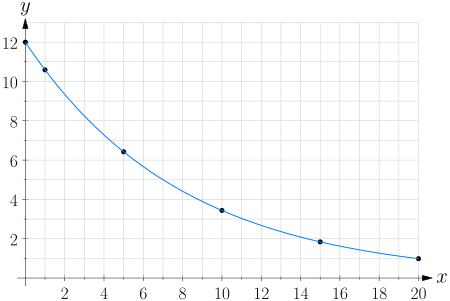
There are also multiple tools for plotting the curve for . For example, you may
visit WolframAlpha.com and in the search bar simply type:
plot 12 e^ (-t/8) from t=0 to t=20.
Exercise 14.18. If a hot body cools so that in minutes its excess of temperature has fallen to half the initial amount, deduce the time-constant, and find how long it will be in cooling down to per cent. of the original excess.
Answer
;
minutes.
Solution
The equation of cooling is
After 24 minutes
\begin{aligned} \frac{\theta}{\theta_{0}} & =\frac{1}{2}=e^{-\frac{24}{T}} \\ \Rightarrow \quad \ln \frac{1}{2} & =\ln \left(e^{-\frac{24}{T}}\right) \\ -\ln 2 & =-\frac{24}{T} \\ T & =\frac{24}{\ln 2} \approx 34.6247 \end{aligned}
time-constant is approximately .
Now we want to find such that
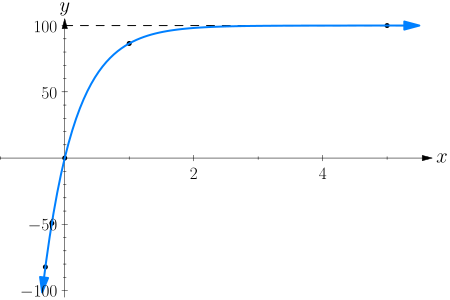
Exercise 14.19. Plot the curve
Solution
When ,
When is a large positive number, the term becomes negligible (). Consequently, we have
On the other hand, when is a large negative number, the terms becomes very large positive. As a result becomes numerically large but negative.
The curve is shown below.
Exercise 14.20. The following equations give very similar curves: \begin{aligned} \text{(i)}\ y &= \frac{ax}{x + b}; \\ \text{(ii)}\ y &= a(1 - e^{-\frac{x}{b}}); \\ \text{(iii)}\ y &= \frac{2a}{\pi} \arctan \left(\frac{x}{b}\right).\quad (\text{it may be written as }y = \frac{2a}{\pi} \tan^{-1} \left(\frac{x}{b}\right)) \end{aligned} Draw all three curves, taking units; units.
Solution
Let’s assume .
When , then
is zero.
is zero because .
is zero because .
When is very large positive
is because we can ignore compared to (for example, when and , then ).
is because is negligible for large values of .
is because when is large, .
For negative values of , these curves are not comparable because is very large when is close to .
When is large negative,
is large positive. Therefore is large negative when is large negative.
is because again is negligible compared to and thus .
is because when is large negative, .
These curves are shown below.
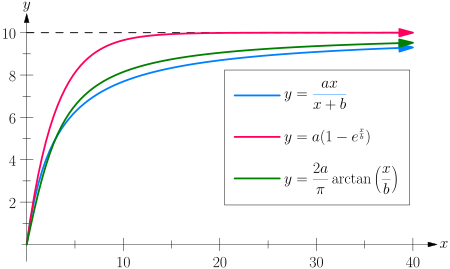
Exercise 14.21. Find the derivative of with respect to , if
Answer
a) ; (b) ; (c) .
Solution
(a)
Taking the natural logarithm of both sides and recalling :
\begin{aligned} \ln y & =\ln \left(x^{x}\right) \\ & =x \ln x \end{aligned}
Now differentiating and using the Chain Rule for the left-hand side and the Product Rule for the right-hand side
\begin{aligned} \frac{1}{y} \frac{d y}{d x} & =\ln x+x \cdot \frac{1}{x} \\ \Rightarrow \quad \frac{d y}{d x} & =y(\ln x+1) \\ & =x^{x}(\ln x+1) \end{aligned}
(b)
Method 1)
Taking the natural logarithm of both sides and using the property , we have
\begin{aligned} \ln y & =\ln \left(\left(e^{x}\right)^{x}\right) \\ & =x \ln \left(e^{x}\right) \\ & =x \cdot x=x^{2} \end{aligned}
Now let’s differentiate both sides with respect to :
Simplifying, we find
Method 2) Recall that . Therefore
Let and applying the Chain Rule with where , we get
\begin{aligned} \frac{d y}{d x} & =\frac{d y}{d u} \cdot \frac{d u}{d x} \\ & =e^{u} \cdot 2 x \\ & =y \cdot 2 x \\ & =2 x\left(e^{x}\right)^{x} \end{aligned}
(c)
Method 1) Let Then using the result of part (a) and the Chain Rule, we obtain \begin{aligned} \frac{d y}{d x} & =\frac{d y}{d u} \cdot \frac{d u}{d x}\\ &= e^{u} \cdot\left[x^{x}(\ln x+1)\right] \\ & =e^{\left(x^{x}\right)} \cdot x^{x}(\ln x+1) . \end{aligned}
Method 2) Take of both sides
\begin{aligned} \ln y & =\ln \left(e^{\left(x^{x}\right)}\right)\\ & =x^{x} \ln e \\ & =x^{x} \end{aligned} Now differentiate both sides with respect to to get \begin{aligned} \frac{1}{y} \frac{d y}{d x} & =\frac{d\left(x^{x}\right)}{d x} \\ & =x^{x}(\ln x+1) \end{aligned} Therefore \begin{aligned} \frac{d y}{d x} & =y \times x^{x}(\ln x+1) \\ & =e^{\left(x^{x}\right)} \times x^{x}(\ln x+1) . \end{aligned}
Exercise 14.22. For “Thorium ,” the value of is ; find the “mean life,” that is, the time taken by the transformation of a quantity of “Thorium ” equal to half the initial quantity in the expression being in seconds.
Answer
seconds.
Solution
We need to find
such that
Taking the natural logarithm of both sides \begin{aligned} \ln (0.5) & =\ln \left(e^{-5 t}\right) \\ & =-5 t \ln e \\ & =-5 t \\ \Rightarrow \quad t & =-\frac{\ln (0.5)}{5} \approx 0.1386 \text { seconds. } \end{aligned}
Exercise 14.23. A condenser of capacity , charged to a potential , is discharging through a resistance of ohms. Find the potential after (a) second; (b) second; assuming that the fall of potential follows the rule .
Answer
(a) ;(b) .
Solution
Here or
(a) When
(b) When
Exercise 14.24. The charge of an electrified insulated metal sphere is reduced from to units in minutes. Find the coefficient of leakage, if ; being the initial charge and being in seconds. Hence find the time taken by half the charge to leak away.
Answer
, .
Solution
Since we can find
\begin{aligned} & \ln \frac{16}{20}=-\mu \times 10 \times 60 \\ & \Rightarrow \quad \mu=-\frac{1}{600} \ln 0.8 \approx 0.000372 \end{aligned}
Now we need to find such that
\begin{aligned} \frac{1}{2} & =e^{-0.000372 t} \\ \ln (0.5) & =-0.000372 t \\ t & \approx 1863.77 \mathrm{~s} \approx 31 \mathrm{~min}\ 3.77 \mathrm{~s} \end{aligned}
Exercise 14.25. The damping on a telephone line can be ascertained from the relation , where is the strength, after seconds, of a telephonic current of initial strength ; is the length of the line in kilometres, and is a constant. For the Franco-English submarine cable laid in 1910, . Find the damping at the end of the cable ( kilometres), and the length along which is still % of the original current (limiting value of very good audition).
Answer
is
% of , kilometres.
Solution
(a)
Therefore, the strength becomes of the initial strength.
(b)
\begin{aligned} \frac{i}{i_{0}}=0.08 & =e^{-0.0114\, l} \\ \ln (0.08) & =-0.0114\,l \\ \ell & =-\frac{\ln (0.08)}{0.0114} \approx 221.555 \mathrm{~km} \end{aligned}
Exercise 14.26. The pressure of the atmosphere at an altitude kilometres is given by ; being the pressure at sea-level ( millimetres).
The pressures at , and kilometres being , , respectively, find in each case. Using the mean value of , find the percentage error in each case.
Answer
, , , mean ; %, practically nil, %.
Solution
Calculating when ,
Calculating when
Calculating when
Average (the mean value of ):
Calculating using when :
\begin{aligned} & 760 \times e^{-10 \times 0.1446}=178.99 \\ & \text { error }=\frac{178.99-199.2}{199.2} \approx-10.1 \% \end{aligned}
Calculating using when :
\begin{aligned} & 760 \times e^{-20 \times 0.1446}=42.15 \\ & \text { error }=\frac{42.2-42.15}{42.2} \approx 0.12 \% \end{aligned}
Calculating using when :
Exercise 14.27. Find the minimum or maximum of .
Answer
Min. for .
Solution
In Exercise S, we showed that
Setting
Since , at the minimum or maximum, we must have Then \begin{aligned} e^{\ln x} & =e^{-1} \\ x & =e^{-1}=\frac{1}{e} . \end{aligned}
To determine if this value of makes a maximum or a minimum, we apply the Second Derivative Test:
\begin{aligned} \frac{d^{2} y}{d x^{2}} & =\frac{d\left(x^{x}\right)}{d x}(\ln x+1)+x^{x}\left(\frac{1}{x}\right) \\ & =x^{x}(\ln x+1)^{2}+\frac{x^{x}}{x} \end{aligned} When , then \begin{aligned} \frac{d^{2} y}{d x^{2}} & =\left(\frac{1}{e}\right)^{\frac{1}{e}} \times 0+\frac{\left(\frac{1}{e}\right)^{\frac{1}{e}}}{\frac{1}{e}} \\ & =\frac{1}{e}\left(\frac{1}{e}\right)^{\frac{1}{e}}>0 \end{aligned} Therefore, corresponds to a minimum value of .
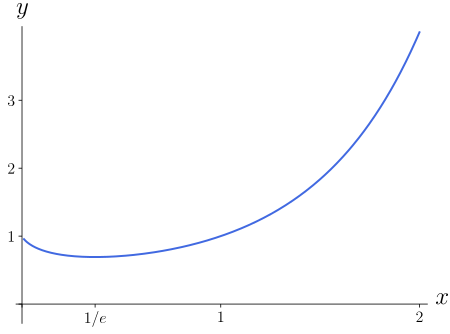
The graph of is shown below.
Exercise 14.28. Find the minimum or maximum of .
Answer
Max. for .
Solution
To differentiate, we first take the natural logarithm of both sides then use the Chain Rule:
\begin{aligned} \ln y & =\ln \left(x^{\frac{1}{x}}\right) \\ & =\frac{1}{x} \ln x \\ \frac{1}{y} \frac{d y}{d x} & =-\frac{1}{x^{2}} \ln x+\frac{1}{x} \cdot \frac{1}{x} \\ \frac{d y}{d x} & =\frac{y}{x^{2}}(1-\ln x) \end{aligned}
Since ,
or
To determine whether makes a minimum or a maximum, we compare the value of at this point with the values of at some nearby points:
When
When
When
Therefore makes a maximum.
We can also apply the Second Derivative Test:
Using the Quotient Rule
Therefore,
When , both and are zero. Therefore, when
It follows from the Second Derivative Test that is a maximum occurring when .
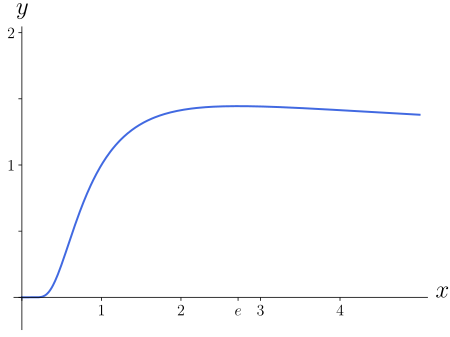
The graph of is shown below
Exercise 14.29. Find the minimum or maximum of .
Answer
Min. for .
Solution
Using the Product Rule
To find , let and use the Chain Rule
\begin{aligned} \frac{d a^{u}}{d x} & =\frac{d a^{u}}{d u} \cdot \frac{d u}{d x} \\ & =\left(a^{u} \ln a\right)\left(-\frac{1}{x^{2}}\right) \\ & =-\frac{\ln a}{x^{2}} a^{\frac{1}{x}} \end{aligned}
Therefore
Since ,
or
Using the Second Derivative Test
When
Therefore is a minimum occurring when .
Hyperbolic Functions
Hyperbolic functions are specific combinations of exponential functions that arise frequently in various applications, leading mathematicians to give them distinctive names and thoroughly investigate their properties. Although hyperbolic functions are combined exponential functions, in some ways they resemble the trigonometric functions. As a result, the hyperbolic functions are given individual names such as hyperbolic sine, hyperbolic cosine, hyperbolic tangent, and others. Their definitions are as follows:
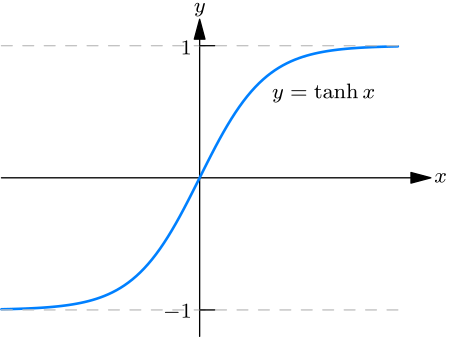
\boxed{\begin{aligned} \sinh x&=\frac{e^{x}-e^{-x}}{2},\\ \cosh x&=\frac{e^{x}+e^{-x}}{2},\\ \tanh x&=\frac{\sinh x}{\cosh x}\\ \text{coth } x&=\frac{1}{\tanh x}=\frac{\cosh x}{\sinh x}\\ \text{sech }x &=\frac{1}{\cosh x}\\ \text{csch }x &=\frac{1}{\sinh x} \end{aligned}}One can easily sketch the graphs of and by plotting the curves and , adding and subtracting the ordinates, and taking half of each. The following figure displays their graphs.
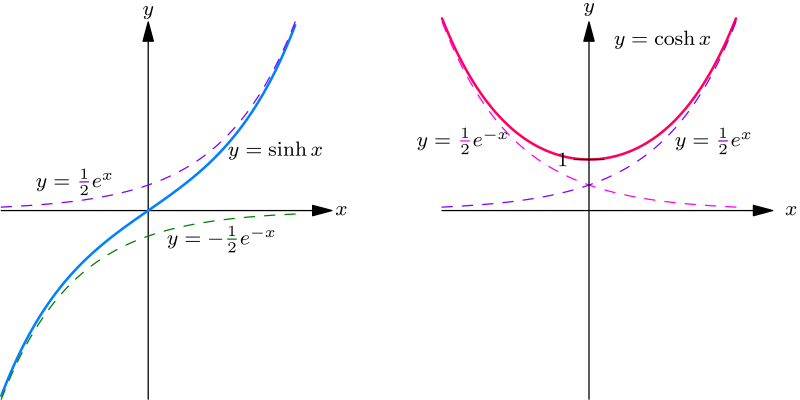
A catenary, which is the graph of the hyperbolic cosine, is a curve that describes the shape of a homogeneous chain or cord hanging under its own weight.
When is positive large, is very large, while is extremely small; hence leading to: Similarly, when is negative large, is negligible, making , and hence: The graph of is shown below.
Identities Between Hyperbolic Functions
The properties of the hyperbolic functions closely resemble the corresponding properties of the trigonometric functions.
It follows directly from the definitions that \begin{aligned} \cosh x-\sinh x & =e^{-x}\\ \cosh x+\sinh x & =e^{x} \end{aligned} Now using , we get \begin{aligned} \cosh^2 x-\sinh^2 x&=(\cosh x-\sinh x)(\cosh x+\sinh x)\\ &= e^{-x}\cdot e^x=e^{-x+x}=e^0=1 \end{aligned} As such we have proved one of the fundamental identities: Now if we divide each term of the above equation by , we obtain Similarly, dividing each term of by gives us
Example 14.15. Prove .
Solution
Let’s simplify the
right-hand side \begin{aligned}
\sinh x\cosh y+\cosh x\sinh y= &
\frac{e^{x}-e^{-x}}{2}\frac{e^{y}+e^{-y}}{2}+\frac{e^{x}+e^{-x}}{2}\frac{e^{y}-e^{-y}}{2}\\[6pt]
= &
\frac{1}{4}\left[e^{x+y}+\cancel{e^{x-y}}-\bcancel{e^{-x+y}}-e^{-x-y}\right]\\[6pt]
&
\quad+\frac{1}{4}\left[e^{x+y}-\cancel{e^{x-y}}+\bcancel{e^{-x+y}}-e^{-x-y}\right]\\[6pt]
= & \frac{1}{2}\left[e^{x+y}-e^{-(x+y)}\right]\\[6pt]
= & \sinh(x+y)
\end{aligned}
Therefore, In a similar way, we can prove It follows from the above identity that Hence, Similarly, Therefore,
Another important set of identities, which follow at once from the definitions, is:3
Derivatives of the Hyperbolic Functions
As the hyperbolic functions are combinations of exponential functions, and we have just learned how to differentiate exponential functions, we can apply the differentiation rules learned in Chapters 5 and 6 to determine the derivatives of the hyperbolic functions.
For example, since , we have \begin{aligned} \frac{d(\sinh x)}{dx}&=\frac{d}{dx}\left(\frac{e^x}{2}-\frac{e^{-x}}{2}\right)\\ &=\frac{1}{2}\frac{d(e^x)}{dx}-\frac{1}{2}\frac{d(e^{-x})}{dx}\\ &=\frac{e^x}{2}-\frac{-e^{-x}}{2}=\frac{e^x+e^{-x}}{2}=\cosh x. \end{aligned} Similarly, we can show that .
Example 14.16. Show .
Solution
Since , we can use the
Quotient Rule: \begin{aligned}
\frac{d}{dx}\tanh x= & \frac{d}{dx}\frac{\sinh x}{\cosh x}\\[6pt]
= & \frac{\cosh x-\frac{d(\sinh x)}{dx}-\sinh x\frac{d(\cosh
x)}{dx}}{\cos^2 x}\\[6pt]
= & \frac{\cosh^2 x-\sinh^2 x}{\cosh^2 x}=\frac{1}{\cosh^{2}x}
&& {\small(\cosh^{2}x-\sinh^{2}x=1)}\\[6pt]
= & \text{ sech}^{2}x
\end{aligned}
In summary,
Inverse Hyperbolic Functions
The inverse hyperbolic sine function is denoted by or , and is defined by We may also define the inverse hyperbolic cosine function, denoted by or , as However, note that if , then is also equal to . This means that the above definition assigns two values of to each value of . To make a single-valued function, we agree that it produces only non-negative values of . Furthermore, because , the inverse hyperbolic cosine function does not take any values of less than .
Similarly, the inverse hyperbolic tangent function is defined by Since , the inverse hyperbolic tangent function does not take any values of greater than or equal to or less than or equal to .
In summary,
\boxed{\begin{aligned}y=\text{ arcsinh } x
& \Leftrightarrow y=\sinh x \\
y=\text{ arccosh } x & \Leftrightarrow x=\cosh y & & (x\geq
1,y\geq 0)\\
y=\text{ arctanh } x & \Leftrightarrow x=\tanh y & &
(-1
We can find explicit formulas for the inverse hyperbolic functions.
Example 14.17. Show that .
Solution
If , then
Multiplying by by , we obtain or
This is a quadratic equation in terms of . Therefore, by the quadratic
formula,
Since and is greater than , only the positive sign is acceptable.
Hence,
Taking the natural logarithm of each side produces
Therefore,
In a similar fashion, we can derive explicit formulas for the other
inverse hyperbolic functions. \boxed{\begin{aligned} & \text{ arcsinh
}x=\ln\left(x+\sqrt{x^{2}+1}\right) & & (x \text{ can be any
number})\\
& \text{ arccosh }x=\ln\left(x+\sqrt{x^{2}-1}\right) & &
(x\geq1)\\
& \text{ arctanh }x=\frac{1}{2}\ln\frac{1+x}{1-x} & &
(-1
Derivatives of the Inverse Hyperbolic Functions
With what we have learned so far, we can find the derivatives of the inverse hyperbolic functions.
Example 14.18. If (also denoted by ), find .
Solution
If , then , and By the derivative of an inverse function (see here)
\begin{aligned}
\frac{dy}{dx}&=\frac{1}{\dfrac{dx}{dy}}=\frac{1}{\cosh
y}=\frac{1}{\sqrt{1+\sinh^2 y}}=\frac{1}{\sqrt{1+x^2}}.
\end{aligned}
We can also find the derivative of by differentiating . Using the chain rule and the fact that , we get \begin{aligned} \frac{d}{dx} \ln(x+\sqrt{x^2+1}) &= \frac{1}{x+\sqrt{x^2+1}}\cdot\left(1+\frac{x}{\sqrt{x^2+1}}\right)= \frac{1}{\sqrt{x^2+1}} . \end{aligned} This confirms the result we obtained earlier.
Example 14.19. If (also denoted by ), find .
Solution
If , then , and Hence,
Example 14.20. If (also denoted by ), find .
Solution
If , then , and Thus
In summary,
\boxed{\begin{aligned} &
\frac{d\left(\text{arcsinh
}x\right)}{dx}=\frac{d\left(\sinh^{-1}x\right)}{dx}=\frac{1}{\sqrt{x^{2}+1}}
& & (x\in\mathbb{R})\\
& \frac{d\left(\text{arccosh
}x\right)}{dx}=\frac{d\left(\cosh^{-1}x\right)}{dx}=\frac{1}{\sqrt{x^{2}-1}}
& & (x>1)\\
& \frac{d\left(\text{arctanh
}x\right)}{dx}=\frac{d\left(\tanh^{-1}x\right)}{dx}=\frac{1}{1-x^{2}}
& & (-1