Chapter Summary (Express)
Partial Fractions
When differentiating fractions, the process can become complicated, especially if the fraction is not simple. However, by splitting the fraction into simpler fractions, differentiating each one of them, and then adding the derivatives together, the differentiation process can be made easier.
We have seen that when we differentiate a fraction we have to perform a rather complicated operation; and, if the fraction is not itself a simple one, the result is bound to be a complicated expression. If we could split the fraction into two or more simpler fractions such that their sum is equivalent to the original fraction, we could then proceed by differentiating each of these simpler expressions. And the result of differentiating would be the sum of two (or more) derivatives, each one of which is relatively simple; while the final expression, though of course it will be the same as that which could be obtained without resorting to this dodge, is thus obtained with much less effort and appears in a simplified form.
We are familiar with the process of adding fractions together. However, it is possible to reverse this process by splitting a given fraction back into its original components or partial fractions. We don’t know yet how to split it.
The process of splitting, presented here, is applicable to "proper" algebraic fractions, where the numerator has a lesser degree than the denominator.
Simplification through division can be applied if the fraction is not proper, resulting in a proper algebraic fraction that can be further split into partial fractions.
Let us see how to reach this result. Try first the job of adding two fractions together to form a resultant fraction. Take, for example, the two fractions and . Every student can add these together and find their sum to be . And in the same way they can add together three or more fractions. Now this process can certainly be reversed: that is to say, that if this last expression were given, it is certain that it can somehow be split back again into its original components or partial fractions. Only we do not know in every case that may be presented to us how we can so split it. In order to find this out we shall consider a simple case at first. But it is important to bear in mind that all which follows applies only to what are called “proper” algebraic fractions, meaning fractions like the above, which have the numerator of a lesser degree than the denominator; that is, those in which the highest index of is less in the numerator than in the denominator. If we have to deal with such an expression as , we can simplify it by division, since it is equivalent to ; and is a proper algebraic fraction to which the operation of splitting into partial fractions can be applied, as explained hereafter.
Case I: When the factors of the denominator are all of the first degree and none repeated
When the factors of the denominators are all of the first degree and none repeated, each nonrepeated linear factor, such as , corresponds to a partial fraction of the form For example, since , we write where A and B are constants to be determined.
If we perform many additions of two or more fractions the denominators of which contain only terms in , and no terms in , , or any other powers of , we always find that the denominator of the final resulting fraction is the product of the denominators of the fractions which were added to form the result. It follows that by factorizing the denominator of this final fraction, we can find every one of the denominators of the partial fractions of which we are in search.
Example 13.1. Suppose we wish to go back from to the components which we know are and . If we did not know what those components were we can still prepare the way by writing: leaving blank the places for the numerators until we know what to put there. We may always assume the sign between the partial fractions to be plus, since, if it be minus, we shall simply find the corresponding numerator to be negative. Now, since the partial fractions are proper fractions, the numerators are mere numbers without at all, and we can call them , , as we please. So, in this case, we have:
If now we perform the addition of these two partial fractions, we get ; and this must be equal to . And, as the denominators in these two expressions are the same, the numerators must be equal, giving us:
Now, this is an equation with two unknown quantities, and it would seem that we need another equation before we can solve them and find and . But there is another way out of this difficulty. The equation must be true for all values of ; therefore it must be true for such values of as will cause and to become zero, that is for and for respectively. If we make , we get , so that ; and if we make , we get , so that . Replacing the and of the partial fractions by these new values, we find them to become and ; and the thing is done.
Example 13.2. As a farther example, let us take the fraction .
The denominator becomes zero when is given the value ; hence is a factor of it, and obviously then the other factor will be ;1 and this can again be decomposed into . So we may write the fraction thus: making three partial factors.
Proceeding as before, we find
Now, if we make , we get:
If , we get:
If , we get:
So then the partial fractions are: which is far easier to differentiate with respect to than the complicated expression from which it is derived.
Case II: When the denominator contains factors of the second degree2 and none repeated
When the denominator contains non-repeated quadratic factors of the form where , each of these factors corresponds to a partial fraction of the form where and are constants to be determined.
If some of the factors of the denominator contain terms in , and are not conveniently put into factors, then the corresponding numerator may contain a term in , as well as a simple number; and hence it becomes necessary to represent this unknown numerator not by the symbol but by ; the rest of the calculation being made as before.
Example 13.3. Try, for instance:
Putting , we get ; and ;
hence and
Putting , we get ;
hence and so that , and the partial fractions are:
Example 13.4. Take as another example the fraction
We get \begin{align} \frac{x^3-2}{(x^2+1)(x^2+2)} &= \frac{Ax+B}{x^2+1} + \frac{Cx+D}{x^2+2}\\ &= \frac{(Ax+B)(x^2+2)+(Cx+D)(x^2+1)}{(x^2+1)(x^2+2)}. \end{align}
In this case the determination of , , , is not so easy. It will be simpler to proceed as follows: Since the given fraction and the fraction found by adding the partial fractions are equal, and have identical denominators, the numerators must also be identically the same. In such a case, and for such algebraical expressions as those with which we are dealing here, the coefficients of the same powers of are equal and of same sign.
Hence, since \begin{align} x^3-2 &= (Ax+B)(x^2+2) + (Cx+D)(x^2+1) \\ &= (A+C)x^3 + (B+D)x^2 + (2A+C)x + 2B+D, \end{align} we have ; (the coefficient of in the left expression being zero); ; and . Here are four equations, from which we readily obtain ; ; ; ; so that the partial fractions are . This method can always be used; but the method shown first will be found the quickest in the case of factors in only.
Case III: When the denominator contains factors of the first or second degree and some repeated
When the denominator contains linear or quadratic factors, some of which are repeated, for every -fold linear factor, such as , there correspond partial fractions of the form Similarly, for every -fold quadratic factor, such as , there correspond partial fractions of the form
When, among the factors of the denominator there are some which are raised to some power, one must allow for the possible existence of partial fractions having for denominator the several powers of that factor up to the highest.
Example 13.5. In splitting the fraction we must allow for the possible existence of a denominator as well as and .
It maybe thought, however, that, since the numerator of the fraction the denominator of which is may contain terms in , we must allow for this in writing for its numerator, so that If, however, we try to find , , and in this case, we fail, because we get four unknowns; and we have only three relations connecting them, yet
But if we write we get which gives for . Replacing by its value, transposing, gathering like terms and dividing by , we get , which gives for . Replacing by its value, we get
Hence ; so that the partial fractions are: instead of stated above as being the fractions from which was obtained. The mystery is cleared if we observe that can itself be split into the two fractions , so that the three fractions given are really equivalent to which are the partial fractions obtained.
As we can see from the preceding example, it is sufficient to allow for one numerical term in each numerator, and that we always get the ultimate partial fractions.
When there is a power of a factor of in the denominator, however, the corresponding numerators must be of the form .
Example 13.6.
which gives
For , this gives . Replacing, transposing, collecting like terms, and dividing by , we get
Hence and ; and ; or and , and finally, or . So that we obtain as the partial fractions:
It is useful to check the results obtained. The simplest way is to replace by a single value, say , both in the given expression and in the partial fractions obtained.
Whenever the denominator contains but a power of a single factor, a very quick method is as follows:
Example 13.7. Taking, for example, , let ; then .
Replacing, we get
The partial fractions are, therefore,
Application of Partial Fractions in Differentiation
Let it be required to differentiate ; we have \begin{align} \frac{dy}{dx} &= -\frac{(6x^2+7x-3) \times 4 + (5 - 4x)(12x + 7)}{(6x^2 + 7x - 3)^2}\\ &= \frac{24x^2 - 60x - 23}{(6x^2 + 7x - 3)^2}. \end{align}
If we split the given expression into we get, however, which is really the same result as above split into partial fractions. But the splitting, if done after differentiating, is more complicated, as will easily be seen. When we shall deal with the integration of such expressions, we shall find the splitting into partial fractions a precious auxiliary (see here).
Exercises
Split into fractions
Exercise 13.1. .
Answer
.
Solution
\begin{align} \frac{3 x+5}{(x-3)(x+4)}&=\frac{A}{x-3}+\frac{B}{x+4} \\ &=\frac{A(x+4)+B(x-3)}{(x-3)(x+4)} \end{align}
For , we get
Putting in (*), we get Therefore
Exercise 13.2. .
Answer
.
Solution
Putting in (*), we get
Putting in (*), we get
Therefore,
Exercise 13.3. .
Answer
.
Solution
Since , we write
Putting in (*), we get
Putting in (*), we get
Exercise 13.4. .
Answer
.
Solution
Since
Putting in (*), we get
Putting in (*), we get
Therefore,
Exercise 13.5. .
Answer
.
Solution
Putting in (*), we get
Putting in (*), we get
Hence,
Exercise 13.6. .
Answer
.
Solution
Thus
Putting in (*), we get
Putting in (*), we get
Putting in (*), we get
Therefore,
Exercise 13.7. .
Answer
.
Solution
Therefore,
Putting in (*)
Putting in (*)
Putting in (*)
Thus
Exercise 13.8. .
Answer
.
Solution
Therefore,
Putting in (*),
Putting in (*)
Putting in (*)
Therefore,
Exercise 13.9. .
Answer
.
Solution
It follows that For , we have Substituting in (*), expanding, and collecting like terms, we get \begin{align} & x^{2}=\frac{1}{3}\left(x^{2}+x+1\right)+B x^{2}+(C-B) x-C \\ & x^{2}=\left(B+\frac{1}{3}\right) x^{2}+\left(C-B+\frac{1}{3}\right) x-C+\frac{1}{3} \end{align} Therefore, we must have , , and : \begin{align} & B+\frac{1}{3}=1 \Rightarrow B=\frac{2}{3} \\ & C-\frac{2}{3}+\frac{1}{3}=0 \Rightarrow C=\frac{1}{3} \\ & -C+\frac{1}{3}=-\frac{1}{3}+\frac{1}{3}=0 \quad \text { Check } \end{align}
Therefore
Exercise 13.10. .
Answer
.
Solution
Since the degree of the numerator is larger than the degree of the denominator, we do not have a proper fraction. We can divide the numerator by the denominator to get a proper fraction:
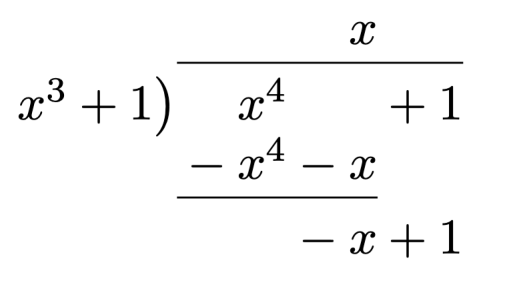
Therefore
Since , we write
Putting in (*), we get
Thus Expanding, and collecting like terms, we get We must have , , and : \begin{align} \frac{2}{3}+B=0 & \Rightarrow \boxed{B=-\frac{2}{3}} \\ C-\frac{1}{3}=0 & \Rightarrow \boxed{C=\frac{1}{3}} \end{align}
Therefore
Exercise 13.11. .
Answer
.
Solution
For , we have Substituting in (*) leads to \begin{align} 5 x^{2}+6 x+4&=3\left(x^{2}+x+1\right)+B x^{2}+(B+C) x+C \\ & =(3+B) x^{2}+(B+C+3) x+3+C \end{align} \Rightarrow \left\{\begin{align} &3+B=5 \\ &B+C+3=6\\ &3+C=4 \end{align} \right. \Rightarrow \boxed{B=2, C=1}
Therefore
Exercise 13.12. .
Answer
.
Solution
For every , we must have
For ,
\begin{align} & 1=A \times(1-2)^{2}+B \times 0+C \times 0 \\ & \Rightarrow \boxed{A=1} \end{align}
For ,
Since no other value of will make any factor vanish, we choose a convenient value of to simplify the calculation. For example, for , we get
or
Therefore
Exercise 13.13. .
Answer
.
Solution
Therefore, for every , we must have
For
For
For
Hence
Exercise 13.14. .
Answer
.
Solution
For every , we must have
For
For
A convenient choice for to simplify calculations is zero. But you can choose anther value for .
For
\begin{align} 3&=\frac{4}{9} \times 4+B(-1)(2)-\frac{1}{3}(-1) \\ & \Rightarrow \boxed{B=-\frac{4}{9}} \end{align}
Hence
Exercise 13.15. .
Answer
.
Solution
For every , we have
For , we have
To find , and , we choose some convenient values of . Then we try to solve the system of equations.
For
For ,
\begin{align} 6= & 1 \times 3^{2}+(B+C)(3)(3)+(D-C)(3) \\ & 9 B+6 C+3 D=-3 \end{align}
For ,
For ,
\begin{align} 17= & 49+(2 B+C)(7)(4)+(2 D-C)(4) \\ & 56 B+24 C+8 D=-32 \end{align}
or
Therefore
Exercise 13.16. .
Answer
.
Solution
For every , we must have
For
For
For
Therefore
Exercise 13.17. .
Answer
.
Solution
Let , then and Therefore,
For every , we have
For
For
For
For
If we add and together, we get
Substituting in and , we get \begin{align} \left\{\begin{array}{l} A+C=\dfrac{55}{9} \\ 4 A-C=-\dfrac{55}{9} \end{array} \Rightarrow 5 A=0 \Rightarrow \boxed{A=0}\right. \end{align} and from one of these simplified equations, we obtain
Therefore
and
Exercise 13.18. .
Answer
.
Solution
Recall that So we can write and hence To split the given expression into fractions, we write For every , we have For : Knowing , for :
Knowing , for :
Similarly for :
is
Since , then Since , , and , we get Therefore,
Derivative of an Inverse Function
Consider the function ; it can be expressed in the form ; this latter form is called the inverse function to the one originally given.
If ,; if ,, and we see that
Consider (for ), ; the inverse function is
Here again
It can be shown that for all functions which can be put into the inverse form, one can always write
It follows that, being given a function, if it be easier to differentiate the inverse function, this may be done, and the reciprocal of the derivative of the inverse function gives the derivative of the given function itself.
Example 13.8. Suppose that we wish to differentiate .
We have seen one way of doing this, by writing , and finding and . This gives
If we had forgotten how to proceed by this method, or wished to check our result by some other way of obtaining the derivative, or for any other reason we could not use the ordinary method, we can proceed as follows: The inverse function3 is .
hence
Example 13.9. Let us take, as another example,
The inverse function is or , and
It follows that , as might have been found otherwise.
We shall find this dodge most useful later on; meanwhile you are advised to become familiar with it by verifying by its means the results obtained in Exercises 4, Nos. 5, 6, 7; this, this, this, this Examples; and Exercises 9.1, Nos. 1, 2, 3 and 4.
You will surely realize from this chapter and the preceding, that in many respects the calculus is an art rather than a science: an art only to be acquired, as all other arts are, by practice. Hence you should work many examples, and set yourself other examples, to see if you can work them out, until the various artifices become familiar by use.
Full Chapter
Partial Fractions
We have seen that when we differentiate a fraction we have to perform a rather complicated operation; and, if the fraction is not itself a simple one, the result is bound to be a complicated expression. If we could split the fraction into two or more simpler fractions such that their sum is equivalent to the original fraction, we could then proceed by differentiating each of these simpler expressions. And the result of differentiating would be the sum of two (or more) derivatives, each one of which is relatively simple; while the final expression, though of course it will be the same as that which could be obtained without resorting to this dodge, is thus obtained with much less effort and appears in a simplified form.
Let us see how to reach this result. Try first the job of adding two fractions together to form a resultant fraction. Take, for example, the two fractions and . Every student can add these together and find their sum to be . And in the same way they can add together three or more fractions. Now this process can certainly be reversed: that is to say, that if this last expression were given, it is certain that it can somehow be split back again into its original components or partial fractions. Only we do not know in every case that may be presented to us how we can so split it. In order to find this out we shall consider a simple case at first. But it is important to bear in mind that all which follows applies only to what are called “proper” algebraic fractions, meaning fractions like the above, which have the numerator of a lesser degree than the denominator; that is, those in which the highest index of is less in the numerator than in the denominator. If we have to deal with such an expression as , we can simplify it by division, since it is equivalent to ; and is a proper algebraic fraction to which the operation of splitting into partial fractions can be applied, as explained hereafter.
Case I: When the factors of the denominator are all of the first degree and none repeated
If we perform many additions of two or more fractions the denominators of which contain only terms in , and no terms in , , or any other powers of , we always find that the denominator of the final resulting fraction is the product of the denominators of the fractions which were added to form the result. It follows that by factorizing the denominator of this final fraction, we can find every one of the denominators of the partial fractions of which we are in search.
Example 13.1. Suppose we wish to go back from to the components which we know are and . If we did not know what those components were we can still prepare the way by writing: leaving blank the places for the numerators until we know what to put there. We may always assume the sign between the partial fractions to be plus, since, if it be minus, we shall simply find the corresponding numerator to be negative. Now, since the partial fractions are proper fractions, the numerators are mere numbers without at all, and we can call them , , as we please. So, in this case, we have:
If now we perform the addition of these two partial fractions, we get ; and this must be equal to . And, as the denominators in these two expressions are the same, the numerators must be equal, giving us:
Now, this is an equation with two unknown quantities, and it would seem that we need another equation before we can solve them and find and . But there is another way out of this difficulty. The equation must be true for all values of ; therefore it must be true for such values of as will cause and to become zero, that is for and for respectively. If we make , we get , so that ; and if we make , we get , so that . Replacing the and of the partial fractions by these new values, we find them to become and ; and the thing is done.
Example 13.2. As a farther example, let us take the fraction .
The denominator becomes zero when is given the value ; hence is a factor of it, and obviously then the other factor will be ;1 and this can again be decomposed into . So we may write the fraction thus: making three partial factors.
Proceeding as before, we find
Now, if we make , we get:
If , we get:
If , we get:
So then the partial fractions are: which is far easier to differentiate with respect to than the complicated expression from which it is derived.
Case II: When the denominator contains factors of the second degree2 and none repeated
If some of the factors of the denominator contain terms in , and are not conveniently put into factors, then the corresponding numerator may contain a term in , as well as a simple number; and hence it becomes necessary to represent this unknown numerator not by the symbol but by ; the rest of the calculation being made as before.
Example 13.3. Try, for instance:
Putting , we get ; and ;
hence and
Putting , we get ;
hence and so that , and the partial fractions are:
Example 13.4. Take as another example the fraction
We get \begin{align} \frac{x^3-2}{(x^2+1)(x^2+2)} &= \frac{Ax+B}{x^2+1} + \frac{Cx+D}{x^2+2}\\ &= \frac{(Ax+B)(x^2+2)+(Cx+D)(x^2+1)}{(x^2+1)(x^2+2)}. \end{align}
In this case the determination of , , , is not so easy. It will be simpler to proceed as follows: Since the given fraction and the fraction found by adding the partial fractions are equal, and have identical denominators, the numerators must also be identically the same. In such a case, and for such algebraical expressions as those with which we are dealing here, the coefficients of the same powers of are equal and of same sign.
Hence, since \begin{align} x^3-2 &= (Ax+B)(x^2+2) + (Cx+D)(x^2+1) \\ &= (A+C)x^3 + (B+D)x^2 + (2A+C)x + 2B+D, \end{align} we have ; (the coefficient of in the left expression being zero); ; and . Here are four equations, from which we readily obtain ; ; ; ; so that the partial fractions are . This method can always be used; but the method shown first will be found the quickest in the case of factors in only.
Case III: When the denominator contains factors of the first or second degree and some repeated
When, among the factors of the denominator there are some which are raised to some power, one must allow for the possible existence of partial fractions having for denominator the several powers of that factor up to the highest.
Example 13.5. In splitting the fraction we must allow for the possible existence of a denominator as well as and .
It maybe thought, however, that, since the numerator of the fraction the denominator of which is may contain terms in , we must allow for this in writing for its numerator, so that If, however, we try to find , , and in this case, we fail, because we get four unknowns; and we have only three relations connecting them, yet
But if we write we get which gives for . Replacing by its value, transposing, gathering like terms and dividing by , we get , which gives for . Replacing by its value, we get
Hence ; so that the partial fractions are: instead of stated above as being the fractions from which was obtained. The mystery is cleared if we observe that can itself be split into the two fractions , so that the three fractions given are really equivalent to which are the partial fractions obtained.
As we can see from the preceding example, it is sufficient to allow for one numerical term in each numerator, and that we always get the ultimate partial fractions.
When there is a power of a factor of in the denominator, however, the corresponding numerators must be of the form .
Example 13.6.
which gives
For , this gives . Replacing, transposing, collecting like terms, and dividing by , we get
Hence and ; and ; or and , and finally, or . So that we obtain as the partial fractions:
It is useful to check the results obtained. The simplest way is to replace by a single value, say , both in the given expression and in the partial fractions obtained.
Whenever the denominator contains but a power of a single factor, a very quick method is as follows:
Example 13.7. Taking, for example, , let ; then .
Replacing, we get
The partial fractions are, therefore,
Application of Partial Fractions inDifferentiation
Let it be required to differentiate ; we have \begin{align} \frac{dy}{dx} &= -\frac{(6x^2+7x-3) \times 4 + (5 - 4x)(12x + 7)}{(6x^2 + 7x - 3)^2}\\ &= \frac{24x^2 - 60x - 23}{(6x^2 + 7x - 3)^2}. \end{align}
If we split the given expression into we get, however, which is really the same result as above split into partial fractions. But the splitting, if done after differentiating, is more complicated, as will easily be seen. When we shall deal with the integration of such expressions, we shall find the splitting into partial fractions a precious auxiliary (see here).
Exercises
Split into fractions
Exercise 13.1. .
Answer
.
Solution
\begin{align} \frac{3 x+5}{(x-3)(x+4)}&=\frac{A}{x-3}+\frac{B}{x+4} \\ &=\frac{A(x+4)+B(x-3)}{(x-3)(x+4)} \end{align}
For , we get
Putting in (*), we get Therefore
Exercise 13.2. .
Answer
.
Solution
Putting in (*), we get
Putting in (*), we get
Therefore,
Exercise 13.3. .
Answer
.
Solution
Since , we write
Putting in (*), we get
Putting in (*), we get
Exercise 13.4. .
Answer
.
Solution
Since
Putting in (*), we get
Putting in (*), we get
Therefore,
Exercise 13.5. .
Answer
.
Solution
Putting in (*), we get
Putting in (*), we get
Hence,
Exercise 13.6. .
Answer
.
Solution
Thus
Putting in (*), we get
Putting in (*), we get
Putting in (*), we get
Therefore,
Exercise 13.7. .
Answer
.
Solution
Therefore,
Putting in (*)
Putting in (*)
Putting in (*)
Thus
Exercise 13.8. .
Answer
.
Solution
Therefore,
Putting in (*),
Putting in (*)
Putting in (*)
Therefore,
Exercise 13.9. .
Answer
.
Solution
It follows that For , we have Substituting in (*), expanding, and collecting like terms, we get \begin{align} & x^{2}=\frac{1}{3}\left(x^{2}+x+1\right)+B x^{2}+(C-B) x-C \\ & x^{2}=\left(B+\frac{1}{3}\right) x^{2}+\left(C-B+\frac{1}{3}\right) x-C+\frac{1}{3} \end{align} Therefore, we must have , , and : \begin{align} & B+\frac{1}{3}=1 \Rightarrow B=\frac{2}{3} \\ & C-\frac{2}{3}+\frac{1}{3}=0 \Rightarrow C=\frac{1}{3} \\ & -C+\frac{1}{3}=-\frac{1}{3}+\frac{1}{3}=0 \quad \text { Check } \end{align}
Therefore
Exercise 13.10. .
Answer
.
Solution
Since the degree of the numerator is larger than the degree of the denominator, we do not have a proper fraction. We can divide the numerator by the denominator to get a proper fraction:
Therefore
Since , we write
Putting in (*), we get
Thus Expanding, and collecting like terms, we get We must have , , and : \begin{align} \frac{2}{3}+B=0 & \Rightarrow \boxed{B=-\frac{2}{3}} \\ C-\frac{1}{3}=0 & \Rightarrow \boxed{C=\frac{1}{3}} \end{align}
Therefore
Exercise 13.11. .
Answer
.
Solution
For , we have Substituting in (*) leads to \begin{align} 5 x^{2}+6 x+4&=3\left(x^{2}+x+1\right)+B x^{2}+(B+C) x+C \\ & =(3+B) x^{2}+(B+C+3) x+3+C \end{align} \Rightarrow \left\{\begin{align} &3+B=5 \\ &B+C+3=6\\ &3+C=4 \end{align} \right. \Rightarrow \boxed{B=2, C=1}
Therefore
Exercise 13.12. .
Answer
.
Solution
For every , we must have
For ,
\begin{align} & 1=A \times(1-2)^{2}+B \times 0+C \times 0 \\ & \Rightarrow \boxed{A=1} \end{align}
For ,
Since no other value of will make any factor vanish, we choose a convenient value of to simplify the calculation. For example, for , we get
or
Therefore
Exercise 13.13. .
Answer
.
Solution
Therefore, for every , we must have
For
For
For
Hence
Exercise 13.14. .
Answer
.
Solution
For every , we must have
For
For
A convenient choice for to simplify calculations is zero. But you can choose anther value for .
For
\begin{align} 3&=\frac{4}{9} \times 4+B(-1)(2)-\frac{1}{3}(-1) \\ & \Rightarrow \boxed{B=-\frac{4}{9}} \end{align}
Hence
Exercise 13.15. .
Answer
.
Solution
For every , we have
For , we have
To find , and , we choose some convenient values of . Then we try to solve the system of equations.
For
For ,
\begin{align} 6= & 1 \times 3^{2}+(B+C)(3)(3)+(D-C)(3) \\ & 9 B+6 C+3 D=-3 \end{align}
For ,
For ,
\begin{align} 17= & 49+(2 B+C)(7)(4)+(2 D-C)(4) \\ & 56 B+24 C+8 D=-32 \end{align}
or
Therefore
Exercise 13.16. .
Answer
.
Solution
For every , we must have
For
For
For
Therefore
Exercise 13.17. .
Answer
.
Solution
Let , then and Therefore,
For every , we have
For
For
For
For
If we add and together, we get
Substituting in and , we get \begin{align} \left\{\begin{array}{l} A+C=\dfrac{55}{9} \\ 4 A-C=-\dfrac{55}{9} \end{array} \Rightarrow 5 A=0 \Rightarrow \boxed{A=0}\right. \end{align} and from one of these simplified equations, we obtain
Therefore
and
Exercise 13.18. .
Answer
.
Solution
Recall that So we can write and hence To split the given expression into fractions, we write For every , we have For : Knowing , for :
Knowing , for :
Similarly for :
is
Since , then Since , , and , we get Therefore,
Derivative of an Inverse Function
Consider the function ; it can be expressed in the form ; this latter form is called the inverse function to the one originally given.
If ,; if ,, and we see that
Consider (for ), ; the inverse function is
Here again
It can be shown that for all functions which can be put into the inverse form, one can always write
It follows that, being given a function, if it be easier to differentiate the inverse function, this may be done, and the reciprocal of the derivative of the inverse function gives the derivative of the given function itself.
Example 13.8. Suppose that we wish to differentiate .
We have seen one way of doing this, by writing , and finding and . This gives
If we had forgotten how to proceed by this method, or wished to check our result by some other way of obtaining the derivative, or for any other reason we could not use the ordinary method, we can proceed as follows: The inverse function3 is .
hence
Example 13.9. Let us take, as another example,
The inverse function is or , and
It follows that , as might have been found otherwise.
We shall find this dodge most useful later on; meanwhile you are advised to become familiar with it by verifying by its means the results obtained in exercises 5, 6, 7 of the chapter on the Power Rule; Examples 9.1, 9.2, 9.4 ; and exercises 1, 2, 3 and 4 of the chapter on the Chain Rule.
You will surely realize from this chapter and the preceding, that in many respects the calculus is an art rather than a science: an art only to be acquired, as all other arts are, by practice. Hence you should work many examples, and set yourself other examples, to see if you can work them out, until the various artifices become familiar by use.