Chapter Summary (Express)
The Sum and Difference Rules
We have learned how to differentiate simple algebraical functions such as or , and we have now to consider how to tackle the sum of two or more functions.
For instance, let what will its be? How are we to go to work on this new job?
The answer to this question is quite simple: just differentiate them, one after the other, thus:
If you have any doubt whether this is right, try a more general case, working it by first principles. And this is the way.
Sum Rule: If , where is any function of , and any other function of , then
Let , where is any function of , and any other function of . Then, letting increase to , will increase to ; and will increase to ; and to .
And we shall have: Subtracting the original , we get and dividing through by , we get:
This justifies the procedure. You differentiate each function separately and add the results. This is called the Sum Rule.
\bbox[5px,border:1px solid black;background-color:#f2f2f2]{y=u+v\qquad\Rightarrow\qquad \dfrac{dy}{dx}=\dfrac{du}{dx}+\dfrac{dv}{dx}}\tag{Sum Rule}
Example 6.1. If now we take the example of the preceding paragraph, and put in the values of the two functions, we shall have, using the notation shown, \begin{align} \frac{dy}{dx} &= \frac{d(x^2+c)}{dx} + \frac{d(ax^4+b)}{dx} \\ &= 2x + 4ax^3 , \end{align} exactly as before.
If there were three functions of , which we may call , and , so that \begin{align} y &= u+v+w; \end{align} then \begin{align} \frac{dy}{dx} &= \frac{du}{dx} + \frac{dv}{dx} + \frac{dw}{dx}. \end{align}
As for subtraction, it follows at once; for if the function had itself had a negative sign, its derivative would also be negative; so that by differentiating \begin{align} y &= u-v, \end{align} we should get \begin{align} \frac{dy}{dx} &= \frac{du}{dx} - \frac{dv}{dx}. \end{align} This is called the Difference Rule. \bbox[5px,border:1px solid black;background-color:#f2f2f2]{y=u-v\qquad\Rightarrow\qquad \dfrac{dy}{dx}=\dfrac{du}{dx}-\dfrac{dv}{dx}}\tag{Difference Rule}
The Product Rule
When we come to do with Products, the thing is not quite so simple.
Suppose we were asked to differentiate the expression what are we to do? The result will certainly not be ; for it is easy to see that neither , nor , would have been taken into that product.
Product Rule: To differentiate the product of two functions, multiply each function by the derivative of the other, and add together the two products so obtained.
Now there are two ways in which we may go to work.
Do the multiplying first, and, having worked it out, then differentiate.
Accordingly, we multiply together and .
This gives
Now differentiate, and we get:
Go back to first principles, and consider the equation where is one function of , and is any other function of . Then, if grows to be ; and to ; and becomes , and becomes , we shall have: \begin{align} y + dy &= (u + du) \times (v + dv) \\ &= u \cdot v + u \cdot dv + v \cdot du + du \cdot dv. \end{align}
Now is a small quantity of the second order of smallness, and therefore in the limit may be discarded, leaving
Then, subtracting the original , we have left and, dividing through by , we get the result:
This shows that our instructions will be as follows: To differentiate the product of two functions, multiply each function by the derivative of the other, and add together the two products so obtained. This is called the Product Rule.
You should note that this process amounts to the following: Treat as constant while you differentiate ; then treat as constant while you differentiate ; and the whole derivative will be the sum of these two treatments.
\bbox[5px,border:1px solid black;background-color:#f2f2f2]{y=u\times v\qquad\Rightarrow\qquad \dfrac{dy}{dx} = u\, \dfrac{dv}{dx} + v\, \dfrac{du}{dx}}\tag{Product Rule}
Now, having found this rule, apply it to the concrete example which was considered above.
Example 6.2. We want to differentiate the product
Call ; and .
Then, by the general rule just established, we may write: \begin{align} \dfrac{dy}{dx} &= (x^2 + c)\, \frac{d(ax^4 + b)}{dx} &&+ (ax^4 + b)\, \frac{d(x^2 + c)}{dx} \\ &= (x^2 + c)\, 4ax^3 &&+ (ax^4 + b)\, 2x \\ &= 4ax^5 + 4acx^3 &&+ 2ax^5 + 2bx, \end{align}
exactly as before.
The Quotient Rule
Lastly, we have to differentiate quotients.
If where and are two different functions of the independent variable , then
Think of this example, . In such a case it is no use to try to work out the division beforehand, because will not divide into , neither have they any common factor. So there is nothing for it but to go back to first principles, and find a rule.
So we will put where and are two different functions of the independent variable . Then, when becomes , will become ; and will become ; and will become . So then Now perform the algebraic division, thus:
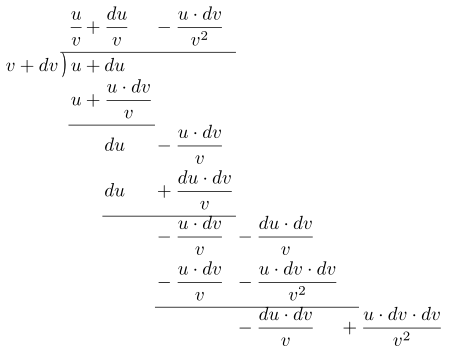
As both these remainders are small quantities of the second order, they may be neglected, and the division may stop here, since any further remainders would be of still smaller magnitudes.
So we have got: which may be written Now subtract the original , and we have left: therefore,
A different approach to obtaining the Quotient Rule is to write the quotient as If we differentiate both sides with respect to , by the Product Rule we obtain Solving for gives Now if we make the substitution in the right-hand side of the above formula, we get \begin{align} \frac{dy}{dx}=\frac{\dfrac{du}{dx}-\dfrac{u}{v}\dfrac{dv}{dx}}{v} \end{align} or \begin{align} \frac{dy}{dx}=\frac{v\dfrac{du}{dx}-u\dfrac{dv}{dx}}{v^2}, \end{align} as before.
This gives us our instructions as to how to differentiate a quotient of two functions. Multiply the divisor function by the derivative of the dividend function; then multiply the dividend function by the derivative of the divisor function; and subtract. Lastly divide by the square of the divisor function. This is called the Quotient Rule.
\bbox[5px,border:1px solid black;background-color:#f2f2f2]{y=\dfrac{u}{v}\qquad\Rightarrow\qquad \dfrac{dy}{dx}=\dfrac{v\dfrac{du}{dx}-u\dfrac{dv}{dx}}{v^2}}\tag{Quotient Rule}
Example 6.3. Going back to our example ,
write and
Then \begin{align} \frac{dy}{dx} &= \frac{(x^2 + a)\, \dfrac{d(bx^5 + c)}{dx} - (bx^5 + c)\, \dfrac{d(x^2 + a)}{dx}}{(x^2 + a)^2} \\ &= \frac{(x^2 + a)(5bx^4) - (bx^5 + c)(2x)}{(x^2 + a)^2}, \\ \frac{dy}{dx} &= \frac{3bx^6 + 5abx^4 - 2cx}{(x^2 + a)^2}.\quad {(\text{Answer}.)} \end{align}
The working out of quotients is often tedious, but there is nothing difficult about it.
Some further examples fully worked out are given hereafter.
Example 6.4. Differentiate .
Solution
Being a constant, vanishes, and we have
But ; so we get:
Example 6.5. Differentiate .
Solution
Putting in the index form, we get
Now or,
Example 6.6. Differentiate .
Solution
This may be written: .
The vanishes, and we have or, or,
Example 6.7. Differentiate .
Solution
A direct way of doing this will be explained later (see here); but we can nevertheless manage it now without any difficulty.
Developing the cube, we get hence
Example 6.8. Differentiate .
Solution
\begin{align} \frac{dy}{dx} &= (2x - 3)\, \frac{d\bigl[(x + 1)(x + 1)\bigr]}{dx}+ (x + 1)^2 \, \frac{d(2x - 3)}{dx} \\ &= (2x - 3) \left[(x + 1)\, \frac{d(x + 1)}{dx}+(x + 1)\, \frac{d(x + 1)}{dx}\right] + (x + 1)^2 \, \frac{d(2x - 3)}{dx} \\ &= 2(x + 1)\bigl[(2x - 3) + (x + 1)\bigr]\\ & = 2(x + 1)(3x - 2); \end{align} or, more simply, multiply out and then differentiate.
Example 6.9. Differentiate .
Solution
\begin{align} \frac{dy}{dx} &= 0.5\left[x^3 \frac{d(x-3)}{dx} + (x-3) \frac{d(x^3)}{dx}\right] \\ &= 0.5\left[x^3 + (x-3) \times 3x^2 \right] = 2x^3 - 4.5x^2 . \end{align}
Same remarks as for preceding example.
Example 6.10. Differentiate .
Solution
This may be written \begin{align} \frac{dw}{d\theta} &= (\theta + \theta^{-1}) \frac{d(\theta^{\frac{1}{2}} + \theta^{-\frac{1}{2}})}{d\theta} + (\theta^{\frac{1}{2}} + \theta^{-\frac{1}{2}}) \frac{d(\theta+\theta^{-1})}{d\theta} \\ &= (\theta + \theta^{-1})(\tfrac{1}{2}\theta^{-\frac{1}{2}} - \tfrac{1}{2}\theta^{-\frac{3}{2}}) + (\theta^{\frac{1}{2}} + \theta^{-\frac{1}{2}})(1 - \theta^{-2}) \\ &= \tfrac{1}{2}(\theta^{ \frac{1}{2}} + \theta^{-\frac{3}{2}} - \theta^{-\frac{1}{2}} - \theta^{-\frac{5}{2}}) + (\theta^{ \frac{1}{2}} + \theta^{-\frac{1}{2}} - \theta^{-\frac{3}{2}} - \theta^{-\frac{5}{2}}) \\&= \tfrac{3}{2} \left(\sqrt{\theta} - \frac{1}{\sqrt{\theta^5}}\right) + \tfrac{1}{2} \left(\frac{1}{\sqrt{\theta}} - \frac{1}{\sqrt{\theta^3}}\right). \end{align}
This, again, could be obtained more simply by multiplying the two factors first, and differentiating afterwards. This is not, however, always possible; see, for instance, Example 15.8, in which the rule for differentiating a product must be used.
Example 6.11. Differentiate .
Solution
\begin{align} \frac{dy}{dx} &= \frac{(1 + ax^{\frac{1}{2}} + a^2x) \times 0 - a\dfrac{d(1 + ax^{\frac{1}{2}} + a^2x)}{dx}} {(1 + a\sqrt{x} + a^2x)^2} \\ &= - \frac{a(\frac{1}{2}ax^{-\frac{1}{2}} + a^2)} {(1 + ax^{\frac{1}{2}} + a^2x)^2}. \end{align}
Example 6.12. Differentiate .
Solution
Example 6.13. Differentiate .
Solution
In the indexed form, . hence
Example 6.14. Differentiate
Solution
Now \begin{align} \theta &= \frac{1 - at^{\frac{2}{3}}}{1 + at^{\frac{3}{2}}}. \\[9pt] \frac{d\theta}{dt} &= \frac{(1 + at^{\frac{3}{2}}) (-\tfrac{2}{3} at^{-\frac{1}{3}}) - (1 - at^{\frac{2}{3}}) \times \tfrac{3}{2} at^{\frac{1}{2}}} {(1 + at^{\frac{3}{2}})^2} \\ &= \frac{5a^2 \sqrt[6]{t^7} - \dfrac{4a}{\sqrt[3]{t}} - 9a \sqrt[2]{t}} {6(1 + a \sqrt[2]{{t^3}})^2}. \end{align}
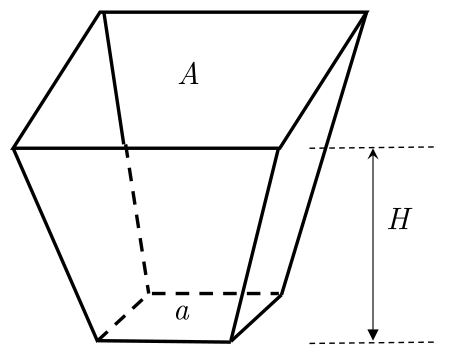
Example 6.15. A reservoir of square cross-section has sides sloping at an angle of with the vertical. The side of the bottom is feet. Find an expression for the quantity pouring in or out when the depth of water varies by foot; hence find, in gallons, the quantity withdrawn hourly when the depth is reduced from to feet in hours.
The volume of a frustum of pyramid (see the next figure) of height , and of bases and , is .
Solution
It is easily seen that, the slope being , if the depth be , the length of the side of the square surface of the water is feet (see the next figure), so that the volume of water is
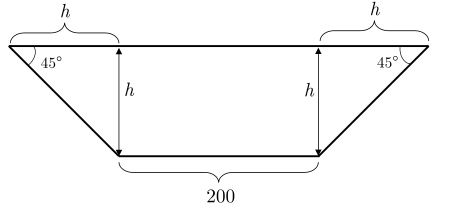
cubic feet per foot of depth variation. The mean level from to feet is feet, when , cubic feet.
Gallons per hour corresponding to a change of depth of ft in hours gallons.
Example 6.16. The absolute pressure, in atmospheres, , of saturated steam at the temperature measured in Centigrades is given by Dulong as being as long as is above C. Find the rate of variation of the pressure with the temperature at C.
Solution
Expand the numerator by the binomial theorem (see the appendix).
hence \begin{align} \dfrac{dP}{dT} = &\dfrac{1}{537,824 \times 10^5}\left(5 \times 40^4 + 20 \times 40^3 T + 30 \times 40^2 T^2 + 20 \times 40 T^3 + 5 T^4 \right), \end{align} when this becomes atmosphere per degree Centigrade change of temperature.
Exercises
Exercise 6.1. Differentiate
.
.
.
.
Answer
(1) .
(2) .
(3) .
(4) .
Solution
(1)
\begin{align} & u=1+x+\frac{x^{2}}{1 \times 2}+\frac{x^{3}}{1 \times 2 \times 3}+\cdots \\ & \frac{d u}{d x}=1+x+\frac{x^{2}}{1 \times 2}+\frac{x^{3}}{1 \times 2 \times 3}+\cdots=u \end{align}
(2)
\begin{align} & y=a x^{2}+b x+c \\ & \frac{d y}{d x}=2 a x+b \end{align}
(3)
\begin{align} & y=(x+a)^{2} \\ & y=x^{2}+2 a x+a^{2} \\ & \frac{d y}{d x}=2 x+2 a=2(x+a) \end{align}
(4)
\begin{align} y & =(x+a)^{3} \\ y & =x^{3}+3 x^{2} a+3 x a+a^{3} \\ \frac{d y}{d x} & =3 x^{2}+6 x a+3 a^{2} \\ & =3\left(x^{2}+2 a x+a^{2}\right) \\ & =3(x+a)^{2} \end{align}
Exercise 6.2. If , find .
Answer
.
Solution
\begin{align} w & =a t-\frac{1}{2} b t^{2} \\ \frac{d w}{d t} & =a-b t \end{align}
Exercise 6.3. Find the derivative of
Answer
.
Solution
Method 1) Using the Product Rule, we get
\begin{align} \frac{d y}{d x} & =1 \times(x-\sqrt{-1})+1 \times(x+\sqrt{-1}) \\ & =2 x \end{align}
Method 2) First, let’s simplify the expression \begin{align} y & =(x+\sqrt{-1})(x-\sqrt{-1}) \\ & =x^{2}-(\sqrt{-1})^{2} \\ & =x^{2}-(-1)=x^{2}+1 \end{align} Now we can easily differentiate it:
Exercise 6.4. Differentiate
Answer
.
Solution
Method a) Use the Product Rule Therefore,
Method b) Expand the given expression and then differentiate
\begin{align} y & =\left(197 x-34 x^{2}\right)\left(7+22 x-83 x^{3}\right) \\ & =2822 x^{5}-16351 x^{4}-748 x^{3}+4096 x^{2}+1379 x \\ \frac{d y}{d x} & =14110 x^{4}-65404 x^{3}-2244 x^{2}+8192 x+1379 \end{align}
Exercise 6.5. If , find .
Answer
.
Solution
Using the Product Rule, we get: \begin{align} \frac{d x}{d y}&=\frac{d(y+3)}{dy}(y+5)+\frac{d(y+5)}{dy}(y+3) \\ &=1(y+5)+1(y+3)\\ & =2 y+8 \end{align}
Exercise 6.6. Differentiate .
Answer
.
Solution
Find the derivatives of
Exercise 6.7. .
Answer
.
Solution
Using the Quotient Rule, we get:
\begin{align} \frac{d y}{d x} & =\frac{\dfrac{d(2x+3)}{dx}(3x+2)-\dfrac{d(3x+2)}{dx}(2x+3)}{(3x+2)^2}\\ &=\frac{2(3 x+2)-3(2 x+3)}{(3 x+2)^{2}} \\ & =-\frac{5}{(3 x+2)^{2}} \end{align}
Exercise 6.8. .
Answer
.
Solution
Using the Quotient Rule, we get
\begin{align} \frac{d y}{d x} & = \frac{\dfrac{d(1+x+2 x^{2}+3 x^{3})}{dx}\left(1+x+2 x^{2}\right)-\dfrac{d(1+x+2 x^{2})}{dx}(1+x+2 x^{2}+3 x^{3})}{\left(1+x+2 x^{2}\right)^2}\\ &=\frac{\left(1+4 x+9 x^{2}\right)\left(1+x+2 x^{2}\right)-(1+4 x)\left(1+x+2 x^{2}+3 x^{3}\right)}{(1+x+2 x)^{2}} \\ & =\frac{6 x^{4}+6 x^{3}+9 x^{2}}{(1+x+2 x)^{2}} \end{align}
Exercise 6.9. .
Answer
.
Solution
Exercise 6.10. .
Answer
.
Solution
\begin{align} \frac{dy}{d x} &= \frac{n x^{n-1}\left(x^{-n}+b\right)-(-n) x^{-n-1}\left(x^{n}+a\right)}{\left(x^{-n}+b\right)^{2}} \\ &= \frac{n x^{-1}+n b x^{n-1}+n x^{-1}+a n x^{-n-1}}{\left(x^{-n}+b\right)^{2}} \\ &= \frac{a n x^{-n-1}+b n x^{n-1}+2 n x^{-1}}{\left(x^{-n}+b\right)^{2}} \end{align}
Exercise 6.11. The temperature of the filament of an incandescent electric lamp is connected to the current passing through the lamp by the relation Find an expression giving the variation of the current corresponding to a variation of temperature.
Answer
.
Solution
\begin{align} C&=a+b T+c T^{2} \\ \frac{d C}{d T}&=b+2 c T \end{align}
Exercise 6.12. The following formulae have been proposed to express the relation between the electric resistance of a wire at the temperature measured in C., and the resistance of that same wire at centigrade, , , being constants. \begin{align} R &= R_0 \left(1 + a T + bT^2 \right). \\ R &= R_0 \left(1 + a T + b\sqrt{T}\right). \\ R &= R_0 \left(1 + a T + bT^2 \right)^{-1}. \end{align}Find the rate of variation of the resistance with regard to temperature as given by each of these formulae.
Answer
,, or.
Solution
If : \begin{align} \frac{d R}{d T}&=\frac{d\left\{R_{0}\left(1+a T+b T^{2}\right)\right\}}{d T}\\ &=R_0 \ \frac{d\left(1+a T+b T^{2}\right)}{d T}\\ &=R_{0}\,(a+2 b T) \end{align}
If
\begin{align} \frac{d R}{d T}&=\frac{d\left\{R_{0}\left(1+a T+b T^{\frac{1}{2}}\right)\right\}}{d T}\\ &= R_0 \frac{d\left(1+a T+b T^{\frac{1}{2}}\right)}{d T}\\ &=R_{0}\left(a+\frac{b}{2} T^{-\frac{1}{2}}\right)\\ &=R_{0}\left(a+\frac{b}{2 \sqrt{T}}\right) \end{align}
If \begin{align} \frac{d R}{d T}&=\frac{d}{d T}\left(\frac{R_{0}}{1+a T+b T^{2}}\right)\\ &=R_{0} \frac{-(a+2 b T)}{\left(1+a T+b T^{2}\right)^{2}} \end{align}
Since , the result can also be written as
Exercise 6.13. The electromotive-force of a certain type of standard cell has been found to vary with the temperature according to the relation Find the change of electromotive-force per degree, at C, C and C.
Answer
,,,.
Solution
or Therefore
\begin{align} & \frac{d E}{d T}=1.4340[-0.000814-0.00021+0.000014 T] \\ & =1.4340[-0.001024+0.000014 T] \end{align}
When ,
When ,
When ,
Exercise 6.14. The electromotive-force necessary to maintain an electric arc of length with a current of intensity has been found by Mrs. Ayrton to be where , , , are constants.
Find an expression for the variation of the electromotive-force (a) with regard to the length of the arc; (b) with regard to the strength of the current.
Answer
,.
Solution
The variation of the electromotive-force with regard to the length of the arc:
To find the variation of the electromotive-force with regard to the strength of the current or , we rewrite as Then \begin{align} \frac{d E}{d i} & =-(c+k l) i^{-2} \\ & =-\frac{c+k l}{i^{2}} \end{align}
Full Chapter
The Sum and Difference Rules
We have learned how to differentiate simple algebraical functions such as or , and we have now to consider how to tackle the sum of two or more functions.
For instance, let what will its be? How are we to go to work on this new job?
The answer to this question is quite simple: just differentiate them, one after the other, thus:
If you have any doubt whether this is right, try a more general case, working it by first principles. And this is the way.
Let , where is any function of , and any other function of . Then, letting increase to , will increase to ; and will increase to ; and to .
And we shall have: Subtracting the original , we get and dividing through by , we get:
This justifies the procedure. You differentiate each function separately and add the results. This is called the Sum Rule.
\bbox[5px,border:1px solid black;background-color:#f2f2f2]{y=u+v\qquad\Rightarrow\qquad \dfrac{dy}{dx}=\dfrac{du}{dx}+\dfrac{dv}{dx}}\tag{Sum Rule}
Example 6.1. If now we take the example of the preceding paragraph, and put in the values of the two functions, we shall have, using the notation shown \begin{align} \frac{dy}{dx} &= \frac{d(x^2+c)}{dx} + \frac{d(ax^4+b)}{dx} \\ &= 2x + 4ax^3, \end{align} exactly as before.
If there were three functions of , which we may call , and , so that \begin{align} y &= u+v+w; \end{align} then \begin{align} \frac{dy}{dx} &= \frac{du}{dx} + \frac{dv}{dx} + \frac{dw}{dx}. \end{align}
As for subtraction, it follows at once; for if the function had itself had a negative sign, its derivative would also be negative; so that by differentiating \begin{align} y &= u-v, \end{align} we should get \begin{align} \frac{dy}{dx} &= \frac{du}{dx} - \frac{dv}{dx}. \end{align} This is called the Difference Rule. \bbox[5px,border:1px solid black;background-color:#f2f2f2]{y=u-v\qquad\Rightarrow\qquad \dfrac{dy}{dx}=\dfrac{du}{dx}-\dfrac{dv}{dx}}\tag{Difference Rule}
The Product Rule
When we come to do with Products, the thing is not quite so simple.
Suppose we were asked to differentiate the expression what are we to do? The result will certainly not be ; for it is easy to see that neither , nor , would have been taken into that product.
Now there are two ways in which we may go to work.
Do the multiplying first, and, having worked it out, then differentiate.
Accordingly, we multiply together and .
This gives
Now differentiate, and we get:
Go back to first principles, and consider the equation where is one function of , and is any other function of . Then, if grows to be ; and to ; and becomes , and becomes , we shall have: \begin{align} y + dy &= (u + du) \times (v + dv) \\ &= u \cdot v + u \cdot dv + v \cdot du + du \cdot dv. \end{align}
Now is a small quantity of the second order of smallness, and therefore in the limit may be discarded, leaving
Then, subtracting the original , we have left and, dividing through by , we get the result:
This shows that our instructions will be as follows: To differentiate the product of two functions, multiply each function by the derivative of the other, and add together the two products so obtained. This is called the Product Rule.
You should note that this process amounts to the following: Treat as constant while you differentiate ; then treat as constant while you differentiate ; and the whole derivative will be the sum of these two treatments.
\bbox[5px,border:1px solid black;background-color:#f2f2f2]{y=u\times v\qquad\Rightarrow\qquad \dfrac{dy}{dx} = u\, \dfrac{dv}{dx} + v\, \dfrac{du}{dx}}\tag{Product Rule}
Now, having found this rule, apply it to the concrete example which was considered above.
Example 6.2. We want to differentiate the product
Call ; and .
Then, by the general rule just established, we may write: \begin{align} \dfrac{dy}{dx} &= (x^2 + c)\, \frac{d(ax^4 + b)}{dx} &&+ (ax^4 + b)\, \frac{d(x^2 + c)}{dx} \\ &= (x^2 + c)\, 4ax^3 &&+ (ax^4 + b)\, 2x \\ &= 4ax^5 + 4acx^3 &&+ 2ax^5 + 2bx, \end{align}
exactly as before.
The Quotient Rule
Lastly, we have to differentiate quotients.
Think of this example, . In such a case it is no use to try to work out the division beforehand, because will not divide into , neither have they any common factor. So there is nothing for it but to go back to first principles, and find a rule.
So we will put where and are two different functions of the independent variable . Then, when becomes , will become ; and will become ; and will become . So then Now perform the algebraic division, thus:
As both these remainders are small quantities of the second order, they may be neglected, and the division may stop here, since any further remainders would be of still smaller magnitudes.
So we have got: which may be written Now subtract the original , and we have left: therefore,
A different approach to obtaining the Quotient Rule is to write the quotient as If we differentiate both sides with respect to , by the Product Rule we obtain Solving for gives Now if we make the substitution in the right-hand side of the above formula, we get \begin{align} \frac{dy}{dx}=\frac{\dfrac{du}{dx}-\dfrac{u}{v}\dfrac{dv}{dx}}{v} \end{align} or \begin{align} \frac{dy}{dx}=\frac{v\dfrac{du}{dx}-u\dfrac{dv}{dx}}{v^2}, \end{align} as before.
This gives us our instructions as to how to differentiate a quotient of two functions. Multiply the divisor function by the derivative of the dividend function; then multiply the dividend function by the derivative of the divisor function; and subtract. Lastly divide by the square of the divisor function. This is called the Quotient Rule.
\bbox[5px,border:1px solid black;background-color:#f2f2f2]{y=\dfrac{u}{v}\qquad\Rightarrow\qquad \dfrac{dy}{dx}=\dfrac{v\dfrac{du}{dx}-u\dfrac{dv}{dx}}{v^2}}\tag{Quotient Rule}
Example 6.3. Going back to our example ,
write and
Then \begin{align} \frac{dy}{dx} &= \frac{(x^2 + a)\, \dfrac{d(bx^5 + c)}{dx} - (bx^5 + c)\, \dfrac{d(x^2 + a)}{dx}}{(x^2 + a)^2} \\ &= \frac{(x^2 + a)(5bx^4) - (bx^5 + c)(2x)}{(x^2 + a)^2}, \\ \frac{dy}{dx} &= \frac{3bx^6 + 5abx^4 - 2cx}{(x^2 + a)^2}.\quad {(\text{Answer}.)} \end{align}
The working out of quotients is often tedious, but there is nothing difficult about it.
Some further examples fully worked out are given hereafter.
Example 6.4. Differentiate .
Solution. Being a constant, vanishes, and we have
But ; so we get:
Example 6.5. Differentiate .
Solution. Putting in the index form, we get
Now or,
Example 6.6. Differentiate .
Solution. This may be written: .
The vanishes, and we have or, or,
Example 6.7. Differentiate .
Solution. A direct way of doing this will be explained later; but we can nevertheless manage it now without any difficulty.
Developing the cube, we get hence
Example 6.8. Differentiate .
Solution. \begin{align} \frac{dy}{dx} &= (2x - 3)\, \frac{d\bigl[(x + 1)(x + 1)\bigr]}{dx}+ (x + 1)^2\, \frac{d(2x - 3)}{dx} \\ &= (2x - 3) \left[(x + 1)\, \frac{d(x + 1)}{dx}+(x + 1)\, \frac{d(x + 1)}{dx}\right] + (x + 1)^2\, \frac{d(2x - 3)}{dx} \\ &= 2(x + 1)\bigl[(2x - 3) + (x + 1)\bigr]\\ & = 2(x + 1)(3x - 2); \end{align} or, more simply, multiply out and then differentiate.
Example 6.9. Differentiate .
Solution. \begin{align} \frac{dy}{dx} &= 0.5\left[x^3 \frac{d(x-3)}{dx} + (x-3) \frac{d(x^3)}{dx}\right] \\ &= 0.5\left[x^3 + (x-3) \times 3x^2\right] = 2x^3 - 4.5x^2. \end{align}
Same remarks as for preceding example.
Example 6.10. Differentiate .
Solution. This may be written \begin{align} \frac{dw}{d\theta} &= (\theta + \theta^{-1}) \frac{d(\theta^{\frac{1}{2}} + \theta^{-\frac{1}{2}})}{d\theta} + (\theta^{\frac{1}{2}} + \theta^{-\frac{1}{2}}) \frac{d(\theta+\theta^{-1})}{d\theta} \\ &= (\theta + \theta^{-1})(\tfrac{1}{2}\theta^{-\frac{1}{2}} - \tfrac{1}{2}\theta^{-\frac{3}{2}}) + (\theta^{\frac{1}{2}} + \theta^{-\frac{1}{2}})(1 - \theta^{-2}) \\ &= \tfrac{1}{2}(\theta^{ \frac{1}{2}} + \theta^{-\frac{3}{2}} - \theta^{-\frac{1}{2}} - \theta^{-\frac{5}{2}}) + (\theta^{ \frac{1}{2}} + \theta^{-\frac{1}{2}} - \theta^{-\frac{3}{2}} - \theta^{-\frac{5}{2}}) \\&= \tfrac{3}{2} \left(\sqrt{\theta} - \frac{1}{\sqrt{\theta^5}}\right) + \tfrac{1}{2} \left(\frac{1}{\sqrt{\theta}} - \frac{1}{\sqrt{\theta^3}}\right). \end{align}
This, again, could be obtained more simply by multiplying the two factors first, and differentiating afterwards. This is not, however, always possible; see, for instance, Example 15.8, in which the rule for differentiating a product must be used.
Example 6.11. Differentiate .
Solution. \begin{align} \frac{dy}{dx} &= \frac{(1 + ax^{\frac{1}{2}} + a^2x) \times 0 - a\dfrac{d(1 + ax^{\frac{1}{2}} + a^2x)}{dx}} {(1 + a\sqrt{x} + a^2x)^2} \\ &= - \frac{a(\frac{1}{2}ax^{-\frac{1}{2}} + a^2)} {(1 + ax^{\frac{1}{2}} + a^2x)^2}. \end{align}
Example 6.12. Differentiate .
Solution.
Example 6.13. Differentiate .
Solution. In the indexed form, . hence
Example 6.14. Differentiate
Solution. Now \begin{align} \theta &= \frac{1 - at^{\frac{2}{3}}}{1 + at^{\frac{3}{2}}}. \\[9pt] \frac{d\theta}{dt} &= \frac{(1 + at^{\frac{3}{2}}) (-\tfrac{2}{3} at^{-\frac{1}{3}}) - (1 - at^{\frac{2}{3}}) \times \tfrac{3}{2} at^{\frac{1}{2}}} {(1 + at^{\frac{3}{2}})^2} \\ &= \frac{5a^2 \sqrt[6]{t^7} - \dfrac{4a}{\sqrt[3]{t}} - 9a \sqrt[2]{t}} {6(1 + a \sqrt[2]{{t^3}})^2}. \end{align}
Example 6.15. A reservoir of square cross-section has sides sloping at an angle of with the vertical. The side of the bottom is feet. Find an expression for the quantity pouring in or out when the depth of water varies by foot; hence find, in gallons, the quantity withdrawn hourly when the depth is reduced from to feet in hours.
The volume of a frustum of pyramid (see the following figure) of height , and of bases and , is .
Solution. It is easily seen that, the slope being , if the depth be , the length of the side of the square surface of the water is feet (see the following figure), so that the volume of water is
cubic feet per foot of depth variation. The mean level from to feet is feet, when , cubic feet.
Gallons per hour corresponding to a change of depth of ft in hours gallons.
Example 6.16. The absolute pressure, in atmospheres, , of saturated steam at the temperature measured in Centigrades is given by Dulong as being as long as is above C. Find the rate of variation of the pressure with the temperature at C.
Solution. Expand the numerator by the binomial theorem (see the appendix).
hence \begin{align} \dfrac{dP}{dT} = &\dfrac{1}{537,824 \times 10^5}\left(5 \times 40^4 + 20 \times 40^3 T + 30 \times 40^2 T^2 + 20 \times 40 T^3 + 5 T^4\right), \end{align} when this becomes atmosphere per degree Centigrade change of temperature.
Exercises
Exercise 6.1. Differentiate
.
.
.
.
Answer
(1) .
(2) .
(3) .
(4) .
Solution
(1)
\begin{align} & u=1+x+\frac{x^{2}}{1 \times 2}+\frac{x^{3}}{1 \times 2 \times 3}+\cdots \\ & \frac{d u}{d x}=1+x+\frac{x^{2}}{1 \times 2}+\frac{x^{3}}{1 \times 2 \times 3}+\cdots=u \end{align}
(2)
\begin{align} & y=a x^{2}+b x+c \\ & \frac{d y}{d x}=2 a x+b \end{align}
(3)
\begin{align} & y=(x+a)^{2} \\ & y=x^{2}+2 a x+a^{2} \\ & \frac{d y}{d x}=2 x+2 a=2(x+a) \end{align}
(4)
\begin{align} y & =(x+a)^{3} \\ y & =x^{3}+3 x^{2} a+3 x a+a^{3} \\ \frac{d y}{d x} & =3 x^{2}+6 x a+3 a^{2} \\ & =3\left(x^{2}+2 a x+a^{2}\right) \\ & =3(x+a)^{2} \end{align}
Exercise 6.2. If , find .
Answer
.
Solution
\begin{align} w & =a t-\frac{1}{2} b t^{2} \\ \frac{d w}{d t} & =a-b t \end{align}
Exercise 6.3. Find the derivative of
Answer
.
Solution
Method 1) Using the Product Rule, we get
\begin{align} \frac{d y}{d x} & =1 \times(x-\sqrt{-1})+1 \times(x+\sqrt{-1}) \\ & =2 x \end{align}
Method 2) First, let’s simplify the expression \begin{align} y & =(x+\sqrt{-1})(x-\sqrt{-1}) \\ & =x^{2}-(\sqrt{-1})^{2} \\ & =x^{2}-(-1)=x^{2}+1 \end{align} Now we can easily differentiate it:
Exercise 6.4. Differentiate
Answer
.Solution
Method a) Use the Product Rule Therefore,Method b) Expand the given expression and then differentiate
\begin{align} y & =\left(197 x-34 x^{2}\right)\left(7+22 x-83 x^{3}\right) \\ & =2822 x^{5}-16351 x^{4}-748 x^{3}+4096 x^{2}+1379 x \\ \frac{d y}{d x} & =14110 x^{4}-65404 x^{3}-2244 x^{2}+8192 x+1379 \end{align}
Exercise 6.5. If , find .
Answer
.
Solution
Using the Product Rule, we get: \begin{align} \frac{d x}{d y}&=\frac{d(y+3)}{dy}(y+5)+\frac{d(y+5)}{dy}(y+3) \\ &=1(y+5)+1(y+3)\\ & =2 y+8 \end{align}
Exercise 6.6. Differentiate .
Answer
.
Solution
Find the derivatives of
Exercise 6.7. .
Answer
.
Solution
Using the Quotient Rule, we get:
\begin{align} \frac{d y}{d x} & =\frac{\dfrac{d(2x+3)}{dx}(3x+2)-\dfrac{d(3x+2)}{dx}(2x+3)}{(3x+2)^2}\\ &=\frac{2(3 x+2)-3(2 x+3)}{(3 x+2)^{2}} \\ & =-\frac{5}{(3 x+2)^{2}} \end{align}
Exercise 6.8. .
Answer
.
Solution
Using the Quotient Rule, we get
\begin{align} \frac{d y}{d x} & = \frac{\dfrac{d(1+x+2 x^{2}+3 x^{3})}{dx}\left(1+x+2 x^{2}\right)-\dfrac{d(1+x+2 x^{2})}{dx}(1+x+2 x^{2}+3 x^{3})}{\left(1+x+2 x^{2}\right)^2}\\ &=\frac{\left(1+4 x+9 x^{2}\right)\left(1+x+2 x^{2}\right)-(1+4 x)\left(1+x+2 x^{2}+3 x^{3}\right)}{(1+x+2 x)^{2}} \\ & =\frac{6 x^{4}+6 x^{3}+9 x^{2}}{(1+x+2 x)^{2}} \end{align}
Exercise 6.9. .
Answer
.
Solution
Exercise 6.10. .
Answer
.
Solution
\begin{align} \frac{dy}{d x}&= \frac{n x^{n-1}\left(x^{-n}+b\right)-(-n) x^{-n-1}\left(x^{n}+a\right)}{\left(x^{-n}+b\right)^{2}} \\ &= \frac{n x^{-1}+n b x^{n-1}+n x^{-1}+a n x^{-n-1}}{\left(x^{-n}+b\right)^{2}} \\ &= \frac{a n x^{-n-1}+b n x^{n-1}+2 n x^{-1}}{\left(x^{-n}+b\right)^{2}} \end{align}
Exercise 6.11. The temperature of the filament of an incandescent electric lamp is connected to the current passing through the lamp by the relation Find an expression giving the variation of the current corresponding to a variation of temperature.
Answer
.
Solution
\begin{align} C&=a+b T+c T^{2} \\ \frac{d C}{d T}&=b+2 c T \end{align}
Exercise 6.12. The following formulae have been proposed to express the relation between the electric resistance of a wire at the temperature measured in C., and the resistance of that same wire at centigrade, , , being constants. \begin{align} R &= R_0\left(1 + a T + bT^2\right). \\ R &= R_0\left(1 + a T + b\sqrt{T}\right). \\ R &= R_0\left(1 + a T + bT^2\right)^{-1}. \end{align} Find the rate of variation of the resistance with regard to temperature as given by each of these formulae.
Answer
,, or.
Solution
If : \begin{align} \frac{d R}{d T}&=\frac{d\left\{R_{0}\left(1+a T+b T^{2}\right)\right\}}{d T}\\ &=R_0\ \frac{d\left(1+a T+b T^{2}\right)}{d T}\\ &=R_{0}\,(a+2 b T) \end{align}
If
\begin{align} \frac{d R}{d T}&=\frac{d\left\{R_{0}\left(1+a T+b T^{\frac{1}{2}}\right)\right\}}{d T}\\ &= R_0 \frac{d\left(1+a T+b T^{\frac{1}{2}}\right)}{d T}\\ &=R_{0}\left(a+\frac{b}{2} T^{-\frac{1}{2}}\right)\\ &=R_{0}\left(a+\frac{b}{2 \sqrt{T}}\right) \end{align}
If \begin{align} \frac{d R}{d T}&=\frac{d}{d T}\left(\frac{R_{0}}{1+a T+b T^{2}}\right)\\ &=R_{0} \frac{-(a+2 b T)}{\left(1+a T+b T^{2}\right)^{2}} \end{align}
Since , the result can also be written as
Exercise 6.13. The electromotive-force of a certain type of standard cell has been found to vary with the temperature according to the relation Find the change of electromotive-force per degree, at C, C and C.
Answer
,,,.
Solution
or Therefore
\begin{align} & \frac{d E}{d T}=1.4340[-0.000814-0.00021+0.000014 T] \\ & =1.4340[-0.001024+0.000014 T] \end{align}
When ,
When ,
When ,
Exercise 6.14. The electromotive-force necessary to maintain an electric arc of length with a current of intensity has been found by Mrs. Ayrton to be where , , , are constants.
Find an expression for the variation of the electromotive-force (a) with regard to the length of the arc; (b) with regard to the strength of the current.
Answer
,.
Solution
The variation of the electromotive-force with regard to the length of the arc:
To find the variation of the electromotive-force with regard to the strength of the current or , we rewrite as Then \begin{align} \frac{d E}{d i} & =-(c+k l) i^{-2} \\ & =-\frac{c+k l}{i^{2}} \end{align}