Chapter Summary (Express)
Greek letters being usual to denote angles, we will take as the usual letter for any variable angle the letter (“theta”). In this chapter, is measured in radians.1
Derivative of Sine
We are investigating the derivative of the function or . The task involves exploring the relationship between small changes in the angle (denoted ) and the corresponding small changes in its sine value (denoted ) Using the difference to product identity, we derive Finally, considering as indefinitely small and using the approximation , we establish
Let us consider the function
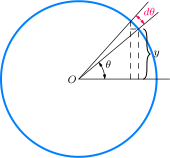
What we have to investigate is the value of ; or, in other words, if the angle varies, we have to find the relation between the increment of the sine and the increment of the angle, both increments being indefinitely small in themselves. Examine Fig. 15.1, wherein, if the radius of the circle is unity, the height of is the sine, and is the angle. Now, if is supposed to increase by the addition to it of the small angle —an element of angle—the height of , the sine, will be increased by a small element . The new height will be the sine of the new angle , or, stating it as an equation, and subtracting from this the first equation gives
The quantity on the right-hand side is the difference between two sines, and books on trigonometry tell us how to work this out. For they tell us that if and are two different angles,
If, then, we put for one angle, and for the other, we may write \begin{align} dy &= 2 \cos\frac{\theta + d\theta + \theta}{2} \cdot \sin\frac{\theta + d\theta - \theta}{2}, \end{align} or, \begin{align} dy &= 2\cos\left(\theta + \frac{1}{2}d\theta\right)\cdot \sin\frac{d\theta}{2}. \end{align}
But if we regard as indefinitely small, then in the limit we may neglect by comparison with , and may also take as being the same as . The equation then becomes: \begin{align} dy &= 2 \cos \theta \times \frac{1}{2} d \theta; \\ dy &= \cos \theta \cdot d \theta, \end{align} and, finally, \begin{align} \dfrac{dy}{d \theta} &= \cos \theta. \end{align} [Notice that the approximation is true only when is measured in radians.]
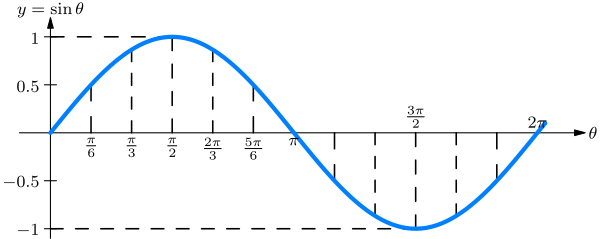
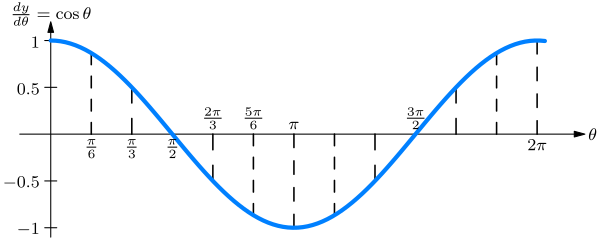
The accompanying curves, Fig. 15.2 and Fig. 15.3, show, plotted to scale, the values of , and , for the corresponding values of .
Derivative of Cosine
To differentiate , since , we can use the Chain Rule to get
Take next the cosine.
Let .
Now .
Therefore \begin{align} &\begin{align} dy = d\left(\sin\left(\frac{\pi}{2} - \theta\right)\right) &= \cos\left(\frac{\pi}{2} - \theta\right) \times d(-\theta), \\ &= \cos\left(\frac{\pi}{2} - \theta\right) \times (-d\theta), \end{align} \\ &\frac{dy}{d\theta} = -\cos\left(\frac{\pi}{2} - \theta\right). \end{align} And it follows that
Derivative of Tangent
As , we can apply the Quotient Rule and the identity to find :
Lastly, take the tangent.
As , we can apply the Quotient Rule to find :2
\begin{align} \frac{d(\tan\theta)}{d\theta}&=\frac{\cos\theta \dfrac{d(\sin\theta)}{d\theta}-\sin\theta \dfrac{d(\cos\theta)}{d\theta}}{\cos^2\theta}\\ &=\frac{\cos\theta \cdot \cos\theta -\sin\theta (-\sin\theta)}{\cos^2\theta}\\ &=\frac{\cos^2\theta+\sin^2\theta}{\cos^2\theta} \end{align} Since we get Also, since , we get Therefore,
Summary of Results
Collecting these results, we have:
The results tabulated above are true only when is measured in radians.
To derive the above results, we replaced by . In general, is approximately equal to when (1) is small (2) is measured in radians For example, is the same as radians, and we cannot approximate by 1 but Therefore, the results tabulated above are true only when is measured in radians.
Sometimes, in mechanical and physical questions, as, for example, in simple harmonic motion and in wave-motions, we have to deal with angles that increase in proportion to the time. Thus, if be the time of one complete period, or movement round the circle, then, since the angle all round the circle is radians, (equivalent to ), the amount of angle moved through in time , will be \begin{align} \theta &= 2\pi\frac{t}{T},\quad \text{in radians.} \end{align} If the frequency, or number of periods per second, be denoted by , then , and we may then write: Then we shall have
If, now, we wish to know how the sine varies with respect to time, we must differentiate with respect, not to , but to . For this we must resort to the Chain Rule, and put
Now will obviously be ; so that \begin{align} \frac{dy}{dt} &= \cos \theta \times 2\pi n \\ &= 2\pi n \cdot \cos (2\pi nt). \end{align} Similarly, it follows that \begin{align} \frac{d\left(\cos (2\pi nt)\right)}{dt} &= -2\pi n \cdot \sin (2\pi nt). \end{align}
Second Derivative of Sine or Cosine.
and
We have seen that when is differentiated with respect to it becomes ; and that when is differentiated with respect to it becomes ; or, in symbols,
So we have this curious result that we have found a function such that if we differentiate it twice over, we get the same thing from which we started, but with the sign changed from to .
The same thing is true for the cosine; for differentiating gives us , and differentiating gives us ; or thus:
Sines and cosines are the only functions of which the second derivative is equal (and of opposite sign to) the original function.
Examples
With what we have so far learned we can now differentiate expressions of a more complex nature.
Example 15.1. If , find .
[In many modern calculus textbooks, the inverse sine is denoted by ; that is, . Note that is NOT the same as . To avoid confusion, the notation may be preferred over in some texts, including this one.]
Solution
If is the arc whose sine is , then .
Passing now from the inverse function to the original one, we get \begin{align} \frac{dy}{dx} &= \frac{1}{\;\dfrac{dx}{dy}\;} = \frac{1}{\cos y}. \end{align} now since , hence \begin{align} \frac{dy}{dx} &=\frac{1}{\cos y}= \pm \frac{1}{\sqrt{1-x^2}}. \end{align} But which one is correct? plus or minus? If we look at the graph of (see the following figure), we realize that the slope of the curve is always positive, indicating that that we must take the positive square root. Hence,
![Graph of y = arcsin x showing a continuous, increasing curve defined on the domain [-1,1] with range [−π/2, π/2]. The curve passes through the origin (0, 0), with endpoints at (−1,−π/2) and (1,π/2). The slope is positive throughout the domain, confirming that the derivative should take the positive square root.](/book-images/CME/arcsin.svg)
\begin{align} \boxed{\dfrac{d(\arcsin x)}{dx}=\dfrac{1}{\sqrt{1-x^2}}} \end{align}
Example 15.2. If , find .
Solution
This is the same thing as .
Let ; then ; . \begin{align} \frac{dv}{d\theta} &= -\sin\theta.\\ \frac{dy}{d\theta} &= \frac{dy}{dv} \times \frac{dv}{d\theta}\\ &= -3 \cos^2 \theta \sin\theta. \end{align}
Example 15.3. If , find .
Solution
Let ;then .
Example 15.4. If , find .
Solution
Let ;. \begin{align} \frac{dy}{dv} &= \frac{1}{v};\quad \frac{dv}{d\theta}=\cos\theta;\\ \frac{dy}{d\theta} &= \frac{1}{\sin\theta} \times \cos\theta = \cot\theta. \end{align}
Example 15.5. If , find .
Solution
\begin{align} \frac{dy}{d\theta} &= \frac{-\sin^2\theta - \cos^2 \theta}{\sin^2 \theta}\\ &= -(1+\cot^2 \theta) = -\text{csc}^2 \theta. \end{align}
Example 15.6. If , find .
Solution
Let ;;.
Example 15.7. If , find .
Solution
.
Let . (for, if , \begin{align} v &= 3u^2;\quad \frac{dv}{du} = 6u;\quad \frac{du}{d\theta} = \sec^2 \theta; \end{align} hence ;)
hence \begin{align} \frac{dy}{d\theta} &= \frac{6\tan\theta \sec^2\theta}{2\sqrt{1 + 3\tan^2\theta}}. \end{align}
Example 15.8. If , find .
Solution
\begin{align} \frac{dy}{dx} &= \sin x(-\sin x) + \cos x \times \cos x = \cos^2 x - \sin^2 x. \end{align}
Exercises
Exercise 15.1. Differentiate the following: \begin{align} \text{(i)}\quad y &= A \sin\left(\theta - \frac{\pi}{2}\right).\\ \text{(ii)}\quad y &= \sin^2 \theta;\quad \text{and }\quad y = \sin 2\theta.\\ \text{(iii)}\quad y &= \sin^3 \theta;\quad \text{and }\quad y = \sin 3\theta. \end{align}
Answer
(i) ;
(ii) and ;
(iii) and .
Solution
(i)
We write Using the Chain Rule: \begin{align} \frac{d y}{d \theta}&= \frac{d y}{d u} \cdot \frac{d u}{d \theta} \\ & =(A \cos u)(1) \\ & =A \cos \left(\theta-\frac{\pi}{2}\right) \end{align}
(ii) If
Let Using the Chain Rule: \begin{align} \frac{d y}{d \theta} & =\frac{d y}{d u} \cdot \frac{d u}{d \theta} \\ & =2 u \cdot \cos \theta \\ & =2 \sin \theta \cos \theta \end{align} The result can also be written as since
If , let Using the Chain Rule: \begin{align} \frac{d y}{d \theta}&=\frac{d y}{d u} \cdot \frac{d u}{d \theta} \\ &=(\cos u)(2) \\ &=2 \cos (2 \theta) \end{align} If , we write Then using the Chain Rule \begin{align} \frac{d y}{d \theta}&=\frac{d y}{d u} \cdot \frac{d u}{d \theta} \\ &=3 u^{2} \cdot \cos \theta \\ &=3(\sin \theta)^{2} \cdot \cos \theta \\ &=3 \cos \theta \sin ^{2} \theta \\ &=(\cos u) \cdot(3) \\ &=3 \cos 3 \theta \cdot \sin 3 \theta \end{align} If , we write Then \begin{align} \frac{dy}{d \theta}&=\frac{d y}{d u} \cdot \frac{d u}{d \theta} \\ &=(\cos u)(3)\\ &=3\cos {3\theta} \end{align}
Exercise 15.2. Find the value of for which is a maximum.
Answer
or radians.
Solution
Method 1) Using the Product Rule:
\begin{align} \frac{d y}{d \theta}&=\cos \theta \cdot \cos \theta-\sin \theta \sin \theta \\ &=\cos ^{2} \theta-\sin ^{2} \theta \\ &=\cos 2 \theta \end{align} \begin{align} \frac{d^{2} y}{d \theta^{2}}&= \frac{d(\cos 2 \theta)}{d(2 \theta)} \cdot \frac{d(2 \theta)}{d \theta} \\ &=(-\sin 2 \theta)(2) \\ &=-2 \sin 2 \theta \end{align} When Hence, the curve is concave downward, and thus when , has a maximum of
When hence, the curve is concave upward and thus when , has a minimum of \begin{align} \sin \left(\frac{3 \pi}{4}\right) \cos \left(\frac{3 \pi}{4}\right) & =\sin \left(\frac{\pi}{2}+\frac{\pi}{4}\right) \cos \left(\frac{\pi}{2}+\frac{\pi}{4}\right) \\ & =\cos \left(\frac{\pi}{4}\right) \times\left(-\sin \left(\frac{\pi}{4}\right)\right) \\ & =\frac{1}{\sqrt{2}} \times \frac{-1}{\sqrt{2}} \\ & =-\frac{1}{2}. \end{align}
Method 2)
is a maximum wherever is a maximum and that occurs when The maximum of is then .
Exercise 15.3. Differentiate .
Answer
.
Solution
We write \begin{align} \frac{d y}{d t} &= \frac{d y}{d u} \cdot \frac{d u}{d t} \\ &=-\frac{1}{2 \pi} \sin u \cdot 2 \pi n \\ &=-n \sin u \\ &= n \sin (2 \pi n t) \end{align}
Exercise 15.4. If , find .
Answer
.
Solution
Let where . Then \begin{align} \frac{d y}{d x} & =\frac{d y}{d u} \cdot \frac{d u}{d x} \\ & =\cos u \cdot a^{x} \cdot \ln a \\ & =\cos \left(a^{x}\right) \cdot a^{x} \cdot \ln a \end{align}
Exercise 15.5. Differentiate .
Answer
Solution
We write where . Then
\begin{align} \frac{d y}{d x} & =\frac{d y}{d u} \cdot \frac{d u}{d x} \\ & =\frac{1}{u} \cdot(-\sin x) \\ & =\frac{1}{\cos x}(-\sin x) \\ & =-\tan x \end{align}
Exercise 15.6. Differentiate .
Answer
.
Solution
We wrtie where . Then
\begin{align} \frac{d y}{d x} & =\frac{d y}{d u} \cdot \frac{d u}{d x} \\ & =(18.2 \cos u)(1) \\ & =18.2 \cos (x+26) \end{align}
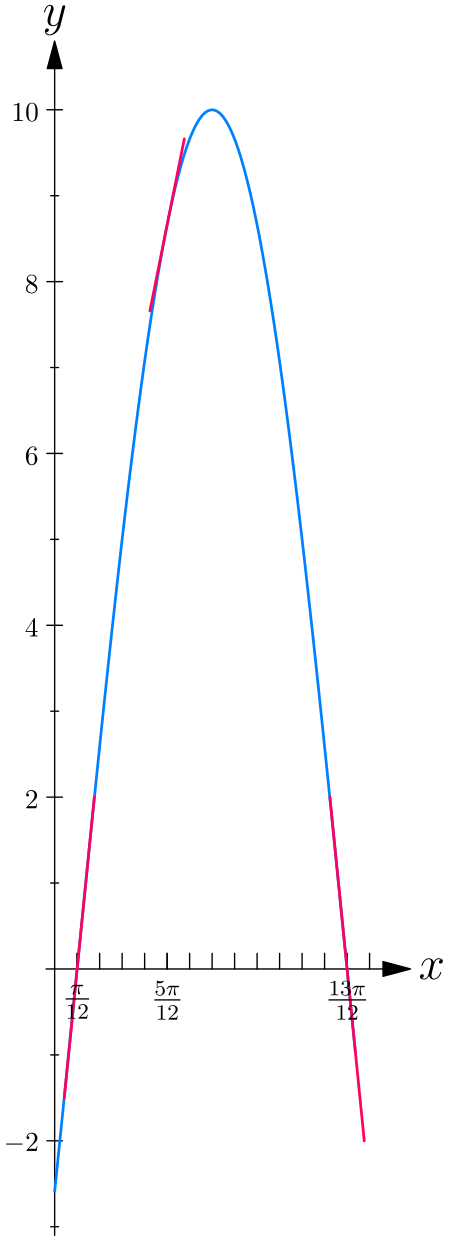
Exercise 15.7. Plot the curve ; and show that the slope of the curve at is half the maximum slope.
Answer
The slope is , which is a maximum when , or ; the value of the slope being then . When the slope is .
Solution
\begin{align} & y=10 \sin \left(\theta-\frac{\pi}{12}\right) \\ & \frac{d y}{d \theta}=10 \cos \left(\theta-\frac{\pi}{12}\right) \end{align}
To find the maximum slope, we have to differentiate with respect to and equate the result to zero
\begin{align} \frac{d^{2} y}{d \theta^{2}}=0\quad\Leftrightarrow &\quad \theta-\frac{\pi}{12}=0 \quad \text { or } \quad \theta-\frac{\pi}{12}=\pi \\ \frac{d^{2} y}{d \theta^{2}}=0\quad \Leftrightarrow &\quad \theta=\frac{\pi}{12} \quad \text { or } \quad \theta=\frac{13 \pi}{12} \end{align}
When
When
Slope when : \begin{align} \frac{d y}{d \theta} & =10 \cos \left(\frac{5 \pi}{12}-\frac{\pi}{12}\right)=10 \cos \left(\frac{\pi}{3}\right) \\ & =10 \times \frac{1}{2}=5 . \end{align} As we can see the slope of the curve at , which is 5, is half the maximum slope, which is 10 and occurs when
Exercise 15.8. If , find .
Answer
\begin{align} \cos\theta \sin2\theta + 2\cos2\theta \sin\theta &= 2\sin\theta\left(\cos^2 \theta + \cos2\theta\right) \\ &= 2\sin\theta\left(3\cos^2 \theta - 1\right). \end{align}
Solution
Using the Product Rule:
We showed in Exercise 1 (ii) .
Hence
We can further simplify it using
and
\begin{align} \frac{d y}{d \theta} & =2 \sin \theta \cos ^{2} \theta+2 \sin \theta\left(2 \cos ^{2} \theta-1\right) \\ & =2 \sin \theta\left(\cos ^{2} \theta+2 \cos ^{2} \theta-1\right) \\ & =2 \sin \theta\left(3 \cos ^{2} \theta-1\right) . \end{align}
Exercise 15.9. If , find the derivative of with respect to .
Answer
.
Solution
We write Then
\begin{align} & \frac{d y}{d \theta}=\frac{d y}{d u} \cdot \frac{d u}{d v} \cdot \frac{d v}{d \theta} \\ &=a m u^{m-1} \cdot \sec ^{2} v \cdot n \cdot \theta^{n-1} \\ &=a m (\tan v)^{m-1} \cdot \sec ^{2} v \cdot n \cdot \theta^{n-1} \\ &=a \cdot m \cdot n \cdot\left[\tan \left(\theta^{n}\right)\right]^{m-1} \cdot \sec ^{2}\left(\theta^{n}\right) \cdot \theta^{n-1} \end{align} Note that means and can be written as . Hence
Exercise 15.10. If , find and .
Answer
;.
Solution
To find , we notice that
and
\begin{align} \frac{d\left(u^{2}\right)}{d x} & =\frac{d\left(u^{2}\right)}{d u} \cdot \frac{d u}{d x} \qquad(u=\sin x) \\ & =2 u \cdot \cos x \\ & =2 \sin x \cos x \\ & =\sin 2 x \end{align} Therefore \begin{align} \frac{d y}{d x} & =\frac{d\left(e^{x}\right)}{d x} \sin ^{2} x+e^{x} \frac{d\left(\sin ^{2} x\right)}{d x} \\ & =e^{x} \sin ^{2} x+e^{x} \sin 2 x \\ & =e^{x}\left(\sin ^{2} x+\sin 2 x\right) \end{align}
The second derivative: \begin{align} \frac{d y}{d x}&= \frac{d\left(e^{x}\left(\sin ^{2} x+\sin 2 x\right)\right)}{dx}\\ &=\frac{d(e^x)}{dx}\left(\sin ^{2} x+\sin 2 x\right)+e^x\left(\frac{d(\sin^2 x)}{dx}+\frac{d(\sin 2x)}{dx}\right)\\ &=e^x\left(\sin ^{2} x+\sin 2 x\right)+e^x\left(\underbrace{2\cos x \sin x}_{\sin 2x}+2\cos 2x\right)\\ &=e^x\left(\sin^2 x+2\sin 2x+2\cos 2x\right). \end{align}
Exercise 15.11. Differentiate the three equations of Exercises 14.II (see here), No. 4, and compare their derivatives, as to whether they are equal, or nearly equal, for very small values of , or for very large values of , or for values of in the neighbourhood of .
Answer
; (ii) ; (iii) .
Solution
(i) Using the Quotient Rule:
(ii)
(iii) To differentiate , we write Then \begin{align} \frac{d y}{d x} & =\frac{d y}{d u} \cdot \frac{d u}{d x} \\ & =\frac{2 a}{\pi} \frac{1}{1+u^{2}} \cdot \frac{1}{b} \\ & =\frac{2 a}{\pi b} \frac{1}{1+\left(\frac{x}{b}\right)^{2}} \\ & =\frac{2 a b}{\pi} \frac{1}{x^{2}+b^{2}} \end{align}
When is very large
\begin{align} & \frac{a b}{(x+b)^{2}} \approx \frac{a b}{x^{2}} \approx 0 \\ & \frac{a}{b} e^{-\frac{x}{b}} \approx \frac{a}{b} \times 0=0 \\ & \frac{2 a b}{x^{2}+b^{2}} \approx \frac{2 a b}{x^{2}} \approx 0 \end{align}
Therefore their slopes are almost zero for large values of .
When \begin{align} & \frac{a b}{(x+b)^{2}} \approx \frac{a b}{b^{2}}=\frac{a}{b} \\ & e^{-\frac{x}{b}} \approx 1 \Rightarrow \frac{a}{b} e^{-\frac{x}{b}} \approx \frac{a}{b} \\ & \frac{2 a b}{x^{2}+b^{2}} \approx \frac{2 a b}{b^{2}}=\frac{2 a}{b} \end{align} When is small (), the slopes of and are almost identical, but the slope of is twice as much as them.
When \begin{align} & \frac{a b}{(x+b)^{2}} \approx \frac{a b}{(2 b)^{2}}=\frac{a}{4 b} \\ & \frac{a}{b} e^{-\frac{x}{b}} \approx \frac{a}{b} \cdot e^{-1}=\frac{a}{2.78 b} \\ & \frac{2 a b}{x^{2}+b^{2}} \approx \frac{2 a b}{2 b^{2}}=\frac{a}{b} . \end{align}
Exercise 15.12. Differentiate the following: \begin{align} \text{(i)}\quad y &= \sec x. & \text{(ii)}\quad y &= \arccos x. \\ \text{(iii)}\quad y &= \arctan x. & \text{(iv)}\quad y &= \text{arcsec} x. \\ \text{(v)}\quad y &= \tan x \times \sqrt{3 \sec x}. && \end{align}
Answer
(i) ;
(ii) ;
(iii) ;
(iv) ;
(v) .
Solution
(i)
Using the Quotient Rule \begin{align} \frac{d y}{d x} & =\frac{-(-\sin x)}{\cos ^{2} x}=\frac{\sin x}{\cos x} \cdot \frac{1}{\cos x} \\ & =\tan x \cdot \sec x . \end{align}
(ii) (or )
If , then and
\begin{align} \frac{d y}{d x} & =\frac{1}{\frac{d x}{d y}} \\ & =\frac{1}{-\sin y} \end{align} Since Since But which one is correct? The sign or the sign? If we look at the graph of , the slope is negative everywhere.
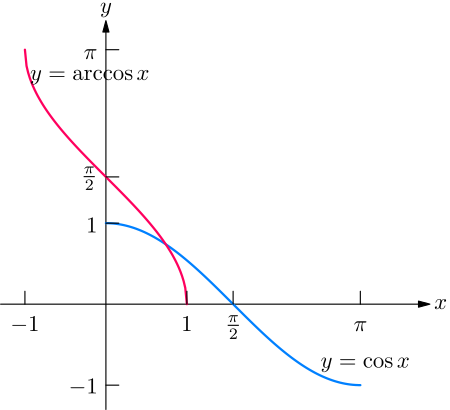
Hence
(iii) If , then and
Therefore,
\begin{align} \frac{d y}{d x} & =\frac{1}{\dfrac{d x}{d y}} \\ & =\frac{1}{1+\tan ^{2} y} \\ & =\frac{1}{1+x^{2}} \end{align}
(iv) If then . In part (i), we showed that
Hence \begin{align} \frac{d y}{d x} & =\frac{1}{\dfrac{d x}{d y}} \\ & =\frac{1}{\tan y \cdot \sec y} \end{align} Since , we have \begin{align} \frac{d y}{d x} & =\frac{1}{ \pm \sqrt{\sec ^{2} y-1} \cdot \sec y} \\ & =\frac{1}{ \pm x \sqrt{x^{2}-1}} . \end{align}
Now we need to decide about the sign.
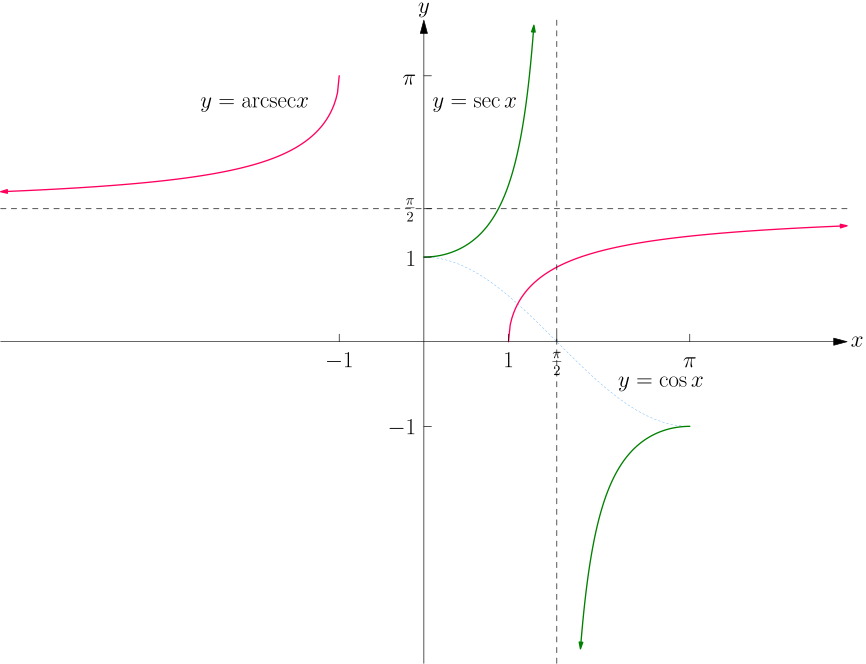
As we can see from the graph , the slope is always positive. So we must have
\begin{align} & \frac{d y}{d x}=\frac{1}{x \sqrt{x^{2}-1}} &&\text { if } x \geq 1 \\ & \frac{d y}{d x}=\frac{1}{-x \sqrt{x^{2}-1}} &&\text { if } x \leq-1 \end{align} We can combine these two and write
(v) .
Using the Product Rule:
To find , let . Then
\begin{align} \frac{d(\sqrt{u})}{d x} & =\frac{d(\sqrt{u})}{d u} \cdot \frac{d u}{d x} \\ & =\frac{1}{2 \sqrt{u}} \cdot \sec x \cdot \tan x \\ & =\frac{1}{2 \sqrt{\sec x}} \cdot \sec x \cdot \tan x \\ & =\frac{1}{2} \tan x\cdot \sqrt{\sec x} . \end{align}
Hence
\begin{align} \frac{d y}{d x} & =\sqrt{3}\left[\sec ^{2} x \sqrt{\sec x}+\frac{1}{2} \tan ^{2} x \sqrt{\sec x}\right] \\ & =\sqrt{3 \sec x} \quad\left[\sec ^{2} x+\frac{1}{2} \tan ^{2} x\right] \end{align}
We can simplify this further (or rewrite it in a different form) using
\begin{align} & \frac{d y}{d x}=\sqrt{3 \sec x} \cdot\left[\sec ^{2} x+\frac{1}{2}\left(\sec ^{2} x-1\right)\right] \\ & =\frac{1}{2} \sqrt{3 \sec x}\left[3 \sec ^{2} x-1\right] \end{align}
Exercise 15.13. Differentiate .
Answer
.
Solution
\begin{align} & y=\sin (2 \theta+3)^{2.3}=\sin \left[(2 \theta+3)^{2.3}\right] \\ y & =\sin u, \quad u=v^{2.3}, \quad v=2 \theta+3 \\ \frac{d y}{d x}= & \frac{d y}{d u} \cdot \frac{d u}{d v} \cdot \frac{d v}{d x} \\ & =\cos u\left(2.3 v^{1.3}\right) \cdot 2 \\ & =4.6(2 \theta+3)^{1.3} \cos v^{2.3} \\ & =4.6(2 \theta+3)^{1.3} \cos \left[(2 \theta+3)^{2.3}\right] . \end{align}
Exercise 15.14. Differentiate .
Answer
.
Solution
We differentiate term by term
To find , let and
\begin{align} \frac{d 3^{u}}{d \theta} & =\frac{d 3^{u}}{d u} \cdot \frac{d u}{d \theta} \\ & =3^{u} \cdot \ln 3 \cdot \cos \theta \\ & =3^{\sin \theta} \cdot \ln 3 \cdot \cos \theta \end{align}
Therefore
Exercise 15.15. Find the maximum or minimum of ().
Answer
; is max. for , min. for .
Solution
Using the Product Rule
\begin{align} \frac{d y}{d \theta}&=\cos \theta+\theta(-\sin \theta) \\ &=\cos \theta-\theta \sin \theta \\ \end{align}
The solutions of can be obtained approximately
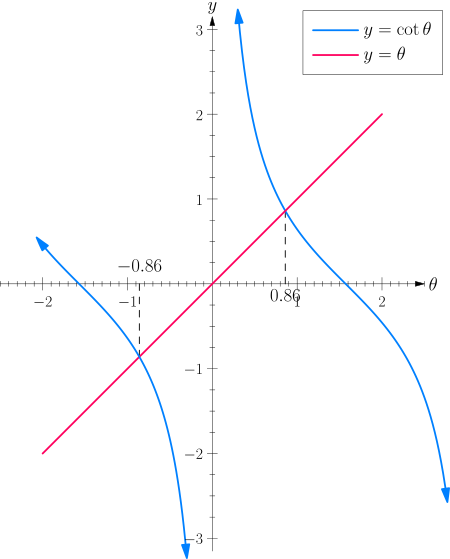
To distinguish between a maximum and a minimum, we use the Second Derivative Test:
\begin{align} \frac{d^{2} y}{d \theta^{2}} & =\frac{d(\cos \theta-\theta \sin \theta)}{d \theta} \\ & =-\sin \theta-(\sin \theta+\theta \cos \theta) \\ & =\theta \cos \theta-2 \sin \theta \end{align}
When
Hence, the curve is concave downward, and has a maximum of when .
When Hence, the curve is concave upward, and thus has a minimum of when
Full Chapter
Greek letters being usual to denote angles, we will take as the usual letter for any variable angle the letter (“theta”). In this chapter, is measured in radians.1
Derivative of Sine
Let us consider the function
What we have to investigate is the value of ; or, in other words, if the angle varies, we have to find the relation between the increment of the sine and the increment of the angle, both increments being indefinitely small in themselves. Examine the next figure, wherein, if the radius of the circle is unity, the height of is the sine, and is the angle. Now, if is supposed to increase by the addition to it of the small angle —an element of angle—the height of , the sine, will be increased by a small element . The new height will be the sine of the new angle , or, stating it as an equation, and subtracting from this the first equation gives
The quantity on the right-hand side is the difference between two sines, and books on trigonometry tell us how to work this out. For they tell us that if and are two different angles,
If, then, we put for one angle, and for the other, we may write \begin{align} dy &= 2 \cos\frac{\theta + d\theta + \theta}{2} \cdot \sin\frac{\theta + d\theta - \theta}{2}, \end{align} or, \begin{align} dy &= 2\cos\left(\theta + \frac{1}{2}d\theta\right)\cdot \sin\frac{d\theta}{2}. \end{align}
But if we regard as indefinitely small, then in the limit we may neglect by comparison with , and may also take as being the same as . The equation then becomes: \begin{align} dy &= 2 \cos \theta \times \frac{1}{2} d \theta; \\ dy &= \cos \theta \cdot d \theta, \end{align} and, finally, \begin{align} \dfrac{dy}{d \theta} &= \cos \theta. \end{align} [Notice that the approximation is true only when is measured in radians.]
The accompanying curves in the next two figures show, plotted to scale, the values of , and , for the corresponding values of .
Derivative of Cosine
Take next the cosine.
Let .
Now .
Therefore \begin{align} dy = d\left(\sin\left(\frac{\pi}{2} - \theta\right)\right) &= \cos\left(\frac{\pi}{2} - \theta\right) \times d(-\theta), \\ &= \cos\left(\frac{\pi}{2} - \theta\right) \times (-d\theta), \end{align} And it follows that
Derivative of Tangent
Lastly, take the tangent.
As , we can apply the Quotient Rule to find :2
\begin{align} \frac{d(\tan\theta)}{d\theta}&=\frac{\cos\theta \dfrac{d(\sin\theta)}{d\theta}-\sin\theta \dfrac{d(\cos\theta)}{d\theta}}{\cos^2\theta}\\ &=\frac{\cos\theta \cdot \cos\theta -\sin\theta (-\sin\theta)}{\cos^2\theta}\\ &=\frac{\cos^2\theta+\sin^2\theta}{\cos^2\theta} \end{align} Since we get Also, since , we get Therefore,
Summary of Results
Collecting these results, we have:
To derive the above results, we replaced by . In general, is approximately equal to when (1) is small (2) is measured in radians For example, is the same as radians, and we cannot approximate by 1 but Therefore, the results tabulated above are true only when is measured in radians.
Sometimes, in mechanical and physical questions, as, for example, in simple harmonic motion and in wave-motions, we have to deal with angles that increase in proportion to the time. Thus, if be the time of one complete period, or movement round the circle, then, since the angle all round the circle is radians, (equivalent to ), the amount of angle moved through in time , will be \begin{align} \theta &= 2\pi\frac{t}{T},\quad \text{in radians.} \end{align} If the frequency, or number of periods per second, be denoted by , then , and we may then write: Then we shall have
If, now, we wish to know how the sine varies with respect to time, we must differentiate with respect, not to , but to . For this we must resort to the chain rule explained in the chapter on the Chain Rule, and put
Now will obviously be ; so that \begin{align} \frac{dy}{dt} &= \cos \theta \times 2\pi n \\ &= 2\pi n \cdot \cos (2\pi nt). \end{align} Similarly, it follows that \begin{align} \frac{d\left(\cos (2\pi nt)\right)}{dt} &= -2\pi n \cdot \sin (2\pi nt). \end{align}
Second Derivatives of Sine and Cosine
We have seen that when is differentiated with respect to it becomes ; and that when is differentiated with respect to it becomes ; or, in symbols,
So we have this curious result that we have found a function such that if we differentiate it twice over, we get the same thing from which we started, but with the sign changed from to .
The same thing is true for the cosine; for differentiating gives us , and differentiating gives us ; or thus:
Sines and cosines are the only functions of which the second derivative is equal (and of opposite sign to) the original function.
Examples
With what we have so far learned we can now differentiate expressions of a more complex nature.
Example 15.1. If , find .
[In many modern calculus textbooks, the inverse sine is denoted by ; that is, . Note that is NOT the same as . To avoid confusion, the notation may be preferred over in some texts, including this one.]
Solution. If is the arc whose sine is , then .
Passing now from the inverse function to the original one, we get \begin{align} \frac{dy}{dx} &= \frac{1}{\;\dfrac{dx}{dy}\;} = \frac{1}{\cos y}. \end{align} now since , hence \begin{align} \frac{dy}{dx} &=\frac{1}{\cos y}= \pm \frac{1}{\sqrt{1-x^2}}. \end{align} But which one is correct? plus or minus? If we look at the graph of (the following figure), we realize that the slope of the curve is always positive, indicating that that we must take the positive square root. Hence,
\begin{align} \boxed{\dfrac{d(\arcsin x)}{dx}=\dfrac{1}{\sqrt{1-x^2}}} \end{align}
Example 15.2. If , find .
Solution. This is the same thing as .
Let ;then ;. \begin{align} \frac{dv}{d\theta} &= -\sin\theta.\\ \frac{dy}{d\theta} &= \frac{dy}{dv} \times \frac{dv}{d\theta} = -3 \cos^2 \theta \sin\theta. \end{align}
Example 15.3. If , find .
Solution. Let ;then .
Example 15.4. If , find .
Solution. Let ;. \begin{align} \frac{dy}{dv} &= \frac{1}{v};\quad \frac{dv}{d\theta}=\cos\theta;\\ \frac{dy}{d\theta} &= \frac{1}{\sin\theta} \times \cos\theta = \cot\theta. \end{align}
Example 15.5. If , find .
Solution. \begin{align} \frac{dy}{d\theta} &= \frac{-\sin^2\theta - \cos^2 \theta}{\sin^2 \theta}\\ &= -(1+\cot^2 \theta) = -\text{csc}^2 \theta. \end{align}
Example 15.6. If , find .
Solution. Let ;;.
Example 15.7. If , find .
Solution. .
Let . (for, if , \begin{align} v &= 3u^2;\quad \frac{dv}{du} = 6u;\quad \frac{du}{d\theta} = \sec^2 \theta; \end{align} hence ;)
hence \begin{align} \frac{dy}{d\theta} &= \frac{6\tan\theta \sec^2\theta}{2\sqrt{1 + 3\tan^2\theta}}. \end{align}
Example 15.8. If , find .
Solution. \begin{align} \frac{dy}{dx} &= \sin x(-\sin x) + \cos x \times \cos x = \cos^2 x - \sin^2 x. \end{align}
Exercises
Exercise 15.1. Differentiate the following: \begin{align} \text{(i)}\quad y &= A \sin\left(\theta - \frac{\pi}{2}\right).\\ \text{(ii)}\quad y &= \sin^2 \theta;\quad \text{and }\quad y = \sin 2\theta.\\ \text{(iii)}\quad y &= \sin^3 \theta;\quad \text{and }\quad y = \sin 3\theta. \end{align}
Answer
(i) ;
(ii) and ;
(iii) and .
Solution
(i)
We write Using the Chain Rule: \begin{align} \frac{d y}{d \theta}&= \frac{d y}{d u} \cdot \frac{d u}{d \theta} \\ & =(A \cos u)(1) \\ & =A \cos \left(\theta-\frac{\pi}{2}\right) \end{align}
(ii) If
Let Using the Chain Rule: \begin{align} \frac{d y}{d \theta} & =\frac{d y}{d u} \cdot \frac{d u}{d \theta} \\ & =2 u \cdot \cos \theta \\ & =2 \sin \theta \cos \theta \end{align} The result can also be written as since
If , let Using the Chain Rule: \begin{align} \frac{d y}{d \theta}&=\frac{d y}{d u} \cdot \frac{d u}{d \theta} \\ &=(\cos u)(2) \\ &=2 \cos (2 \theta) \end{align} If , we write Then using the Chain Rule \begin{align} \frac{d y}{d \theta}&=\frac{d y}{d u} \cdot \frac{d u}{d \theta} \\ &=3 u^{2} \cdot \cos \theta \\ &=3(\sin \theta)^{2} \cdot \cos \theta \\ &=3 \cos \theta \sin ^{2} \theta \\ &=(\cos u) \cdot(3) \\ &=3 \cos 3 \theta \cdot \sin 3 \theta \end{align} If , we write Then \begin{align} \frac{dy}{d \theta}&=\frac{d y}{d u} \cdot \frac{d u}{d \theta} \\ &=(\cos u)(3)\\ &=3\cos {3\theta} \end{align}
Exercise 15.2. Find the value of for which is a maximum.
Answer
or radians.
Solution
Method 1) Using the Product Rule:
\begin{align} \frac{d y}{d \theta}&=\cos \theta \cdot \cos \theta-\sin \theta \sin \theta \\ &=\cos ^{2} \theta-\sin ^{2} \theta \\ &=\cos 2 \theta \end{align} \begin{align} \frac{d^{2} y}{d \theta^{2}}&= \frac{d(\cos 2 \theta)}{d(2 \theta)} \cdot \frac{d(2 \theta)}{d \theta} \\ &=(-\sin 2 \theta)(2) \\ &=-2 \sin 2 \theta \end{align} When Hence, the curve is concave downward, and thus when , has a maximum of
When hence, the curve is concave upward and thus when , has a minimum of \begin{align} \sin \left(\frac{3 \pi}{4}\right) \cos \left(\frac{3 \pi}{4}\right) & =\sin \left(\frac{\pi}{2}+\frac{\pi}{4}\right) \cos \left(\frac{\pi}{2}+\frac{\pi}{4}\right) \\ & =\cos \left(\frac{\pi}{4}\right) \times\left(-\sin \left(\frac{\pi}{4}\right)\right) \\ & =\frac{1}{\sqrt{2}} \times \frac{-1}{\sqrt{2}} \\ & =-\frac{1}{2}. \end{align}
Method 2)
is a maximum wherever is a maximum and that occurs when The maximum of is then .
Exercise 15.3. Differentiate .
Answer
.
Solution
We write \begin{align} \frac{d y}{d t} &= \frac{d y}{d u} \cdot \frac{d u}{d t} \\ &=-\frac{1}{2 \pi} \sin u \cdot 2 \pi n \\ &=-n \sin u \\ &= n \sin (2 \pi n t) \end{align}
Exercise 15.4. If , find .
Answer
.
Solution
Let where . Then \begin{align} \frac{d y}{d x} & =\frac{d y}{d u} \cdot \frac{d u}{d x} \\ & =\cos u \cdot a^{x} \cdot \ln a \\ & =\cos \left(a^{x}\right) \cdot a^{x} \cdot \ln a \end{align}
Exercise 15.5. Differentiate .
Answer
Solution
We write where . Then
\begin{align} \frac{d y}{d x} & =\frac{d y}{d u} \cdot \frac{d u}{d x} \\ & =\frac{1}{u} \cdot(-\sin x) \\ & =\frac{1}{\cos x}(-\sin x) \\ & =-\tan x \end{align}
Exercise 15.6. Differentiate .
Answer
.
Solution
We wrtie where . Then
\begin{align} \frac{d y}{d x} & =\frac{d y}{d u} \cdot \frac{d u}{d x} \\ & =(18.2 \cos u)(1) \\ & =18.2 \cos (x+26) \end{align}
Exercise 15.7. Plot the curve ; and show that the slope of the curve at is half the maximum slope.
Answer
The slope is , which is a maximum when , or ; the value of the slope being then . When the slope is .
Solution
\begin{align} & y=10 \sin \left(\theta-\frac{\pi}{12}\right) \\ & \frac{d y}{d \theta}=10 \cos \left(\theta-\frac{\pi}{12}\right) \end{align}
To find the maximum slope, we have to differentiate with respect to and equate the result to zero
\begin{align} \frac{d^{2} y}{d \theta^{2}}=0\quad\Leftrightarrow &\quad \theta-\frac{\pi}{12}=0 \quad \text { or } \quad \theta-\frac{\pi}{12}=\pi \\ \frac{d^{2} y}{d \theta^{2}}=0\quad \Leftrightarrow &\quad \theta=\frac{\pi}{12} \quad \text { or } \quad \theta=\frac{13 \pi}{12} \end{align}
When
When
Slope when : \begin{align} \frac{d y}{d \theta} & =10 \cos \left(\frac{5 \pi}{12}-\frac{\pi}{12}\right)=10 \cos \left(\frac{\pi}{3}\right) \\ & =10 \times \frac{1}{2}=5 . \end{align} As we can see the slope of the curve at , which is 5, is half the maximum slope, which is 10 and occurs when
Exercise 15.8. If , find .
Answer
\begin{align} \cos\theta \sin2\theta + 2\cos2\theta \sin\theta &= 2\sin\theta\left(\cos^2 \theta + \cos2\theta\right) \\ &= 2\sin\theta\left(3\cos^2 \theta - 1\right). \end{align}
Solution
Using the Product Rule:
We showed in Exercise 1 (ii) .
Hence
We can further simplify it using
and
\begin{align} \frac{d y}{d \theta} & =2 \sin \theta \cos ^{2} \theta+2 \sin \theta\left(2 \cos ^{2} \theta-1\right) \\ & =2 \sin \theta\left(\cos ^{2} \theta+2 \cos ^{2} \theta-1\right) \\ & =2 \sin \theta\left(3 \cos ^{2} \theta-1\right) . \end{align}
Exercise 15.9. If , find the derivative of with respect to .
Answer
.
Solution
We write Then
\begin{align} & \frac{d y}{d \theta}=\frac{d y}{d u} \cdot \frac{d u}{d v} \cdot \frac{d v}{d \theta} \\ &=a m u^{m-1} \cdot \sec ^{2} v \cdot n \cdot \theta^{n-1} \\ &=a m (\tan v)^{m-1} \cdot \sec ^{2} v \cdot n \cdot \theta^{n-1} \\ &=a \cdot m \cdot n \cdot\left[\tan \left(\theta^{n}\right)\right]^{m-1} \cdot \sec ^{2}\left(\theta^{n}\right) \cdot \theta^{n-1} \end{align} Note that means and can be written as . Hence
Exercise 15.10. If , find and .
Answer
;.
Solution
To find , we notice that
and
\begin{align} \frac{d\left(u^{2}\right)}{d x} & =\frac{d\left(u^{2}\right)}{d u} \cdot \frac{d u}{d x} \qquad(u=\sin x) \\ & =2 u \cdot \cos x \\ & =2 \sin x \cos x \\ & =\sin 2 x \end{align} Therefore \begin{align} \frac{d y}{d x} & =\frac{d\left(e^{x}\right)}{d x} \sin ^{2} x+e^{x} \frac{d\left(\sin ^{2} x\right)}{d x} \\ & =e^{x} \sin ^{2} x+e^{x} \sin 2 x \\ & =e^{x}\left(\sin ^{2} x+\sin 2 x\right) \end{align}
The second derivative: \begin{align} \frac{d y}{d x}&= \frac{d\left(e^{x}\left(\sin ^{2} x+\sin 2 x\right)\right)}{dx}\\ &=\frac{d(e^x)}{dx}\left(\sin ^{2} x+\sin 2 x\right)+e^x\left(\frac{d(\sin^2 x)}{dx}+\frac{d(\sin 2x)}{dx}\right)\\ &=e^x\left(\sin ^{2} x+\sin 2 x\right)+e^x\left(\underbrace{2\cos x \sin x}_{\sin 2x}+2\cos 2x\right)\\ &=e^x\left(\sin^2 x+2\sin 2x+2\cos 2x\right). \end{align}
Exercise 15.11. Differentiate the three equations of Exercises 14.II (see here), No. 4, and compare their derivatives, as to whether they are equal, or nearly equal, for very small values of , or for very large values of , or for values of in the neighbourhood of .
Answer
; (ii) ; (iii) .
Solution
(i) Using the Quotient Rule:
(ii)
(iii) To differentiate , we write Then \begin{align} \frac{d y}{d x} & =\frac{d y}{d u} \cdot \frac{d u}{d x} \\ & =\frac{2 a}{\pi} \frac{1}{1+u^{2}} \cdot \frac{1}{b} \\ & =\frac{2 a}{\pi b} \frac{1}{1+\left(\frac{x}{b}\right)^{2}} \\ & =\frac{2 a b}{\pi} \frac{1}{x^{2}+b^{2}} \end{align}
When is very large
\begin{align} & \frac{a b}{(x+b)^{2}} \approx \frac{a b}{x^{2}} \approx 0 \\ & \frac{a}{b} e^{-\frac{x}{b}} \approx \frac{a}{b} \times 0=0 \\ & \frac{2 a b}{x^{2}+b^{2}} \approx \frac{2 a b}{x^{2}} \approx 0 \end{align}
Therefore their slopes are almost zero for large values of .
When \begin{align} & \frac{a b}{(x+b)^{2}} \approx \frac{a b}{b^{2}}=\frac{a}{b} \\ & e^{-\frac{x}{b}} \approx 1 \Rightarrow \frac{a}{b} e^{-\frac{x}{b}} \approx \frac{a}{b} \\ & \frac{2 a b}{x^{2}+b^{2}} \approx \frac{2 a b}{b^{2}}=\frac{2 a}{b} \end{align} When is small (), the slopes of and are almost identical, but the slope of is twice as much as them.
When \begin{align} & \frac{a b}{(x+b)^{2}} \approx \frac{a b}{(2 b)^{2}}=\frac{a}{4 b} \\ & \frac{a}{b} e^{-\frac{x}{b}} \approx \frac{a}{b} \cdot e^{-1}=\frac{a}{2.78 b} \\ & \frac{2 a b}{x^{2}+b^{2}} \approx \frac{2 a b}{2 b^{2}}=\frac{a}{b} . \end{align}
Exercise 15.12. Differentiate the following: \begin{align} \text{(i)}\quad y &= \sec x. & \text{(ii)}\quad y &= \arccos x. \\ \text{(iii)}\quad y &= \arctan x. & \text{(iv)}\quad y &= \text{arcsec} x. \\ \text{(v)}\quad y &= \tan x \times \sqrt{3 \sec x}. && \end{align}
Answer
(i) ;
(ii) ;
(iii) ;
(iv) ;
(v) .
Solution
(i)
Using the Quotient Rule \begin{align} \frac{d y}{d x} & =\frac{-(-\sin x)}{\cos ^{2} x}=\frac{\sin x}{\cos x} \cdot \frac{1}{\cos x} \\ & =\tan x \cdot \sec x . \end{align}
(ii) (or )
If , then and
\begin{align} \frac{d y}{d x} & =\frac{1}{\frac{d x}{d y}} \\ & =\frac{1}{-\sin y} \end{align} Since Since But which one is correct? The sign or the sign? If we look at the graph of , the slope is negative everywhere.
Hence
(iii) If , then and
Therefore,
\begin{align} \frac{d y}{d x} & =\frac{1}{\dfrac{d x}{d y}} \\ & =\frac{1}{1+\tan ^{2} y} \\ & =\frac{1}{1+x^{2}} \end{align}
(iv) If then . In part (i), we showed that
Hence \begin{align} \frac{d y}{d x} & =\frac{1}{\dfrac{d x}{d y}} \\ & =\frac{1}{\tan y \cdot \sec y} \end{align} Since , we have \begin{align} \frac{d y}{d x} & =\frac{1}{ \pm \sqrt{\sec ^{2} y-1} \cdot \sec y} \\ & =\frac{1}{ \pm x \sqrt{x^{2}-1}} . \end{align}
Now we need to decide about the sign.
As we can see from the graph , the slope is always positive. So we must have
\begin{align} & \frac{d y}{d x}=\frac{1}{x \sqrt{x^{2}-1}} &&\text { if } x \geq 1 \\ & \frac{d y}{d x}=\frac{1}{-x \sqrt{x^{2}-1}} &&\text { if } x \leq-1 \end{align} We can combine these two and write
(v) .
Using the Product Rule:
To find , let . Then
\begin{align} \frac{d(\sqrt{u})}{d x} & =\frac{d(\sqrt{u})}{d u} \cdot \frac{d u}{d x} \\ & =\frac{1}{2 \sqrt{u}} \cdot \sec x \cdot \tan x \\ & =\frac{1}{2 \sqrt{\sec x}} \cdot \sec x \cdot \tan x \\ & =\frac{1}{2} \tan x\cdot \sqrt{\sec x} . \end{align}
Hence
\begin{align} \frac{d y}{d x} & =\sqrt{3}\left[\sec ^{2} x \sqrt{\sec x}+\frac{1}{2} \tan ^{2} x \sqrt{\sec x}\right] \\ & =\sqrt{3 \sec x} \quad\left[\sec ^{2} x+\frac{1}{2} \tan ^{2} x\right] \end{align}
We can simplify this further (or rewrite it in a different form) using
\begin{align} & \frac{d y}{d x}=\sqrt{3 \sec x} \cdot\left[\sec ^{2} x+\frac{1}{2}\left(\sec ^{2} x-1\right)\right] \\ & =\frac{1}{2} \sqrt{3 \sec x}\left[3 \sec ^{2} x-1\right] \end{align}
Exercise 15.13. Differentiate .
Answer
.
Solution
\begin{align} & y=\sin (2 \theta+3)^{2.3}=\sin \left[(2 \theta+3)^{2.3}\right] \\ y & =\sin u, \quad u=v^{2.3}, \quad v=2 \theta+3 \\ \frac{d y}{d x}= & \frac{d y}{d u} \cdot \frac{d u}{d v} \cdot \frac{d v}{d x} \\ & =\cos u\left(2.3 v^{1.3}\right) \cdot 2 \\ & =4.6(2 \theta+3)^{1.3} \cos v^{2.3} \\ & =4.6(2 \theta+3)^{1.3} \cos \left[(2 \theta+3)^{2.3}\right] . \end{align}
Exercise 15.14. Differentiate .
Answer
.
Solution
We differentiate term by term
To find , let and
\begin{align} \frac{d 3^{u}}{d \theta} & =\frac{d 3^{u}}{d u} \cdot \frac{d u}{d \theta} \\ & =3^{u} \cdot \ln 3 \cdot \cos \theta \\ & =3^{\sin \theta} \cdot \ln 3 \cdot \cos \theta \end{align}
Therefore
Exercise 15.15. Find the maximum or minimum of ().
Answer
; is max. for , min. for .
Solution
Using the Product Rule
\begin{align} \frac{d y}{d \theta}&=\cos \theta+\theta(-\sin \theta) \\ &=\cos \theta-\theta \sin \theta \\ \end{align}
The solutions of can be obtained approximately
To distinguish between a maximum and a minimum, we use the Second Derivative Test:
\begin{align} \frac{d^{2} y}{d \theta^{2}} & =\frac{d(\cos \theta-\theta \sin \theta)}{d \theta} \\ & =-\sin \theta-(\sin \theta+\theta \cos \theta) \\ & =\theta \cos \theta-2 \sin \theta \end{align}
When
Hence, the curve is concave downward, and has a maximum of when .
When Hence, the curve is concave upward, and thus has a minimum of when