Chapter Summary (Express)
In the chapter entitled Curvature of Curves, we have learned how we can find out which way a curve is curved, that is, whether it curves upwards or downwards towards the right. This gave us no indication whatever as to how much the curve is curved, or, in other words, what is its curvature.
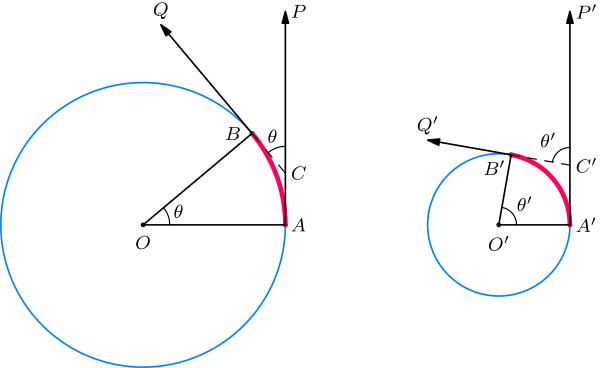
The curvature of a line refers to the degree of bending or deflection that occurs along a certain length of the line. For example, consider two circular paths of equal lengths but different radii (Fig. 21.1).
As you move from one point to another along these arcs, your direction changes. The change in direction, or the angle through which you turn, represents the curvature. The second path, which is part of a smaller circle, has a greater change in direction (greater angle), and therefore a greater curvature than the first. The larger the circle (i.e., the larger the radius), the less the curvature. In fact, the curvature of a circle is inversely proportional to its radius. This relationship is typically represented as This means that as the radius of the circle increases, the curvature decreases proportionally, and vice versa.
By curvature of a line, we mean the amount of bending or deflection taking place along a certain length of the line, say along a portion of the line the length of which is one unit of length (the same unit which is used to measure the radius, whether it be one inch, one foot, or any other unit). For instance, consider two circular paths of centre and O^{\prime} and of equal lengths AB, A^{\prime} B^{\prime} (see Fig. 21.1). When passing from to along the arc of the first one, one changes one’s direction from to , since at one faces in the direction and at one faces in the direction . In other words, in walking from to one unconsciously turns round through the angle , which is equal to the angle . Similarly, in passing from A^\prime to B^{\prime}, along the arc A^\prime B^\prime, of equal length to , on the second path, one turns round through the angle \angle P^{\prime} C^{\prime} Q^{\prime}, which is equal to the angle \angle A^{\prime} O^{\prime} B^{\prime}, obviously greater than the corresponding angle . The second path bends therefore more than the first for an equal length.
This fact is expressed by saying that the curvature of the second path is greater than that of the first one. The larger the circle, the lesser the bending, that is the lesser the curvature. If the radius of the first circle is etc. times greater than the radius of the second, then the angle of bending or deflection along an arc of unit length will be 2, 3, 4 , ... etc. times less on the first circle than on the second, that is, it will be etc. of the bending or deflection along the arc of same length on the second circle. In other words, the curvature of the first circle will be etc. of that of the second circle. We see that, as the radius becomes 2, 3, 4, .. etc. times greater, the curvature becomes 2, 3, 4, ... etc. times smaller, and this is expressed by saying that the curvature of a circle is inversely proportional to the radius of the circle, or
where is a constant. It is agreed to take , so that always.
We can consider a straight line as an arc of circle of infinite radius. Therefore, the curvature of a straight line is zero ( zero).
If the radius becomes indefinitely great, the curvature becomes zero, since when the denominator of a fraction is indefinitely large, the value of the fraction is indefinitely small. For this reason mathematicians sometimes consider a straight line as an arc of circle of infinite radius, or zero curvature.
The curvature of a curve can vary between different points, and it may be significantly different for two points close to each other.
To determine the curvature of an arc on a curve, consider a very small arc such as (see Fig. 21.2) and draw a circle such that the arc of the circle closely matches the arc of the curve. This circle is called the osculating circle or the circle of curvature.
The curvature at a specific point on the curve is then the reciprocal of the radius of the osculating circle.
The curvature of the curve at a point can be calculated using the formula: curvature = 1/radius of curvature.
In the case of a circle, which is perfectly symmetrical and uniform, so that the curvature is the same at every point of its circumference, the above method of expressing the curvature is perfectly definite. In the case of any other curve, however, the curvature is not the same at different points, and it may differ considerably even for two points fairly close to one another. It would not then be accurate to take the amount of bending or deflection between two points as a measure of the curvature of the arc between these points, unless this arc is very small, in fact, unless it is indefinitely small.
If then we consider a very small arc such as (see Fig. 21.2), and if we draw such a circle that an arc of this circle coincides with the arc of the curve more closely than would be the case with any other circle, then the curvature of this circle may be taken as the curvature of the arc of the curve. The smaller the arc , the easier it will be to find a circle an arc of which most nearly coincides with the arc of the curve. When and are very near one another, so that is so small so that the length of the arc is practically negligible, then the coincidence of the two arcs, of circle and of curve, may be considered as being practically perfect, and the curvature of the curve at the point (or ), being then the same as the curvature of the circle, will be expressed by the reciprocal of the radius of this circle, that is, by , according to our way of measuring curvature, explained above.
Now, at first, you may think that, if is very small, then the circle must be very small also. A little thinking will, however, cause you to perceive that it is by no means necessarily so, and that the circle may have any size, according to the amount of bending of the curve along this very small arc . In fact, if the curve is almost flat at that point, the circle will be extremely large. This circle is called the circle of curvature, or the osculating circle at the point considered. Its radius is the radius of curvature of the curve at that particular point.
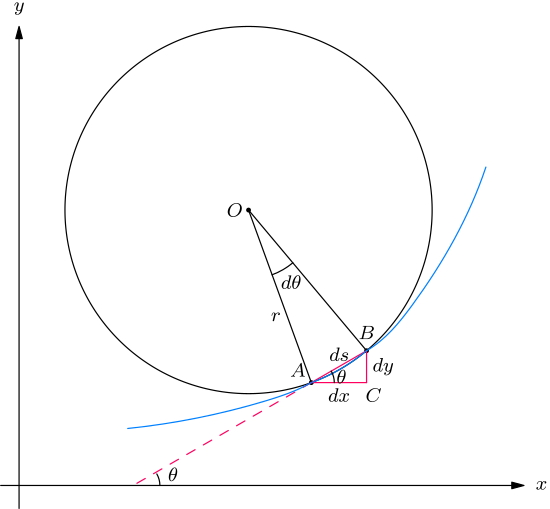
If you represent the arc by and the angle by , the radius of curvature () is related to these quantities as When the arc is very small, the line segment connecting the two points of the arc becomes a tangent to the curve at that point.
If the arc is represented by and the angle by , then, if is the radius of curvature,
The secant makes with the -axis the angle , and it will be seen from the small triangle that . When is indefinitely small, so that practically coincides with , the line becomes a tangent to the curve at the point (or ).
Since , So It follows that \begin{align} \frac{1}{r}&=\frac{d\theta}{ds}=\frac{d\theta}{dx}\frac{dx}{ds}\\ &=\left(\frac{1}{\sec^2\theta}\theta \frac{d^2 y}{dx^2}\right)\frac{dx}{ds} \end{align} Since (see the above figure) but . Hence
Now, depends on the position of the point (or , which is supposed to nearly coincide with it), that is, it depends on , or, in other words, is "a function" of .
Differentiating with regard to to get the slope (see here), we get
or
(see here);
hence
But , and for one may write therefore
but ;1 hence
and finally,
\bbox[5px,border:1px solid black;background-color:#f2f2f2]{\displaystyle r=\pm \frac{\left\{1+\left(\dfrac{d y}{d x}\right)^{2}\right\}^{\frac{3}{2}}}{\dfrac{d^{2} y}{d x^{2}}}.}
It is important to note that the radius must always be positive, as a negative radius would have no physical meaning. Therefore, when using the above formula, one must select the sign if the denominator is positive and the sign if the denominator is negative, as the numerator, being a square root, is always positive.2
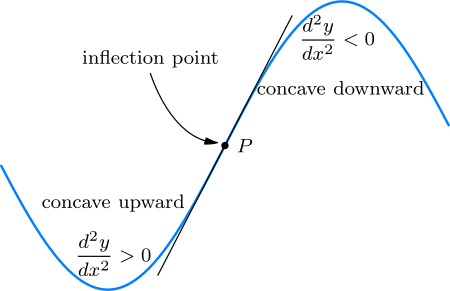
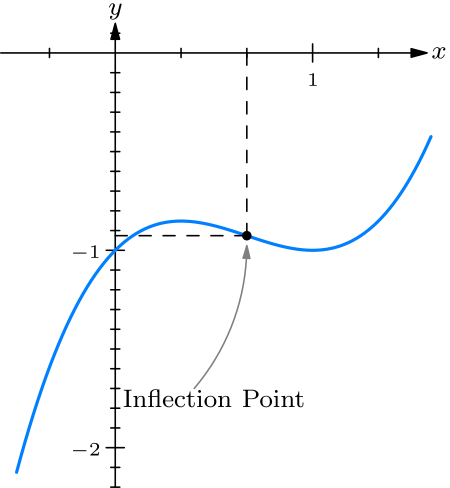
It has been shown in the chapter on Curvature of Curves that if is positive, the curve is concave upward (also called convex), while if is negative, the curve is concave downward (also simply called concave). If , the radius of curvature is infinitely great, that is, the corresponding portion of the curve is a bit of straight line. This necessarily happens whenever a curve gradually changes from being concave upward to concave downward or vice versa. The point, like in Fig. 21.3, where this occurs is called a point of inflection.
The center of the osculating circle, also known as the circle of curvature, is called the center of curvature.
Its coordinates, given by , result in the equation of the circle being By differentiating twice with respect to , we can find \bbox[5px,border:1px solid black;background-color:#f2f2f2]{\displaystyle y_{1}=y+\frac{1+\left(\dfrac{d y}{d x}\right)^{2}}{\dfrac{d^{2} y}{d x^{2}}}.} Replacing this in the equation of the circle, we get \bbox[5px,border:1px solid black;background-color:#f2f2f2]{\displaystyle x_{1}=x-\frac{\dfrac{d y}{d x}\left\{1+\left(\dfrac{d y}{d x}\right)^{2}\right\}}{\dfrac{d^{2} y}{d x^{2}}}.}
The centre of the circle of curvature is called the centre of curvature. If its coordinates are , then the equation of the circle is (see here)
hence
and
x-x_1+\left(y-y_1\right) \frac{d y}{d x}=0.\tag{1}
Why did we differentiate? To get rid of the constant . This leaves but two unknown constants and ; differentiate again; you shall get rid of one of them. This last differentiation is not quite as easy as it seems; let us do it together; we have:
the numerator of the second term is a product; hence differentiating it gives
so that the result of differentiating (1) is
from this we at once get
Replacing in (1), we get
and give the position of the centre of curvature. The use of these formulae will be best seen by carefully going through a few worked-out examples.
Example 21.1. Find the radius of curvature and the coordinates of the centre of curvature of the curve at the point .
Solution
We have
\begin{align} & \frac{d y}{d x}=4 x-1,\qquad \frac{d^{2} y}{d x^{2}}=4 . \\ & r=\frac{\pm\left\{1+\left(\dfrac{d y}{d x}\right)^{2}\right\}^{\frac{3}{2}}}{\dfrac{d^{2} y}{d x^{2}}}=\frac{\left\{1+(4 x-1)^{2}\right\}^{\frac{3}{2}}}{4}, \end{align}
when ; this becomes
If are the coordinates of the centre f curvature then
\begin{align} & x_{1}=x-\frac{\dfrac{d y}{d x}\left\{1+\left(\dfrac{d y}{d x}\right)^{2}\right\}}{\dfrac{d^{2} y}{d x^{2}}}=x-\frac{(4 x-1)\left\{1+(4 x-1)^{2}\right\}}{4} \\ & =0-\frac{(-1)\left\{1+(-1)^{2}\right\}}{4}=\frac{1}{2} \end{align}
when , so that
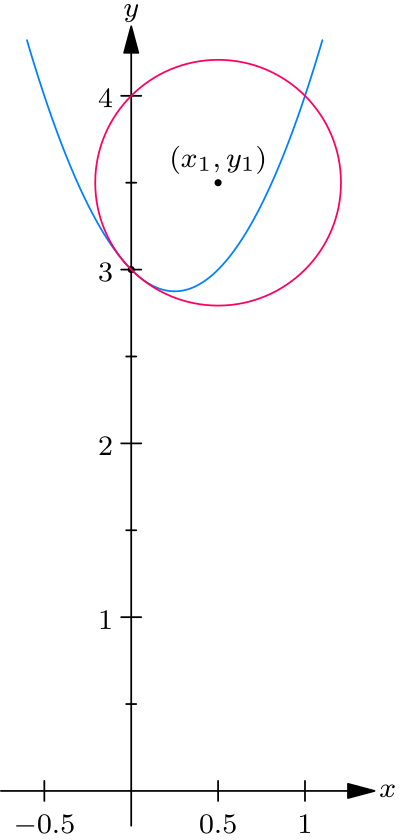
The curve and the circle are illustrated below. The values can be checked easily, as since when , here
Example 21.2. Find the radius of curvature and the position of the centre of curvature of the curve () at the point for which .
Solution
Here
\begin{align} & \frac{dy}{d x}=\frac{1}{2} m^{\frac{1}{2}} x^{-\frac{1}{2}}=\frac{m^{\frac{1}{2}}}{2 x^{\frac{1}{2}}} \text {, } \\[9pt] & \frac{d^{2} y}{d x^{2}}=-\frac{1}{2} \times \frac{m^{\frac{1}{2}}}{2} x^{-\frac{3}{2}}=-\frac{m^{\frac{1}{2}}}{4 x^{\frac{3}{2}}} ; \end{align}
hence
\begin{align} & r=\frac{\pm\left\{1+\left(\frac{d y}{d x}\right)^{2}\right\}^{\frac{3}{2}}}{\frac{d^{2} y}{d x^{2}}}=\frac{\pm\left\{1+\frac{m}{4 x}\right\}^{\frac{3}{2}}}{-\frac{m^{\frac{1}{2}}}{4 x^{\frac{5}{2}}}}=\frac{(4 x+m)^{\frac{3}{2}}}{2 m^{\frac{1}{2}}}, \end{align}
taking the sign at the numerator, so as to have positive.
Since, when , , we get
\begin{align} r=\frac{m^{\frac{3}{2}}}{2 m^{\frac{1}{2}}}=\frac{m}{2}. \end{align}
Also, if are the coordinates of the centre,
\begin{align} x_{1}&=x-\frac{\frac{d y}{d x}\left\{1+\left(\frac{d y}{d x}\right)^{2}\right\}}{\frac{d^{2} y}{d^{2} x}}\\ &=x-\frac{\frac{m^{\frac{1}{2}}}{2 x^{\frac{1}{2}}}\left\{1+\frac{m}{4 x}\right\}}{-\frac{m^{\frac{1}{2}}}{4 x^{\frac{3}{3}}}} \\[6pt] & =x+\frac{4 x+m}{2}=3 x+\frac{m}{2} \text {, } \end{align}
when , then . Also
\begin{align} y_{1}&=y+\frac{1+\left(\frac{d y}{d x}\right)^{2}}{\frac{d^{2} y}{d x^{2}}}\\ &=m^{\frac{1}{2}} x^{\frac{1}{2}}-\frac{1+\frac{m}{4 x}}{\frac{m^{\frac{1}{2}}}{4 x^{\frac{3}{2}}}}\\ &=-\frac{4 x^{\frac{3}{2}}}{m^{\frac{1}{2}}} \end{align}
when . Therefore, the centre of curvature is .
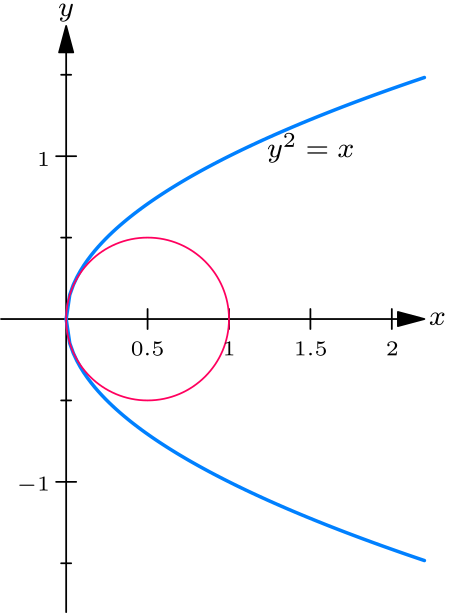
The following figure shows the curve for and its circle of curvature at .
Example 21.3. Show that the circle is a curve of constant curvature.
Solution
If are the coordinates of the centre, and is the radius, the equation of the circle in rectangular coordinates is
this is easily put into the form
To differentiate, let ; then
\begin{align} \frac{d y}{d x}&=\frac{d y}{d v} \times \frac{d v}{d x}\\[6pt] &=-\frac{1}{2}\left\{R^{2}-\left(x-x_{1}\right)^{2}\right\}^{-\frac{1}{2}} \times 2\left(x-x_{1}\right) \\[6pt] &=\frac{-\left(x-x_{1}\right)}{\left\{R^{2}-\left(x-x_{1}\right)^{2}\right\}^{\frac{1}{2}}}. \end{align}
Differentiate again ; using the rule for differentiation of a fraction, we get
\begin{align} \dfrac{d^2 y}{dx^2}=\frac{\left\{R^{2}-\left(x-x_{1}\right)^{2}\right\}^{\frac{1}{2}} \times \frac{d\left\{-\left(x-x_{1}\right)\right\}}{d x}-\left\{-\left(x-x_{1}\right)\right\}\times \frac{d}{d x}\left\{R^{2}-\left(x-x_{1}\right)^{2}\right\}^{\frac{1}{2}}}{R^{2}-\left(x-x_{1}\right)^{2} } \end{align} (it is always a good plan to write out the whole expression in this way when dealing with a complicated expression); this simplifies to
\begin{align} \frac{d^{2} y}{d x^{2}} & =\frac{\left\{R^{2}-\left(x-x_{1}\right)^{2}\right\}^{\frac{1}{2}}(-1)-\frac{\left(x-x_{1}\right)^{2}}{\left\{\boldsymbol{R}^{2}-\left(x-x_{1}\right)^{2}\right\}^{\frac{1}{2}}}}{R^{2}-\left(x-x_{1}\right)^{2}} \\ & =\frac{R^{2}}{\left\{R^{2}-\left(x-x_{1}\right)^{2}\right\}^{\frac{3}{2}}} ; \end{align}
hence
the radius of curvature is constant and equal to the radius of the circle.
Example 21.4. Find the radius and the centre of curvature of the curve at points where and . Find also the position of the point of inflection of the curve.
Solution
Here
\begin{align} & \quad \frac{d y}{d x}=3 x^{2}-4 x+1, \quad \frac{d^{2} y}{d x^{2}}=6 x-4 . \\[9pt] & r= \frac{\left\{1+\left(3 x^{2}-4 x+1\right)^{2}\right\}^{\frac{3}{2}}}{6 x-4}, \\ & x_{1}=x-\frac{\left(3 x^{2}-4 x+1\right)\left\{1+\left(3 x^{2}-4 x+1\right)^{2}\right\}}{6 x-4}, \\ & y_{1}=y+\frac{1+\left(3 x^{2}-4 x+1\right)^{2}}{6 x-4} . \end{align}
When ,
\begin{align} r=\frac{\sqrt{8}}{4}&=\frac{1}{\sqrt{2}}= 0.7071.\\ \quad x_{1}=0+\frac{1}{2}=0.5,& \qquad y_{1}=-1-\frac{1}{2}=-1.5. \end{align}
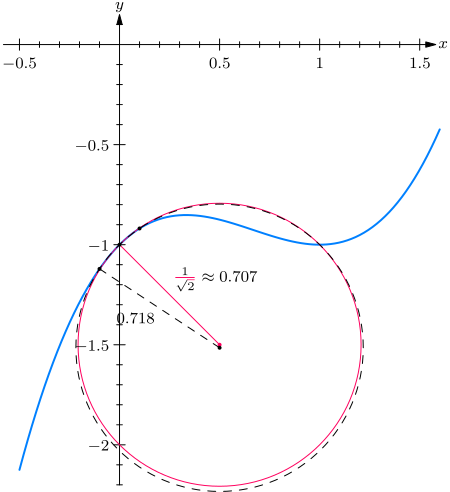
Let’s choose two points on the curve on either side of the point , say points with -coordinates and . When , . When , . If we consider the circle passing through these three points: , , and , we can determine the coordinates of its center to be , and its radius to be , 3 a very fair agreement with the circle of curvature. To improve the approximation, we can choose two other points with -coordinates closer to than —for instance, and —and repeat the calculations.
The curve , its circle of curvature at , and the circle passing through , and are shown below.
When , \begin{align} & r=\frac{-\left\{1+(-0.25)^{2}\right\}^{\frac{3}{2}}}{-1}= 1.095 \\ & x_{1}=0.5-\frac{-0.25 \times 1.0625}{-1}= 0.2344, \\ & y_{1}=-0.875+\frac{1.0625}{-1}= -1.938. \end{align} Considering three points , , and on the curve, the circle passing through them is of center and of radius .
When , \begin{align} & r=\frac{(1+0)^{\frac{3}{2}}}{2}=0.5, \\ & x_{1}=1-\frac{0 \times(1+0)}{2}=1, \\ & y_{1}=-1+\frac{1+0^{2}}{2}=-0.5 . \end{align} Considering three points , , and on the curve, the circle passing through them is of center and of radius .
At the point of inflection , and hence (see the following figure).
Example 21.5. Find the radius and centre of curvature of the curve ,4 at the point for which . (This curve is called the catenary, as a hanging chain affects the same slope exactly.)
Solution
The equation of the curve may be written
then Similarly
since , or
\begin{align} & \qquad r=\frac{a^{2}}{8 y} \sqrt{\left(2 e^{\frac{x}{a}-\frac{x}{a}}+e^{\frac{2 x}{a}}+e^{-\frac{2 x}{a}}\right)^{3}}=\frac{a^{2}}{8 y} \sqrt{\left(e^{\frac{x}{a}}+e^{-\frac{x}{a}}\right)^{6}}=\frac{y^{2}}{a}, \end{align} when , , and ; hence
The radius of curvature at the vertex is equal to the constant .
Also
\begin{align} & x_{1}=0-\frac{0(1+0)}{\frac{1}{a}}=0, \\ & y_{1}=y+\frac{1+0}{\frac{1}{a}}=a+a=2 a . \end{align}
You are now sufficiently familiar with this type of problem to work out the following exercises by yourself. You are advised to check your answers by careful plotting of the curve and construction of the circle of curvature, as explained in Example 4 in this chapter.
Exercises
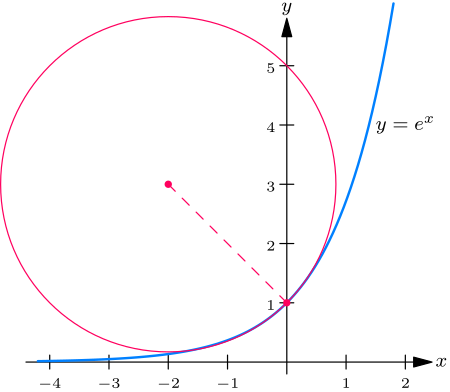
Exercise 21.1. Find the radius of curvature and the position of the centre of curvature of the curve at the point for which .
Answer
, , .
Solution
When
We just plug these numbers in the formulae for , and
\begin{align} & r=\frac{\left(1+1^{2}\right)^{\frac{3}{2}}}{1}=2^{\frac{3}{2}}=2 \sqrt{2} \\ & x_{1}=0-\frac{1\left(1+1^{2}\right)}{1}=-2 \\ & y_{1}=1+\frac{1+1^{2}}{1}=3 \end{align}
Exercise 21.2. Find the radius and the centre of curvature of the curve at the point for which .
Answer
, , .
Solution
\begin{align} & y=x\left(\frac{x}{2}-1\right)=\frac{x^{2}}{2}-x \\ & \frac{d y}{d x}=x-1 \quad, \quad \frac{d^{2} y}{d x^{2}}=1 \end{align}
When
We just put these numbers in the formulae for , and
\begin{align} & r=\frac{\left(1+1^{2}\right)^{\frac{3}{2}}}{1}=2^{\frac{3}{2}}=2 \sqrt{2} \\ & x_{1}=2-\frac{1\left(1+1^{2}\right)}{1}=0 \\ & y_{1}=0+\frac{1+1^{2}}{1}=2 \end{align}
Exercise 21.3. Find the point or points of curvature unity in the curve .
Answer
,
Solution
Since , if , then or
Solving the above equation for :
When , .
We have solved the problem, but if we wish to draw the circle of curvature (also known as the osculating circle), we need to determine and when and :
When and :
When and :
The graph of and the two osculating circles with radii of are shown below:
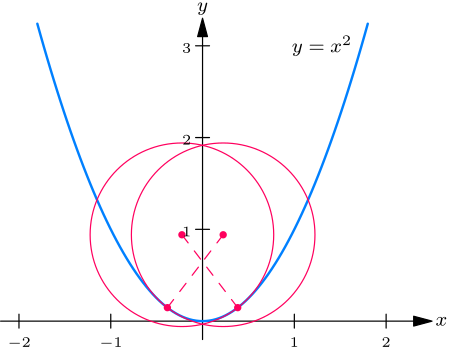
Exercise 21.4. Find the radius and the centre of curvature of the curve , at the point for which .
Answer
, .
Solution
When ,
Hence \begin{align} & r=\frac{\left(1+(-1)^{2}\right)^{\frac{3}{2}}}{\frac{2}{\sqrt{m}}}=\frac{\sqrt{m}}{2} 2^{\frac{3}{2}}=\sqrt{2 m} \\ & x_{1}=\sqrt{m}-\frac{(-1)\left(1+(-1)^{2}\right)}{\frac{2}{\sqrt{m}}}=2 \sqrt{m} \\ & y_{1}=\sqrt{m}+\frac{1+(-1)^{2}}{\frac{2}{\sqrt{m}}}=2 \sqrt{m} \end{align}
Exercise 21.5. Find the radius and the centre of curvature of the curve at the point for which .
Answer
, , when , , .
Solution
In Example 160, we showed that if , then
By comparison, we realize if , then
When . Therefore
Exercise 21.6. Find the radius and the centre of curvature of the curve at the points for which and also .
Answer
When , infinity, .
When .
When , , , .
Solution
When ,
Hence
\begin{align} & r=\frac{\left(1+2.43^{2}\right)^{\frac{3}{2}}}{5.4} \approx 3.36 \\ & x_{1}=0.9-\frac{2.43\left(1+2.43^{2}\right)}{5.4} \approx-2.21 \\ & y_{1}=0.729+\frac{1+2.43^{2}}{5.4} \approx 2.01 \end{align}
When
Hence \begin{align} & r=-\frac{\left(1+2.43^{2}\right)^{\frac{3}{2}}}{5.4} \approx 3.36 \\ & x_{1}=-0.9-\frac{2.43\left(1+2.43^{2}\right)}{-5.4} \approx 2.21 \\ & y_{1}=-0.729+\frac{1+2.43^{2}}{-5.4} \approx-2.01 \end{align}
When Hence \begin{align} & r=\frac{\left(1+0^{2}\right)^{3 / 2}}{0}=\infty \\ & x_{1}=x-\frac{3 x^{2}\left(1+9 x^{4}\right)}{6 x}=x-\frac{1}{2} x\left(1+9 x^{4}\right) \end{align}
If we substitute into the above expression for , we get
If we substitute into the above equation, we get
Exercise 21.7. Find the radius of curvature and the coordinates of the centre of curvature of the curve at the two points for which and , respectively. Find also the maximum or minimum value of . Verify graphically all your results.
Answer
When , , .
When , , .
Minimum .
Solution
Then
When ,
\begin{align} & r=\frac{\left(1+(-1)^{2}\right)^{\frac{3}{2}}}{2}=\sqrt{2} \approx 1.41 \\ & x_{1}=0-\frac{(-1)\left(1+(-1)^{2}\right)}{2}=1 \\ & y_{1}=2+\frac{1+(-1)^{2}}{2}=3 \end{align}
When Hence, \begin{align} & r=\frac{\left(1+1^{2}\right)^{\frac{3}{2}}}{2}=\sqrt{2} \approx 1.41 \\ & x_{1}=1-\frac{1\left(1+1^{2}\right)}{2}=0 \\ & y_{1}=2+\frac{1+1^{2}}{2}=3 \end{align}
To find the maximum or minimum value of
Since , the curve is concave upward and the value of at , which is is the minimum value of .
Exercise 21.8. Find the radius of curvature and the coordinates of the centre of curvature of the curve at the points for which , and .
Answer
For , , , .
For , infinity.
For , , , .
Solution
When ,
\begin{align} & r=-\frac{\left(1+11^{2}\right)^{\frac{3}{2}}}{-12} \approx 112.3 \\ & x_{1}=-2-\frac{11\left(1+11^{2}\right)}{-12} \approx 109.8 \\ & y_{1}=-7+\frac{1+11^{2}}{-12} \approx-17.2 \end{align}
When ,
Hence, \begin{align} & r=\frac{\left(1+(-1)^{2}\right)^{\frac{3}{2}}}{0}=\infty \\ & x_{1}=0-\frac{(-1)\left(1+(-1)^{2}\right)}{0}=\infty \\ & y_{1}=-1+\frac{1+(-1)^{2}}{0}=\infty \end{align}
When
\begin{align} & r=\frac{\left(1+2^{2}\right)^{\frac{3}{2}}}{6} \approx 1.86 \\ & x_{1}=1-\frac{2\left(1+2^{2}\right)}{6}=-\frac{2}{3} \approx-0.67\\ &y_{1}=-1+\frac{1+2}{6}=-\frac{1}{6} \approx-0.17 \end{align}
Exercise 21.9. Find the coordinates of the point or points of inflection of the curve .
Answer
,
Solution
To find the point(s) of inflection
If and if .
Therefore, the direction of concavity changes at .
When .
Hence, is the point of inflection.
Exercise 21.10. Find the radius of curvature and the coordinates of the centre of curvature of the curve at the points for which , , and . What is this curve?
Answer
, , for all points. A circle.
Solution
\begin{align} \frac{d y}{d x} & =\frac{1}{2}(4-2 x)\left(4 x-x^{2}-3\right)^{-\frac{1}{2}}\\ &=(2-x)\left(4 x-x^{2}-3\right)^{-\frac{1}{2}} \end{align}
\begin{align} \frac{d^{2} y}{d x^{2}} & =-\left(4 x-x^{2}-3\right)^{-\frac{1}{2}}-(2-x)^{2}\left(4 x-x^{2}-3\right)^{\frac{-3}{2}} \\ & =\frac{-\left(4 x-x^{2}-3\right)-(2-x)^{2}}{\left(4 x-x^{2}-3\right)^{\frac{3}{2}}} \\ & =\frac{-1}{\left(4 x-x^{2}-3\right)^{\frac{3}{2}}} \end{align}
Instead of calculating , , and for the given points, we find the general formulae for them in this case:
\begin{align} & r=\frac{\left(1+\left(\frac{d y}{d x}\right)^{2}\right)^{2}}{\frac{d^{2} y}{d x^{2}}} \\ & =-\frac{\left(1+\frac{(2-x)^{2}}{4 x-x^{2}-3}\right)^{\frac{3}{2}}}{\frac{-1}{\left(4 x-x^{2}-3\right)^{\frac{3}{2}}}} \\ & =\frac{\left(\frac{4 x-x^{2}-3+\left(4-4 x-x^{2}\right)}{4 x-x^{2}-3}\right)^{\frac{3}{2}}}{\frac{1}{\left(4 x-x^{2}-3\right)^{\frac{3}{2}}}}\\ & =1 \end{align} \begin{align} x_{1}&=x-\frac{\frac{2-x}{\sqrt{4 x-x^{2}-3}}\left(1+\frac{(2-x)^{2}}{4 x-x^{2}-3}\right)}{\frac{-1}{\left(4 x-x^{2}-3\right)^{\frac{3}{2}}}} \\ &=x+(2-x)\\ &=2 \end{align} \begin{align} y_{1}&=y+\frac{1+\frac{(2-x)^{2}}{4 x-x^{2}-3}}{\frac{-1}{\left(4 x-x^{2}-3\right)^{\frac{3}{2}}}}\\ & =y+\frac{\frac{1}{4 x-x^{2}-3}}{\frac{-1}{\left(4 x-x^{2}-3\right)^{\frac{3}{2}}}} \\ & =y-\sqrt{4 x-x^{2}-3} \\ & =0 \end{align}
Therefore, for all points . This is the equation of a circle. To see that note
The last one is the equation of a circle of radius 1 and of center .
Exercise 21.11. Find the radius and the centre of curvature of the curve at the points for which . Find also the position of the point of inflection.
Answer
When , .
When , , , .
, for zero curvature.
Solution
When
Hence, \begin{align} & r=-\frac{\left(1+2^{2}\right)^{\frac{3}{2}}}{-6}=\frac{5^{\frac{3}{2}}}{6}=\frac{5 \sqrt{5}}{6} \approx 1.86 \\ & x_{1}=0-\frac{2\left(1+2^{2}\right)}{-6}=\frac{10}{6}=\frac{5}{3} \approx 1.67 \\ & y_{1}=1+\frac{1+2^{2}}{-6}=\frac{1}{6} \approx 0.17 \end{align}
When ,
\begin{align} & r=\frac{\left(1+\frac{1}{16}\right)^{\frac{3}{2}}}{3}=\frac{17 \sqrt{17}}{192} \approx 0.365 \\ & x_{1}=1.5-\frac{-\frac{1}{4}\left(1+\frac{1}{16}\right)}{3}=\frac{305}{192} \approx 1.59 \\ & y_{1}=\frac{5}{8}+\frac{1+\frac{1}{16}}{3}=\frac{47}{48} \approx 0.98 \end{align}
At , the second derivative changes from negative to positive, indicating a change in concavity from downward to upward. When , the corresponding value is . Therefore, the point is a point of inflection on the curve.
Exercise 21.12. Find the radius and centre of curvature of the curve at the points for which and . Find the position of the point of inflection.
Answer
When , , , .
When , , ,
Solution
Notice that in this exercise, we are not using polar coordinates. We are using the regular Cartesian coordinates, but instead of the independent variable is denoted by . Therefore,
\begin{align} & r= \pm \frac{\left(1+\left(\frac{d y}{d \theta}\right)^{2}\right)^{\frac{3}{2}}}{\frac{d^{2} y}{d \theta^{2}}} \\ & \theta_{1}=\theta-\frac{\frac{d y}{d \theta}\left[1+\left(\frac{d y}{d \theta}\right)^{2}\right]}{\frac{d^{2} y}{d \theta^{2}}} \\ & y_{1}=y+\frac{1+\left(\frac{d y}{d \theta}\right)^{2}}{\frac{d^{2} y}{d \theta^{2}}} \end{align}
When
Hence \begin{align} & r=-\frac{\left(1+\frac{1}{2}\right)^{\frac{3}{2}}}{\frac{-1}{\sqrt{2}}}=\frac{3 \sqrt{3}}{2} \approx 2.598\\ & \theta_{1}=\frac{\pi}{4}-\frac{\frac{1}{\sqrt{2}}\left(1+\frac{1}{2}\right)}{-\frac{1}{\sqrt{2}}}=\frac{\pi+6}{4} \approx 2.285 \\ & y_{1}=\frac{1}{\sqrt{2}}+\frac{1+\frac{1}{2}}{-\frac{1}{\sqrt{2}}}=-\sqrt{2} \approx-1.414 \end{align}
When , Hence, \begin{align} & r=-\frac{(1+0)^{\frac{3}{2}}}{-1}=1 \\ & \theta_{1}=\frac{\pi}{2}-\frac{0\left(1+0^{2}\right)}{-1}=\frac{\pi}{2} \\ & y_{1}=1+\frac{1+0^{2}}{-1}=0 \end{align}
Exercise 21.13. Draw a circle of radius 3 , the centre of which has for its coordinates , . Deduce the equation of such a circle from first principles (see here). Find by calculation the radius of curvature and the coordinates of the centre of curvature for several suitable points, as accurately as possible, and verify that you get the known values.
Solution
The equation of a circle of radius and center is
Therefore, in this case
Differentiate with respect to
Therefore
Differentiating again using the quotient rule yields
\begin{align} \frac{d^{2} y}{d x^{2}} & =-\frac{y-\frac{d y}{d x}(x-1)}{y^{2}} \\ & =-\frac{y+\frac{(x-1)^{2}}{y}}{y^{2}} \\ & =-\frac{y^{2}+(x-1)^{2}}{y^{3}} \\ & =-\frac{R^{2}}{y^{3}} \end{align}
Radius of curvature:
\begin{align} r & =\frac{\left[1+\left(\dfrac{d y}{d x}\right)^{2}\right]^{\frac{3}{2}}}{\dfrac{d^{2} y}{d x^{2}}} \\ & =-\frac{\left[1+\dfrac{(x-1)^{2}}{y^{2}}\right]^{\frac{3}{2}}}{-\dfrac{R^{2}}{y^{3}}} \\ & =\frac{\left(\dfrac{R^{2}}{y^{2}}\right)^{\frac{3}{2}}}{\dfrac{R^{2}}{y^{2}}}\\ &=\frac{\dfrac{R^{3}}{y^2}}{\dfrac{R^{2}}{y^{2}}}=R \end{align}
Centre of curvature:
\begin{align} x_{1} & =x-\frac{-\frac{x-1}{y}\left(1+\frac{(x-1)^{2}}{y^{2}}\right)}{-\frac{R^{2}}{y^{3}}} \\ & =x-\frac{\frac{x-1}{y^{3}}\left((x-1)^{2}+y^{2}\right)}{\frac{R^{2}}{y^{3}}} \\ & =x-\frac{(x-1) R^{2}}{R^{2}}\\ & =x-(x-1)=1. \end{align} \begin{align} y_{1} & =y+\frac{1+\frac{(x-1)^{2}}{y^{2}}}{-\frac{R^{2}}{y^{3}}} \\ & =y-\frac{y^{2}+(x-1)^{2}}{y^{2}} \\ & =y-\frac{\dfrac{R^{2}}{y^{3}}}{\dfrac{R^{2}}{y^{2}}} \\ & =y-y=0. \end{align} Hence the center of curvature is .
Exercise 21.14. Find the radius and centre of curvature of the curve at the points for which , and .
Answer
When , , , .
When , , , .
When , infinity.
Solution
Again, similar to exercise 12, we are using the Cartesian coordinates, but the independent variable is denoted by , instead of
When Hence, \begin{align} & r=-\frac{\left(1+0^{2}\right)^{\frac{3}{2}}}{-1}=1 \\ & \theta_{1}=0-\frac{0\left(1+0^{2}\right)}{-1}=0 \\ & y_{1}=1+\frac{1+0^{2}}{-1}=0 \end{align}
When ,
Hence, \begin{align} & r=-\frac{\left(1+\frac{1}{2}\right)^{\frac{3}{2}}}{\frac{-1}{\sqrt{2}}}=\frac{3 \sqrt{3}}{2} \approx 2.598 \\ & \theta_{1}=\frac{\pi}{4}-\frac{-\frac{1}{\sqrt{2}}\left(1+\frac{1}{2}\right)}{-\frac{1}{\sqrt{2}}}=\frac{\pi}{4}-\frac{3}{2} \approx-0.715\\ & y_{1}=\frac{1}{\sqrt{2}}+\frac{1+\frac{1}{2}}{-\frac{1}{\sqrt{2}}}=-\sqrt{2} \approx-1.414 \end{align}
When , Hence, \begin{align} & r=\frac{(1+1)^{\frac{3}{2}}}{0}=\infty \\ & \theta_{1}=\frac{\pi}{2}-\frac{-1(1+1)}{0}=\infty\\ & y_{1}=0+\frac{1+1}{0}=\infty \end{align}
Exercise 21.15. Find the radius of curvature and the centre of curvature of the ellipse at the points for which and at the points for which .
Answer
, where , , , .
Solution
Multiplying both sides by , we get
Differentiating both sides of with respect to , we obtain \begin{align} & 2 b^{2} x+2 a^{2} y \frac{d y}{d x}=0 \\ & \frac{d y}{d x}=-\frac{b^{2}}{a^{2}} \frac{x}{y} \end{align}
Differentiating the last equation with respect to using the quotient rule, we get
\begin{align} \frac{d^{2} y}{d x^{2}} & =-\frac{b^{2}}{a^{2}} \frac{y-\frac{d y}{d x} x}{y^{2}} \\ & =-\frac{b^{2}}{a^{2}} \frac{y+\frac{b^{2}}{a^{2}} \frac{x}{y}}{y^{2}} \\ & =-\frac{b^{2}}{a^{2}} \frac{a^{2} y^{2}+b^{2} x^{2}}{a^{2} y^{3}} \\ & =-\frac{b^{2}}{a^{2}} \frac{a^{2} b^{2}}{a^{2} y^{3}}=-\frac{b^{4}}{a^{2} y^{3}} \end{align}
Hence \begin{align} r & = \pm \frac{\left(1+\left(\frac{d y}{d x}\right)^{2}\right)^{\frac{3}{2}}}{\frac{d^{2} y}{d x^{2}}} \\ & =\frac{\left(1+\frac{b^{4}}{a^{4}} \frac{x^{2}}{y^{2}}\right)^{\frac{3}{2}}}{\frac{b^{4}}{a^{2} y^{3}}}=\frac{\left(\frac{a^{4} y^{2}+b^{4} x^{2}}{a^{4} y^{2}}\right)^{\frac{3}{2}}}{\frac{b^{4}}{a^{2} y^{2}}} \\ & =\frac{\left(a^{4} y^{2}+b^{4} x^{2}\right)^{\frac{3}{2}}}{a^{4} b^{4}} \end{align}
\begin{align} x_{1} & =x-\frac{-\frac{a^{2}}{\bar{y}}\left(1+\frac{a}{a^{4}} \frac{x}{y^{2}}\right)}{-\frac{b^{4}}{a^{2} y^{3}}} \\ & =x-\frac{\frac{b^{2}}{a^{6}} \frac{x}{y^{3}}\left(a^{4} y^{2}+b^{4} x^{2}\right)}{\frac{b^{4}}{a^{2} y^{3}}} \\ & =x-\frac{x}{a^{4} b^{2}}\left(a^{4} y^{2}+b^{4} x^{2}\right) \end{align}
\begin{align} y_{1} & =y+\frac{1+\frac{b^{4}}{a^{4}} \frac{x^{2}}{y^{2}}}{-\frac{b^{4}}{a^{2} y^{3}}} \\ & =y-\frac{y}{a^{2} b^{4}}\left(a^{4} y^{2}+b^{4} x^{2}\right) \\ & =y-\frac{\frac{1}{a^{4} y^{2}}\left(a^{4} y^{2}+b^{4} x^{2}\right)}{a^{4} y^{3}} \end{align}
When , then or
When and
\begin{align} & x_{1}=0-0=0 \\ & y_{1}=b-\frac{b}{a^{2} b^{4}}\left(a^{4} b^{2}\right)=b-\frac{a^{2}}{b}=\frac{b^{2}-a^{2}}{b} \end{align}
When and
\begin{align} & y=-b \\ & r=\frac{a^{2}}{b}, \quad x_{1}=0 \quad y_{1}=-b+\frac{a^{2}}{b}=\frac{a^{2}-b^{2}}{b} \end{align}
When , then or
When and
\begin{align} & r=\frac{1}{a^{4} b^{4}}\left(b^{4} a^{2}\right)^{\frac{3}{2}}=\frac{b^{6} a^{3}}{a^{4} b^{4}}=\frac{b^{2}}{a} \\ & x_{1}=a-\frac{a}{a^{4} b^{2}}\left(0+b^{4} a^{2}\right)=a-\frac{b^{2}}{a}=\frac{a^{2}-b^{2}}{a} \\ & y_{1}=0-0=0 \end{align}
When and
Full Chapter
In the chapter entitled Curvature of Curves, we have learned how we can find out which way a curve is curved, that is, whether it curves upwards or downwards towards the right. This gave us no indication whatever as to how much the curve is curved, or, in other words, what is its curvature.
By curvature of a line, we mean the amount of bending or deflection taking place along a certain length of the line, say along a portion of the line the length of which is one unit of length (the same unit which is used to measure the radius, whether it be one inch, one foot, or any other unit). For instance, consider two circular paths of centre and O^{\prime} and of equal lengths AB, A^{\prime} B^{\prime} (see the following figure). When passing from to along the arc of the first one, one changes one’s direction from to , since at one faces in the direction and at one faces in the direction . In other words, in walking from to one unconsciously turns round through the angle , which is equal to the angle . Similarly, in passing from A^\prime to B^{\prime}, along the arc A^\prime B^\prime, of equal length to , on the second path, one turns round through the angle \angle P^{\prime} C^{\prime} Q^{\prime}, which is equal to the angle \angle A^{\prime} O^{\prime} B^{\prime}, obviously greater than the corresponding angle . The second path bends therefore more than the first for an equal length.
This fact is expressed by saying that the curvature of the second path is greater than that of the first one. The larger the circle, the lesser the bending, that is the lesser the curvature. If the radius of the first circle is etc. times greater than the radius of the second, then the angle of bending or deflection along an arc of unit length will be 2, 3, 4 , ... etc. times less on the first circle than on the second, that is, it will be etc. of the bending or deflection along the arc of same length on the second circle. In other words, the curvature of the first circle will be etc. of that of the second circle. We see that, as the radius becomes 2, 3, 4, .. etc. times greater, the curvature becomes 2, 3, 4, ... etc. times smaller, and this is expressed by saying that the curvature of a circle is inversely proportional to the radius of the circle, or
where is a constant. It is agreed to take , so that always.
If the radius becomes indefinitely great, the curvature becomes zero, since when the denominator of a fraction is indefinitely large, the value of the fraction is indefinitely small. For this reason mathematicians sometimes consider a straight line as an arc of circle of infinite radius, or zero curvature.
In the case of a circle, which is perfectly symmetrical and uniform, so that the curvature is the same at every point of its circumference, the above method of expressing the curvature is perfectly definite. In the case of any other curve, however, the curvature is not the same at different points, and it may differ considerably even for two points fairly close to one another. It would not then be accurate to take the amount of bending or deflection between two points as a measure of the curvature of the arc between these points, unless this arc is very small, in fact, unless it is indefinitely small.
If then we consider a very small arc such as (see the next figure ), and if we draw such a circle that an arc of this circle coincides with the arc of the curve more closely than would be the case with any other circle, then the curvature of this circle may be taken as the curvature of the arc of the curve. The smaller the arc , the easier it will be to find a circle an arc of which most nearly coincides with the arc of the curve. When and are very near one another, so that is so small so that the length of the arc is practically negligible, then the coincidence of the two arcs, of circle and of curve, may be considered as being practically perfect, and the curvature of the curve at the point (or ), being then the same as the curvature of the circle, will be expressed by the reciprocal of the radius of this circle, that is, by , according to our way of measuring curvature, explained above.
Now, at first, you may think that, if is very small, then the circle must be very small also. A little thinking will, however, cause you to perceive that it is by no means necessarily so, and that the circle may have any size, according to the amount of bending of the curve along this very small arc . In fact, if the curve is almost flat at that point, the circle will be extremely large. This circle is called the circle of curvature, or the osculating circle at the point considered. Its radius is the radius of curvature of the curve at that particular point.
If the arc is represented by and the angle by , then, if is the radius of curvature,
The secant makes with the -axis the angle , and it will be seen from the small triangle that . When is indefinitely small, so that practically coincides with , the line becomes a tangent to the curve at the point (or ).
Now, depends on the position of the point (or , which is supposed to nearly coincide with it), that is, it depends on , or, in other words, is "a function" of .
Differentiating with regard to to get the slope (see here), we get
or
(see here);
hence
But , and for one may write therefore
but ;1 hence
and finally,
\bbox[5px,border:1px solid black;background-color:#f2f2f2]{\displaystyle r=\pm \frac{\left\{1+\left(\dfrac{d y}{d x}\right)^{2}\right\}^{\frac{3}{2}}}{\dfrac{d^{2} y}{d x^{2}}}.}
It is important to note that the radius must always be positive, as a negative radius would have no physical meaning. Therefore, when using the above formula, one must select the sign if the denominator is positive and the sign if the denominator is negative, as the numerator, being a square root, is always positive.2
It has been shown in the chapter on Curvature of Curves that if is positive, the curve is concave upward (also called convex), while if is negative, the curve is concave downward (also simply called concave). If , the radius of curvature is infinitely great, that is, the corresponding portion of the curve is a bit of straight line. This necessarily happens whenever a curve gradually changes from being concave upward to concave downward or vice versa. The point, like in the following figure, where this occurs is called a point of inflection.
The centre of the circle of curvature is called the centre of curvature. If its coordinates are , then the equation of the circle is (see here)
hence
and
x-x_1+\left(y-y_1\right) \frac{d y}{d x}=0.\tag{1}
Why did we differentiate? To get rid of the constant . This leaves but two unknown constants and ; differentiate again; you shall get rid of one of them. This last differentiation is not quite as easy as it seems; let us do it together; we have:
the numerator of the second term is a product; hence differentiating it gives
so that the result of differentiating (1) is
from this we at once get
\bbox[5px,border:1px solid black;background-color:#f2f2f2]{\displaystyle y_{1}=y+\frac{1+\left(\dfrac{d y}{d x}\right)^{2}}{\dfrac{d^{2} y}{d x^{2}}}.}
Replacing in (1), we get
\bbox[5px,border:1px solid black;background-color:#f2f2f2]{\displaystyle x_{1}=x-\frac{\dfrac{d y}{d x}\left\{1+\left(\dfrac{d y}{d x}\right)^{2}\right\}}{\dfrac{d^{2} y}{d x^{2}}};}
and give the position of the centre of curvature. The use of these formulae will be best seen by carefully going through a few worked-out examples.
Example 1. Example 21.1. Find the radius of curvature and the coordinates of the centre of curvature of the curve at the point . Solution. We have when ; this becomes If are the coordinates of the centre f curvature then when , so that The curve and the circle are illustrated below. The values can be checked easily, as since when , here
Example 2. Example 21.2. Find the radius of curvature and the position of the centre of curvature of the curve () at the point for which . Solution. Here hence taking the sign at the numerator, so as to have positive. Since, when , , we get Also, if are the coordinates of the centre, when , then . Also when . Therefore, the centre of curvature is . The following figure shows the curve for and its circle of curvature at .
Example 3. Example 21.3. Show that the circle is a curve of constant curvature. Solution. If are the coordinates of the centre, and is the radius, the equation of the circle in rectangular coordinates is this is easily put into the form To differentiate, let ; then Differentiate again ; using the rule for differentiation of a fraction, we get (it is always a good plan to write out the whole expression in this way when dealing with a complicated expression); this simplifies to hence the radius of curvature is constant and equal to the radius of the circle.
Example 4. Example 21.4. Find the radius and the centre of curvature of the curve at points where and . Find also the position of the point of inflection of the curve. Solution. Here When , Let’s choose two points on the curve on either side of the point , say points with -coordinates and . When , . When , . If we consider the circle passing through these three points: , , and , we can determine the coordinates of its center to be , and its radius to be , 3 a very fair agreement with the circle of curvature. To improve the approximation, we can choose two other points with -coordinates closer to than —for instance, and —and repeat the calculations. The curve , its circle of curvature at , and the circle passing through , and are shown below.
When , \begin{align} & r=\frac{-\left\{1+(-0.25)^{2}\right\}^{\frac{3}{2}}}{-1}= 1.095 \\ & x_{1}=0.5-\frac{-0.25 \times 1.0625}{-1}= 0.2344, \\ & y_{1}=-0.875+\frac{1.0625}{-1}= -1.938. \end{align} Considering three points , , and on the curve, the circle passing through them is of center and of radius .
When , \begin{align} & r=\frac{(1+0)^{\frac{3}{2}}}{2}=0.5, \\ & x_{1}=1-\frac{0 \times(1+0)}{2}=1, \\ & y_{1}=-1+\frac{1+0^{2}}{2}=-0.5 . \end{align} Considering three points , , and on the curve, the circle passing through them is of center and of radius .
At the point of inflection , and hence (see Fig. 21.4).
Example 5. Example 21.5. Find the radius and centre of curvature of the curve ,4 at the point for which . (This curve is called the catenary, as a hanging chain affects the same slope exactly.) Solution. The equation of the curve may be written then (see these examples), Similarly since , or when , , and ; hence The radius of curvature at the vertex is equal to the constant . Also You are now sufficiently familiar with this type of problem to work out the following exercises by yourself. You are advised to check your answers by careful plotting of the curve and construction of the circle of curvature, as explained in Example 22.4.
Exercises
Exercise 1. Exercise 21.1. Find the radius of curvature and the position of the centre of curvature of the curve at the point for which .
Answer
, , .
Solution
When
We just plug these numbers in the formulae for , and
\begin{align} & r=\frac{\left(1+1^{2}\right)^{\frac{3}{2}}}{1}=2^{\frac{3}{2}}=2 \sqrt{2} \\ & x_{1}=0-\frac{1\left(1+1^{2}\right)}{1}=-2 \\ & y_{1}=1+\frac{1+1^{2}}{1}=3 \end{align}
Exercise 2. Exercise 21.2. Find the radius and the centre of curvature of the curve at the point for which .
Answer
, , .
Solution
\begin{align} & y=x\left(\frac{x}{2}-1\right)=\frac{x^{2}}{2}-x \\ & \frac{d y}{d x}=x-1 \quad, \quad \frac{d^{2} y}{d x^{2}}=1 \end{align}
When
We just put these numbers in the formulae for , and
\begin{align} & r=\frac{\left(1+1^{2}\right)^{\frac{3}{2}}}{1}=2^{\frac{3}{2}}=2 \sqrt{2} \\ & x_{1}=2-\frac{1\left(1+1^{2}\right)}{1}=0 \\ & y_{1}=0+\frac{1+1^{2}}{1}=2 \end{align}
Exercise 3. Exercise 21.3. Find the point or points of curvature unity in the curve .
Answer
,
Solution
Since , if , then or
Solving the above equation for :
When , .
We have solved the problem, but if we wish to draw the circle of curvature (also known as the osculating circle), we need to determine and when and :
When and :
When and :
The graph of and the two osculating circles with radii of are shown below:
Exercise 4. Exercise 21.4. Find the radius and the centre of curvature of the curve , at the point for which .
Answer
, .
Solution
When ,
Hence \begin{align} & r=\frac{\left(1+(-1)^{2}\right)^{\frac{3}{2}}}{\frac{2}{\sqrt{m}}}=\frac{\sqrt{m}}{2} 2^{\frac{3}{2}}=\sqrt{2 m} \\ & x_{1}=\sqrt{m}-\frac{(-1)\left(1+(-1)^{2}\right)}{\frac{2}{\sqrt{m}}}=2 \sqrt{m} \\ & y_{1}=\sqrt{m}+\frac{1+(-1)^{2}}{\frac{2}{\sqrt{m}}}=2 \sqrt{m} \end{align}
Exercise 5. Exercise 21.5. Find the radius and the centre of curvature of the curve at the point for which .
Answer
, , when , , .
Solution
In Example 160, we showed that if , then
By comparison, we realize if , then
When . Therefore
Exercise 6. Exercise 21.6. Find the radius and the centre of curvature of the curve at the points for which and also .
Answer
When , infinity, .
When .
When , , , .
Solution
When ,
Hence
\begin{align} & r=\frac{\left(1+2.43^{2}\right)^{\frac{3}{2}}}{5.4} \approx 3.36 \\ & x_{1}=0.9-\frac{2.43\left(1+2.43^{2}\right)}{5.4} \approx-2.21 \\ & y_{1}=0.729+\frac{1+2.43^{2}}{5.4} \approx 2.01 \end{align}
When
Hence \begin{align} & r=-\frac{\left(1+2.43^{2}\right)^{\frac{3}{2}}}{5.4} \approx 3.36 \\ & x_{1}=-0.9-\frac{2.43\left(1+2.43^{2}\right)}{-5.4} \approx 2.21 \\ & y_{1}=-0.729+\frac{1+2.43^{2}}{-5.4} \approx-2.01 \end{align}
When Hence \begin{align} & r=\frac{\left(1+0^{2}\right)^{3 / 2}}{0}=\infty \\ & x_{1}=x-\frac{3 x^{2}\left(1+9 x^{4}\right)}{6 x}=x-\frac{1}{2} x\left(1+9 x^{4}\right) \end{align}
If we substitute into the above expression for , we get
If we substitute into the above equation, we get
Exercise 7. Exercise 21.7. Find the radius of curvature and the coordinates of the centre of curvature of the curve at the two points for which and , respectively. Find also the maximum or minimum value of . Verify graphically all your results.
Answer
When , , .
When , , .
Minimum .
Solution
Then
When ,
\begin{align} & r=\frac{\left(1+(-1)^{2}\right)^{\frac{3}{2}}}{2}=\sqrt{2} \approx 1.41 \\ & x_{1}=0-\frac{(-1)\left(1+(-1)^{2}\right)}{2}=1 \\ & y_{1}=2+\frac{1+(-1)^{2}}{2}=3 \end{align}
When Hence, \begin{align} & r=\frac{\left(1+1^{2}\right)^{\frac{3}{2}}}{2}=\sqrt{2} \approx 1.41 \\ & x_{1}=1-\frac{1\left(1+1^{2}\right)}{2}=0 \\ & y_{1}=2+\frac{1+1^{2}}{2}=3 \end{align}
To find the maximum or minimum value of
Since , the curve is concave upward and the value of at , which is is the minimum value of .
Exercise 8. Exercise 21.8. Find the radius of curvature and the coordinates of the centre of curvature of the curve at the points for which , and .
Answer
For , , , .
For , infinity.
For , , , .
Solution
When ,
\begin{align} & r=-\frac{\left(1+11^{2}\right)^{\frac{3}{2}}}{-12} \approx 112.3 \\ & x_{1}=-2-\frac{11\left(1+11^{2}\right)}{-12} \approx 109.8 \\ & y_{1}=-7+\frac{1+11^{2}}{-12} \approx-17.2 \end{align}
When ,
Hence, \begin{align} & r=\frac{\left(1+(-1)^{2}\right)^{\frac{3}{2}}}{0}=\infty \\ & x_{1}=0-\frac{(-1)\left(1+(-1)^{2}\right)}{0}=\infty \\ & y_{1}=-1+\frac{1+(-1)^{2}}{0}=\infty \end{align}
When
\begin{align} & r=\frac{\left(1+2^{2}\right)^{\frac{3}{2}}}{6} \approx 1.86 \\ & x_{1}=1-\frac{2\left(1+2^{2}\right)}{6}=-\frac{2}{3} \approx-0.67\\ &y_{1}=-1+\frac{1+2}{6}=-\frac{1}{6} \approx-0.17 \end{align}
Exercise 9. Exercise 21.9. Find the coordinates of the point or points of inflection of the curve .
Answer
,
Solution
To find the point(s) of inflection
If and if .
Therefore, the direction of concavity changes at .
When .
Hence, is the point of inflection.
Exercise 10. Exercise 21.10. Find the radius of curvature and the coordinates of the centre of curvature of the curve at the points for which , , and . What is this curve?
Answer
, , for all points. A circle.
Solution
\begin{align} \frac{d y}{d x} & =\frac{1}{2}(4-2 x)\left(4 x-x^{2}-3\right)^{-\frac{1}{2}}\\ &=(2-x)\left(4 x-x^{2}-3\right)^{-\frac{1}{2}} \end{align}
\begin{align} \frac{d^{2} y}{d x^{2}} & =-\left(4 x-x^{2}-3\right)^{-\frac{1}{2}}-(2-x)^{2}\left(4 x-x^{2}-3\right)^{\frac{-3}{2}} \\ & =\frac{-\left(4 x-x^{2}-3\right)-(2-x)^{2}}{\left(4 x-x^{2}-3\right)^{\frac{3}{2}}} \\ & =\frac{-1}{\left(4 x-x^{2}-3\right)^{\frac{3}{2}}} \end{align}
Instead of calculating , , and for the given points, we find the general formulae for them in this case:
\begin{align} & r=\frac{\left(1+\left(\frac{d y}{d x}\right)^{2}\right)^{2}}{\frac{d^{2} y}{d x^{2}}} \\ & =-\frac{\left(1+\frac{(2-x)^{2}}{4 x-x^{2}-3}\right)^{\frac{3}{2}}}{\frac{-1}{\left(4 x-x^{2}-3\right)^{\frac{3}{2}}}} \\ & =\frac{\left(\frac{4 x-x^{2}-3+\left(4-4 x-x^{2}\right)}{4 x-x^{2}-3}\right)^{\frac{3}{2}}}{\frac{1}{\left(4 x-x^{2}-3\right)^{\frac{3}{2}}}}\\ & =1 \end{align} \begin{align} x_{1}&=x-\frac{\frac{2-x}{\sqrt{4 x-x^{2}-3}}\left(1+\frac{(2-x)^{2}}{4 x-x^{2}-3}\right)}{\frac{-1}{\left(4 x-x^{2}-3\right)^{\frac{3}{2}}}} \\ &=x+(2-x)\\ &=2 \end{align} \begin{align} y_{1}&=y+\frac{1+\frac{(2-x)^{2}}{4 x-x^{2}-3}}{\frac{-1}{\left(4 x-x^{2}-3\right)^{\frac{3}{2}}}}\\ & =y+\frac{\frac{1}{4 x-x^{2}-3}}{\frac{-1}{\left(4 x-x^{2}-3\right)^{\frac{3}{2}}}} \\ & =y-\sqrt{4 x-x^{2}-3} \\ & =0 \end{align}
Therefore, for all points . This is the equation of a circle. To see that note
The last one is the equation of a circle of radius 1 and of center .
Exercise 11. Exercise 21.11. Find the radius and the centre of curvature of the curve at the points for which . Find also the position of the point of inflection.
Answer
When , .
When , , , .
, for zero curvature.
Solution
When
Hence, \begin{align} & r=-\frac{\left(1+2^{2}\right)^{\frac{3}{2}}}{-6}=\frac{5^{\frac{3}{2}}}{6}=\frac{5 \sqrt{5}}{6} \approx 1.86 \\ & x_{1}=0-\frac{2\left(1+2^{2}\right)}{-6}=\frac{10}{6}=\frac{5}{3} \approx 1.67 \\ & y_{1}=1+\frac{1+2^{2}}{-6}=\frac{1}{6} \approx 0.17 \end{align}
When ,
\begin{align} & r=\frac{\left(1+\frac{1}{16}\right)^{\frac{3}{2}}}{3}=\frac{17 \sqrt{17}}{192} \approx 0.365 \\ & x_{1}=1.5-\frac{-\frac{1}{4}\left(1+\frac{1}{16}\right)}{3}=\frac{305}{192} \approx 1.59 \\ & y_{1}=\frac{5}{8}+\frac{1+\frac{1}{16}}{3}=\frac{47}{48} \approx 0.98 \end{align}
At , the second derivative changes from negative to positive, indicating a change in concavity from downward to upward. When , the corresponding value is . Therefore, the point is a point of inflection on the curve.
Exercise 12. Exercise 21.12. Find the radius and centre of curvature of the curve at the points for which and . Find the position of the point of inflection.
Answer
When , , , .
When , , ,
Solution
Notice that in this exercise, we are not using polar coordinates. We are using the regular Cartesian coordinates, but instead of the independent variable is denoted by . Therefore,
\begin{align} & r= \pm \frac{\left(1+\left(\frac{d y}{d \theta}\right)^{2}\right)^{\frac{3}{2}}}{\frac{d^{2} y}{d \theta^{2}}} \\ & \theta_{1}=\theta-\frac{\frac{d y}{d \theta}\left[1+\left(\frac{d y}{d \theta}\right)^{2}\right]}{\frac{d^{2} y}{d \theta^{2}}} \\ & y_{1}=y+\frac{1+\left(\frac{d y}{d \theta}\right)^{2}}{\frac{d^{2} y}{d \theta^{2}}} \end{align}
When
Hence \begin{align} & r=-\frac{\left(1+\frac{1}{2}\right)^{\frac{3}{2}}}{\frac{-1}{\sqrt{2}}}=\frac{3 \sqrt{3}}{2} \approx 2.598\\ & \theta_{1}=\frac{\pi}{4}-\frac{\frac{1}{\sqrt{2}}\left(1+\frac{1}{2}\right)}{-\frac{1}{\sqrt{2}}}=\frac{\pi+6}{4} \approx 2.285 \\ & y_{1}=\frac{1}{\sqrt{2}}+\frac{1+\frac{1}{2}}{-\frac{1}{\sqrt{2}}}=-\sqrt{2} \approx-1.414 \end{align}
When , Hence, \begin{align} & r=-\frac{(1+0)^{\frac{3}{2}}}{-1}=1 \\ & \theta_{1}=\frac{\pi}{2}-\frac{0\left(1+0^{2}\right)}{-1}=\frac{\pi}{2} \\ & y_{1}=1+\frac{1+0^{2}}{-1}=0 \end{align}
Exercise 13. Exercise 21.13. Draw a circle of radius 3 , the centre of which has for its coordinates , . Deduce the equation of such a circle from first principles (see here). Find by calculation the radius of curvature and the coordinates of the centre of curvature for several suitable points, as accurately as possible, and verify that you get the known values.
Solution
The equation of a circle of radius and center is
Therefore, in this case
Differentiate with respect to
Therefore
Differentiating again using the quotient rule yields
\begin{align} \frac{d^{2} y}{d x^{2}} & =-\frac{y-\frac{d y}{d x}(x-1)}{y^{2}} \\ & =-\frac{y+\frac{(x-1)^{2}}{y}}{y^{2}} \\ & =-\frac{y^{2}+(x-1)^{2}}{y^{3}} \\ & =-\frac{R^{2}}{y^{3}} \end{align}
Radius of curvature:
\begin{align} r & =\frac{\left[1+\left(\dfrac{d y}{d x}\right)^{2}\right]^{\frac{3}{2}}}{\dfrac{d^{2} y}{d x^{2}}} \\ & =-\frac{\left[1+\dfrac{(x-1)^{2}}{y^{2}}\right]^{\frac{3}{2}}}{-\dfrac{R^{2}}{y^{3}}} \\ & =\frac{\left(\dfrac{R^{2}}{y^{2}}\right)^{\frac{3}{2}}}{\dfrac{R^{2}}{y^{2}}}\\ &=\frac{\dfrac{R^{3}}{y^2}}{\dfrac{R^{2}}{y^{2}}}=R \end{align}
Centre of curvature:
\begin{align} x_{1} & =x-\frac{-\frac{x-1}{y}\left(1+\frac{(x-1)^{2}}{y^{2}}\right)}{-\frac{R^{2}}{y^{3}}} \\ & =x-\frac{\frac{x-1}{y^{3}}\left((x-1)^{2}+y^{2}\right)}{\frac{R^{2}}{y^{3}}} \\ & =x-\frac{(x-1) R^{2}}{R^{2}}\\ & =x-(x-1)=1. \end{align} \begin{align} y_{1} & =y+\frac{1+\frac{(x-1)^{2}}{y^{2}}}{-\frac{R^{2}}{y^{3}}} \\ & =y-\frac{y^{2}+(x-1)^{2}}{y^{2}} \\ & =y-\frac{\dfrac{R^{2}}{y^{3}}}{\dfrac{R^{2}}{y^{2}}} \\ & =y-y=0. \end{align} Hence the center of curvature is .
Exercise 14. Exercise 21.14. Find the radius and centre of curvature of the curve at the points for which , and .
Answer
When , , , .
When , , , .
When , infinity.
Solution
Again, similar to exercise 12, we are using the Cartesian coordinates, but the independent variable is denoted by , instead of
When Hence, \begin{align} & r=-\frac{\left(1+0^{2}\right)^{\frac{3}{2}}}{-1}=1 \\ & \theta_{1}=0-\frac{0\left(1+0^{2}\right)}{-1}=0 \\ & y_{1}=1+\frac{1+0^{2}}{-1}=0 \end{align}
When ,
Hence, \begin{align} & r=-\frac{\left(1+\frac{1}{2}\right)^{\frac{3}{2}}}{\frac{-1}{\sqrt{2}}}=\frac{3 \sqrt{3}}{2} \approx 2.598 \\ & \theta_{1}=\frac{\pi}{4}-\frac{-\frac{1}{\sqrt{2}}\left(1+\frac{1}{2}\right)}{-\frac{1}{\sqrt{2}}}=\frac{\pi}{4}-\frac{3}{2} \approx-0.715\\ & y_{1}=\frac{1}{\sqrt{2}}+\frac{1+\frac{1}{2}}{-\frac{1}{\sqrt{2}}}=-\sqrt{2} \approx-1.414 \end{align}
When , Hence, \begin{align} & r=\frac{(1+1)^{\frac{3}{2}}}{0}=\infty \\ & \theta_{1}=\frac{\pi}{2}-\frac{-1(1+1)}{0}=\infty\\ & y_{1}=0+\frac{1+1}{0}=\infty \end{align}
Exercise 15. Exercise 21.15. Find the radius of curvature and the centre of curvature of the ellipse at the points for which and at the points for which .
Answer
, where , , , .
Solution
Multiplying both sides by , we get
Differentiating both sides of with respect to , we obtain \begin{align} & 2 b^{2} x+2 a^{2} y \frac{d y}{d x}=0 \\ & \frac{d y}{d x}=-\frac{b^{2}}{a^{2}} \frac{x}{y} \end{align}
Differentiating the last equation with respect to using the quotient rule, we get
\begin{align} \frac{d^{2} y}{d x^{2}} & =-\frac{b^{2}}{a^{2}} \frac{y-\frac{d y}{d x} x}{y^{2}} \\ & =-\frac{b^{2}}{a^{2}} \frac{y+\frac{b^{2}}{a^{2}} \frac{x}{y}}{y^{2}} \\ & =-\frac{b^{2}}{a^{2}} \frac{a^{2} y^{2}+b^{2} x^{2}}{a^{2} y^{3}} \\ & =-\frac{b^{2}}{a^{2}} \frac{a^{2} b^{2}}{a^{2} y^{3}}=-\frac{b^{4}}{a^{2} y^{3}} \end{align}
Hence \begin{align} r & = \pm \frac{\left(1+\left(\frac{d y}{d x}\right)^{2}\right)^{\frac{3}{2}}}{\frac{d^{2} y}{d x^{2}}} \\ & =\frac{\left(1+\frac{b^{4}}{a^{4}} \frac{x^{2}}{y^{2}}\right)^{\frac{3}{2}}}{\frac{b^{4}}{a^{2} y^{3}}}=\frac{\left(\frac{a^{4} y^{2}+b^{4} x^{2}}{a^{4} y^{2}}\right)^{\frac{3}{2}}}{\frac{b^{4}}{a^{2} y^{2}}} \\ & =\frac{\left(a^{4} y^{2}+b^{4} x^{2}\right)^{\frac{3}{2}}}{a^{4} b^{4}} \end{align}
\begin{align} x_{1} & =x-\frac{-\frac{a^{2}}{\bar{y}}\left(1+\frac{a}{a^{4}} \frac{x}{y^{2}}\right)}{-\frac{b^{4}}{a^{2} y^{3}}} \\ & =x-\frac{\frac{b^{2}}{a^{6}} \frac{x}{y^{3}}\left(a^{4} y^{2}+b^{4} x^{2}\right)}{\frac{b^{4}}{a^{2} y^{3}}} \\ & =x-\frac{x}{a^{4} b^{2}}\left(a^{4} y^{2}+b^{4} x^{2}\right) \end{align}
\begin{align} y_{1} & =y+\frac{1+\frac{b^{4}}{a^{4}} \frac{x^{2}}{y^{2}}}{-\frac{b^{4}}{a^{2} y^{3}}} \\ & =y-\frac{y}{a^{2} b^{4}}\left(a^{4} y^{2}+b^{4} x^{2}\right) \\ & =y-\frac{\frac{1}{a^{4} y^{2}}\left(a^{4} y^{2}+b^{4} x^{2}\right)}{a^{4} y^{3}} \end{align}
When , then or
When and
\begin{align} & x_{1}=0-0=0 \\ & y_{1}=b-\frac{b}{a^{2} b^{4}}\left(a^{4} b^{2}\right)=b-\frac{a^{2}}{b}=\frac{b^{2}-a^{2}}{b} \end{align}
When and
\begin{align} & y=-b \\ & r=\frac{a^{2}}{b}, \quad x_{1}=0 \quad y_{1}=-b+\frac{a^{2}}{b}=\frac{a^{2}-b^{2}}{b} \end{align}
When , then or
When and
\begin{align} & r=\frac{1}{a^{4} b^{4}}\left(b^{4} a^{2}\right)^{\frac{3}{2}}=\frac{b^{6} a^{3}}{a^{4} b^{4}}=\frac{b^{2}}{a} \\ & x_{1}=a-\frac{a}{a^{4} b^{2}}\left(0+b^{4} a^{2}\right)=a-\frac{b^{2}}{a}=\frac{a^{2}-b^{2}}{a} \\ & y_{1}=0-0=0 \end{align}
When and
1. Depending on , this can be or .↩︎
2. Alternatively, one may write where denotes the absolute value of . For the definition of the absolute value, see page .↩︎
3. Let with coordinates be the centre of this circle whose radius is . Then the equation of this circle is
Since the point lies on this circle, its coordinates must satisfy the equation of this circle. Thus,
Similarly, since and satisfy this equation too, we have
If we subtract Eq. (1) from (2) and (1) from (3) and use , we get or Solving these two equations for two unknowns and , we can find the coordinates of the centre: From Eq. (1), the radius of this circle is ↩︎
4. Notice that . For the definitions of the hyperbolic functions see here.↩︎