Chapter Summary (Express)
One of the principal uses of the process of differentiating is to find out under what conditions the value of the thing differentiated becomes a maximum, or a minimum. This is often exceedingly important in engineering questions, where it is most desirable to know what conditions will make the cost of working a minimum, or will make the efficiency a maximum.
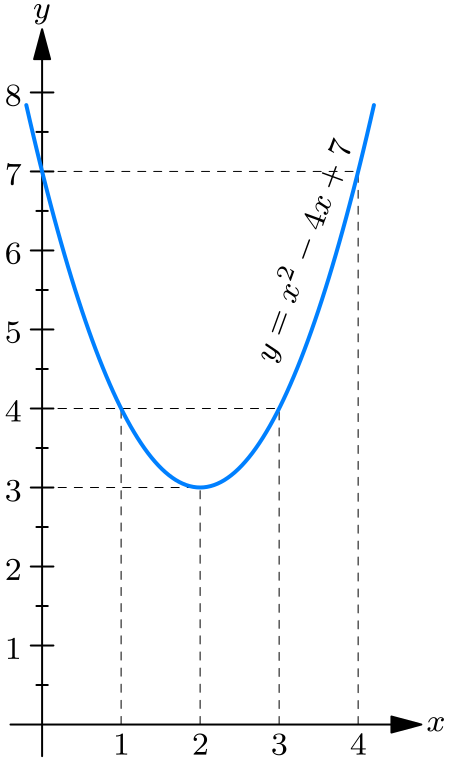
Consider the equation . By evaluating for different values of , we observe a curve with a minimum (see the following figure). While it appears that the minimum occurs at with a value of , there is uncertainty whether it precisely corresponds to or if it occurs at slightly different values like or . While it is possible with any algebraic expression to calculate numerous values and gradually approach the specific value that may be a maximum or a minimum, this process can be time-consuming.
Now, to begin with a concrete case, let us take the equation
By assigning a number of successive values to , and finding the corresponding values of , we can readily see that the equation represents a curve with a minimum.
These values are plotted in the following figure, which shows that has apparently a minimum value of , when is made equal to . But are you sure that the minimum occurs at , and not at or at ?
Of course it would be possible with any algebraic expression to work out a lot of values, and in this way arrive gradually at the particular value that may be a maximum or a minimum.
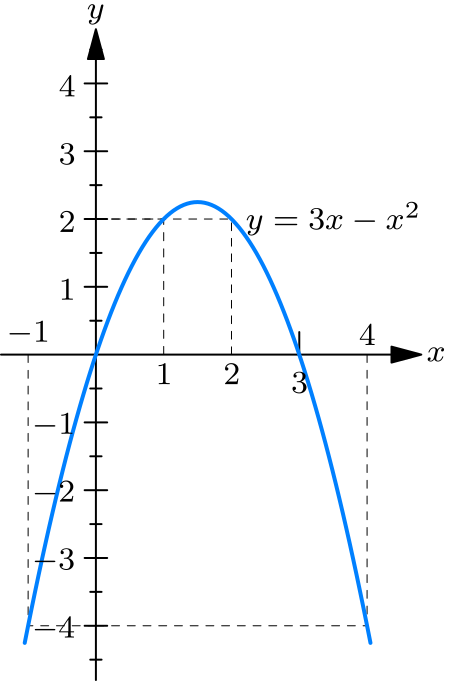
Similarly, for , the plotted graph (see the following figure) indicates a maximum between and , with an approximate value of . But how can we be sure that is the real maximum or that it occurs exactly when ?
Here is another example:
Let .
Calculate a few values thus:
| 0 |
Plot these values as in the following figure.
It will be evident that there will be a maximum somewhere between and ; and the thing looks as if the maximum value of ought to be about . Try some intermediate values. If , ; if , ; if , . How can we be sure that is the real maximum, or that it occurs exactly when ?
Differentiating an equation provides a method to directly determine maximum or minimum values without relying on extensive trials or guesses. By observing that the derivative equals zero at the maximum or minimum height of a curve, a valuable clue is obtained. To find the value of that corresponds to the minimum or maximum of an equation, differentiate the equation, set the derivative to zero, solve for , substitute this value back into the original equation, and obtain the desired value of . This process is commonly called “equating to zero."
Now it may sound like juggling to be assured that there is a way by which one can arrive straight at a maximum (or minimum) value without making a lot of preliminary trials or guesses. And that way depends on differentiating. Look back to the previous chapter for the remarks about Fig. 10.8 and Fig. 10.9, and you will see that whenever a curve gets either to its maximum or to its minimum height, at that point its . Now this gives us the clue to the dodge that is wanted. When there is put before you an equation, and you want to find that value of that will make its a minimum (or a maximum), first differentiate it, and having done so, write its as equal to zero, and then solve for . Put this particular value of into the original equation, and you will then get the required value of . This process is commonly called “equating to zero.”
Process of finding the maxima or minima of a function
(1) Differentiate with respect to (find ).
(2) Equate to zero, and then solve for .
(3) Putting the particular value of found in Step 2 into the original equation gives the value of that you are looking for.
To see how simply it works, take the example with which this chapter opens.
Example 11.1. Find the minimum value of if
Solution
Differentiating, we get: Now equate this to zero, thus: Solving this equation for , we get: \begin{align} 2x &= 4, \\ x &= 2. \end{align}
Now, we know that the maximum (or minimum) will occur exactly when .
Putting the value into the original equation, we get \begin{align} y &= 2^2 - (4\times2) + 7 \\ &= 4 - 8 + 7 \\ &= 3. \end{align}
Now look back at Fig. 11.1, and you will see that the minimum occurs when , and that this minimum of .
Try the second example (Fig. 11.2).
Example 11.2. Find the maximum value of if
Solution
Differentiating, Equating to zero, whence and putting this value of into the original equation, we find: \begin{align} y &= 4 \frac{1}{2} - \left(1 \frac{1}{2} \times 1 \frac{1}{2}\right), \\ y &= 2 \frac{1}{4}. \end{align} This gives us exactly the information as to which the method of trying a lot of values left us uncertain.
Now, before we go on to any further cases, we have two remarks to make.
1) Setting equal to zero does not mean that is always zero. Rather, we use the equation as a condition. By solving this equation, we can determine the specific value of that results in being zero.
When you are told to equate to zero, you feel at first (that is if you have any wits of your own) a kind of resentment, because you know that has all sorts of different values at different parts of the curve, according to whether it is sloping up or down. So, when you are suddenly told to write you resent it, and feel inclined to say that it can’t be true. Now you will have to understand the essential difference between “an equation,” and “an equation of condition.” Ordinarily you are dealing with equations that are true in themselves, but, on occasions, of which the present are examples, you have to write down equations that are not necessarily true, but are only true if certain conditions are to be fulfilled; and you write them down in order, by solving them, to find the conditions which make them true. Now we want to find the particular value that has when the curve is neither sloping up nor sloping down, that is, at the particular place where . So, writing does not mean that it always is ; but you write it down as a condition in order to see how much will come out if is to be zero.
2) One important observation is that equating a derivative to zero does not inherently indicate whether the resulting value of corresponds to a maximum or a minimum value of . However, this distinction can be determined using additional methods such as second differentiation or the first derivative test explained later in the chapter. For now, a practical approach is to try alternative values of close to the one found and compare the corresponding values of to determine if they are greater or smaller.
The second remark is one which (if you have any wits of your own) you will probably have already made: namely, that this much-belauded process of equating to zero entirely fails to tell you whether the that you thereby find is going to give you a maximum value of or a minimum value of . Quite so. It does not of itself discriminate; it finds for you the right value of but leaves you to find out for yourselves whether the corresponding is a maximum or a minimum. Of course, if you have plotted the curve, you know already which it will be.
For instance, take the equation:
Without stopping to think what curve it corresponds to, differentiate it, and equate to zero: whence and, inserting this value,
will be either a maximum or else a minimum. But which? You will hereafter be told a way, depending upon a second differentiation, (see here). At the end of this chapter, an alternative method will be presented, which explains how to distinguish between a maximum and a minimum based on the sign of the derivative (see here). But at present it is enough if you will simply try any other value of differing a little from the one found, and see whether with this altered value the corresponding value of is less or greater than that already found.
Suppose you are asked to divide a number into two parts such that their product is maximized. Without the knowledge of equating to zero, you could attempt different divisions and calculate the corresponding products. However, let’s apply the calculus approach. Let the number be denoted as , and if represents one part, the other part will be . The product can be expressed as . Differentiating and equating to zero, we find yielding Therefore, dividing the number into equal parts will result in the maximum product, which is .
Try another simple problem in maxima and minima. Suppose you were asked to divide any number into two parts, such that the product was a maximum? How would you set about it if you did not know the trick of equating to zero? I suppose you could worry it out by the rule of try, try, try again. Let be the number. You can try cutting it into two parts, and multiplying them together. Thus, times is ; times is ; times is ; times is ; times is . This looks like a maximum: try varying it. times is , which is not so good; and times is , which is worse. So it seems that the biggest product will be got by dividing into two equal halves.
Now see what the calculus tells you. Let the number to be cut into two parts be called . Then if is one part, the other will be , and the product will be or . So we write . Now differentiate and equate to zero; \begin{align} \dfrac{dy}{dx} = n - 2x = 0 \end{align} Solving for , we get \begin{align} \dfrac{n}{2} = x. \end{align} So now we know that whatever number may be, we must divide it into two equal parts if the product of the parts is to be a maximum; and the value of that maximum product will always be .
The above examples provides a very useful rule, and applies to any number of factors, so that if a constant number, is a maximum when .
Test Case
Let us at once apply our knowledge to a case that we can test.
Example 11.3. Let \begin{align} y &= x^2 - x; \end{align} and let us find whether this function has a maximum or minimum; and if so, test whether it is a maximum or a minimum.
Solution
Differentiating, we get Equating to zero, we get whence or
That is to say, when is made , the corresponding value of will be either a maximum or a minimum. Accordingly, putting in the original equation, we get \begin{align} y &= \left(\frac{1}{2}\right)^2 - \frac{1}{2}, \\ \end{align} or \begin{align} y &= -\frac{1}{4}. \end{align}
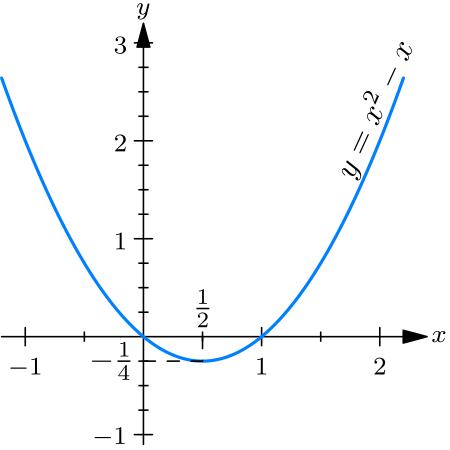
Is this a maximum or a minimum? To test it, try putting a little bigger than ,—say make . Then which is higher up than ; showing that is a minimum.
The curve is plotted below. As we can see, the minimum of is , which occurs when .
Further Examples
A most interesting example is afforded by a curve that has both a maximum and a minimum.
Example 11.4. Consider a curve whose equation is: Now
Equating to zero, we get the quadratic, and solving the quadratic gives us two roots, viz. \left\{\begin{align} x &= 3 \\ x &= 1. \end{align}\right.
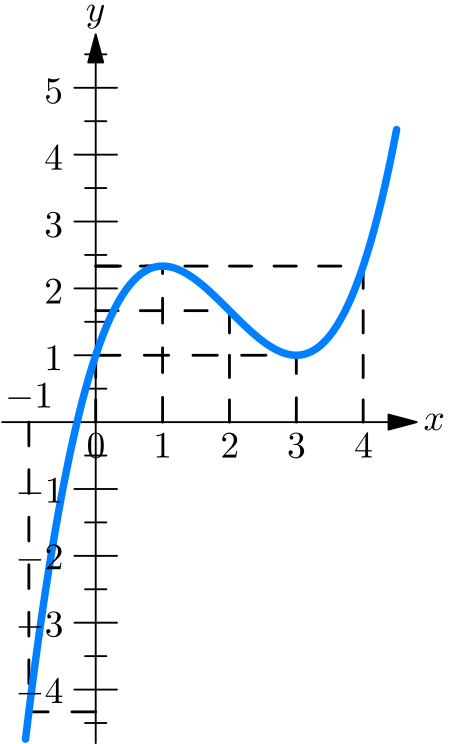
Now, when , ; and when , . The first of these is a minimum, the second a maximum.
The curve itself may be plotted (as in the following figure) from the values calculated, as below, from the original equation.
| 1 | 1 |
A further exercise in maxima and minima is afforded by the following example:
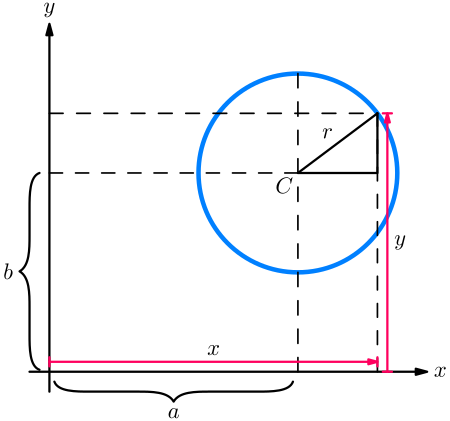
Example 11.5. The equation to a circle of radius (), having its centre at the point whose coordinates are , , as depicted in the following figure, is:
This may be transformed into
Now we know beforehand, by mere inspection of the figure, that when , will be either at its maximum value, , or else at its minimum value, . But let us not take advantage of this knowledge; let us set about finding what value of will make a maximum or a minimum, by the process of differentiating and equating to zero. \begin{align} \frac{dy}{dx} &=\pm \frac{1}{2} \frac{1}{\sqrt{r^2-(x-a)^2}} \times (2a-2x), \end{align} which reduces to \begin{align} \frac{dy}{dx} &=\pm \frac{a-x}{\sqrt{r^2-(x-a)^2}}. \end{align}
Then the condition for being maximum or minimum is:
Since no value whatever of will make the denominator infinite, the only condition to give zero is Inserting this value in the original equation for the circle, we find and as , we have two resulting values of , \begin{cases} y=b+r \\ y=b-r. \end{cases}
The first of these is the maximum, at the top; the second the minimum, at the bottom.
If the curve is such that there is no place that is a maximum or minimum, the process of equating to zero will yield an impossible result. For instance:
Example 11.6. Let
Then
Equating this to zero, we get , and
which is impossible.1 Therefore has no maximum nor minimum.
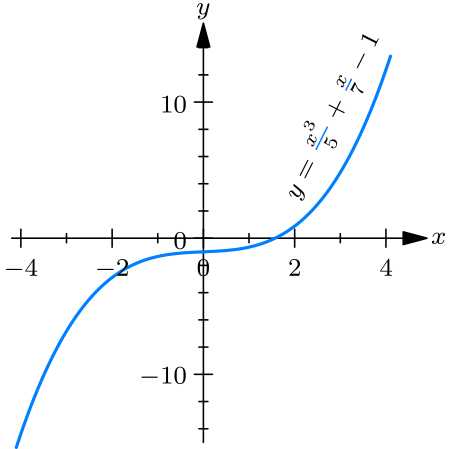
The following figure depicts the graph of with specific values for , , and . It is evident from the figure that does not possess any maximum or minimum points.
A few more worked examples will enable you to thoroughly master this most interesting and useful application of the calculus.
Example 11.7. What are the sides of the rectangle of maximum area inscribed in a circle of radius ?
Solution
If one side is called , and as the diagonal of the rectangle is necessarily a diameter, the other side (see the Figure below).
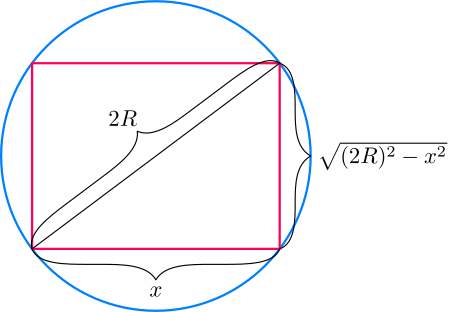
Then, area of rectangle , \frac{dS}{dx} = x \times \dfrac{d\left(\sqrt{4R^2 - x^2}\,\right)}{dx} + \sqrt{4R^2 - x^2} \times \dfrac{d(x)}{dx}.\tag{Use Product Rule}
If you have forgotten how to differentiate , here is a hint: write and , and seek and ; fight it out, and only if you can’t get on refer to the Chain Rule.
You will get \begin{align} \dfrac{dS}{dx} &= x \times \left( -\dfrac{x}{\sqrt{4R^2 - x^2}} \right)+ \sqrt{4R^2 - x^2}\\ &= \dfrac{4R^2 - 2x^2}{\sqrt{4R^2 - x^2}}. \end{align}
For maximum or minimum we must have that is, and .
The other side ; the two sides are equal; the figure is a square the side of which is equal to the diagonal of the square constructed on the radius. In this case it is, of course, a maximum with which we are dealing.
Example 11.8. What is the radius of the opening of a conical vessel the sloping side of which has a length when the capacity of the vessel is greatest?
[From geometry recall that the volume of a cone of radius and height is (see Appendix A)].
Solution
If be the radius and the corresponding height, (see the Figure below).
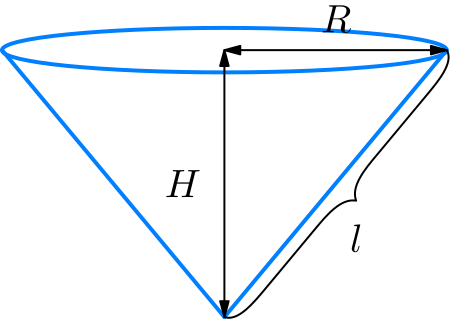
Proceeding as in the previous problem, we get \begin{align} \dfrac{dV}{dR} &= \pi R^2 \times \left(-\dfrac{R}{3\sqrt{l^2 - R^2}}\right) + \dfrac{2\pi R}{3} \sqrt{l^2 - R^2} \\ &= \dfrac{2\pi R(l^2 - R^2) - \pi R^3}{3\sqrt{l^2 - R^2}} = 0 \end{align} for maximum or minimum.
Or, , and , for a maximum, obviously.
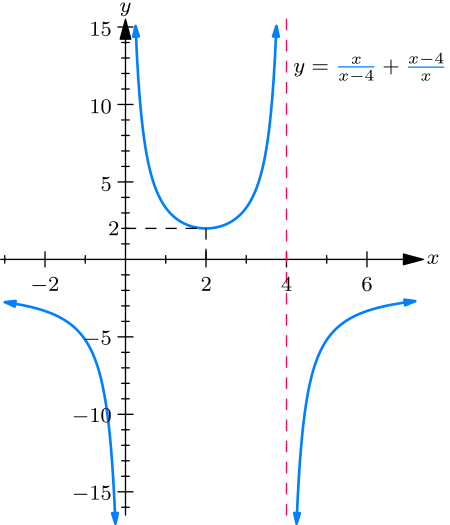
Example 11.9. Find the maxima and minima of the function
Solution
We get for maximum or minimum; or
There is only one value, hence only one maximum or minimum. \begin{align} \text{For}\quad x &= 2,\phantom{.5}\quad y = 2, \\ \text{for}\quad x &= 1.5,\quad y = 2.27, \\ \text{for}\quad x &= 2.5,\quad y = 2.27; \end{align} it is therefore a minimum.
The graph of is shown below.
Example 11.10. Find the maxima and minima of the function .
Solution
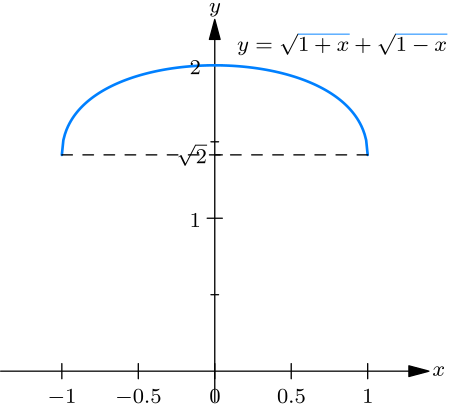
Differentiating gives at once (see this example) for maximum or minimum.
Hence and , the only solution
For ,.
For , , so this is a maximum.
The graph of is shown below.
Example 11.11. Find the maxima and minima of the function
Solution
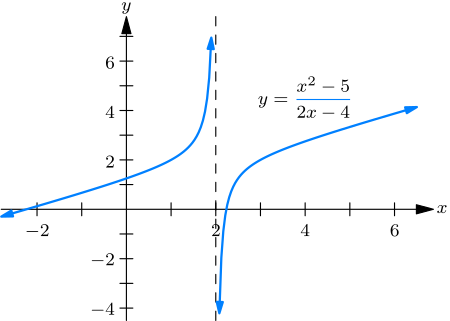
We have for maximum or minimum; or or ; which has for solutions
These being imaginary, there is no real value of for which ; hence there is neither maximum nor minimum.
The following figure shows the graph of .
Example 11.12. Find the maxima and minima of the function
Solution
This may be written . that is, , which is satisfied for , and for , that is for . So there are two solutions.
Taking first . If , , and if , . On one side is imaginary; that is, there is no value of that can be represented by a graph; the latter is therefore entirely on the right side of the axis of (see the following figure).
On plotting the graph it will be found that the curve goes to the origin, as if there were a minimum there; but instead of continuing beyond, as it should do for a minimum, it retraces its steps (forming what is called a “cusp”). There is no minimum, therefore, although the condition for a minimum is satisfied, namely . It is necessary therefore always to check by taking one value on either side.
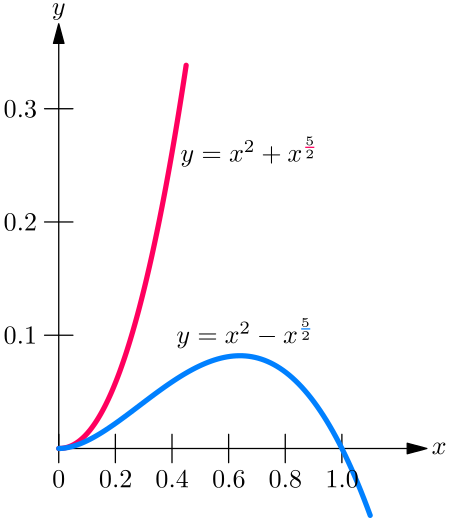
Now, if we take . If , and ; if , becomes and ; and if , becomes and .
This shows that there are two branches of the curve; the upper one does not pass through a maximum, but the lower one does.
Make other examples for yourself. There are few subjects which offer such a wealth for interesting examples.
Exercises
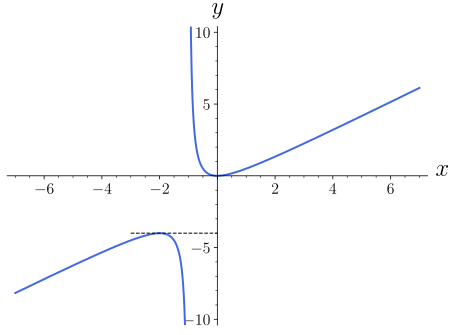
Exercise 11.1. What values of will make a maximum and a minimum, if ?
Answer
Min.: , ; max.: , .
Solution
\begin{align} \frac{dy}{dx}&=\frac{\dfrac{d(x^2)}{dx}(x+1)-x^2\dfrac{d(x+1)}{dx}}{(x+1)^2}\\ &=\frac{2x(x+1)-x^2(1)}{(x+1)^2}\\ &=\frac{x^2+2x}{(x+1)^2}\\ &=\frac{x(x+2)}{(x+1)^2} \end{align}
When , .
When , .
When , .
Therefore is a minimum occurring when .
When , .
When , .
When , .
Therefore, is a maximum occurring when .
The graph of is shown below.
Exercise 11.2. What value of will make a maximum in the equation ?
Answer
.
Solution
Then \begin{align} \frac{d y}{d x}&=\frac{a^{2}+x^{2}-2 x \cdot x}{a^{2}+x^{2}}\\ &=\frac{a^{2}-x^{2}}{a^{2}+x^{2}} \end{align}
To see which value of makes a maximum and which value of makes a minimum, it would be the best if we use the first derivative test:
If , then and hence If , then and hence
It follows from the First Derivative Test that correspondent to a maximum .
Similarly, if , then and hence If , then and hence . Therefore makes a minimum of .
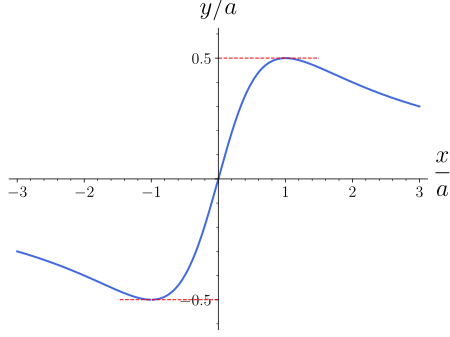
We can rewrite the given equation as or
Now we can easily plot versus (see the following figure). As we can see, the graph reaches a maximum at and a minimum at . The maximum value of is and the minimum value of is .
Exercise 11.3. A line of length is to be cut up into parts and put together as a rectangle. Show that the area of the rectangle will be a maximum if each of its sides is equal to .
Solution
Let:
length of rectangle
width of rectangle
We want to maximize the area while
We can express in terms of alone
\begin{align} & 2 x+2 y=p \Rightarrow y=\frac{p}{2}-x \\ & A=x y=x\left(\frac{p}{2}-x\right)=\frac{p}{2} x-x^{2} \end{align}
To find the maximum of
when .
Hence the area of the rectangle will be a maximum if the length of each side is .
Exercise 11.4. A piece of string inches long has its two ends joined together and is stretched by pegs so as to form a triangle. What is the largest triangular area that can be enclosed by the string?
[Hint: Use apply the rule you learned here for dividing a number into three parts such that the product is a maximum]
Answer
square inches.
Solution
Let be the lengths of the sides. of a triangle. The area is given by
Where is half the perimeter or . In this problem
is a maximum if or
\begin{align} & a+b+c=3 a=30 \\ \Rightarrow & a=b=c=10 . \end{align}
The maximum area is thus
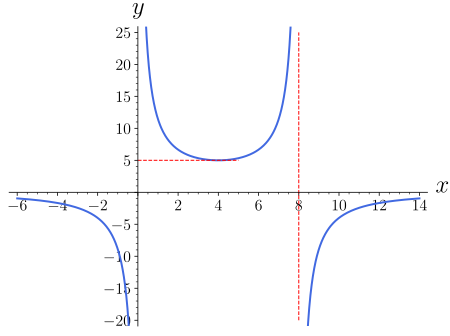
Exercise 11.5. Plot the curve corresponding to the equation also find , and deduce the value of that will make a minimum; and find that minimum value of .
Answer
; ; .
Solution
\begin{align} \frac{d y}{d x} & =-10 x^{-2}+10(8-x)^{-2}=\frac{10}{(8-x)^{2}}-\frac{10}{x^{2}} \\ & =\frac{10 x^{2}-10(8-x)^{2}}{x^{2}(8-x)^{2}} \\ & =\frac{10 x^{2}-10\left(64-16 x+x^{2}\right)}{x^{2}(8-x)^{2}} \\ & =\frac{160 x-640}{x^{2}(8-x)^{2}}=\frac{160(x-4)}{x^{2}\left(8-x^{2}\right)} \\ \frac{d y}{dx} & =0 \Leftrightarrow x=4 \end{align}
From the graph, it is clear that makes a minimum
When .
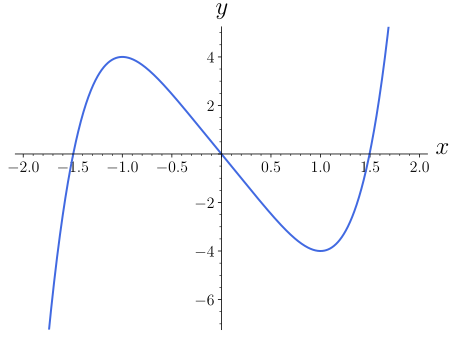
Exercise 11.6. If , find what values of will make a maximum or a minimum.
Answer
Max. for ; min. for .
Solution
when
when
when
when
when
Hence is a maximum occurring when and is minimum occurring when .
The graph of is shown below.
Exercise 11.7. What is the smallest square that can be inscribed in a given square?
Answer
Join the middle points of the four sides.
Solution
Let the length of a side of the given square be
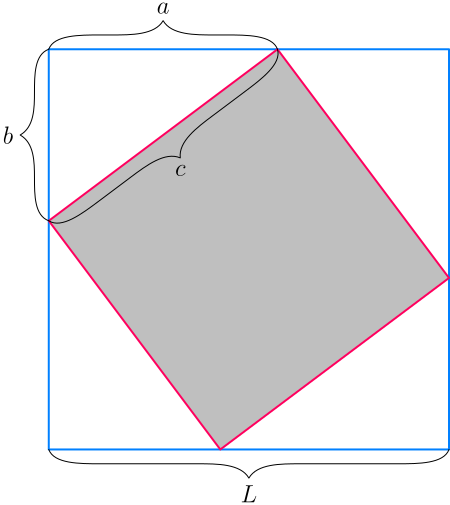
The area of the inscribed square is but . Therefore
Since , we have
To minimize ,
\begin{align} \frac{d A}{d a} & =2 a+2(-1)(L-a) \\ & =2 a+2(a-L)=4 a-2 L \\ \end{align}
The area of the inscribed square is minimum if or if we join the middle points of the four sides.
Exercise 11.8. Inscribe in a given cone, the height of which is equal to the radius of the base, a cylinder (a) whose volume is a maximum; (b) whose lateral area is a maximum; (c) whose total area is a maximum.
Answer
, , no max.
Solution
Let
radius of the base and height of the cone
radius of the cylinder
height of the cylinder
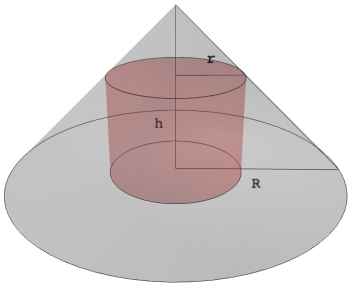
(a)
\begin{align} V & =\pi r^{2} \cdot h=\pi r^{2}(R-r) \\ & =\pi R r^{2}-\pi r^{3} \\ \frac{d V}{d r} & =2 \pi R r-3 \pi r^{2}=\pi r(2 R-3 r)=0 \\ & \Leftrightarrow r=\frac{2}{3} R \text { or } r=0 \end{align}
The volume is a maximum if
(b) Lateral area
\begin{align} & A=2 \pi r(R-r)=2 \pi R r-2 \pi r^{2} \\ & \frac{d A}{d r}=2 \pi R-4 \pi r=0 \Leftrightarrow r=\frac{R}{2} \end{align}
The maximum lateral area is obtained if .
(c) Total area
\begin{align} S&=2 \pi r h+2 \pi r^{2}\\ & =2 \pi r(R-r)+2 \pi r^{2} \\ & =2 \pi r R \end{align}
The graph of versus is a straight line with slope , where varies between .
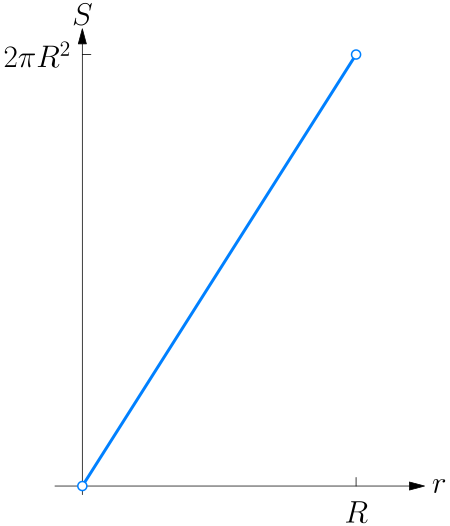
From the above figure, it is clear that the total area, , has no maximum.
Exercise 11.9. Inscribe in a sphere, a cylinder () whose volume is a maximum; () whose lateral area is a maximum; () whose total area is a maximum.
Answer
, , .
Solution
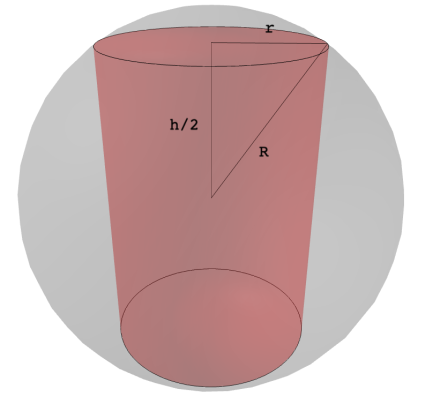
From geometry (see the above figure)
or
(a) or \begin{align} \frac{d V}{d r}& =4 \pi r \sqrt{R^{2}-r^{2}}-\frac{2 \pi r^{3}}{\sqrt{R^{2}-r^{2}}}\\ & =\frac{4 \pi r\left(R^{2}-r^{2}\right)-2 \pi r^{3}}{\sqrt{R^{2}-r^{2}}} \\ & =\frac{2 \pi r\left[2 R^{2}-3 r^{2}\right]}{\sqrt{R^{2}-r^{2}}} & \end{align} Hence,
is a maximum when
(b) Lateral area or
\begin{align} \frac{d A}{d r} & =4 \pi \sqrt{R^{2}-r^{2}}+4 \pi r \frac{-2 r}{2 \sqrt{R^{2}-r^{2}}} \\ & =4 \pi\left[\sqrt{R^{2}-r^{2}}-\frac{r^{2}}{\sqrt{R^{2}-r^{2}}}\right] \\ & =4 \pi\left[\frac{R^{2}-r^{2}-r^{2}}{\sqrt{R^{2}-r^{2}}}\right] \end{align} Hence,
is a maximum for .
(c) Total area
\begin{align} S & =2 \pi r h+2 \pi r^{2} \\ & =4 \pi r \sqrt{R^{2}-r^{2}}+2 \pi r^{2} \end{align}
\begin{align} \frac{d S}{d r}& =\frac{d A}{d r}+4 \pi r \\ &=4 \pi \frac{R^{2}-2 r^{2}}{\sqrt{R^{2}-r^{2}}}+4 \pi r \\ &=4 \pi\left[\frac{R^{2}-2 r^{2}}{\sqrt{R^{2}-r^{2}}}+r\right] \\ &= 4 \pi\left[\frac{R^{2}-2 r^{2}+r \sqrt{R^{2}-r^{2}}}{\sqrt{R^{2}-r^{2}}}\right] \end{align} \begin{align} \frac{d s}{d r}=0\quad \Leftrightarrow\quad &R^{2}-2 r^{2}+r \sqrt{R^{2}-r^{2}}=0 \\ & r \sqrt{R^{2}-r^{2}}=2 r^{2}-R^{2} \\ & r^{2}\left(R^{2}-r^{2}\right)=\left(2 r^{2}-R^{2}\right)^{2} \\ & r^{2} R^{2}-r^{4}=4 r^{4}-4 R^{2} r^{2}+R^{4} \end{align} or This is a quadratic equation is terms of
Now let’s check if both values of satisfy the onginal equation
It turns out that only satisfy this equation.
Therefore, the total area is a maximum for
Exercise 11.10. Inscribe in a given sphere a cone whose volume is a maximum.
Answer
where is the radius of the sphere. The maximum volume is .
Solution
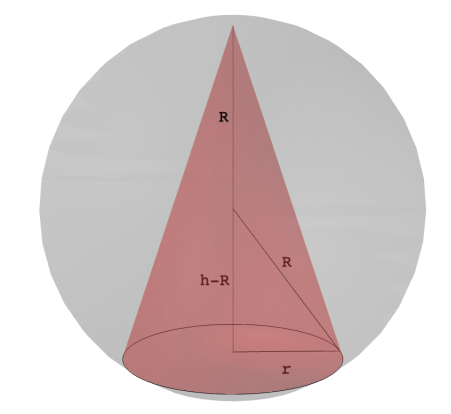
\begin{align} & r^{2}+(h-R)^{2}=R^{2} \\ & h-R=\sqrt{R^{2}-r^{2}} \\ & h=R+\sqrt{R^{2}-r^{2}} \end{align}
\begin{align} V & =\frac{1}{3} \pi r^{2} h=\frac{2}{3} \pi r^{2}\left(\sqrt{R^{2}-r^{2}}+R\right) \\ \frac{d V}{d r} & =\frac{2 \pi}{3}\left[2 r\left(\sqrt{R^{2}-r^{2}}+R\right)-r \frac{r}{\sqrt{R^{2}-r^{2}}}\right] \\ & =\frac{2 \pi r}{3}\left[2 \sqrt{R^{2}-r^{2}}+2 R-\frac{r^{2}}{\sqrt{R^{2}-r^{2}}}\right] \\ & =\frac{2 \pi r}{3 \sqrt{R^{2}-r^{2}}}\left[2\left(R^{2}-r^{2}\right)+2 R \sqrt{R^{2}-r^{2}}-r^{2}\right] \end{align}
\begin{align} \frac{d v}{d r}=0 \Rightarrow & r=0 \text { or } 2 R^{2}-3 r^{2}+2 R \sqrt{R^{2}-r^{2}}=0 \\ & 2 R \sqrt{R^{2}-r^{2}}=3 r^{2}-2 R^{2} \\ & 4 R\left(R^{2}-r^{2}\right)=9 r^{4}-12 R^{2} r^{2}+4 R^{2} \\ & 9 r^{4}-8 R^{2} r^{2}=0 \\ & r^{2}\left[9 r^{2}-8 R^{2}\right]=0 \\ & r= \pm \sqrt{\frac{8}{9} R^{2}}= \pm \frac{\sqrt{8}}{3} R \end{align}
Therefore
and are not acceptable
makes a maximum
Exercise 11.11. The current given by a battery of similar voltaic cells is , where , , , are constants and is the number of cells coupled in series. Find the proportion of to for which the current is greatest.
Answer
.
Solution
\begin{align} & C=\frac{E n}{R+\frac{r}{N} n^{2}} \\ & \frac{d C}{d n}=\frac{E\left(R+\frac{r}{N} n^{2}\right)-E n\left(\frac{2 r}{N}\right) n}{\left(R+\frac{r}{N} n^{2}\right)} \end{align}
Quotient Rule To maximize the current, let
or
or
is a maximum if .
More About Maxima and Minima
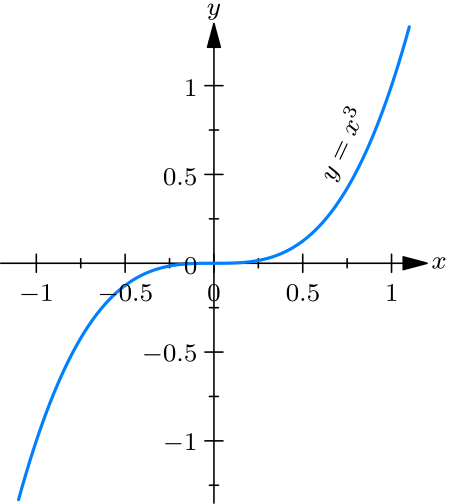
We saw that wherever a “smooth” curve gets either to its maximum or its minimum height, is zero. However, the converse is not true. That is, if the derivative at a point is zero, the curve does not necessarily gets to its maximum or minimum height. For example, consider . Then is zero for , but has no maximum or minimum when (the following figure).
Now consider the function y=|x|=\left\{\begin{align} &x, && \text{if }x\geq 0\\ &-x, &&\text{if }x<0 \end{align}\right. The graph of this function is shown below.
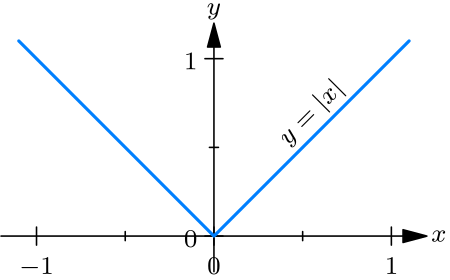
It is clear that this “curve” has a minimum at the origin; however, at the origin does not exist because just a little bit to the right of the origin and just a little but to the left of the origin .
Hence, in a more general case, we can say that if a curve has a maximum or minimum then at that point either is zero or does not exist. If at some points does not exist, we must also examine those points for being a maximum or a minimum.
The First Derivative Test
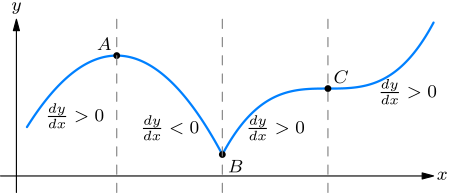
In the previous chapter, we learned that if , the curve is ascending and if , the curve is descending. Now notice that if the curve stops ascending and begins to descend at a point, then has a maximum at that point (for example, point in the following figure). Conversely, if the curve changes from descending to ascending, then has a minimum (for example, point in the following figure). However, if the sign of is the same on both sides of a point, the curve will continue to ascend or descend, and hence cannot have a maximum or minimum at that point (for example, point in the following figure).
Therefore,
The First Derivative Test
If immediately at the left of a point and immediately at its right, then at this point is a maximum.
If immediately at the left of a point and immediately at its right, then at this point is a minimum.
If the sign of the derivative is the same on both sides of a point, then at that point is neither a maximum nor a minimum.
This is called the First Derivative Test. It provides us with a method to figure out whether the value of we find by equating to zero gives a maximum or a minimum. In the next chapter, we will learn how to use the second derivative to distinguish between a maximum and a minimum.
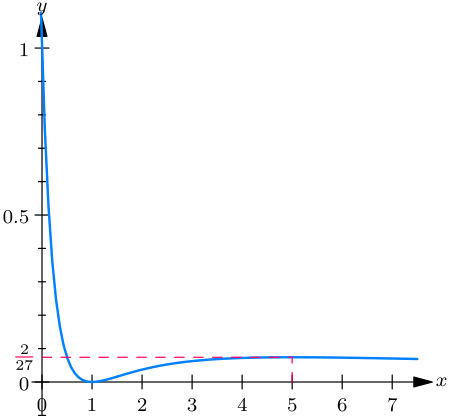
Example 11.13. Find the maxima and minima of the function
Solution
First, we find the derivative of \frac{dy}{dx}=\frac{2(x-1)(x+1)^3-3(x+1)^2(x-1)^2}{(x+1)^6}\tag{Quotient Rule} or \begin{align} \frac{dy}{dx}&=\frac{2(x-1)(x+1)-3(x-1)^2}{(x+1)^4}\\ &=\frac{(x-1)[2(x+1)-3(x-1)]}{(x+1)^4}\\ &=\frac{(x-1)(5-x)}{(x+1)^4} \end{align} Therefore, for and , we have .
To determine whether each of these values of gives a maximum or minimum, we can apply the First Derivative Test. Considering the sign of the derivative for values of that are slightly less than and slightly larger than , we have:
\left.\begin{align} \text{When }x<1, \ \dfrac{dy}{dx}=\frac{(-)(+)}{(+)}=(-)\\ \text{When }x>1, \ \dfrac{dy}{dx}=\frac{(+)(+)}{(+)}=(+) \end{align}\right\} Hence corresponds to a minimum .
Similarly, considering the sign of the derivative for the values of that are slightly less than and slightly greater than , we get: \left.\begin{align} \text{When }x<5, \ \dfrac{dy}{dx}=\frac{(+)(+)}{(+)}=(+)\\ \text{When }x>5, \ \dfrac{dy}{dx}=\frac{(+)(-)}{(+)}=(-) \end{align}\right\} Hence corresponds to a maximum .
This curve is plotted below.
Full Chapter
One of the principal uses of the process of differentiating is to find out under what conditions the value of the thing differentiated becomes a maximum, or a minimum. This is often exceedingly important in engineering questions, where it is most desirable to know what conditions will make the cost of working a minimum, or will make the efficiency a maximum.
Now, to begin with a concrete case, let us take the equation
By assigning a number of successive values to , and finding the corresponding values of , we can readily see that the equation represents a curve with a minimum.
| 0 | 1 | 2 | 3 | 4 | 5 | |
|---|---|---|---|---|---|---|
| 7 | 4 | 3 | 4 | 7 | 12 |
These values are plotted in the following figure, which shows that has apparently a minimum value of , when is made equal to . But are you sure that the minimum occurs at , and not at or at ?
Of course it would be possible with any algebraic expression to work out a lot of values, and in this way arrive gradually at the particular value that may be a maximum or a minimum.
Here is another example:
Let .
Calculate a few values thus:
| 5 | |||||||
|---|---|---|---|---|---|---|---|
| 0 |
Plot these values as in the following figure.
It will be evident that there will be a maximum somewhere between and ; and the thing looks as if the maximum value of ought to be about . Try some intermediate values. If , ; if , ; if , . How can we be sure that is the real maximum, or that it occurs exactly when ?
Now it may sound like juggling to be assured that there is a way by which one can arrive straight at a maximum (or minimum) value without making a lot of preliminary trials or guesses. And that way depends on differentiating. Look back to the previous chapter for the remarks about Fig. 10.8 and Fig. 10.9, and you will see that whenever a curve gets either to its maximum or to its minimum height, at that point its . Now this gives us the clue to the dodge that is wanted. When there is put before you an equation, and you want to find that value of that will make its a minimum (or a maximum), first differentiate it, and having done so, write its as equal to zero, and then solve for . Put this particular value of into the original equation, and you will then get the required value of . This process is commonly called “equating to zero.”
Process of finding the maxima or minima of a function
Differentiate with respect to (find ).
Equate to zero, and then solve for .
Putting the particular value of found in Step 2 into the original equation gives the value of that you are looking for.
To see how simply it works, take the example with which this chapter opens.
Example 11.1. Find the minimum value of if
Solution. Differentiating, we get: Now equate this to zero, thus: Solving this equation for , we get: \begin{align} 2x &= 4, \\ x &= 2. \end{align}
Now, we know that the maximum (or minimum) will occur exactly when .
Putting the value into the original equation, we get \begin{align} y &= 2^2 - (4\times2) + 7 \\ &= 4 - 8 + 7 \\ &= 3. \end{align}
Now look back at Fig. 11.1, and you will see that the minimum occurs when , and that this minimum of .
Try the second example (Fig. 11.2).
Example 11.2. Find the maximum value of if
Solution. Differentiating, Equating to zero, whence and putting this value of into the original equation, we find: \begin{align} y &= 4 \frac{1}{2} - \left(1 \frac{1}{2} \times 1 \frac{1}{2}\right), \\ y &= 2 \frac{1}{4}. \end{align} This gives us exactly the information as to which the method of trying a lot of values left us uncertain.
Now, before we go on to any further cases, we have two remarks to make. When you are told to equate to zero, you feel at first (that is if you have any wits of your own) a kind of resentment, because you know that has all sorts of different values at different parts of the curve, according to whether it is sloping up or down. So, when you are suddenly told to write you resent it, and feel inclined to say that it can’t be true. Now you will have to understand the essential difference between “an equation,” and “an equation of condition.” Ordinarily you are dealing with equations that are true in themselves, but, on occasions, of which the present are examples, you have to write down equations that are not necessarily true, but are only true if certain conditions are to be fulfilled; and you write them down in order, by solving them, to find the conditions which make them true. Now we want to find the particular value that has when the curve is neither sloping up nor sloping down, that is, at the particular place where . So, writing does not mean that it always is ; but you write it down as a condition in order to see how much will come out if is to be zero.
The second remark is one which (if you have any wits of your own) you will probably have already made: namely, that this much-belauded process of equating to zero entirely fails to tell you whether the that you thereby find is going to give you a maximum value of or a minimum value of . Quite so. It does not of itself discriminate; it finds for you the right value of but leaves you to find out for yourselves whether the corresponding is a maximum or a minimum. Of course, if you have plotted the curve, you know already which it will be.
For instance, take the equation:
Without stopping to think what curve it corresponds to, differentiate it, and equate to zero: whence and, inserting this value,
will be either a maximum or else a minimum. But which? You will hereafter be told a way, depending upon a second differentiation (see Chapter [Ch:Curvature]). At the end of this chapter, an alternative method will be presented, which explains how to distinguish between a maximum and a minimum based on the sign of the derivative. But at present it is enough if you will simply try any other value of differing a little from the one found, and see whether with this altered value the corresponding value of is less or greater than that already found.
Try another simple problem in maxima and minima. Suppose you were asked to divide any number into two parts, such that the product was a maximum? How would you set about it if you did not know the trick of equating to zero? I suppose you could worry it out by the rule of try, try, try again. Let be the number. You can try cutting it into two parts, and multiplying them together. Thus, times is ; times is ; times is ; times is ; times is . This looks like a maximum: try varying it. times is , which is not so good; and times is , which is worse. So it seems that the biggest product will be got by dividing into two equal halves.
Now see what the calculus tells you. Let the number to be cut into two parts be called . Then if is one part, the other will be , and the product will be or . So we write . Now differentiate and equate to zero; \begin{align} \dfrac{dy}{dx} = n - 2x = 0 \end{align} Solving for , we get \begin{align} \dfrac{n}{2} = x. \end{align} So now we know that whatever number may be, we must divide it into two equal parts if the product of the parts is to be a maximum; and the value of that maximum product will always be .
This is a very useful rule, and applies to any number of factors, so that if a constant number, is a maximum when .
Test Case
Let us at once apply our knowledge to a case that we can test.
Example 11.3. Let \begin{align} y &= x^2 - x; \end{align} and let us find whether this function has a maximum or minimum; and if so, test whether it is a maximum or a minimum.
Solution. Differentiating, we get Equating to zero, we get whence or
That is to say, when is made , the corresponding value of will be either a maximum or a minimum. Accordingly, putting in the original equation, we get \begin{align} y &= \left(\frac{1}{2}\right)^2 - \frac{1}{2}, \\ \end{align} or \begin{align} y &= -\frac{1}{4}. \end{align}
Is this a maximum or a minimum? To test it, try putting a little bigger than ,—say make . Then which is higher up than ; showing that is a minimum.
The curve is plotted below. As we can see, the minimum of is , which occurs when .
Further Examples
A most interesting example is afforded by a curve that has both a maximum and a minimum.
Example 11.4. Consider a curve whose equation is: Now
Equating to zero, we get the quadratic, and solving the quadratic gives us two roots, viz. \left\{\begin{align} x &= 3 \\ x &= 1. \end{align}\right.
Now, when , ; and when , . The first of these is a minimum, the second a maximum.
The curve itself may be plotted (as in the following figure) from the values calculated, as below, from the original equation.
| 1 |
A further exercise in maxima and minima is afforded by the following example:
Example 11.5. The equation to a circle of radius (), having its centre at the point whose coordinates are , , as depicted below, is:
This may be transformed into
Now we know beforehand, by mere inspection of the figure, that when , will be either at its maximum value, , or else at its minimum value, . But let us not take advantage of this knowledge; let us set about finding what value of will make a maximum or a minimum, by the process of differentiating and equating to zero. \begin{align} \frac{dy}{dx} &=\pm \frac{1}{2} \frac{1}{\sqrt{r^2-(x-a)^2}} \times (2a-2x), \end{align} which reduces to \begin{align} \frac{dy}{dx} &=\pm \frac{a-x}{\sqrt{r^2-(x-a)^2}}. \end{align}
Then the condition for being maximum or minimum is:
Since no value whatever of will make the denominator infinite, the only condition to give zero is Inserting this value in the original equation for the circle, we find and as , we have two resulting values of , \begin{cases} y=b+r \\ y=b-r. \end{cases}
The first of these is the maximum, at the top; the second the minimum, at the bottom.
If the curve is such that there is no place that is a maximum or minimum, the process of equating to zero will yield an impossible result. For instance:
Example 11.6. Let
Then
Equating this to zero, we get , and
which is impossible.1 Therefore has no maximum nor minimum.
The following figure depicts the graph of with specific values for , , and . It is evident from the figure that the function does not possess any maximum or minimum points.
A few more worked examples will enable you to thoroughly master this most interesting and useful application of the calculus.
Example 11.7. What are the sides of the rectangle of maximum area inscribed in a circle of radius ?
Solution. If one side is called , and as the diagonal of the rectangle is necessarily a diameter, the other side (see the following figure).
Then, area of rectangle , \frac{dS}{dx} = x \times \dfrac{d\left(\sqrt{4R^2 - x^2}\,\right)}{dx} + \sqrt{4R^2 - x^2} \times \dfrac{d(x)}{dx}.\tag{Use Product Rule}
If you have forgotten how to differentiate , here is a hint: write and , and seek and ; fight it out, and only if you can’t get on refer to the Chain Rule on page .
You will get \begin{align} \dfrac{dS}{dx} &= x \times \left( -\dfrac{x}{\sqrt{4R^2 - x^2}} \right)+ \sqrt{4R^2 - x^2}\\ &= \dfrac{4R^2 - 2x^2}{\sqrt{4R^2 - x^2}}. \end{align}
For maximum or minimum we must have that is, and .
The other side ; the two sides are equal; the figure is a square the side of which is equal to the diagonal of the square constructed on the radius. In this case it is, of course, a maximum with which we are dealing.
Example 11.8. What is the radius of the opening of a conical vessel the sloping side of which has a length when the capacity of the vessel is greatest?
.
Solution. If be the radius and the corresponding height, (see the following figure).
Proceeding as in the previous problem, we get \begin{align} \dfrac{dV}{dR} &= \pi R^2 \times \left(-\dfrac{R}{3\sqrt{l^2 - R^2}}\right) + \dfrac{2\pi R}{3} \sqrt{l^2 - R^2} \\ &= \dfrac{2\pi R(l^2 - R^2) - \pi R^3}{3\sqrt{l^2 - R^2}} = 0 \end{align} for maximum or minimum.
Or, , and , for a maximum, obviously.
Example 11.9. Find the maxima and minima of the function Solution. We get for maximum or minimum; or
There is only one value, hence only one maximum or minimum. \begin{align} \text{For}\quad x &= 2,\phantom{.5}\quad y = 2, \\ \text{for}\quad x &= 1.5,\quad y = 2.27, \\ \text{for}\quad x &= 2.5,\quad y = 2.27; \end{align} it is therefore a minimum.
The graph of is shown below.
Example 11.10. Find the maxima and minima of the function .
Solution. Differentiating gives at once (see example 9.1) for maximum or minimum.
Hence and , the only solution
For ,.
For , , so this is a maximum.
The graph of is shown below.
Example 11.11. Find the maxima and minima of the function
Solution. We have for maximum or minimum; or or ; which has for solutions
These being imaginary, there is no real value of for which ; hence there is neither maximum nor minimum.
The following figure shows the graph of .
Example 11.12. Find the maxima and minima of the function
Solution. This may be written . that is, , which is satisfied for , and for , that is for . So there are two solutions.
Taking first . If , , and if , . On one side is imaginary; that is, there is no value of that can be represented by a graph; the latter is therefore entirely on the right side of the axis of (see the following figure).
On plotting the graph it will be found that the curve goes to the origin, as if there were a minimum there; but instead of continuing beyond, as it should do for a minimum, it retraces its steps (forming what is called a “cusp”). There is no minimum, therefore, although the condition for a minimum is satisfied, namely . It is necessary therefore always to check by taking one value on either side.
Now, if we take . If , and ; if , becomes and ; and if , becomes and .
This shows that there are two branches of the curve; the upper one does not pass through a maximum, but the lower one does.
Make other examples for yourself. There are few subjects which offer such a wealth for interesting examples.
Exercises
Exercise 11.1. What values of will make a maximum and a minimum, if ?
Answer
Min.: , ; max.: , .
Solution
\begin{align} \frac{dy}{dx}&=\frac{\dfrac{d(x^2)}{dx}(x+1)-x^2\dfrac{d(x+1)}{dx}}{(x+1)^2}\\ &=\frac{2x(x+1)-x^2(1)}{(x+1)^2}\\ &=\frac{x^2+2x}{(x+1)^2}\\ &=\frac{x(x+2)}{(x+1)^2} \end{align}
When , .
When , .
When , .
Therefore is a minimum occurring when .
When , .
When , .
When , .
Therefore, is a maximum occurring when .
The graph of is shown below.
Exercise 11.2. What value of will make a maximum in the equation ?
Answer
.
Solution
Then \begin{align} \frac{d y}{d x}&=\frac{a^{2}+x^{2}-2 x \cdot x}{a^{2}+x^{2}}\\ &=\frac{a^{2}-x^{2}}{a^{2}+x^{2}} \end{align}
To see which value of makes a maximum and which value of makes a minimum, it would be the best if we use the first derivative test:
If , then and hence If , then and hence
It follows from the First Derivative Test that correspondent to a maximum .
Similarly, if , then and hence If , then and hence . Therefore makes a minimum of .
We can rewrite the given equation as or
Now we can easily plot versus (see the following figure). As we can see, the graph reaches a maximum at and a minimum at . The maximum value of is and the minimum value of is .
Exercise 11.3. A line of length is to be cut up into parts and put together as a rectangle. Show that the area of the rectangle will be a maximum if each of its sides is equal to .
Solution
Let:
length of rectangle
width of rectangle
We want to maximize the area while
We can express in terms of alone
\begin{align} & 2 x+2 y=p \Rightarrow y=\frac{p}{2}-x \\ & A=x y=x\left(\frac{p}{2}-x\right)=\frac{p}{2} x-x^{2} \end{align}
To find the maximum of
when .
Hence the area of the rectangle will be a maximum if the length of each side is .
Exercise 11.4. A piece of string inches long has its two ends joined together and is stretched by pegs so as to form a triangle. What is the largest triangular area that can be enclosed by the string?
[Hint: Use apply the rule you learned here for dividing a number into three parts such that the product is a maximum]
Answer
square inches.
Solution
Let be the lengths of the sides. of a triangle. The area is given by
Where is half the perimeter or . In this problem
is a maximum if or
\begin{align} & a+b+c=3 a=30 \\ \Rightarrow & a=b=c=10 . \end{align}
The maximum area is thus
Exercise 11.5. Plot the curve corresponding to the equation also find , and deduce the value of that will make a minimum; and find that minimum value of .
Answer
; ; .
Solution
\begin{align} \frac{d y}{d x} & =-10 x^{-2}+10(8-x)^{-2}=\frac{10}{(8-x)^{2}}-\frac{10}{x^{2}} \\ & =\frac{10 x^{2}-10(8-x)^{2}}{x^{2}(8-x)^{2}} \\ & =\frac{10 x^{2}-10\left(64-16 x+x^{2}\right)}{x^{2}(8-x)^{2}} \\ & =\frac{160 x-640}{x^{2}(8-x)^{2}}=\frac{160(x-4)}{x^{2}\left(8-x^{2}\right)} \\ \frac{d y}{dx} & =0 \Leftrightarrow x=4 \end{align}
From the graph, it is clear that makes a minimum
When .
Exercise 11.6. If , find what values of will make a maximum or a minimum.
Answer
Max. for ; min. for .
Solution
when
when
when
when
when
Hence is a maximum occurring when and is minimum occurring when .
The graph of is shown below.
Exercise 11.7. What is the smallest square that can be inscribed in a given square?
Answer
Join the middle points of the four sides.
Solution
Let the length of a side of the given square be
The area of the inscribed square is but . Therefore
Since , we have
To minimize ,
\begin{align} \frac{d A}{d a} & =2 a+2(-1)(L-a) \\ & =2 a+2(a-L)=4 a-2 L \\ \end{align}
The area of the inscribed square is minimum if or if we join the middle points of the four sides.
Exercise 11.8. Inscribe in a given cone, the height of which is equal to the radius of the base, a cylinder (a) whose volume is a maximum; (b) whose lateral area is a maximum; (c) whose total area is a maximum.
Answer
, , no max.
Solution
Let
radius of the base and height of the cone
radius of the cylinder
height of the cylinder
(a)
\begin{align} V & =\pi r^{2} \cdot h=\pi r^{2}(R-r) \\ & =\pi R r^{2}-\pi r^{3} \\ \frac{d V}{d r} & =2 \pi R r-3 \pi r^{2}=\pi r(2 R-3 r)=0 \\ & \Leftrightarrow r=\frac{2}{3} R \text { or } r=0 \end{align}
The volume is a maximum if
(b) Lateral area
\begin{align} & A=2 \pi r(R-r)=2 \pi R r-2 \pi r^{2} \\ & \frac{d A}{d r}=2 \pi R-4 \pi r=0 \Leftrightarrow r=\frac{R}{2} \end{align}
The maximum lateral area is obtained if .
(c) Total area
\begin{align} S&=2 \pi r h+2 \pi r^{2}\\ & =2 \pi r(R-r)+2 \pi r^{2} \\ & =2 \pi r R \end{align}
The graph of versus is a straight line with slope , where varies between .
From the above figure, it is clear that the total area, , has no maximum.
Exercise 11.9. Inscribe in a sphere, a cylinder () whose volume is a maximum; () whose lateral area is a maximum; () whose total area is a maximum.
Answer
, , .
Solution
From geometry (see the above figure)
or
(a) or \begin{align} \frac{d V}{d r}& =4 \pi r \sqrt{R^{2}-r^{2}}-\frac{2 \pi r^{3}}{\sqrt{R^{2}-r^{2}}}\\ & =\frac{4 \pi r\left(R^{2}-r^{2}\right)-2 \pi r^{3}}{\sqrt{R^{2}-r^{2}}} \\ & =\frac{2 \pi r\left[2 R^{2}-3 r^{2}\right]}{\sqrt{R^{2}-r^{2}}} & \end{align} Hence,
is a maximum when
(b) Lateral area or
\begin{align} \frac{d A}{d r} & =4 \pi \sqrt{R^{2}-r^{2}}+4 \pi r \frac{-2 r}{2 \sqrt{R^{2}-r^{2}}} \\ & =4 \pi\left[\sqrt{R^{2}-r^{2}}-\frac{r^{2}}{\sqrt{R^{2}-r^{2}}}\right] \\ & =4 \pi\left[\frac{R^{2}-r^{2}-r^{2}}{\sqrt{R^{2}-r^{2}}}\right] \end{align} Hence,
is a maximum for .
(c) Total area
\begin{align} S & =2 \pi r h+2 \pi r^{2} \\ & =4 \pi r \sqrt{R^{2}-r^{2}}+2 \pi r^{2} \end{align}
\begin{align} \frac{d S}{d r}& =\frac{d A}{d r}+4 \pi r \\ &=4 \pi \frac{R^{2}-2 r^{2}}{\sqrt{R^{2}-r^{2}}}+4 \pi r \\ &=4 \pi\left[\frac{R^{2}-2 r^{2}}{\sqrt{R^{2}-r^{2}}}+r\right] \\ &= 4 \pi\left[\frac{R^{2}-2 r^{2}+r \sqrt{R^{2}-r^{2}}}{\sqrt{R^{2}-r^{2}}}\right] \end{align} \begin{align} \frac{d s}{d r}=0\quad \Leftrightarrow\quad &R^{2}-2 r^{2}+r \sqrt{R^{2}-r^{2}}=0 \\ & r \sqrt{R^{2}-r^{2}}=2 r^{2}-R^{2} \\ & r^{2}\left(R^{2}-r^{2}\right)=\left(2 r^{2}-R^{2}\right)^{2} \\ & r^{2} R^{2}-r^{4}=4 r^{4}-4 R^{2} r^{2}+R^{4} \end{align} or This is a quadratic equation is terms of
Now let’s check if both values of satisfy the onginal equation
It turns out that only satisfy this equation.
Therefore, the total area is a maximum for
Exercise 11.10. Inscribe in a given sphere a cone whose volume is a maximum.
Answer
where is the radius of the sphere. The maximum volume is .
Solution
\begin{align} & r^{2}+(h-R)^{2}=R^{2} \\ & h-R=\sqrt{R^{2}-r^{2}} \\ & h=R+\sqrt{R^{2}-r^{2}} \end{align}
\begin{align} V & =\frac{1}{3} \pi r^{2} h=\frac{2}{3} \pi r^{2}\left(\sqrt{R^{2}-r^{2}}+R\right) \\ \frac{d V}{d r} & =\frac{2 \pi}{3}\left[2 r\left(\sqrt{R^{2}-r^{2}}+R\right)-r \frac{r}{\sqrt{R^{2}-r^{2}}}\right] \\ & =\frac{2 \pi r}{3}\left[2 \sqrt{R^{2}-r^{2}}+2 R-\frac{r^{2}}{\sqrt{R^{2}-r^{2}}}\right] \\ & =\frac{2 \pi r}{3 \sqrt{R^{2}-r^{2}}}\left[2\left(R^{2}-r^{2}\right)+2 R \sqrt{R^{2}-r^{2}}-r^{2}\right] \end{align}
\begin{align} \frac{d v}{d r}=0 \Rightarrow & r=0 \text { or } 2 R^{2}-3 r^{2}+2 R \sqrt{R^{2}-r^{2}}=0 \\ & 2 R \sqrt{R^{2}-r^{2}}=3 r^{2}-2 R^{2} \\ & 4 R\left(R^{2}-r^{2}\right)=9 r^{4}-12 R^{2} r^{2}+4 R^{2} \\ & 9 r^{4}-8 R^{2} r^{2}=0 \\ & r^{2}\left[9 r^{2}-8 R^{2}\right]=0 \\ & r= \pm \sqrt{\frac{8}{9} R^{2}}= \pm \frac{\sqrt{8}}{3} R \end{align}
Therefore
and are not acceptable
makes a maximum
Exercise 11.11. The current given by a battery of similar voltaic cells is , where , , , are constants and is the number of cells coupled in series. Find the proportion of to for which the current is greatest.
Answer
.
Solution
\begin{align} & C=\frac{E n}{R+\frac{r}{N} n^{2}} \\ & \frac{d C}{d n}=\frac{E\left(R+\frac{r}{N} n^{2}\right)-E n\left(\frac{2 r}{N}\right) n}{\left(R+\frac{r}{N} n^{2}\right)} \end{align}
Quotient Rule To maximize the current, let
or
or
is a maximum if .
More About Maxima and Minima
We saw that wherever a “smooth” curve gets either to its maximum or its minimum height, is zero. However, the converse is not true. That is, if the derivative at a point is zero, the curve does not necessarily gets to its maximum or minimum height. For example, consider . Then is zero for , but has no maximum or minimum when (see the following figure).
Now consider the function y=|x|=\left\{\begin{align} &x, && \text{if }x\geq 0\\ &-x, &&\text{if }x<0 \end{align}\right. The graph of this function is shown below.
It is clear that this “curve” has a minimum at the origin; however, at the origin does not exist because just a little bit to the right of the origin and just a little but to the left of the origin .
Hence, in a more general case, we can say that if a curve has a maximum or minimum then at that point either is zero or does not exist. If at some points does not exist, we must also examine those points for being a maximum or a minimum.
The First Derivative Test
In the previous chapter, we learned that if , the curve is ascending and if , the curve is descending. Now notice that if the curve stops ascending and begins to descend at a point, then has a maximum at that point (for example, point in the following figure). Conversely, if the curve changes from descending to ascending, then has a minimum (for example, point in the following figure). However, if the sign of is the same on both sides of a point, the curve will continue to ascend or descend, and hence cannot have a maximum or minimum at that point (for example, point in the following figure).
Therefore,
The First Derivative Test
If immediately at the left of a point and immediately at its right, then at this point is a maximum.
If immediately at the left of a point and immediately at its right, then at this point is a minimum.
If the sign of the derivative is the same on both sides of a point, then at that point is neither a maximum nor a minimum.
This is called the First Derivative Test. It provides us with a method to figure out whether the value of we find by equating to zero gives a maximum or a minimum. In the next chapter, we will learn how to use the second derivative to distinguish between a maximum and a minimum.
Example 11.13. Find the maxima and minima of the function
Solution. First, we find the derivative of \frac{dy}{dx}=\frac{2(x-1)(x+1)^3-3(x+1)^2(x-1)^2}{(x+1)^6}\tag{Quotient Rule} or \begin{align} \frac{dy}{dx}&=\frac{2(x-1)(x+1)-3(x-1)^2}{(x+1)^4}\\ &=\frac{(x-1)[2(x+1)-3(x-1)]}{(x+1)^4}\\ &=\frac{(x-1)(5-x)}{(x+1)^4} \end{align} Therefore, for and , we have .
To determine whether each of these values of gives a maximum or minimum, we can apply the First Derivative Test. Considering the sign of the derivative for values of that are slightly less than and slightly larger than , we have:
\left.\begin{align} \text{When }x<1, \ \dfrac{dy}{dx}=\frac{(-)(+)}{+}=-\\ \text{When }x>1, \ \dfrac{dy}{dx}=\frac{(+)(+)}{+}=+ \end{align}\right\} Hence corresponds to a minimum .
Similarly, considering the sign of the derivative for the values of that are slightly less than and slightly greater than , we get: \left.\begin{align} \text{When }x<5, \ \dfrac{dy}{dx}=\frac{(+)(+)}{+}=+\\ \text{When }x>5, \ \dfrac{dy}{dx}=\frac{(+)(-)}{+}=- \end{align}\right\} Hence corresponds to a maximum .
This curve is plotted below.