Chapter Summary (Express)
In this chapter we go to work finding solutions to some important differential equations, using for this purpose the processes shown in the preceding chapters.
The beginner, who now knows how easy most of those processes are in themselves, will here begin to realize that integration is an art. As in all arts, so in this, facility can be acquired only by diligent and regular practice. He or she who would attain that facility must work out examples, and more examples, and yet more examples, such as are found abundantly in all the regular treatises on the Calculus. Our purpose here must be to afford the briefest introduction to serious work.
Example 23.1. Find the solution of the differential equation
Solution.
Transposing we have
Now the mere inspection of this relation tells us that we have got to do with a case in which is proportional to . If we think of the curve which will represent as a function of , it will be such that its slope at any point will be proportional to the ordinate (or the coordinate) at that point, and will be a negative slope if is positive. So obviously the curve will be a die-away curve (see here) provided that , and the solution will contain as a factor. But, without presuming on this bit of sagacity, let us go to work.
As both and occur in the equation and on opposite sides, we can do nothing until we get both and to one side, and to the other. To do this, we must split our usually inseparable companions and from one another.
Having done the deed, we now can see that both sides have got into a shape that is integrable, because we recognize , or , as a differential that we have met with when differentiating logarithms. So we may at once write down the instructions to integrate, and doing the two integrations, we have: where is the constant of integration. Then, delogarizing, we get: \begin{align} |y|&=e^{-\frac{a}{b} x + C}\\ &=e^C e^{-\frac{a}{b} x}\\ &=B e^{-\frac{a}{b} x} \end{align} where we have substituted with for simplicity. Since is always positive, we know . Hence which can be expressed as if we allow the arbitrary constant to take positive or negative values. Additionally, it is important to observe that is a viable possibility since if is always zero, it satisfies the given differential equation.
Now, this solution looks quite unlike the original differential equation from which it was constructed: yet to an expert mathematician they both convey the same information as to the way in which depends on .
Now, as to the , its meaning depends on the initial value of . For if we put in order to see what value then has, we find that this makes ; and as we see that is nothing else than the particular value1 of at starting. This we may call , and so write the solution as
Example 23.2. Let us take as an example to solve where is a constant. Again, inspecting the equation will suggest, (1) that somehow or other will come into the solution, and (2) that if at any part of the curve becomes either a maximum or a minimum, so that , then will have the value . But let us go to work as before, separating the differentials and trying to transform the thing into some integrable shape. \begin{align} b\frac{dy}{dx} &= g -ay; \\ \frac{dy}{dx} &= \frac{a}{b}\left(\frac{g}{a}-y\right); \\ \frac{dy}{y-\dfrac{g}{a}} &= -\frac{a}{b}\, dx. \end{align}
Now we have done our best to get nothing but and on one side, and nothing but on the other. But is the result on the left side integrable?
It is of the same form as the result before; so, writing the instructions to integrate, we have: and, doing the integration, and adding the appropriate constant, whence where , and finally, which is the solution.
If the condition is laid down that when we can find ; for then the exponential becomes ; and we have or
Putting in this value, the solution becomes
But further, assuming both and are positive, if grows indefinitely, will grow to a maximum; for when , the exponential ,2 giving . Substituting this, we get finally This curve is plotted in below.
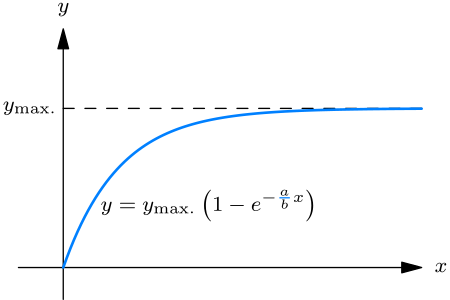
This result is also of importance in physical science.
Example 23.3. Let
We shall find this much less tractable than the preceding. First divide through by .
Now, as it stands, the left side is not integrable. But it can be made so by the artifice—and this is where skill and practice suggest a plan—of multiplying all the terms by , giving us: which is the same as and this being a perfect differential may be integrated thus:—since, if , , or y = \frac{g}{b} e^{-\frac{a}{b} t} \int e^{ \frac{a}{b} t} \cdot \sin (2\pi nt) \cdot dt + Ce^{-\frac{a}{b} t}. \tag{A}
The last term is obviously a term which will die out as increases (provided ), and may be omitted. The trouble now comes in to find the integral that appears as a factor. To tackle this we resort to the device of integration by parts, the general formula for which is . For this purpose write \left\{ \begin{align} u &= e^{\frac{a}{b} t}; \\ dv &= \sin (2\pi nt) \cdot dt. \end{align} \right. We shall then have \left\{ \begin{align} du &= e^{\frac{a}{b} t} \times \frac{a}{b}\, dt; \\ v &= - \frac{1}{2\pi n} \cos (2\pi nt). \end{align} \right.
Inserting these, the integral in question becomes: \begin{align} \int e^{\frac{a}{b} t} &{} \cdot \sin (2 \pi n t) \cdot dt \\ &= -\frac{1}{2 \pi n} \cdot e^{\frac{a}{b} t} \cdot \cos (2 \pi nt) -\int -\frac{1}{2\pi n} \cos (2 \pi nt) \cdot e^{\frac{a}{b} t} \cdot \frac{a}{b}\, dt \\ &= -\frac{1}{2 \pi n} e^{\frac{a}{b} t} \cos (2 \pi nt) +\frac{a}{2 \pi nb} \int e^{\frac{a}{b} t} \cdot \cos (2 \pi nt) \cdot dt. \tag{B} \end{align}
The last integral is still irreducible. To evade the difficulty, repeat the integration by parts of the left side, but treating it in the reverse way by writing: \left\{ \begin{align} u &= \sin (2 \pi n t) ; \\ dv &= e^{\frac{a}{b} t} \cdot dt; \end{align} \right. whence \left\{ \begin{align} du &= 2 \pi n \cdot \cos (2 \pi n t) \cdot dt; \\ v &= \frac{b}{a} e ^{\frac{a}{b} t} \end{align} \right.
Inserting these, we get \begin{align} \int e^{\frac{a}{b} t} &{} \cdot \sin (2 \pi n t) \cdot dt\\ &= \frac{b}{a} \cdot e^{\frac{a}{b} t} \cdot \sin (2 \pi n t) - \frac{2 \pi n b}{a} \int e^{\frac{a}{b} t} \cdot \cos (2 \pi n t) \cdot dt. \tag{C} \end{align}
Noting that the final intractable integral in (C) is the same as that in (B), we may eliminate it, by multiplying (B) by , and multiplying (C) by , and adding them.
The result, when cleared down, is: \begin{align} \int e^{\frac{a}{b} t} \cdot \sin (2 \pi n t) \cdot dt &= e^{\frac{a}{b} t} \left\{\frac{ ab \cdot \sin (2 \pi nt) - 2 \pi n b^2 \cdot \cos (2 \pi n t)}{ a^2 + 4 \pi^2 n^2 b^2 } \right\} \tag{D} \end{align} Inserting this value in (A), we get \begin{align} y &= g \left\{\frac{ a \cdot \sin (2 \pi n t) - 2 \pi n b \cdot \cos (2 \pi nt)}{ a^2 + 4 \pi^2 n^2 b^2}\right\}. \end{align}
To simplify still further, let us imagine an angle such that .
Then and
Substituting these, we get: \begin{align} y &= g \frac{\cos \phi \cdot \sin (2 \pi nt) - \sin \phi \cdot \cos (2 \pi nt)}{\sqrt{a^2 + 4 \pi^2 n^2 b^2}}, \end{align} which may be written which is the solution desired.
This is indeed none other than the equation of an alternating electric current, where represents the amplitude of the electromotive force, the frequency, the resistance, the coefficient of self-induction of the circuit, and is an angle of lag.
Example 23.4. Suppose that
We could integrate this expression directly, if were a function of only, and a function of only; but, if both and are functions that depend on both and , how are we to integrate it? Is it itself an exact differential? That is: have and each been formed by partial differentiation from some common function , or not? If they have, then \left\{ \begin{align} \frac{\partial U}{\partial x} = M, \\ \frac{\partial U}{\partial y} = N. \end{align} \right. And if such a common function exists, then is an exact differential (compare the chapter on partial differentiation).
Now the test of the matter is this. If the expression is an exact differential, it must be true that for then which is necessarily true.
[Note—We often write as . Therefore, the above equation is written as The left partial derivative means that we first differentiate with respect to and then differentiate the result with respect to , while on the right-hand side, the order of differentiation is reversed. In general, the order of differentiation for the functions that we deal with here is immaterial. So and are equal.]
Take as an illustration the equation
Is this an exact differential or not? Apply the test. \left\{ \begin{align} &\frac{\partial(1 + 3xy)}{\partial y}&&=3x, \\ &\dfrac{\partial (x^2)}{\partial x} &&= 2x, \end{align} \right. which do not agree. Therefore, it is not an exact differential, and the two functions and have not come from a common original function.
It is possible in such cases to discover, however, an integrating factor, that is to say, a factor such that if both are multiplied by this factor, the expression will become an exact differential. There is no one rule for discovering such an integrating factor; but experience will usually suggest one. In the present instance will act as such. Multiplying by , we get
Now apply the test to this. \left\{ \begin{align} & \frac{\partial (2x + 6x^2y)}{\partial y}&&=6x^2, \\ &\dfrac{\partial(2x^3)}{\partial x} &&= 6x^2, \end{align} \right. which agrees. Hence this is an exact differential, and may be integrated.
We are looking for such that or To find let’s integrate both sides of with respect to . yields but we should add the constant of integration. However, in this case, the constant of integration, in general, is a function of , say because the derivative of with respect to is zero. That is, This is more general than adding . To determine , let’s differentiate with respect to and compare the result with : By comparison of this result with , we realize that we must have Hence and Because the total differential of or is zero, must be a constant, say . Hence, the solution of the given differential equation is We may combine the two constants and and write the solution as where is an arbitrary constant. We can determine , if we know the value of at (or any other point).
Example 23.5. Let .
In this case we have a differential equation of the second order, in which appears in the form of a second order derivative, as well as in person.
Transposing, we have .
It appears from this that we have to do with a function such that its second derivative is proportional to itself, but with reversed sign. In Chapter 15 we found that there was such a function—namely, the sine (or the cosine also) which possessed this property. So, without further ado, we may infer that the solution will be of the form . However, let us go to work.
Multiply both sides of the original equation by , giving us , and, as we can write or Integrating gives us where is a constant. Then, taking the square roots,
But it can be shown that whence, passing from angles to sines, where is a constant angle that comes in by integration.
Or, preferably, this may be written which is the solution.
Example 23.6. Solve .
Solution
Here we have obviously to deal with a function which is such that its second differential coefficient is proportional to itself. The only function we know that has this property is the exponential function (see [unchanged]), and we may be certain therefore that the solution of the equation will be of that form.
Proceeding as before, by multiplying through by , and integrating, we get , and, as where is a constant, and .
Now, if, and
Hence, integrating, this gives us \begin{align} \ln (y + \sqrt{y^2 + c^2} ) &= nx + \ln C, \\ y + \sqrt{y^2 + c^2} &= C e^{nx}. \tag*{(1)} \end{align} Now whence -y + \sqrt{y^2 + c^2} =\frac{c^2}{y + \sqrt{y^2 + c^2}}= \frac{c^2}{C e^{nx}}=\dfrac{c^2}{C} e^{-nx}. \tag*{(2)}
Subtracting (2) from (1) and dividing by , we then have which is more conveniently written Or, the solution, which at first sight does not look as if it had anything to do with the original equation, shows that consists of two terms, one of which grows logarithmically as increases, and of a second term which dies away as increases.
Example 23.7. Let
Examination of this expression will show that, if , it has the form of Example 23.1, the solution of which was a negative exponential. On the other hand, if , its form becomes the same as that of Example 23.6, the solution of which is the sum of a positive and a negative exponential. It is therefore not very surprising to find that the solution of the present example is \begin{align} y &= (e^{-mt})(A e^{nt} + B e^{-nt}), \end{align} where \begin{align} m &= \frac{a}{2b}\quad \text{and}\quad n = \sqrt{\frac{a^2}{4b^2}} - \frac{g}{b}. \end{align}
The steps by which this solution is reached are not given here; they may be found in advanced treatises or books on differential equations.
Example 23.8. Let
It was seen that this equation was derived from the original where and were any arbitrary functions of .
Another way of dealing with it is to transform it by a change of variables into where , and , leading to the same general solution. If we consider a case in which vanishes, then we have simply and this merely states that, at the time , is a particular function of , and may be looked upon as denoting that the curve of the relation of to has a particular shape. Then any change in the value of is equivalent simply to an alteration in the origin from which is reckoned. That is to say, it indicates that, the form of the function being conserved, it is propagated along the direction with a uniform velocity ; so that whatever the value of the ordinate at any particular time at any particular point , the same value of will appear at the subsequent time at a point further along, the abscissa of which is . In this case the simplified equation represents the propagation of a wave (of any form) at a uniform speed along the direction.
If the differential equation had been written the solution would have been the same, but the velocity of propagation would have had the value
You have now been personally conducted over the frontiers into the enchanted land. And in order that you may have a handy reference to the principal results, the author, in bidding you farewell, begs to present you with a passport in the shape of a convenient collection of standard forms. In the middle column are set down a number of the functions which most commonly occur. The results of differentiating them are set down on the left; the results of integrating them are set down on the right. May you find them useful!
Full Chapter
In this chapter we go to work finding solutions to some important differential equations, using for this purpose the processes shown in the preceding chapters.
The beginner, who now knows how easy most of those processes are in themselves, will here begin to realize that integration is an art. As in all arts, so in this, facility can be acquired only by diligent and regular practice. He or she who would attain that facility must work out examples, and more examples, and yet more examples, such as are found abundantly in all the regular treatises on the Calculus. Our purpose here must be to afford the briefest introduction to serious work.
Example 23.1. Find the solution of the differential equation
Solution.
Transposing we have
Now the mere inspection of this relation tells us that we have got to do with a case in which is proportional to . If we think of the curve which will represent as a function of , it will be such that its slope at any point will be proportional to the ordinate (or the coordinate) at that point, and will be a negative slope if is positive. So obviously the curve will be a die-away curve (see here) provided that , and the solution will contain as a factor. But, without presuming on this bit of sagacity, let us go to work.
As both and occur in the equation and on opposite sides, we can do nothing until we get both and to one side, and to the other. To do this, we must split our usually inseparable companions and from one another.
Having done the deed, we now can see that both sides have got into a shape that is integrable, because we recognize , or , as a differential that we have met with when differentiating logarithms. So we may at once write down the instructions to integrate, and doing the two integrations, we have: where is the constant of integration. Then, delogarizing, we get: \begin{align} |y|&=e^{-\frac{a}{b} x + C}\\ &=e^C e^{-\frac{a}{b} x}\\ &=B e^{-\frac{a}{b} x} \end{align} where we have substituted with for simplicity. Since is always positive, we know . Hence which can be expressed as if we allow the arbitrary constant to take positive or negative values. Additionally, it is important to observe that is a viable possibility since if is always zero, it satisfies the given differential equation.
Now, this solution looks quite unlike the original differential equation from which it was constructed: yet to an expert mathematician they both convey the same information as to the way in which depends on .
Now, as to the , its meaning depends on the initial value of . For if we put in order to see what value then has, we find that this makes ; and as we see that is nothing else than the particular value1 of at starting. This we may call , and so write the solution as
Example 23.2. Let us take as an example to solve where is a constant. Again, inspecting the equation will suggest, (1) that somehow or other will come into the solution, and (2) that if at any part of the curve becomes either a maximum or a minimum, so that , then will have the value . But let us go to work as before, separating the differentials and trying to transform the thing into some integrable shape. \begin{align} b\frac{dy}{dx} &= g -ay; \\ \frac{dy}{dx} &= \frac{a}{b}\left(\frac{g}{a}-y\right); \\ \frac{dy}{y-\dfrac{g}{a}} &= -\frac{a}{b}\, dx. \end{align}
Now we have done our best to get nothing but and on one side, and nothing but on the other. But is the result on the left side integrable?
It is of the same form as the result before; so, writing the instructions to integrate, we have: and, doing the integration, and adding the appropriate constant, whence where , and finally, which is the solution.
If the condition is laid down that when we can find ; for then the exponential becomes ; and we have or
Putting in this value, the solution becomes
But further, assuming both and are positive, if grows indefinitely, will grow to a maximum; for when , the exponential ,2 giving . Substituting this, we get finally This curve is plotted in below.
This result is also of importance in physical science.
Example 23.3. Let
We shall find this much less tractable than the preceding. First divide through by .
Now, as it stands, the left side is not integrable. But it can be made so by the artifice—and this is where skill and practice suggest a plan—of multiplying all the terms by , giving us: which is the same as and this being a perfect differential may be integrated thus:—since, if , , or y = \frac{g}{b} e^{-\frac{a}{b} t} \int e^{ \frac{a}{b} t} \cdot \sin (2\pi nt) \cdot dt + Ce^{-\frac{a}{b} t}. \tag{A}
The last term is obviously a term which will die out as increases (provided ), and may be omitted. The trouble now comes in to find the integral that appears as a factor. To tackle this we resort to the device of integration by parts, the general formula for which is . For this purpose write \left\{ \begin{align} u &= e^{\frac{a}{b} t}; \\ dv &= \sin (2\pi nt) \cdot dt. \end{align} \right. We shall then have \left\{ \begin{align} du &= e^{\frac{a}{b} t} \times \frac{a}{b}\, dt; \\ v &= - \frac{1}{2\pi n} \cos (2\pi nt). \end{align} \right.
Inserting these, the integral in question becomes: \begin{align} \int e^{\frac{a}{b} t} &{} \cdot \sin (2 \pi n t) \cdot dt \\ &= -\frac{1}{2 \pi n} \cdot e^{\frac{a}{b} t} \cdot \cos (2 \pi nt) -\int -\frac{1}{2\pi n} \cos (2 \pi nt) \cdot e^{\frac{a}{b} t} \cdot \frac{a}{b}\, dt \\ &= -\frac{1}{2 \pi n} e^{\frac{a}{b} t} \cos (2 \pi nt) +\frac{a}{2 \pi nb} \int e^{\frac{a}{b} t} \cdot \cos (2 \pi nt) \cdot dt. \tag{B} \end{align}
The last integral is still irreducible. To evade the difficulty, repeat the integration by parts of the left side, but treating it in the reverse way by writing: \left\{ \begin{align} u &= \sin (2 \pi n t) ; \\ dv &= e^{\frac{a}{b} t} \cdot dt; \end{align} \right. whence \left\{ \begin{align} du &= 2 \pi n \cdot \cos (2 \pi n t) \cdot dt; \\ v &= \frac{b}{a} e ^{\frac{a}{b} t} \end{align} \right.
Inserting these, we get \begin{align} \int e^{\frac{a}{b} t} &{} \cdot \sin (2 \pi n t) \cdot dt\\ &= \frac{b}{a} \cdot e^{\frac{a}{b} t} \cdot \sin (2 \pi n t) - \frac{2 \pi n b}{a} \int e^{\frac{a}{b} t} \cdot \cos (2 \pi n t) \cdot dt. \tag{C} \end{align}
Noting that the final intractable integral in (C) is the same as that in (B), we may eliminate it, by multiplying (B) by , and multiplying (C) by , and adding them.
The result, when cleared down, is: \begin{align} \int e^{\frac{a}{b} t} \cdot \sin (2 \pi n t) \cdot dt &= e^{\frac{a}{b} t} \left\{\frac{ ab \cdot \sin (2 \pi nt) - 2 \pi n b^2 \cdot \cos (2 \pi n t)}{ a^2 + 4 \pi^2 n^2 b^2 } \right\} \tag{D} \end{align} Inserting this value in (A), we get \begin{align} y &= g \left\{\frac{ a \cdot \sin (2 \pi n t) - 2 \pi n b \cdot \cos (2 \pi nt)}{ a^2 + 4 \pi^2 n^2 b^2}\right\}. \end{align}
To simplify still further, let us imagine an angle such that .
Then and
Substituting these, we get: \begin{align} y &= g \frac{\cos \phi \cdot \sin (2 \pi nt) - \sin \phi \cdot \cos (2 \pi nt)}{\sqrt{a^2 + 4 \pi^2 n^2 b^2}}, \end{align} which may be written which is the solution desired.
This is indeed none other than the equation of an alternating electric current, where represents the amplitude of the electromotive force, the frequency, the resistance, the coefficient of self-induction of the circuit, and is an angle of lag.
Example 23.4. Suppose that
We could integrate this expression directly, if were a function of only, and a function of only; but, if both and are functions that depend on both and , how are we to integrate it? Is it itself an exact differential? That is: have and each been formed by partial differentiation from some common function , or not? If they have, then \left\{ \begin{align} \frac{\partial U}{\partial x} = M, \\ \frac{\partial U}{\partial y} = N. \end{align} \right. And if such a common function exists, then is an exact differential (compare the chapter on partial differentiation).
Now the test of the matter is this. If the expression is an exact differential, it must be true that for then which is necessarily true.
[Note—We often write as . Therefore, the above equation is written as The left partial derivative means that we first differentiate with respect to and then differentiate the result with respect to , while on the right-hand side, the order of differentiation is reversed. In general, the order of differentiation for the functions that we deal with here is immaterial. So and are equal.]
Take as an illustration the equation
Is this an exact differential or not? Apply the test. \left\{ \begin{align} &\frac{\partial(1 + 3xy)}{\partial y}&&=3x, \\ &\dfrac{\partial (x^2)}{\partial x} &&= 2x, \end{align} \right. which do not agree. Therefore, it is not an exact differential, and the two functions and have not come from a common original function.
It is possible in such cases to discover, however, an integrating factor, that is to say, a factor such that if both are multiplied by this factor, the expression will become an exact differential. There is no one rule for discovering such an integrating factor; but experience will usually suggest one. In the present instance will act as such. Multiplying by , we get
Now apply the test to this. \left\{ \begin{align} & \frac{\partial (2x + 6x^2y)}{\partial y}&&=6x^2, \\ &\dfrac{\partial(2x^3)}{\partial x} &&= 6x^2, \end{align} \right. which agrees. Hence this is an exact differential, and may be integrated.
We are looking for such that or To find let’s integrate both sides of with respect to . yields but we should add the constant of integration. However, in this case, the constant of integration, in general, is a function of , say because the derivative of with respect to is zero. That is, This is more general than adding . To determine , let’s differentiate with respect to and compare the result with : By comparison of this result with , we realize that we must have Hence and Because the total differential of or is zero, must be a constant, say . Hence, the solution of the given differential equation is We may combine the two constants and and write the solution as where is an arbitrary constant. We can determine , if we know the value of at (or any other point).
Example 23.5. Let .
In this case we have a differential equation of the second order, in which appears in the form of a second order derivative, as well as in person.
Transposing, we have .
It appears from this that we have to do with a function such that its second derivative is proportional to itself, but with reversed sign. In Chapter 15 we found that there was such a function—namely, the sine (or the cosine also) which possessed this property. So, without further ado, we may infer that the solution will be of the form . However, let us go to work.
Multiply both sides of the original equation by , giving us , and, as we can write or Integrating gives us where is a constant. Then, taking the square roots,
But it can be shown that whence, passing from angles to sines, where is a constant angle that comes in by integration.
Or, preferably, this may be written which is the solution.
Example 23.6. Solve .
Solution. Here we have obviously to deal with a function which is such that its second differential coefficient is proportional to itself. The only function we know that has this property is the exponential function (see [unchanged]), and we may be certain therefore that the solution of the equation will be of that form.
Proceeding as before, by multiplying through by , and integrating, we get , and, as where is a constant, and .
Now, if, and
Hence, integrating, this gives us \begin{align} \ln (y + \sqrt{y^2 + c^2} ) &= nx + \ln C, \\ y + \sqrt{y^2 + c^2} &= C e^{nx}. \tag*{(1)} \end{align} Now whence -y + \sqrt{y^2 + c^2} =\frac{c^2}{y + \sqrt{y^2 + c^2}}= \frac{c^2}{C e^{nx}}=\dfrac{c^2}{C} e^{-nx}. \tag*{(2)}
Subtracting (2) from (1) and dividing by , we then have which is more conveniently written Or, the solution, which at first sight does not look as if it had anything to do with the original equation, shows that consists of two terms, one of which grows logarithmically as increases, and of a second term which dies away as increases.
Example 23.7. Let
Examination of this expression will show that, if , it has the form of Example 23.1, the solution of which was a negative exponential. On the other hand, if , its form becomes the same as that of Example 23.6, the solution of which is the sum of a positive and a negative exponential. It is therefore not very surprising to find that the solution of the present example is \begin{align} y &= (e^{-mt})(A e^{nt} + B e^{-nt}), \end{align} where \begin{align} m &= \frac{a}{2b}\quad \text{and}\quad n = \sqrt{\frac{a^2}{4b^2}} - \frac{g}{b}. \end{align}
The steps by which this solution is reached are not given here; they may be found in advanced treatises or books on differential equations.
Example 23.8.
It was seen that this equation was derived from the original where and were any arbitrary functions of .
Another way of dealing with it is to transform it by a change of variables into where , and , leading to the same general solution. If we consider a case in which vanishes, then we have simply and this merely states that, at the time , is a particular function of , and may be looked upon as denoting that the curve of the relation of to has a particular shape. Then any change in the value of is equivalent simply to an alteration in the origin from which is reckoned. That is to say, it indicates that, the form of the function being conserved, it is propagated along the direction with a uniform velocity ; so that whatever the value of the ordinate at any particular time at any particular point , the same value of will appear at the subsequent time at a point further along, the abscissa of which is . In this case the simplified equation represents the propagation of a wave (of any form) at a uniform speed along the direction.
If the differential equation had been written the solution would have been the same, but the velocity of propagation would have had the value
You have now been personally conducted over the frontiers into the enchanted land. And in order that you may have a handy reference to the principal results, the author, in bidding you farewell, begs to present you with a passport in the shape of a convenient collection of standard forms. In the middle column are set down a number of the functions which most commonly occur. The results of differentiating them are set down on the left; the results of integrating them are set down on the right. May you find them useful!