Chapter Summary (Express)
One use of the integral calculus is to enable us to ascertain the values of areas bounded by curves.
Let us try to get at the subject bit by bit.
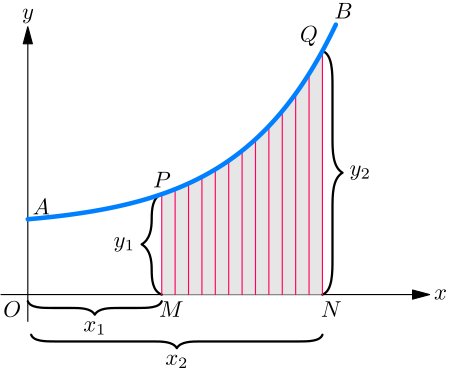
Let AB (Fig. 19.1) be a curve, the equation of which is known. That is, y in this curve is some known function of x. Suppose that we want to calculate the area of the shaded region PQNM that lies beneath the piece PQ. The problem is: how can we calculate the value of this area?
Let AB (Fig. 19.1) be a curve, the equation to which is known. That is, y in this curve is some known function of x. Think of a piece of the curve from the point P to the point Q.Let a perpendicular PM be dropped from P, and another QN from the point Q. Then call OM = x_1 and ON = x_2, and the ordinates PM = y_1 and QN = y_2. We have thus marked out the area PQNM that lies beneath the piece PQ. The problem is, how can we calculate the value of this area?
The problem of finding the area under a curve between two points, x_1 and x_2, can be approached by dividing the area into many narrow strips of width dx and average height y. The area of each strip is therefore y\cdot dx, which we refer to as dS, signifying a small part of the total area S: dS=y\cdot dx.
The secret of solving this problem is to conceive the area as being divided up into a lot of narrow strips, each of them being of the width dx. The smaller we take dx, the more of them there will be between x_1 and x_2. Now, the whole area is clearly equal to the sum of the areas of all such strips. Our business will then be to discover an expression for the area of any one narrow strip, and to integrate it so as to add together all the strips. Now think of any one of the strips. It will be like this: being bounded between two vertical sides, with a flat bottom dx, and with a slightly curved sloping top. Suppose we take its average height as being y; then, as its width is dx, its area will be y\, dx (see the following figure). And seeing that we may take the width as narrow as we please, if we only take it narrow enough its average height will be the same as the height at the middle of it. Now let us call the unknown value of the whole area S, meaning surface. The area of one strip will be simply a bit of the whole area, and may therefore be called dS. So we may write \text{area of } 1 \text{ strip} = dS = y \cdot dx.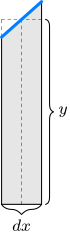
To find the total area S, we sum up the areas of all the strips, which is represented by the integral S=\int y\, dx. But because the area we are trying to find is not the area under the whole length of the curve, but only the area limited on the left by PM, and on the right by QN, it follows that we must do something to define our area between those limits.
If then we add up all the strips, we get \text{total area } S = \int dS = \int y\, dx.
So then our finding S depends on whether we can integrate y \cdot dx for the particular case, when we know what the value of y is as a function of x.
For instance, if you were told that for the particular curve in question y = b + ax^2, no doubt you could put that value into the expression and say: then I must find \displaystyle \int (b + ax^2)\, dx.
That is all very well; but a little thought will show you that something more must be done. Because the area we are trying to find is not the area under the whole length of the curve, but only the area limited on the left by PM, and on the right by QN, it follows that we must do something to define our area between those ‘limits.’
This introduces us to a new notion, namely that of integrating between limits. We suppose x to vary, and for the present purpose we do not require any value of x below x_1 (that is OM), nor any value of x above x_2 (that is ON). When an integral is to be thus defined between two limits, we call the lower of the two values the lower limit, and the upper value the upper limit. Any integral so limited we designate as a definite integral, by way of distinguishing it from an indefinite integral (which is the reverse of differentiation) to which no limits are assigned.
In the symbols which give instructions to integrate, the limits are marked by putting them at the top and bottom respectively of the sign of integration. Thus the instruction \int_{x=x_1}^{x=x_2} y \cdot dx will be read: find the integral of y \cdot dx between the lower limit x_1 and the upper limit x_2.
Sometimes the thing is written more simply \int^{x_2}_{x_1} y \cdot dx. Well, but how do you find an integral between limits, when you have got these instructions?
To determine the area under a curve between two points,
first, you need to calculate the area under the curve from a common
starting point up to each of the two points. This involves finding the
general integral and substituting each limit into the integral formula,
once for the upper limit and once for the lower limit. The area between
the two points is then calculated by subtracting the result of the lower
limit from the result of the upper limit. This process is known as
computing the definite integral between two limits.
As an example, consider a curve where y = b
+ ax^2. The integral of y
with respect to x is found,
yielding the general integral bx +
\frac{a}{3}x^3 + C.
Using this general integral, the area up to an upper limit x_2 and a lower limit x_1 can be calculated. The larger area up
to x_2 is bx_2 + \frac{a}{3}x_2^3 + C and the
smaller area up to x_1 is bx_1 + \frac{a}{3}x_1^3 + C.
The area between x_1 and x_2, denoted as area S, can then be found by subtracting the
smaller area from the larger, yielding b(x_2
- x_1) + \frac{a}{3}(x_2^3 - x_1^3).
In symbolic terms, the calculation of the definite integral between two
limits can be expressed as \int^{x=x_2}_{x=x_1} y\, dx = y_2 - y_1,
where y_2 is the integrated value
of y, dx at x_2, and y_1 is the value at x_1. It is also noted that the constant
C disappears in the process of
finding the definite integral.
Look again at Fig. 19.1. Suppose we could find the area under the larger piece of curve from A to Q, that is from x = 0 to x = x_2, naming the area AQNO. Then, suppose we could find the area under the smaller piece from A to P, that is from x = 0 to x = x_1, namely the area APMO. If then we were to subtract the smaller area from the larger, we should have left as a remainder the area PQNM, which is what we want. Here we have the clue as to what to do; the definite integral between the two limits is the difference between the integral worked out for the upper limit and the integral worked out for the lower limit.
Let us then go ahead. First, find the general integral thus: \int y\, dx, and, as y = b + ax^2 is the equation to the curve (Fig. 19.1), \int (b + ax^2)\, dx is the general integral which we must find.
Doing the integration in question by the rule (see here), we get bx + \frac{a}{3} x^3 + C; and this will be the whole area from 0 up to any value of x that we may assign.
Therefore, the larger area up to the upper limit x_2 will be bx_2 + \frac{a}{3} x_2^3 + C; and the smaller area up to the lower limit x_1 will be bx_1 + \frac{a}{3} x_1^3 + C.
Now, subtract the smaller from the larger, and we get for the area S the value, \text{area~$S$} = b(x_2 - x_1) + \frac{a}{3}(x_2^3 - x_1^3).
This is the answer we wanted. Let us give some numerical values. Suppose b = 10, a = 0.06, and x_2 = 8 and x_1 = 6. Then the area S is equal to \begin{gathered} 10(8 - 6) + \frac{0.06}{3} (8^3 - 6^3) \\ \begin{align} &= 20 + 0.02(512 - 216) \\ &= 20 + 0.02 \times 296 \\ &= 20 + 5.92 \\ &= 25.92. \end{align} \end{gathered}
Let us here put down a symbolic way of stating what we have ascertained about limits: \int^{x=x_2}_{x=x_1} y\, dx = y_2 - y_1, where y_2 is the integrated value of y\, dx corresponding to x_2, and y_1 that corresponding to x_1.
All integration between limits requires the difference between two values to be thus found. Also note that, in making the subtraction the added constant C has disappeared.
In summary, \boxed{\displaystyle \int_{x_1}^{x_2}y\,dx=\left[\int y\,dx\right]_{x_1}^{x_2}}. The symbol \displaystyle \left[\int y\,dx\right]_{x_1}^{x_2} means to evaluate \displaystyle \int y\,dx for x=x_2 and for x=x_1 and subtract the latter from the former.
Examples
Example 19.1. To familiarize ourselves with the process, let us take a case of which we know the answer beforehand. Let us find the area of the triangle (Fig. 19.3), which has base x = 12 and height y = 4. We know beforehand, from obvious mensuration, that the answer will come 24.
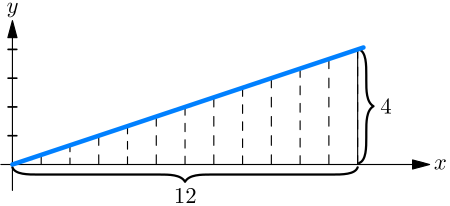
Now, here we have as the “curve” a sloping line for which the equation is y = \frac{x}{3}.
The area in question will be \int^{x=12}_{x=0} y \cdot dx = \int^{x=12}_{x=0} \frac{x}{3} \cdot dx.
Integrating \dfrac{x}{3}\, dx (see here ), and putting down the value of the indefinite integral in square brackets with the limits marked above and below, we get /p>
Let us satisfy ourselves about this rather surprising dodge of calculation, by testing it on a simple example. Get some squared paper, preferably some that is ruled in little squares of one-eighth inch or one-tenth inch each way. On this squared paper plot out the graph of the equation, y = \frac{x}{3}.
The values to be plotted will be: \begin{array} {|c|c|c|c|c|c|} \hline x & 0 & 3 & 6 & 9 & 12 \\ \hline y & 0 & 1 & 2 & 3 & 4 \\ \hline \end{array}
The plot is given below.
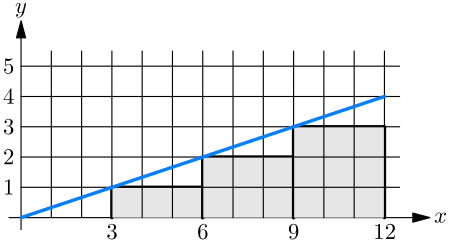
Now reckon out the area beneath the curve by counting the little squares below the line, from x = 0 as far as x = 12 on the right. There are 18 whole squares and four triangles, each of which has an area equal to 1\frac{1}{2} squares; or, in total, 24 squares. Hence 24 is the numerical value of the integral of \dfrac{x}{3}\, dx between the lower limit of x = 0 and the higher limit of x = 12.
As a further exercise, show that the value of the same integral between the limits of x = 3 and x = 15 is 36.
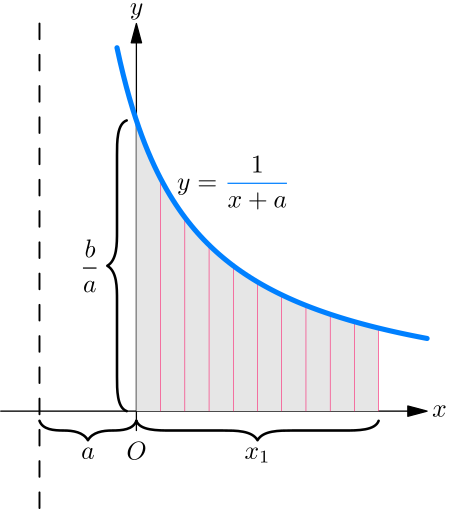
Example 19.2. Find the area, between limits x = x_1 and x = 0, of the curve y = \dfrac{b}{x + a} (see the following figure).
Solution
\[\begin{align} \text{Area} &= \int^{x=x_1}_{x=0} y \cdot dx = \int^{x=x_1}_{x=0} \frac{b}{x+a}\, dx \\[6pt] &= b \bigl[\ln(x + a)+C \bigr]^{x_1} _{0} \\[6pt] &= b \bigl[\ln(x_1 + a)+C - \ln(0 + a)-C\bigr] \\ &= b \ln \frac{x_1 + a}{a}.\quad \text{Ans}. \end{align}\]Note—Notice that in dealing with definite integrals the constant C always disappears by subtraction.
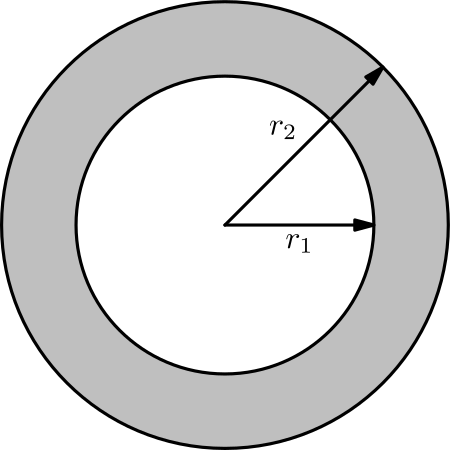
Let it be noted that this process of subtracting one part from a larger to find the difference is really a common practice. How do you find the area of a plane ring (Fig. 19.6), the outer radius of which is r_2 and the inner radius is r_1? You know from mensuration that the area of the outer circle is \pi r_2^2; then you find the area of the inner circle, \pi r_1^2; then you subtract the latter from the former, and find area of ring = \pi(r_2^2 - r_1^2); which may be written \pi(r_2 + r_1)(r_2 - r_1) = \text{mean circumference of ring} \times \text{width of ring}.
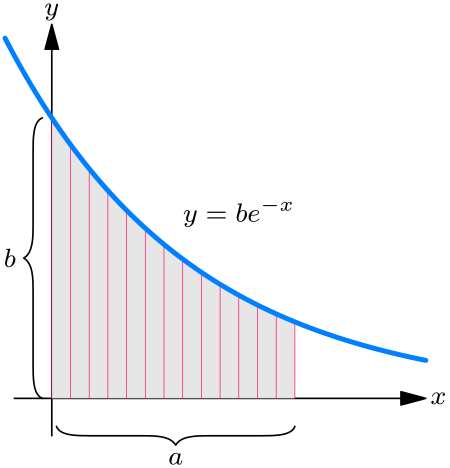
Example 19.3. Here’s another case—that of the die-away
curve. Find the area between x =
0 and x = a, of the curve
(see the following figure) whose equation is \[\begin{align}
y &= be^{-x}.
\end{align}\]/p>
Example 19.4. Another example is afforded by the adiabatic curve of a perfect gas, the equation to which is pv^n = c, where p stands for pressure, v for volume, and n is of the value 1.42 (see the following figure).
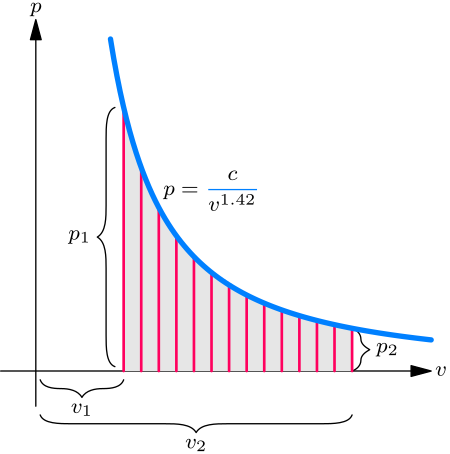
Find the area under the curve (which is proportional to the work done in suddenly compressing the gas) from volume v_2 to volume v_1.
Solution
Here we haveArea of a Disk
Example 19.5. Prove the ordinary mensuration formula, that the area A of a circle whose radius is R, is equal to \pi R^2.
Solution
Consider an elementary zone or annulus of the surface (see the following figure), of breadth dr, situated at a distance r from the centre. We may consider the entire surface as consisting of such narrow zones, and the whole area A will simply be the integral of all such elementary zones from centre to margin, that is, integrated from r = 0 to r = R.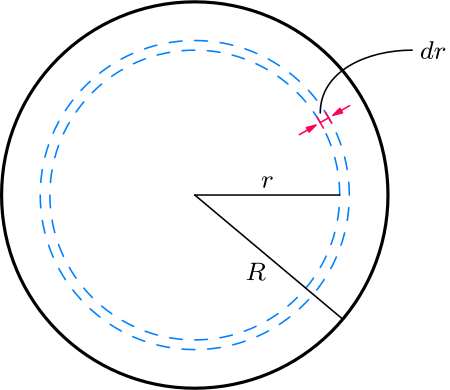
We have therefore to find an expression for the elementary area dA of the narrow zone. Think of it as a strip of breadth dr, and of a length that is the periphery of the circle of radius r, that is, a length of 2 \pi r. Then we have, as the area of the narrow zone, dA = 2 \pi r\, dr.
Hence the area of the whole circle will be: A = \int dA = \int^{r=R}_{r=0} 2 \pi r \cdot dr = 2 \pi \int^{r=R}_{r=0} r \cdot dr.
Now, the general integral of r \cdot dr is \frac{1}{2} r^2. Therefore, A = 2 \pi \left[\frac{1}{2} r^2 \right]^{r=R}_{r=0}; or A = 2 \pi \left[\frac{1}{2} R^2 - \frac{1}{2}(0)^2\right]; whence A = \pi R^2.
Mean (or Average) Value of a Function
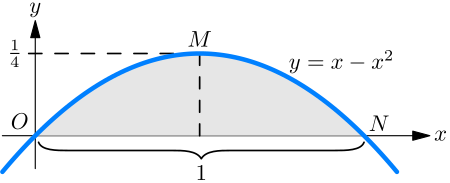
Example 19.6. Let us find the mean ordinate (the average y-value) of the positive part of the curve y = x - x^2, which is shown below.
Solution
To find the mean ordinate, we shall have to find the area of the piece OMN, and then divide it by the length of the base ON. But before we can find the area we must ascertain the length of the base, so as to know up to what limit we are to integrate. At N the ordinate y has zero value; therefore, we must look at the equation and see what value of x will make y = 0. Now, clearly, if x is 0, y will also be 0, the curve passing through the origin O; but also, if x=1, y=0; so that x=1 gives us the position of the point N.Then the area wanted is /p>
But the base length is 1.
Therefore, the average ordinate of the curve = \frac{1}{6}.
[Note—It will be a pretty and simple exercise in maxima and minima to find by differentiation what is the height of the maximum ordinate. It must be greater than the average.]
The mean (or the average) ordinate of any curve, over a range from \boldsymbol{x= x_1} to \boldsymbol{x= x_2}, is given by the expression, \boxed{\displaystyle \text{mean } y = \frac{1}{x_2-x_1} \int^{x=x_2}_{x=x_1} y \cdot dx.}
Areas in Polar Coordinates
When the equation of the boundary of an area is given as a function of the distance r of a point of it from a fixed point O (see the following figure) called the pole, and of the angle which r makes with the positive direction of the x-axis, the process just explained can be applied just as easily, with a small modification. Instead of a strip of area, we consider a small triangle OAB, the angle at O being d\theta, and we find the sum of all the little triangles making up the required area.
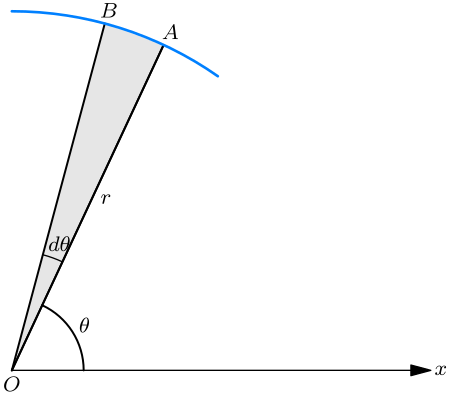
The area of such a small triangle is approximately \dfrac{AB}{2}\times r or \dfrac{r\, d\theta}{2}\times r; hence the portion of the area included between the curve and two positions of r corresponding to the angles \theta_1 and \theta_2 is given by \boxed{\displaystyle \text{Area}=\frac{1}{2} \int^{\theta=\theta_2}_{\theta=\theta_1} r^2\, d\theta.}
Note— In the above formula \theta must be expressed in radian measure.
Examples
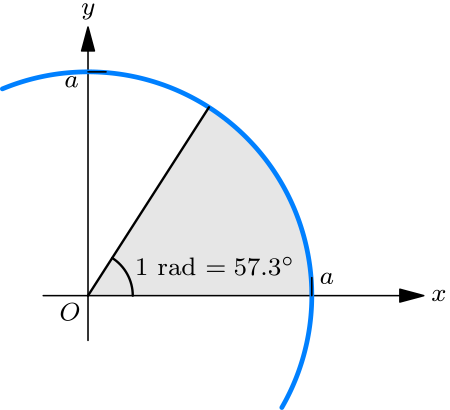
Example 19.7. Find the area of the sector of 1 radian in a circumference of radius a inches (see the following figure).
Solution
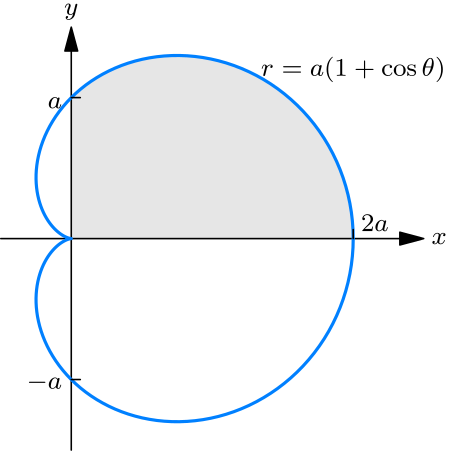
The polar equation of the circumference is evidently r=a. The area is \frac{1}{2} \int^{\theta=\theta_2}_{\theta=\theta_1} a^2\, d\theta = \frac{a^2}{2} \int^{\theta=1}_{\theta=0} d\theta = \frac{a^2}{2}.Example 19.8. Find the area of the first quadrant of the curve (known as “Pascal’s Snail”), the polar equation of which is r=a(1+\cos \theta) (see the following figure).
Solution
Volumes by Integration
What we have done with the area of a little strip of a surface, we can, of course, just as easily do with the volume of a little strip of a solid. We can add up all the little strips that make up the total solid, and find its volume, just as we have added up all the small little bits that made up an area to find the final area of the figure operated upon.
Examples.
Example 19.9. Find the volume of a sphere of radius R.
Solution
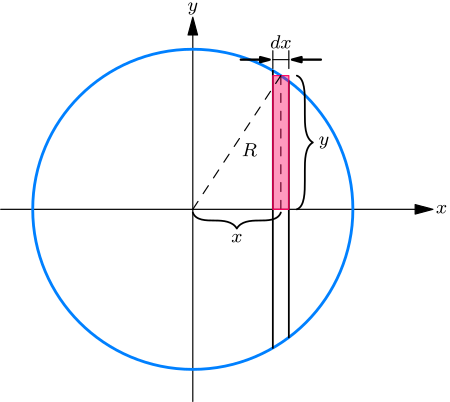
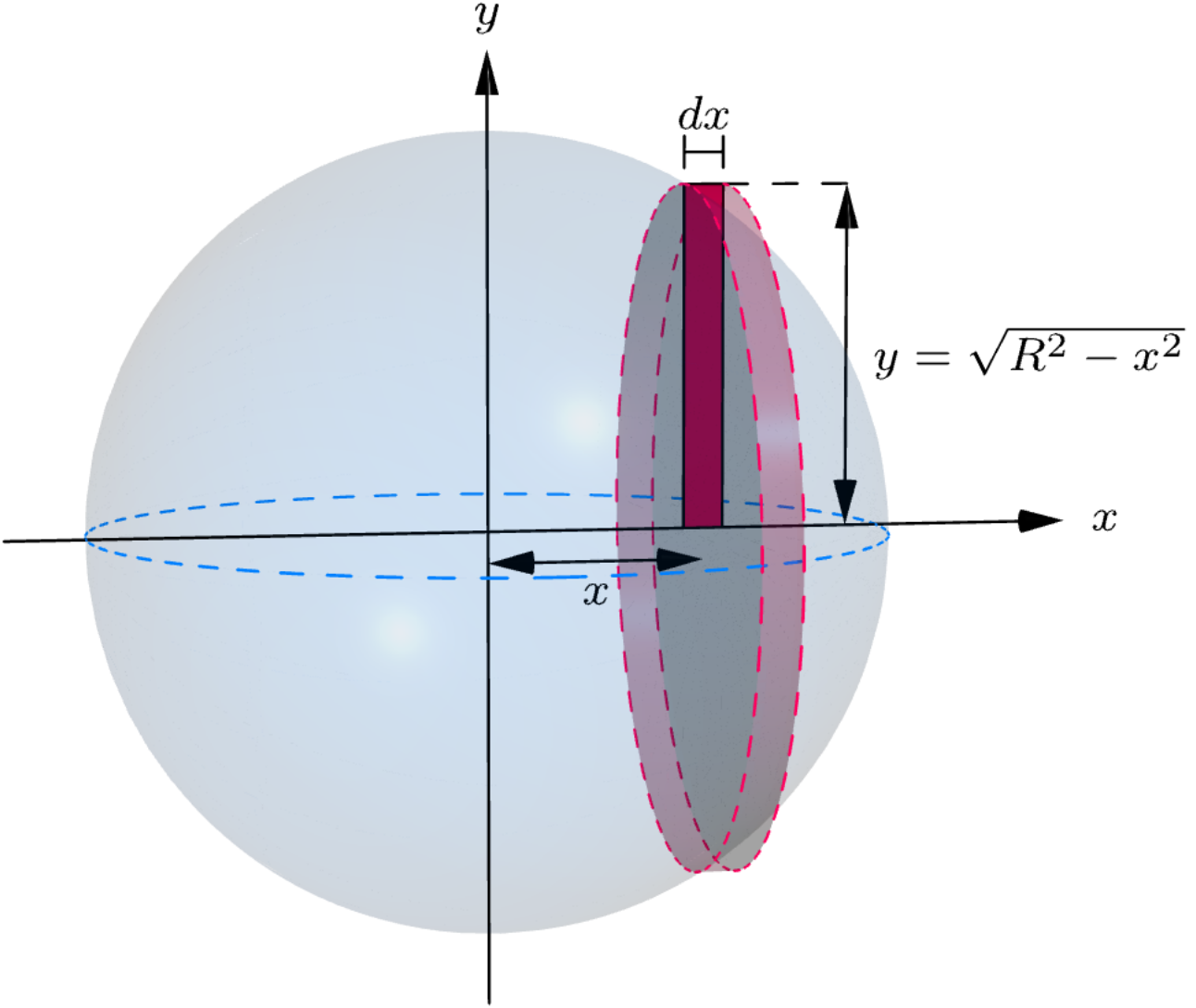
Method (a). A thin spherical shell has for volume 4\pi r^2\, dr (see Fig. 19.9); summing up all the concentric shells which make up the sphere, we have \text{volume sphere} = \int^{r=R}_{r=0} 4\pi r^2\, dr = 4\pi \left[\frac{r^3}{3} \right]^R_0 = \frac{4}{3} \pi R^3.Method (b). We can also proceed as follows: a slice
of the sphere, of thickness dx, has
for volume \pi y^2\, dx. This thin
disk is generated by rotating the strip of thickness dx shown in Fig. 19.14 around the x-axis (see Fig 19.15).
The length of this strip, y, is
related to the distance of this strip from the origin, x, through y^2 = R^2 - x^2. Hence /p>
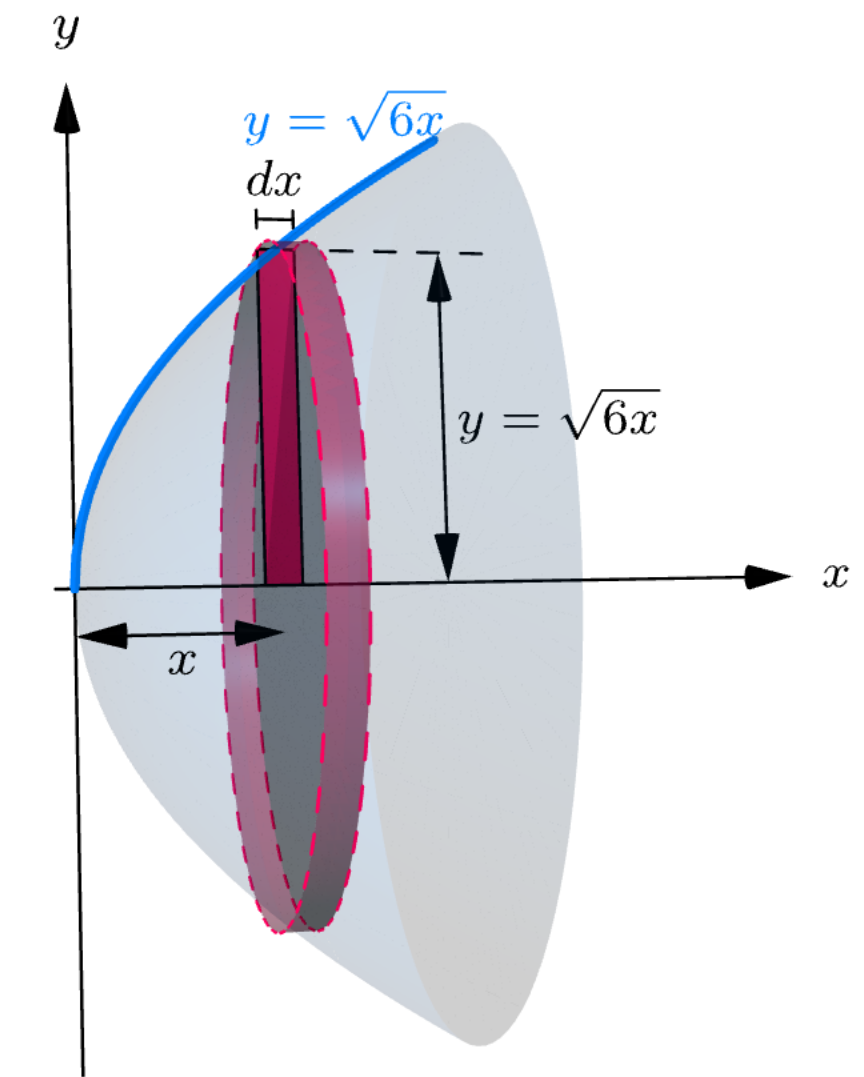
Example 19.10. Find the volume of the solid generated by the revolution of the curve y^2=6x about the axis of x, between x=0 and x=4.
Solution
The volume of a thin disk generated by rotating the thin strip is \pi y^2\, dx (see the following figure).Hence /p>
On Quadratic Means
\boxed{\displaystyle \text{quadratic mean of } y=\sqrt{\frac{1}{L} \int^L_0 y^2\, dx}.}
In certain branches of physics, particularly in the study of alternating electric currents, it is necessary to be able to calculate the quadratic mean of a variable quantity. By “quadratic mean” is denoted the square root of the mean of the squares of all the values between the limits considered. Other names for the quadratic mean of any quantity are its “virtual” value, or its “r.m.s.” (meaning root-mean-square) value. If y is the function under consideration, and the quadratic mean is to be taken between the limits of x=0 and x=L; then the quadratic mean is expressed as \boxed{\displaystyle \text{quadratic mean of } y=\sqrt{\frac{1}{L} \int^L_0 y^2\, dx}.}
Examples.
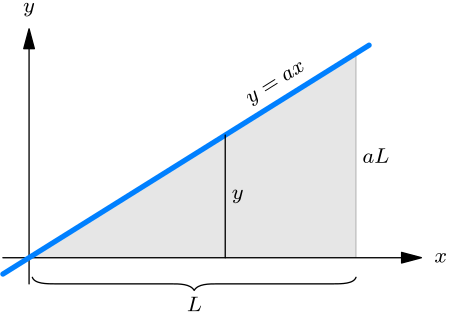
Example 19.11. Find the quadratic mean of the function y=ax (see the following figure).
Solution
Here the integral is \int^L_0 a^2 x^2\, dx, which is \frac{L}{3} a^2 L^3.Dividing by L and taking the square root, we have \text{quadratic mean} = \frac{1}{\sqrt 3}\, aL.
Here the arithmetical mean is \frac{1}{2}aL; and the ratio of quadratic to arithmetical mean (this ratio is called the form-factor) is \dfrac{2}{\sqrt 3}=1.155.
Example 19.12. Find the quadratic mean of the function y=x^a.
Solution
The integral is \displaystyle \int^{x=L}_{x=0} x^{2a}\, dx, that is \dfrac{L^{2a+1}}{2a+1}.Hence \begin{gathered} \text{quadratic mean} = \sqrt{\dfrac{L^{2a}}{2a+1}}. \end{gathered}
Example 19.13. Find the quadratic mean of the function y=a^{\frac{x}{2}}.
Solution
The integral is \displaystyle \int^{x=L}_{x=0} (a^{\frac{x}{2}})^2\, dx, that is \displaystyle \int^{x=L}_{x=0} a^x\, dx, or \begin{gathered} \left[ \frac{a^x}{\ln a} \right]^{x=L}_{x=0}, \end{gathered} which is \dfrac{a^L-1}{\ln a}.Hence the quadratic mean is \sqrt{\dfrac{a^L - 1}{L \ln a}}.
Exercises
Exercise 19.1. Find the area of the curve y=x^2+x-5 between x=0 and x=6, and the mean ordinates (average y-value) between these limits.
Answer
\text{Area} = 60; \text{mean ordinate} = 10.Solution
/p>
\text { mean } y=\frac{\displaystyle \int_{0}^{6}\left(x^{2}+x-6\right) d x}{6-0}=\frac{60}{6}=10 .
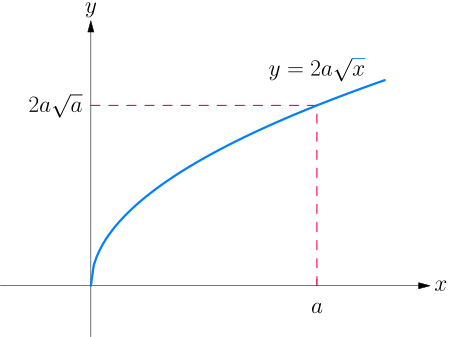
Exercise 19.2. Find the area of the parabola y=2a\sqrt x between x=0 and x=a. Show that it is two-thirds of the rectangle of the limiting ordinate and of its abscissa.
Answer
\text{Area} = \dfrac{2}{3} of a \times 2a \sqrt{a}.Solution
/p>
/p>
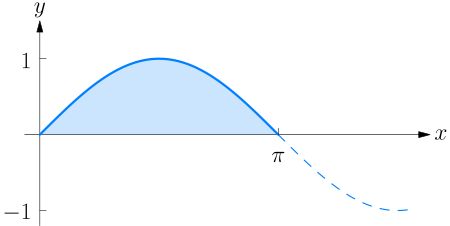
Exercise 19.3. Find the area of the positive portion of a sine curve and the mean ordinate.
Answer
\text{Area} = 2; \text{mean ordinate} = \dfrac{2}{\pi} \approx 0.637.Solution
Exercise 19.4. Find the area of the positive portion of the curve y=\sin^2 x (0\leq x\leq \pi), and find the mean ordinate.
Answer
\text{Area} =\dfrac{\pi}{2}\approx 1.57; \text{mean ordinate} = 0.5.Solution
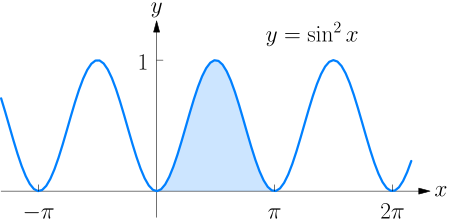
The problem asks for the hatched area
/p>
/p>
Exercise 19.5. Find the area included between the two branches of the curve y=x^2 \pm x^{\frac{5}{2}} from x=0 to x=1, also the area of the positive portion of the lower branch of the curve (see Fig. 11.12).
Answer
\dfrac{4}{7}\approx 0.571, \dfrac{1}{21}\approx 0.0476.Solution
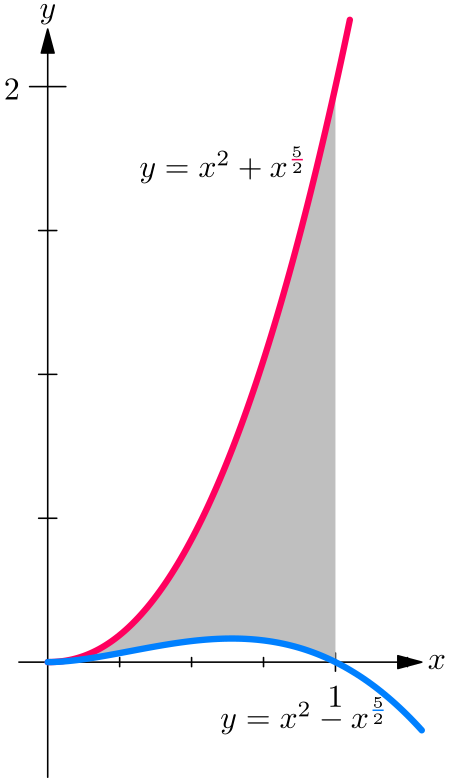
/p>
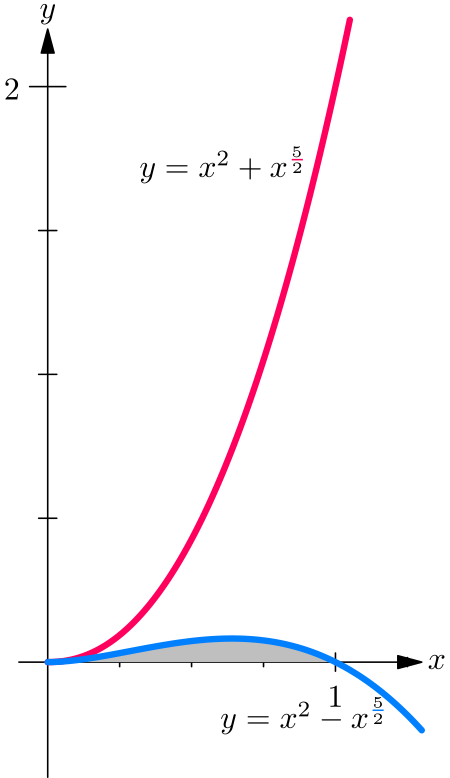
Exercise 19.6. Find the volume of a cone of radius of base r, and of height h.
Answer
\text{Volume} = \pi r^2 \dfrac{h}{3}.Solution
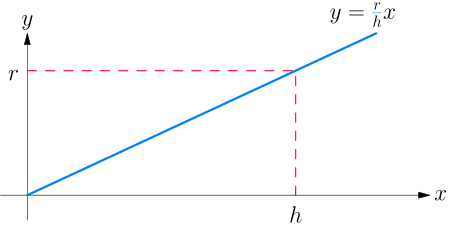
If line y=\frac{r}{h} x rotates around the x-axis, it creates a cone of radius of base r, and of height h.
We just need to calculate the volume of this solid of revolution.
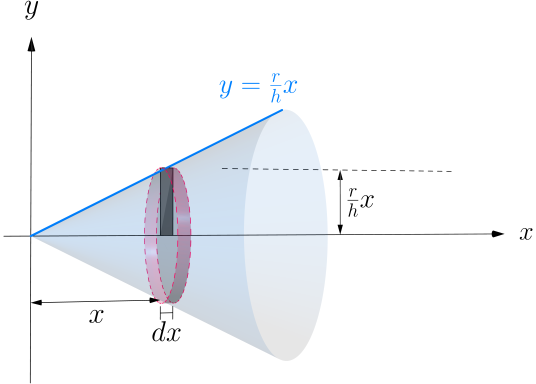
The volume of this thin disk is \pi\left(\dfrac{r}{h} x\right)^{2} d x
Therefore, if we add the volumes of such thin disks, we get the volume of the solid (cone)
Exercise 19.7. Find the area of the curve y=x^3-\ln x between x=0 and x=1.
Answer
1.25.Solution
\text { area }=\int_{0}^{1}\left(x^{3}-\ln x\right) d x=\int_{0}^{1} x^{3} d x-\int_{0}^{1} \ln x d x
We have learned that \displaystyle \int \ln x d x=x \ln x+x. Therefore
\text { area }=\left[\frac{1}{4} x^{4}-x \ln x+x\right]_{0}^{1}
Notice that we cannot simply put x=0 in \frac{1}{4} x^{4}-x \ln x+x because \ln 0 is not defined. However, if x is positive but very close to 0, x \ln x is close to 0 . Therefore
Exercise 19.8. Find the volume generated by the curve y=\sqrt{1+x^2}, as it revolves about the axis of x, between x=0 and x=4.
Answer
\dfrac{76}{3}\pi\approx 79.6.Solution
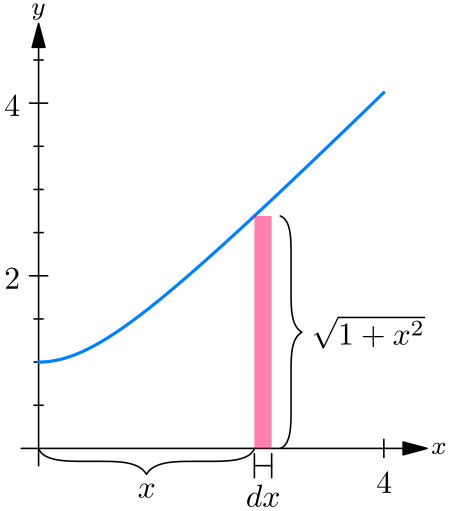
/p>
The total volume is
Exercise 19.9. Find the volume generated by a sine curve revolving about the axis of x (0\leq x\leq \pi).
Answer
\text{Volume} = \dfrac{\pi^2}{2}\approx 4.9348.Solution
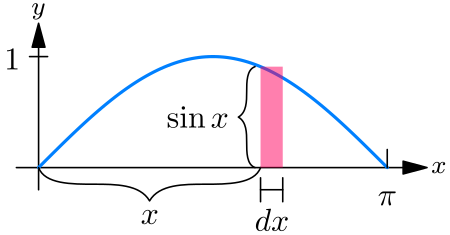
Exercise 19.10. Find the area of the portion of the curve xy=a included between x=1 and x = a. Find the mean ordinate between these limits.
Answer
a\ln a,\dfrac{a}{a - 1} \ln a.Solution
/p>
Exercise 19.11. Show that the quadratic mean of the function y=\sin x, between the limits of 0 and \pi radians, is \dfrac{\sqrt2}{2}. Find also the arithmetical mean of the same function between the same limits; and show that the form-factor is =1.11.
Solution
Recall \text { Quadratic mean }=\sqrt{\frac{1}{L} \int_{0}^{L} y^{2} d x}
Thus
/p>
/p>
\text { Form factor } \approx \frac{0.707}{0.637} \approx 1.11
Exercise 19.12. Find the arithmetical and quadratic means of the function x^2+3x+2, from x=0 to x=3.
Answer
\text{Arithmetical mean} = 9.5; \text{quadratic mean} \approx 10.85.Solution
/p>
Exercise 19.13. Find the quadratic mean and the arithmetical mean of the function y=A_1 \sin x + A_3 \sin 3x (0\leq x\leq 2\pi).
Answer
\text{Quadratic mean} = \dfrac{1}{\sqrt{2}} \sqrt{A_1^2 + A_3^2}; \text{arithmetical mean} = 0.Solution
Quadratic mean =\sqrt{\frac{1}{2 \pi} \int_{0}^{2 \pi}\left(A_{1} \sin x+A_{3} \sin 3 x\right)^{2} d x}
To find \int_{0}^{2 \pi}\left(A_{1} \sin x+A_{3} \sin 3 x\right)^{2}\, d x, we expand the expression. That is, we evaluate
\int_{0}^{2 \pi}\left(A_{1}^{2} \sin ^{2} x+2 A_{1} A_{3} \sin x \sin 3 x+A_{3}^{2} \sin ^{2} 3 x\right) d x
Now we integrate term by term. First, /p>
To evaluate \int_{0}^{2 \pi} \sin x \sin 3 x d x, we use the product-to-sum formula:
\sin M \sin N=\frac{1}{2}[\cos (M-N)-\cos (M+N)]
Therefore,
/p>
Now the last term: /p>
Therefore, the quadratic mean is /p>
Exercise 19.14. A certain curve has the equation y=3.42e^{0.21x}. Find the area included between the curve and the axis of x, from the ordinate at x=2 to the ordinate at x = 8. Find also the height of the mean ordinate of the curve between these points.
Answer
Area is approximately 62.6 square units. Mean ordinate is approximately 10.43.Solution
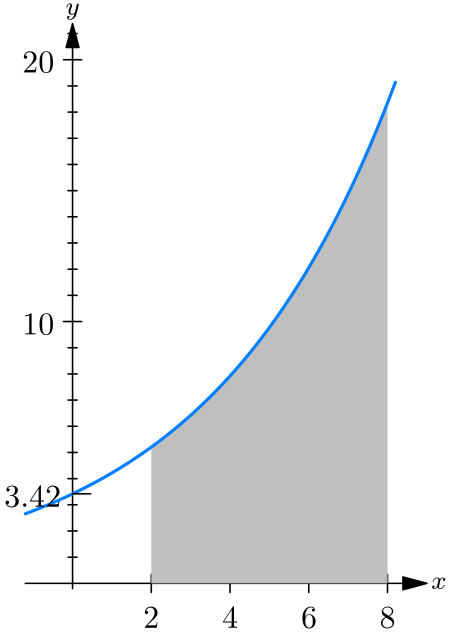
Exercise 19.15. Show that the radius of a circle, the area of which is twice the area of a polar diagram, is equal to the quadratic mean of all the values of r for that polar diagram.
Solution
\text { Area of circle }=\pi R^{2}=2 \times \frac{1}{2} \int_{0}^{2 \pi} r^{2} d \theta
Quadratic mean of r=\sqrt{\frac{1}{2 \pi} \int_{0}^{2 \pi} r^{2} d \theta}
=\sqrt{\frac{1}{2 \pi} \pi R^{2}}=\frac{R}{\sqrt{2}} \text {. }
Exercise 19.16. Find the volume generated by the curve y=\pm\dfrac{x}{6}\sqrt{x(10-x)} rotating about the axis of x.
Answer
436.3. (This solid is pear shaped.)Solution
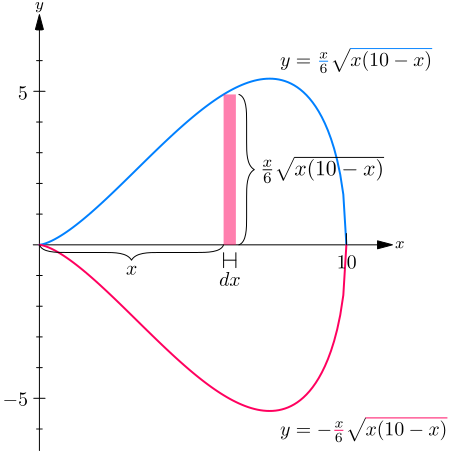
/p>
Full Chapter
One use of the integral calculus is to enable us to ascertain the values of areas bounded by curves.
Let us try to get at the subject bit by bit.
Let (the following figure) be a curve, the equation to which is known. That is, in this curve is some known function of . Think of a piece of the curve from the point to the point .
Let a perpendicular be dropped from , and another from the point . Then call and , and the ordinates and . We have thus marked out the area that lies beneath the piece . The problem is, how can we calculate the value of this area?
The secret of solving this problem is to conceive the area as being divided up into a lot of narrow strips, each of them being of the width . The smaller we take , the more of them there will be between and . Now, the whole area is clearly equal to the sum of the areas of all such strips. Our business will then be to discover an expression for the area of any one narrow strip, and to integrate it so as to add together all the strips. Now think of any one of the strips. It will be like this: being bounded between two vertical sides, with a flat bottom , and with a slightly curved sloping top. Suppose we take its average height as being ; then, as its width is , its area will be (the next figure). And seeing that we may take the width as narrow as we please, if we only take it narrow enough its average height will be the same as the height at the middle of it. Now let us call the unknown value of the whole area , meaning surface. The area of one strip will be simply a bit of the whole area, and may therefore be called . So we may write
If then we add up all the strips, we get
So then our finding depends on whether we can integrate for the particular case, when we know what the value of is as a function of .
For instance, if you were told that for the particular curve in question , no doubt you could put that value into the expression and say: then I must find .
That is all very well; but a little thought will show you that something more must be done. Because the area we are trying to find is not the area under the whole length of the curve, but only the area limited on the left by , and on the right by , it follows that we must do something to define our area between those ‘limits.’
This introduces us to a new notion, namely that of integrating between limits. We suppose to vary, and for the present purpose we do not require any value of below (that is ), nor any value of above (that is ). When an integral is to be thus defined between two limits, we call the lower of the two values the lower limit, and the upper value the upper limit. Any integral so limited we designate as a definite integral, by way of distinguishing it from an indefinite integral (which is the reverse of differentiation) to which no limits are assigned.
In the symbols which give instructions to integrate, the limits are marked by putting them at the top and bottom respectively of the sign of integration. Thus the instruction will be read: find the integral of between the lower limit and the upper limit .
Sometimes the thing is written more simply Well, but how do you find an integral between limits, when you have got these instructions?
Look again at the first figure of this chapter. Suppose we could find the area under the larger piece of curve from to , that is from to , naming the area . Then, suppose we could find the area under the smaller piece from to , that is from to , namely the area . If then we were to subtract the smaller area from the larger, we should have left as a remainder the area , which is what we want. Here we have the clue as to what to do; the definite integral between the two limits is the difference between the integral worked out for the upper limit and the integral worked out for the lower limit.
Let us then go ahead. First, find the general integral thus: and, as is the equation to the curve (Fig. 19.1), is the general integral which we must find.
Doing the integration in question by the rule, we get and this will be the whole area from up to any value of that we may assign.
Therefore, the larger area up to the upper limit will be and the smaller area up to the lower limit will be
Now, subtract the smaller from the larger, and we get for the area the value,
This is the answer we wanted. Let us give some numerical values. Suppose , , and and . Then the area is equal to \begin{gathered} 10(8 - 6) + \frac{0.06}{3} (8^3 - 6^3) \\ \begin{align} &= 20 + 0.02(512 - 216) \\ &= 20 + 0.02 \times 296 \\ &= 20 + 5.92 \\ &= 25.92. \end{align} \end{gathered}
Let us here put down a symbolic way of stating what we have ascertained about limits: where is the integrated value of corresponding to , and that corresponding to .
All integration between limits requires the difference between two values to be thus found. Also note that, in making the subtraction the added constant has disappeared.
In summary, \bbox[5px,border:1px solid black;background-color:#f2f2f2]{\displaystyle \int_{x_1}^{x_2}y\,dx=\left[\int y\,dx\right]_{x_1}^{x_2}}. The symbol means to evaluate for and for and subtract the latter from the former.
Examples
Example 19.1. To familiarize ourselves with the process, let us take a case of which we know the answer beforehand. Let us find the area of the triangle (the following figure), which has base and height . We know beforehand, from obvious mensuration, that the answer will come .
Now, here we have as the “curve” a sloping line for which the equation is
The area in question will be
Integrating and putting down the value of the indefinite integral in square brackets with the limits marked above and below, we get \begin{align} \text{area} &= \left[ \frac{1}{3} \cdot \frac{1}{2} x^2 +C\right]^{x=12}_{x=0} \\ &= \left[ \frac{x^2}{6}+C \right]^{x=12}_{x=0} \\ &= \left[ \frac{12^2}{6}+C \right] - \left[ \frac{0^2}{6}+C \right] \\ &= \frac{144}{6} = 24.\quad \text{Ans}. \end{align}
Let us satisfy ourselves about this rather surprising dodge of calculation, by testing it on a simple example. Get some squared paper, preferably some that is ruled in little squares of one-eighth inch or one-tenth inch each way. On this squared paper plot out the graph of the equation,
The values to be plotted will be:
The plot is given below.
Now reckon out the area beneath the curve by counting the little squares below the line, from as far as on the right. There are whole squares and four triangles, each of which has an area equal to squares; or, in total, squares. Hence is the numerical value of the integral of between the lower limit of and the higher limit of .
As a further exercise, show that the value of the same integral between the limits of and is .
Example 19.2. Find the area, between limits and , of the curve (the following figure).
Solution. \begin{align} \text{Area} &= \int^{x=x_1}_{x=0} y \cdot dx = \int^{x=x_1}_{x=0} \frac{b}{x+a}\, dx \\[6pt] &= b \bigl[\ln(x + a)+C \bigr]^{x_1} _{0} \\[6pt] &= b \bigl[\ln(x_1 + a)+C - \ln(0 + a)-C\bigr] \\ &= b \ln \frac{x_1 + a}{a}.\quad \text{Ans}. \end{align}
Note—Notice that in dealing with definite integrals the constant always disappears by subtraction.
Let it be noted that this process of subtracting one part from a larger to find the difference is really a common practice. How do you find the area of a plane ring (next figure), the outer radius of which is and the inner radius is ? You know from mensuration that the area of the outer circle is ; then you find the area of the inner circle, ; then you subtract the latter from the former, and find area of ring ; which may be written .
Example 19.3. Here’s another case—that of the die-away curve. Find the area between and , of the curve (the following figure) whose equation is \begin{align} y &= be^{-x}. \end{align}
Solution. The integration (see here) gives \begin{align} &= b\big[-e^{-x}\big]^a _0 \\ &= b\bigl[-e^{-a} - (-e^{-0})\bigr] \\ &= b(1-e^{-a}). \end{align}
Example 19.4. Another example is afforded by the adiabatic curve of a perfect gas, the equation to which is , where stands for pressure, for volume, and is of the value (see below).
Find the area under the curve (which is proportional to the work done in suddenly compressing the gas) from volume to volume .
Solution. Here we have \begin{align} \text{area} &= \int^{v=v_2}_{v=v_1} cv^{-n} \cdot dv \\ &= c\left[\frac{1}{1-n} v^{1-n} \right]^{v_2} _{v_1} \\ &= c \frac{1}{1-n} (v_2^{1-n} - v_1^{1-n}) \\ &= \frac{-c}{0.42}\left(\frac{1}{v_2^{0.42}} - \frac{1}{v_1^{0.42}}\right). \end{align}
Area of a Disk
Example 19.5. Prove the ordinary mensuration formula, that the area of a circle whose radius is , is equal to .
Solution. Consider an elementary zone or annulus of the surface (the next figure), of breadth , situated at a distance from the centre. We may consider the entire surface as consisting of such narrow zones, and the whole area will simply be the integral of all such elementary zones from centre to margin, that is, integrated from to .
We have therefore to find an expression for the elementary area of the narrow zone. Think of it as a strip of breadth , and of a length that is the periphery of the circle of radius , that is, a length of . Then we have, as the area of the narrow zone,
Hence the area of the whole circle will be:
Now, the general integral of is . Therefore, or whence
Mean (or Average) Value of a Function
Example 19.6. Let us find the mean ordinate (the average -value) of the positive part of the curve , which is shown below.
Solution. To find the mean ordinate, we shall have to find the area of the piece , and then divide it by the length of the base . But before we can find the area we must ascertain the length of the base, so as to know up to what limit we are to integrate. At the ordinate has zero value; therefore, we must look at the equation and see what value of will make . Now, clearly, if is , will also be , the curve passing through the origin ; but also, if , ; so that gives us the position of the point .
Then the area wanted is \begin{align} \text{area}&= \int^{x=1}_{x=0} (x-x^2)\, dx \\ &= \left[\frac{1}{2} x^2 - \frac{1}{3} x^3 \right]^{1}_{0} \\ &= \left[\frac{1}{2} - \frac{1}{3} \right] - [0-0] \\ &= \frac{1}{6}. \end{align}
But the base length is .
Therefore, the average ordinate of the curve .
[Note—It will be a pretty and simple exercise in maxima and minima to find by differentiation what is the height of the maximum ordinate. It must be greater than the average.]
The mean (or the average) ordinate of any curve, over a range from to , is given by the expression, \bbox[5px,border:1px solid black;background-color:#f2f2f2]{\displaystyle \text{mean } y = \frac{1}{x_2-x_1} \int^{x=x_2}_{x=x_1} y \cdot dx.}
Areas in Polar Coordinates
When the equation of the boundary of an area is given as a function of the distance of a point of it from a fixed point (see the next figure) called the pole, and of the angle which makes with the positive direction of the -axis, the process just explained can be applied just as easily, with a small modification. Instead of a strip of area, we consider a small triangle , the angle at being , and we find the sum of all the little triangles making up the required area.
The area of such a small triangle is approximately or ; hence the portion of the area included between the curve and two positions of corresponding to the angles and is given by \bbox[5px,border:1px solid black;background-color:#f2f2f2]{\displaystyle \text{Area}=\frac{1}{2} \int^{\theta=\theta_2}_{\theta=\theta_1} r^2\, d\theta.}
Note— In the above formula must be expressed in radian measure.
Examples
Example 19.7. Find the area of the sector of radian in a circumference of radius inches (the following figure).
Solution. The polar equation of the circumference is evidently . The area is
Example 19.8. Find the area of the first quadrant of the curve (known as “Pascal’s Snail”), the polar equation of which is (the following figure).
Solution. \begin{align} \text{Area} &= \frac{1}{2} \int^{\theta=\frac{\pi}{2}}_{\theta=0} a^2(1+\cos \theta)^2\, d\theta \\ &= \frac{a^2}{2} \int^{\theta=\frac{\pi}{2}}_{\theta=0} (1+2 \cos \theta + \cos^2 \theta)\, d\theta \\ &= \frac{a^2}{2} \left[\theta + 2 \sin \theta + \frac{\theta}{2} + \frac{\sin 2 \theta}{4} \right]^{\frac{\pi}{2}}_{0} \\ &= \frac{a^2(3\pi+8)}{8}. \end{align}
Volumes by Integration
What we have done with the area of a little strip of a surface, we can, of course, just as easily do with the volume of a little strip of a solid. We can add up all the little strips that make up the total solid, and find its volume, just as we have added up all the small little bits that made up an area to find the final area of the figure operated upon.
Examples.
Example 19.9. Find the volume of a sphere of radius .
Solution. Method (a). A thin spherical shell has for volume (see Fig. 19.9); summing up all the concentric shells which make up the sphere, we have
Method (b). We can also proceed as follows: a slice of the sphere, of thickness , has for volume . This thin disk is generated by rotating the strip of thickness shown in Fig. 19.14 around the -axis (see Fig 19.15). The length of this strip, , is related to the distance of this strip from the origin, , through Hence \begin{align} \text{volume sphere} &= 2 \int^{x=R}_{x=0} \pi(R^2-x^2)\, dx \\ &= 2 \pi \left[ \int^{x=R}_{x=0} R^2\, dx - \int^{x=R}_{x=0} x^2\, dx \right] \\ &= 2 \pi \left[R^2x - \frac{x^3}{3} \right]^R_0 = \frac{4\pi}{3} R^3. \end{align}
Example 19.10. Find the volume of the solid generated by the revolution of the curve about the axis of , between and .
Solution. The volume of a thin disk generated by rotating the thin strip is (see the following figure).
Hence \begin{align} \text{volume} &= \int^{x=4}_{x=0} \pi y^2\, dx = 6\pi \int^{x=4}_{x=0} x\, dx \\ &= 6\pi \left[ \frac{x^2}{2} \right]^4_0 = 48\pi = 150.8. \end{align}
On Quadratic Means
In certain branches of physics, particularly in the study of alternating electric currents, it is necessary to be able to calculate the quadratic mean of a variable quantity. By “quadratic mean” is denoted the square root of the mean of the squares of all the values between the limits considered. Other names for the quadratic mean of any quantity are its “virtual” value, or its “r.m.s.” (meaning root-mean-square) value. If is the function under consideration, and the quadratic mean is to be taken between the limits of and ; then the quadratic mean is expressed as \bbox[5px,border:1px solid black;background-color:#f2f2f2]{\displaystyle \text{quadratic mean of } y=\sqrt{\frac{1}{L} \int^L_0 y^2\, dx}.}
Examples.
Example 19.11. Find the quadratic mean of the function (next figure).
Solution. Here the integral is , which is .
Dividing by and taking the square root, we have
Here the arithmetical mean is ; and the ratio of quadratic to arithmetical mean (this ratio is called the form-factor) is .
Example 19.12. Find the quadratic mean of the function .
Solution. The integral is , that is .
Hence
Example 19.13. Find the quadratic mean of the function .
Solution. The integral is , that is , or which is .
Hence the quadratic mean is .
Exercises
Exercise 19.1. Find the area of the curve between and , and the mean ordinates (average -value) between these limits.
Answer
; .Solution
\begin{align} \text { area } &=\int_{0}^{6}\left(x^{2}+x-5\right) d x \\ &=\left[\frac{x^{3}}{3}+\frac{x^{2}}{2}-5 x\right]_{x=0}^{x=6} \\ & =\left(\frac{6^{3}}{3}+\frac{6^{2}}{2}-5 \times 6\right)-\left(\frac{0}{3}+\frac{0}{2}-5 \times 0\right) \\ & =60 \end{align}
Exercise 19.2. Find the area of the parabola between and . Show that it is two-thirds of the rectangle of the limiting ordinate and of its abscissa.
Answer
of .Solution
\begin{align} \text { area under curve }& =\int_{0}^{a} 2 a \sqrt{x} d x\\ & =2 a \int_{0}^{a} x^{\frac{1}{2}} d x \\ & =\left[2 a \times \frac{2}{3} x^{\frac{3}{2}}\right]_{x=0}^{x=a} \\ & =\frac{4}{3} a^{\frac{5}{2}} \end{align}
\begin{align} \text { area of rectangle }& =a \times(2 a \sqrt{a}) \\ & =2 a^{\frac{5}{2}} \end{align}
\begin{align} \text{area under curve} &=\frac{2}{3}\times \text{ area of rectangle}\\ &=\frac{4}{3}a^{\frac{5}{2}} \end{align}
Exercise 19.3. Find the area of the positive portion of a sine curve and the mean ordinate.
Answer
; .Solution
\begin{align} \text { area of the region shown } & =\int_{0}^{\pi} \sin x d x \\ & =[-\cos x]_{x=0}^{x=\pi} \\ & =1-(-1)=2 \\ \text { mean } y=\frac{1}{\pi} \int_{0}^{\pi} \sin x d x & =\frac{2}{\pi} \end{align}
Exercise 19.4. Find the area of the positive portion of the curve (), and find the mean ordinate.
Answer
; .Solution
The problem asks for the hatched area
\begin{align} \text { area } & =\int_{0}^{\pi} \sin ^{2} x d x \\ & =\int_{0}^{\pi} \frac{1-\cos 2 x}{2} d x\\ & =\frac{1}{2}\left[\int_{0}^{\pi} d x-\int_{0}^{\pi} \cos 2 x d x\right] \\ & =\frac{1}{2}\left[x-\frac{1}{4} \sin 2 x\right]_{0}^{\pi} \\ & =\frac{\pi}{2} \approx 1.57 \end{align}
\begin{align} \text { mean } y&=\frac{1}{\pi} \int_{0}^{\pi} \sin ^{2} x d x\\ &=\frac{1}{\pi} \cdot \frac{\pi}{2}\\ &=\frac{1}{2} \end{align}
Exercise 19.5. Find the area included between the two branches of the curve from to , also the area of the positive portion of the lower branch of the curve (see Fig. 11.12).
Answer
, .Solution
\begin{align} \text { area } & =\int_{0}^{1}\left[\left(x^{2}+x^{5 / 2}\right)-\left(x^{2}-x^{5 / 2}\right)\right] d x \\ & =2 \int_{0}^{1} x^{\frac{5}{2}} d x \\ & =2\left[\frac{2}{7} x^{\frac{7}{2}}\right]_{0}^{1} \\ & =\frac{4}{7} \approx 0.571 \end{align}
\begin{align} \text { area } & =\int_{0}^{1}\left(x^{2}-x^{5 / 2}\right) d x \\ & =\left[\frac{1}{3} x^{3}-\frac{2}{7} x^{\frac{7}{2}}\right]_{0}^{1} \\ & =\frac{1}{3}-\frac{2}{7}=\frac{1}{21} \approx 0.0476 \end{align}
Exercise 19.6. Find the volume of a cone of radius of base , and of height .
Answer
.Solution
If line rotates around the -axis, it creates a cone of radius of base , and of height .
We just need to calculate the volume of this solid of revolution.
The volume of this thin disk is
Therefore, if we add the volumes of such thin disks, we get the volume of the solid (cone)
\begin{align} \text { Volume } & =\int_{0}^{h} \pi\left(\frac{r}{h} x\right)^{2} d x \\ & =\frac{\pi r^{2}}{h^{2}} \int_{0}^{h} x^{2} d x=\frac{\pi r^{2}}{h^{2}}\left[\frac{1}{3} x^{3}\right]_{0}^{h} \\ & =\frac{1}{3}\left(\pi r^{2}\right) h \end{align}
Exercise 19.7. Find the area of the curve between and .
Answer
.Solution
We have learned that . Therefore
Notice that we cannot simply put in because is not defined. However, if is positive but very close to is close to 0 . Therefore
\begin{align} \text { area } & =\left(\frac{1}{4}-1 \times \ln 1+1\right)-(0-0+0) \\ & =\frac{5}{4}=1.25 \end{align}
Exercise 19.8. Find the volume generated by the curve , as it revolves about the axis of , between and .
Answer
.Solution
\begin{align} d V & =\pi\left(\sqrt{1+x^{2}}\right)^{2} d x \\ & =\pi\left(1+x^{2}\right) d x \end{align}
The total volume is
\begin{align} V & =\int_{0}^{4} \pi\left(1+x^{2}\right) d x \\ & =\pi\left[x+\frac{x^{3}}{3}\right]_{0}^{4} \\ & =\frac{76}{3} \pi \approx 79.6 \end{align}
Exercise 19.9. Find the volume generated by a sine curve revolving about the axis of ().
Answer
.Solution
\begin{align} & d V=\pi \sin ^{2} x\, d x \\ V & =\int_{0}^{\frac{\pi}{2}} \pi \sin ^{2} x\, d x \\ = & \pi \int_{0}^{\pi} \frac{1-\cos 2 x}{2}\, d x \\ = & \frac{\pi}{2}\left[x-\frac{1}{4} \sin 2 x\right]_{0}^{\pi} \\ = & \frac{\pi}{2}(\pi-0)=\frac{\pi^{2}}{2} \approx 4.9348 \end{align}
Exercise 19.10. Find the area of the portion of the curve included between and . Find the mean ordinate between these limits.
Answer
,.Solution
\begin{align} \text { Area } & =\int_{1}^{a} y d x \\ & =\int_{1}^{a} \frac{a}{x} d x \\ & =\big[a \ln x\big]_{x=1}^{x=a} \\ & =a \ln a \end{align}
\begin{align} \text { mean } y & =\frac{1}{a-1} \int_{1}^{a} y d x \\ & =\frac{a}{a-1} \ln a \end{align}
Exercise 19.11. Show that the quadratic mean of the function , between the limits of and radians, is . Find also the arithmetical mean of the same function between the same limits; and show that the form-factor is .
Solution
Recall
Thus
\begin{align} \text { Quadratic mean } & =\sqrt{\frac{1}{\pi} \int_0^\pi \sin ^2 x\ d x} \\ & =\sqrt{\frac{1}{\pi} \int_0^\pi \frac{1-\cos 2 x}{2}\ d x} \\ & =\sqrt{\frac{1}{\pi}\left[\frac{x}{2}-\frac{1}{4} \sin 2 x\right]_0^\pi} \\ & =\sqrt{\frac{1}{\pi} \frac{\pi}{2}}=\\ & = \frac{1}{\sqrt{2}} \approx 0.707 \end{align}
\begin{align} \text { Arithmetical mean } & =\frac{1}{L} \int_0^L y\ d x \\ & =\frac{1}{\pi} \int_0^\pi \sin x\ d x \\ & =\left[-\frac{1}{\pi} \cos x\right]_0^\pi\\ & =\frac{2}{\pi} \approx 0.637 \end{align}
Exercise 19.12. Find the arithmetical and quadratic means of the function , from to .
Answer
; .Solution
\begin{align} \text { Arithmetical mean } & =\frac{1}{3} \int_{0}^{3} y\, d x \\ & =\frac{1}{3} \int_{0}^{3}\left(x^{2}+3 x+2\right) d x \\ & =\frac{1}{3}\left[\frac{1}{3} x^{3}+\frac{3}{2} x^{2}+2 x\right]_{0}^{3} \\ & =\frac{19}{2}=9.5 \end{align}
\begin{align} y= & x^{2}+3 x+2,0 \leq x \leq 3 \\ \text { Quadratic mean } & =\sqrt{\frac{1}{3} \int_{0}^{3} y^{2} d x} \\ & =\sqrt{\frac{1}{3} \int_{0}^{3}\left(x^{4}+9 x^{2}+4+6 x^{3}+4 x^{2}+12 x\right) d x} \\ & =\sqrt{\frac{1}{3}\left[\frac{x^{5}}{5}+3 x^{3}+4 x+\frac{3}{2} x^{4}+\frac{4}{3} x^{3}+6 x^{2}\right]_{0}^{3}} \\ & =\sqrt{\frac{1}{3} \times \frac{3531}{10}} \approx \sqrt{117.7} \approx 10.85 \end{align}
Exercise 19.13. Find the quadratic mean and the arithmetical mean of the function ().
Answer
; .Solution
Quadratic mean
To find , we expand the expression. That is, we evaluate
Now we integrate term by term. First, \begin{align} \int_{0}^{2 \pi} \sin ^{2} x d x&=\int_{0}^{2 \pi} \frac{1-\cos 2 x}{2} d x\\ &=\left[\frac{x}{2}-\frac{1}{4} \sin 2 x\right]_{0}^{2 \pi}\\ &=\pi \end{align}
To evaluate , we use the product-to-sum formula:
Therefore,
\begin{align} \int_{0}^{2 \pi} \sin x \sin 3 x\, d x & =\int_{0}^{2 \pi} \frac{1}{2}[\cos 2 x-\cos 4 x]\, d x \\ & =\left[\frac{1}{4} \sin 2 x-\frac{1}{8} \sin 4 x\right]_{0}^{2 \pi} \\ & =0 \end{align}
Now the last term: \begin{align} \int_{0}^{2 \pi} \sin ^{2} 3 x d x & =\int_{0}^{\pi} \frac{1-\cos 6 x}{2} d x \\ & =\left[\frac{x}{2}-\frac{1}{12} \sin 6 x\right]_{0}^{2 \pi} \\ & =\pi . \end{align}
Therefore, the quadratic mean is \begin{align} & \sqrt{\frac{1}{2 \pi} \int_{0}^{2 \pi}\left(A_{1}^{2} \sin ^{2} x+2 A_{1} A_{3} \sin x \sin 3 x+A_{3}^{2} \sin ^{2} 3 x\right) d x} \\ & =\sqrt{\frac{1}{\pi}\left[A_{1}^{2} \int_{0}^{\pi} \sin ^{2} x d x+2 A_{1} A_{3} \int_{0}^{\pi} \sin x \sin 3 x d x+A_{3}^{2} \int_{0}^{\pi} \sin ^{2} 3 x d x\right]} \\ & =\sqrt{\frac{1}{2 \pi}\left[A_{1}^{2} \times \pi+2 A_{1} A_{2} \times 0+A_{3}^{2} \times \pi\right]} \\ & =\sqrt{\frac{1}{2}\left(A_{1}^{2}+A_{3}^{2}\right)} \end{align}
\begin{align} \text { Arithmetical mean } &=\frac{1}{2 \pi} \int_{0}^{2 \pi}\left(A_{1} \sin x+A_{3} \sin 3 x\right) d x \\ & =\frac{1}{2 \pi}\left[-A_{1} \cos x-\frac{A_{3}}{3} \cos 3 x\right]_{0}^{2 \pi} \\ & =0 . \end{align}
Exercise 19.14. A certain curve has the equation . Find the area included between the curve and the axis of , from the ordinate at to the ordinate at . Find also the height of the mean ordinate of the curve between these points.
Answer
Area is approximately square units. Mean ordinate is approximately .Solution
\begin{align} \text { Area } & =\int_{2}^{8} 3.42 e^{0.21 x} d x \\ & =\left[\frac{3.42}{0.21} e^{0.21 x}\right]_{2}^{8} \\ & =\frac{3.42}{0.21}\left(e^{1.68}-e^{0.42}\right) \approx 62.6 \\ \text { mean ordinate } & =\frac{1}{8-2} \int_{0}^{8} y d x \\ & =\frac{1}{6} \times 62.6 \approx 10.43 \end{align}
Exercise 19.15. Show that the radius of a circle, the area of which is twice the area of a polar diagram, is equal to the quadratic mean of all the values of for that polar diagram.
Solution
Quadratic mean of
Exercise 19.16. Find the volume generated by the curve rotating about the axis of .
Answer
. (This solid is pear shaped.)Solution
\begin{align} & d V=\pi \cdot\left[\frac{x}{6} \sqrt{x(10-x)}\right]^{2} d x=\frac{\pi}{36} x^{2}[x(10-x)] d x \\ V & =\int_{0}^{10} \frac{\pi}{36} x^{3}(10-x) d x \\ & =\frac{\pi}{36}\left[\frac{10}{4} x^{4}-\frac{1}{5} x^{5}\right]_{0}^{10} \\ & =\frac{1250 \pi}{9} \approx 436.33 \end{align}