In this section, we shall demonstrate how far an analytic function may be characterized by the nature of its singularities and roots, a singular point being a place where the regularity property fails. In particular, we are concerned with functions whose singularities are isolated. A singular point is said to be an isolated singularity of a single-valued function if it is completely surrounded by regular points; i.e., if is regular in some deleted neighborhood .
Table of Contents
4.2.1 The Nature of Singular Points
The most natural instances of isolated singularities that come to mind are like the singularities of the functions and at the origin . Another example is given by the function defined to be at the origin and zero everywhere else. Note, however, that the point is not an isolated singularity for the multi-valued function . True, does not possess a derivative at the origin, but there is no neighborhood of the origin in which the function is single-valued. In other words, the requirement that be single-valued is meant to exclude the consideration of branch points.
We have at hand a convenient tool, the Laurent series, for analyzing the behavior of a function at an isolated singularity. Set The series converges in any sufficiently small circle about .
We divide isolated singularities into three classes according to the local behavior of the function.
First of all may be bounded in some neighborhood of , In that case we have (after (1.23) ) where can be made arbitrarily small. We conclude that all the coefficients with negative index vanish. Hence, except for the point , may be represented by a simple Taylor series The Taylor series defines an analytic function throughout the interior of a circle about and this function coincides with at all of these points but the center . Hence if we redefine at by setting then the function will be regular. In other words, if is regular and is bounded in the deleted neighborhood of , then the function will have a limiting value at . The singularity can only be due to a break in the continuity of . Thus, in order to make the function regular at it suffices to redefine at the one point so as to make continuous. For this reason, singularities of this type are said to be removable .
On the other hand, if is not bounded in the neighborhood of then terms of negative index will appear in the Laurent expansion. We may then write where \begin{align} g(z-z_{0})&=\sum_{n=0}^{\infty} a_{n}(z-z_{0})^{n} ;\\ h\Big(\frac{1}{z-z_{0}}\Big)&=\sum_{n=1}^{\infty} a_{-n}\Big(\frac{1}{z-z_{0}}\Big)^{n}. \end{align}The series of powers of is called the principal part of . Now, if the principal part of consists of only a finite number of terms; for and , then we say that has a pole of order at . If, on the contrary, the principal part of the Laurent series has an infinite number of terms we say that is an essential singularity of . The function exhibits such a singularity at .
If has a pole of order at then clearly is regular at . Conversely, if is regular at then can have at most a pole of order at . Clearly, if is regular and possesses a zero of order at then has a pole of order at .
At a pole the function becomes infinite: more precisely, given any , however large, there is an entire neighborhood in which This is immediately clear from the fact that can be written in the form where is regular in the neighborhood of .
In contrast to the behavior of a function in the neighborhood of a pole we have the Theorem of Weierstrass .
Theorem 4.3 (Theorem of Weierstrass). In the neighborhood of an isolated essential singularity an analytic function comes arbitrarily close to every complex value.
Proof. Suppose then that has an essential singularity at and that is bounded away from the value in a neighborhood of . It follows that is bounded away from zero and hence that is bounded and regular in the deleted neighborhood of . Hence can have at worst a removable singularity at . The value cannot be zero for then would have only a pole at . On the other hand, if approaches a non-zero limit at then has a removable singularity at which also conflicts with our assumption. The proof is complete. ◻
There is a much stronger result due to Picard which states that, in every neighborhood of an essential singularity, an analytic function actually takes on every complex value, excepting at most two. We shall prove this result in a later chapter.
We broaden the definition of essential singularity to include all singularities (not necessarily isolated) which are not poles or removable singularities. Hence a point of accumulation of poles in a domain where is otherwise regular is an essential singularity. The nomenclature is justified, for an accumulation point of poles does not behave like a pole. Suppose that could be bounded below in a neighborhood of , . Then in that neighborhood the function would be regular and would be an accumulation point of zeros for in its domain of regularity. But this would imply that identically and that is clearly impossible.
The Point
We shall adopt certain conventions for describing the behavior of an analytic function at infinity. Suppose that is regular in the exterior of some circle. We set and define is evidently a regular function in the neighborhood of the origin except perhaps at . We ascribe to at the behavior of the function at the origin.
If is bounded for sufficiently large values of then will be bounded in the neighborhood of and therefore can be completed to be regular at the origin. We then say that is a regular point of . If is regular at infinity then from f'(z)=-\zeta^{2} g'(\zeta) we conclude that the derivative of must have a zero of at least second order at .
If is regular at infinity it may easily be represented by a Laurent series expanded about the origin. In fact, we have the Taylor expansion for : whence
Exercises
Exercise 4.1 . A function is represented by a power series which converges uniformly for all complex values . Show that must be a polynomial.
Exercise 4.2 . The functions and both have poles at of orders and respectively. Characterize the behavior at of the functions
- .
Exercise 4.3 . If is an accumulation point of poles in a domain where is otherwise regular show that comes arbitrarily close to every complex value in every neighborhood of .
4.2.2 The Zeros and Poles of an Analytic Function
Let be a regular function with the possible exception of poles in a simple connected domain . Clearly, there can be no accumulation point of either poles or zeros in , for in the first case would have an essential singularity, in the second would vanish identically. Now, let be a simple closed curve in which avoids the poles and zeros of the function. The integral \frac{1}{2 \pi i} \oint \frac{f'(z)}{f(z)} \,d z is equal to the sum of the residues of f'(z) / f(z) at its singularities inside . These singularities, as we now show, will occur only at the zeros and poles of .
Suppose that is a zero of order. Then in a neighborhood of we may set where is regular and . Hence f'(z)=n(z-a)^{n-1} g(z)+(z-a)^{n} g'(z). Therefore \frac{f'(z)}{f(z)}=\frac{n}{z-a}+\frac{g'(z)}{g(z)}; here g'(z) / g(z) is perfectly regular at . The residue at , either by (1.24) or directly from the definition, is equal to .
Similarly, if has a pole at then in the neighborhood of where is regular and . It follows as before that f'(z) / f(z) has a simple pole at with residue .
We conclude that \tag{2.21} \frac{1}{2 \pi i} \int_{C} \frac{f'(z)}{f(z)} \,d z=Z-P where and denote respectively the number of zeros and the number of poles of inside , each being counted with its order.
If is regular in the full plane with the exception only of poles we obtain an interesting consequence. The integral (2.21) taken in the negative sense may validly be interpreted as an integral in the positive sense about the point . 1 Thus the integral in reverse orientation gives us the number ; here is the total count of zeros, the total count of poles in the exterior of . Hence . In other words, for a function with no essential singularity in the full plane the count of zeros is equal to the count of poles.
Since we have a means of counting the zeros and poles of an analytic function we can give a proof of the fundamental theorem of algebra which is more satisfying than that of Chapter III since it gives a complete count of the roots. We prove that a polynomial of degree has precisely zeros. The only singularity of is a pole of order at . Since the count of roots is the same as the count of poles the number of zeros of counted with their multiplicities is exactly .
The integral (2.21) has an interesting geometrical meaning. We have \tag{2.22} \int_{z_1}^{z_2} \frac{f'(z)}{f(z)} \,d z=\log f(z_{2})-\log f(z_{1}). Now, the function increases by if describes a closed circuit counterclockwise about the origin and decreases by if the circuit is described in the opposite sense. Hence (2.21) counts the number of times the point encircles the origin in the -plane as describes the curve in the -plane once in the positive sense. Since and is single-valued we obtain \tag{2.23} Z-P=\frac{1}{2 \pi i} \int_{C} \frac{f'(z)}{f(z)} \,d z=\frac{1}{2 \pi} \Delta_{C} \operatorname{am}\big(f(z)\big) where denotes the total change in as traverses the closed path . In particular, if is regular in we obtain for the number of zeros \tag{2.24} 2 \pi Z=\Delta_{C} \operatorname{am}\big(f(z)\big).
A useful criterion for the comparison of the zeros of two functions is given by Rouché’s Theorem .
Theorem 4.4 (Rouché’s Theorem). Let and be regular in a simply-connected with boundary curve . On the boundary curve assume and . Then and will have the same number of zeros in the interior of .
Proof. Obviously, neither nor has zeros on . Let and Z' respectively denote the numbers of zero of and in . Then by (2.24) \begin{align} 2 \pi Z'&=\Delta_{C} \operatorname{am}(f+g)\\ &=\Delta_{C} \operatorname{am} \Big(f\big(1+\frac{g}{f}\big)\Big) \\ &=\Delta_{C} \operatorname{am}(f) +\Delta_{C} \operatorname{am}\Big(1+\frac{g}{f}\Big). \end{align}Hence 2 \pi Z'=2 \pi Z+\Delta_{C} \operatorname{am}\Big(1+\frac{g}{f}\Big). Since on , it is clear that on . We can only have , which proves the theorem. ◻
Rouché’s Theorem provides us with another proof of the fundamental theorem of algebra. The polynomial has zeros and on a sufficiently large circle satisfies the conditions of the theorem with respect to .
Exercises
Exercise 4.4 . Show that a rational function not identically constant takes on every complex value exactly as many times as it has poles.
Exercise 4.5 . Let be regular in a region bounded by a simple closed curve . If has a simple root in the interior of and on the boundary demonstrate that the root is given by the integral \zeta=\frac{1}{2 \pi i} \int_{C} \frac{z f'(z)}{f(z)} \,{d}z.
Exercise 4.6 . Prove that if is regular in the circle and maps in a one-to-one manner on a simple closed curve in the -plane, then has a single-valued inverse inside . [Hint: show that , where is any point inside , has only one zero inside .]
Exercise 4.7 . Locate the complex roots of
Exercise 4.8 . Hurwitz Theorem . If are regular functions in and if the tend uniformly to a regular non-constant in , then is a zero of if and only if it is a limit point of zeros of the ( ). Note in particular that this theorem furnishes a proof for the continuous dependence of the roots of a polynomial upon its coefficients. [Hint: use Rouché’s Theorem for the functions and on an arbitrarily small circle about to show that and (for sufficiently large ) have the same number of zeros inside this circle.]
4.2.3 Entire and Meromorphic Functions
An important class of analytic functions consists of those functions which have no essential singularity at any finite point of the plane. These we divide into several categories.
An entire function is a function which is regular throughout the finite part of the plane. Unless an entire function is constant it must have a singularity at infinity; if the singularity is a pole the function is said to be an entire rational function ; if is an essential singularity the function is called an entire transcendental function .
A meromorphic function has no finite singularities except poles. Again, it is said to be rational meromorphic if is a regular point or a pole, transcendental meromorphic if is an essential singularity.
The polynomials are examples of entire rational functions. Conversely, we now prove that an entire rational function can be only a polynomial. For, if has a pole at we may write \tag{2.30} f(z)=a_{n} z^{n}+\cdots+a_{0}+\frac{a_{-1}}{z}+\frac{a_{-2}}{z^{2}}+\cdots where there are only a finite number of terms of positive index. The polynomial coincides with at infinity. Since and are regular everywhere else in the plane the function must be regular in the full plane including the point infinity, therefore uniformly bounded. Hence, by Liouville’s Theorem ,
In the same fashion we show that a rational meromorphic function must be a rational function, the quotient of two polynomials. For let be a rational meromorphic function and suppose that the points include all the poles of . The number of poles is finite since otherwise they would possess a point of accumulation in the full plane and the function would possess an essential singularity. Let denote the principal parts of the Laurent expansions of about the point respectively. By the same reasoning as before the function is regular in the full -plane and hence \tag{2.31} f(z)=p_{\infty}(z)+\sum_{\nu=0}^{\infty} p\Big(\frac{1}{z - z_\nu}\Big) + \textit{constant}. But the are polynomials in their respective arguments. It follows that is a rational function, the quotient of two polynomials, and that (2.31) gives the decomposition of into partial fractions, the being the zeros of .
Exercises
Exercise 4.9 . Let be an entire function for which is bounded in the exterior of a sufficiently large circle, . Show that is a polynomial of degree .
Exercise 4.10 . Using the result of Exercise 9 prove that a rational meromorphic function is the quotient of two polynomials.
An entire rational function, that is, a polynomial, can be represented to within a constant multiple as a product of linear factors. For suppose are the roots of a polynomial of degree. Then we have a regular function in the full -plane and hence constant. Thus, given the roots of a polynomial we may specify to within a multiplicative constant We are led to ask more generally, how completely do the roots characterize an entire (not necessarily rational) function?
Again, in (2.31) we saw that a rational meromorphic function is determined to within an additive constant by its behavior at poles. How completely is an arbitrary meromorphic function defined by the character of its poles?
The answers to these questions are given in two remarkable theorems of Weierstrass and Mittag-Leffler; the one gives an infinite product representation for entire functions, the other represents a meromorphic function by an infinite decomposition into partial fractions.
Before we prove these theorems let us first indicate the limitations on these results. Suppose and are entire functions with the same zeros. The function has no zeros and is also an entire function. As an exercise the reader may verify that can be written in the form where is an entire function. It follows that an entire function is determined by its zeros only to within a factor where is a completely arbitrary entire function. For a meromorphic function it may just as easily be shown that it is characterized by the nature of its poles only to within an added entire function.
In effect we have already answered our question for meromorphic functions when the number of poles is finite. The only other possibility is that is an accumulation point of poles, for obviously no finite accumulation point of poles may be admitted. The complete answer is then given by the Mittag-Leffler Theorem .
Theorem 4.5 (Mittag-Leffler Theorem). Let be any sequence of distinct points tending to infinity and suppose that to each there is associated a polynomial in the variable . It is then possible to find a meromorphic function having poles at the points , but no other points, and with the corresponding principal parts . The function may then be represented in the form \tag{2.32} f(z)=\omega(z)+\sum_{\nu = 1}^{\infty}\bigg(p_\nu\Big(\frac{1}{z-z_{\nu}}\Big)-q_{\nu}(z)\bigg) where the are polynomials and is an entire function of .
Proof. Unlike the finite case we must ensure that the representation (2.32) converges. First of all we may suppose that the sequence is given in order of magnitude since the only accumulation point of is infinity. Conceivably but all other points differ from zero. For the moment we avoid this case and suppose that . The function being regular everywhere except at itself must then be regular at the origin. Therefore it has a Taylor expansion at the origin \tag{2.33} p_{\nu}\Big(\frac{1}{z-z_{\nu}}\Big)=c_{0}^{(\nu)} z+c_{1}^{(\nu)} z+c_{2}^{(\nu)}{z}^{2}+\cdots with the radius of convergence . The series (2.33) is uniformly convergent in the smaller circle : . Consequently, in , can be approximated by a finite sum as closely as we please. In particular, there is a finite sum such that \tag{2.34} \left|p_{\nu}\Big(\frac{1}{z-z_{\nu}}\Big)-q_{\nu}(z)\right|<\frac{1}{2^{\nu}} throughout .
The series converges to the desired meromorphic function in every circle about the origin since any such circle can be contained in one of the . Inside the first part of the series gives us no trouble. It is an analytic function with no singularities but the prescribed poles. The second part of the series is a sum of regular terms in and (by (2.34) ) is dominated by the convergent series . The series must then converge uniformly in . But, by the Weierstrass Convergence Theorem , a uniformly convergent series of regular functions converges to a regular function. Hence the second part of the series can introduce no new singularities into . So, for all intents and purposes, the theorem is proved. 2 ◻
In general, to ensure convergence of the series (2.32) , the degree of the polynomials will not be uniformly bounded. However, in special circumstances, all the may be chosen of the same finite degree. In particular, if the function has only simple poles then the may all be chosen of degree if only the series converges. This case is the most important one for the applications. The meromorphic functions that arise in practice usually have simple poles.
Although the Mittag-Leffler Theorem can be used easily to expand a function with simple poles into partial fractions we would still have the problem of determining the entire function . In this special case we have a more direct method.
Let be any simple closed curve which avoids the poles of . If is any regular point in the interior of then we have where denotes the residue of at , and where the sum is taken over all the singularities of in the interior of . Now, since is assumed to have only simple poles, we have (by (1.24) ) and thus we obtain the representation
Since the poles are isolated we can surely find a sequence of closed curves , each containing all the preceding ones in its interior, each avoiding all the poles of , such that the distance of from the origin tends to infinity with . If for some such sequence , then denoting the poles in the ring-shaped domain between and by we see that the series \tag{2.35} f(z)=\sum_{n=1}^{\infty}\left(\sum\frac{\operatorname{Res} f\big(z_{\nu}^{(n)}\big)}{z-z_{\nu}^{(n)}}\right) converges and gives the decomposition of the function into partial fractions.
Consider the special case where is the quotient of two polynomials where the degree of is greater than that of and has only simple roots which are not roots for . The above representation gives \begin{align} f(z)&=\frac{P(z)}{Q(z)}\\ &=\frac{1}{2 \pi{i}} \int_{C_{\rho}} \frac{P(\zeta) \,d \zeta}{Q(\zeta)(\zeta-z)}+\sum_{\nu=1}^{n} \frac{\operatorname{Res} f(z_{\nu})}{z-z_{\nu}} \end{align}where is a circle containing all the . Now by (1.24) \operatorname{Res} f(z_{\nu})=P(z_{\nu}) / Q'(z_{\nu}) and since tends to zero (cf. III, (3.23) ) as the radius of tends to infinity, we obtain \tag{2.36} \frac{P(z)}{Q(z)}=\sum_{\nu=1}^{n} \frac{1}{z-z_{\nu}} \frac{P(z_{\nu})}{Q'(z_{\nu})}, the familiar formula of Lagrange for the decomposition of a rational function into partial fractions.
The decomposition of a transcendental meromorphic function with only simple poles is well illustrated by the function The poles of this function occur at the zeros of . The function has a simple zero at the origin, hence, in view of its periodicity, at all integral values . It has no other zeros. The cosine function has zeros at none of these points. Consequently has its poles at the integer points and these are all simple. We now show that where by the notation we mean . For paths of integration we take squares with sides parallel to the coordinate axes and side lengths twice . These clearly satisfy the necessary requirements. Since the function is periodic, the residues at all the poles are the same as at the origin and, plainly, . Hence, in any square In order to complete the proof we need only show that the integral in this equation tends to zero as . Accordingly, denote the sides of by , , , and as in the diagram.
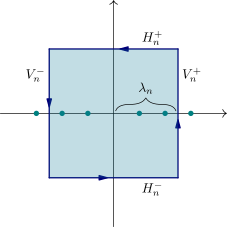
Now is an odd function, that is Consequently and similarly On we have , . On , , . Since we have on For sufficiently large, and on since can only take on negative real values. Thus is uniformly bounded on the .
This provides us with the estimate for and also for . But , whence and this clearly goes to zero as . The proof is now complete. We have shown that \tag{2.37} \pi \cot \pi z=\sum_{\nu = -\infty}^{+\infty} \frac{1}{z - \nu}. The periodicity of the function is exhibited by the fact that we may substitute for without changing the expansion. It is often convenient to use the formula in the form \tag{2.37a}\pi \cot \pi z=\frac{1}{z}+\sum_{n=1}^{\infty} \frac{2 z}{z^{2}-n^{2}}.
Now that we have obtained a partial fractional representation for meromorphic functions we may hope to use it to prove something for the zeros of an entire function, for the zeros of may be interpreted as simple poles for f'(z) / f(z) . In fact we prove the Weierstrass Product Theorem .
Theorem 4.6 (Weierstrass Product Theorem). Let be a sequence of distinct points tending to infinity and suppose that to each there is associated an integer . It is then possible to find an entire function having zeros of order at the points but no other zeros. The function may then be written as a uniformly convergent product 3 \tag{2.38} e^{\omega(z)} \prod_{\nu=0}^{\infty}\Big(1-\frac{z}{z_{\nu}}\Big)^{\alpha_{\nu}} e^{p_{\nu}(z)} where the are polynomials and is an arbitrary entire function.
Proof. We make the same assumption concerning the arrangement of the points of as in the Mittag-Leffler Theorem . Again, if , we reserve that point for separate consideration. The logarithmic derivative \frac{f'(z)}{f(z)}=\frac{d}{d z} \log f(z) is a meromorphic function with only simple poles. For in the neighborhood of the zero of we have where is a regular function and . Hence \frac{f'(z)}{f(z)}=\frac{\alpha_{\nu}}{z-z_{\nu}}+\frac{g'(z)}{g(z)}. We now construct a meromorphic function with the prescribed poles at the points . In the neighborhood of the origin is a regular function and has the Taylor expansion which converges uniformly in the circle of radius . In fact, if we set we obtain So if we choose so large that , say, then in the series the whole tail end of the series from onward converges uniformly in . Integrating along the straight line from to we obtain where is a polynomial and where the logarithm is uniquely defined by the integral. But the uniform convergence of this series implies the uniform convergence of the product Multiplying by a regular function will not change the convergence property so we form the full product This product must then represent an entire function with all the prescribed zeros. If the origin is a zero too then we have to multiply the above product by an appropriate power of . The formula (2.38) follows from our earlier remarks. ◻
The same method used in the proof of the theorem can be applied to obtain the product representation of from the expansion of , (2.37) , since . From (2.37) we derive \begin{align} \frac{d}{d z}(\log \sin \pi z)-\frac{1}{z} & =\frac{d}{d z} \log \Big(\frac{\sin \pi z}{z}\Big) \\ & =\sum_{\nu=1}^{\infty} \frac{2 z}{z^{2}-\nu^{2}}. \end{align}In any finite region the tail end of this series converges uniformly. Hence we may integrate term-by-term. Taking the integral from to we obtain Now at , has a removable singularity so we complete it to a regular function. Thus From this we obtain the convergent infinite product \tag{2.39} \sin \pi z=\pi z \prod_{\nu=1}^{\infty}\Big(1-\frac{z^{2}}{\nu^{2}}\Big), a formula discovered by Euler. If we set , we obtain the well-known Wallis product: \begin{align} \frac{\pi}{2}&=\prod_{\nu=1}^{\infty} \frac{2\nu.2\nu}{(2 \nu-1).(2 \nu+1)}\\ &=\frac{2 \cdot 2}{1 \cdot 3} \cdot \frac{4 \cdot 4}{3 \cdot 5} \cdot \frac{6 \cdot 6}{5 \cdot 7} \cdots. \end{align}
Exercises
Exercise 4.11 . Prove the existence of an entire function taking on arbitrarily preassigned values on any sequence tending to infinity.
Exercise 4.12 . Generalize the Mittag-Leffler Theorem to a function which has an infinite number of poles, but no other singularities, in the interior of the unit circle, .
Exercise 4.13 . Represent the following meromorphic functions in partial fraction form: \begin{align} & {f}({z})=\pi \tan \pi z \\ & {f}({z})=\pi \sec \pi z \\ & {f}({z})=\pi \csc \pi z. \end{align}
Exercise 4.14 . Represent the following entire function as an infinite product: