Until now an analytic function has been taken as a function defined and differentiable in a given domain (except perhaps for isolated points) but we have not so far asked ourselves to what extent any specific domain has to do with the characterization of the function. For example, we have represented a function regular in a circle by a convergent power series. But is there any reason to restrict our notion of the represented function to that circle? Thus the function is defined by the power series in the interior of the unit circle but, while the power series is not even defined beyond the unit circle, the function is both defined and regular everywhere except at the point . We could look at this the other way and think of as an analytic extension of the function defined by the power series in the unit circle. We are led to ask how far the power series determines . Is it possible to construct another function which coincides with in the circle? In this section, we shall show that the values of the function are completely determined once they are specified in any neighborhood.
Table of Contents
4.3.1 Analytic Continuation
In section 4.1.1 we have already proved that two functions regular inside the same circle are identical throughout the circle if they are equal on only as much as a sequence of points with an accumulation point in the interior. With a slight modification this result can be extended to any domain:
Theorem 4.7 . If two functions and , regular in a domain , are equal on a sequence of points with an accumulation point in , then they are identical throughout .
Proof. We show that the function in . We certainly have in a neighborhood of . Now let be any point of . We can connect to by a path lying entirely in . Denote the nearest distance of approach of to the boundary of by . Take a finite subdivision of into lengths no greater than and at each subdivision point draw a circle of radius .
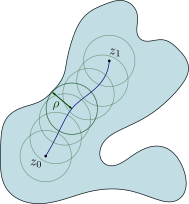
Since the successive centers are no farther apart than we have constructed a chain of overlapping circles running from to in . Since each circle has at least an entire neighborhood in common with the preceding and since in the first circle, it follows that . ◻
Thus we see that a function regular and analytic in a domain is completely determined by its behavior in any neighborhood of an interior point of , and also, if an analytic extension of the function into a larger domain is possible then the extension, too, is virtually determined. We say virtually, because in general the representation of an analytic and regular function in its original domain is not valid in the extended domain, as in the example of .
This leads to a fundamental problem: Given an analytic function defined in a domain , can be extended into a larger domain, and if so, how? We shall use the name function-element for a single-valued analytic function defined in a domain , since the possibility of extending the domain of definition makes it desirable to distinguish between the whole function defined in the largest possible domain into which the function can be extended analytically, " the function in the large ", and the part of it defined in .
Definition 4.1 (Analytic Continuation). Let be an analytic function defined in a domain and let be another domain having a part in common with . Then, a function is said to be a direct analytic continuation of into if is analytic in and coincides identically with in the common portion . Plainly, such an extension is unique.
Since the process is symmetrical in and , is also an analytic continuation of . Note that this is equivalent to the existence of an analytic function in which coincides with in and with in .
The question arises whether analytic continuation is always possible. It is obvious that we can never extend a function analytically over a singular point (excepting a removable discontinuity). We may even construct a function in the unit circle for which every point on the boundary is singular. An example of such a function is given by the power series convergent in the unit circle. Now if is any fraction then for we have whence . The function becomes unbounded in the neighborhood of every boundary point. Therefore the whole unit circle is a singular line for the function, across which no analytical extension is possible. We call such a line a natural boundary for the function.
If a function-element in has been analytically extended by into , then it may be possible to extend , by means of an element , analytically into a domain by the same process. A sequence of function-elements is said to form a "chain" of function-elements if each is a direct analytic continuation of the preceding. We generalize the notion of analytic continuation by calling two function-elements analytic continuations of each other if they can be connected by a chain in the above sense. The original case, that of two directly overlapping function-elements, will be called an "immediate" analytic extension.
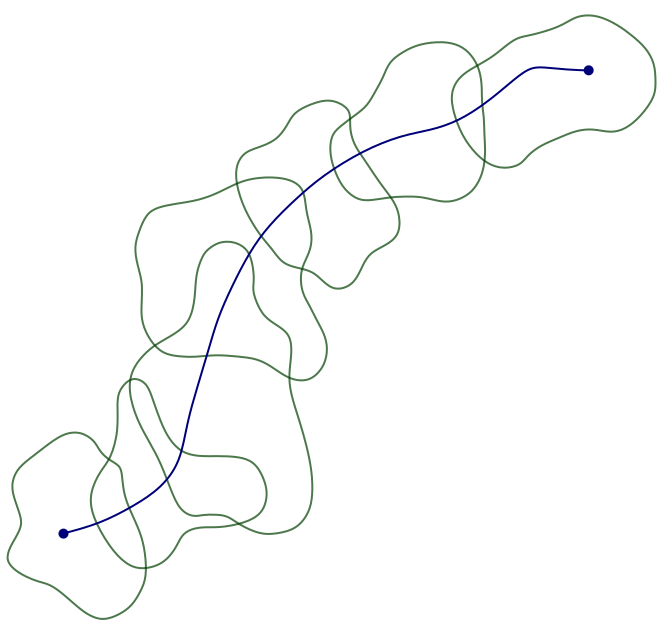
It is often convenient to speak of analytic continuation along an arc, or curve. If is a function-element in and an arc extending out from , then is said to be continued analytically along the arc if we can find a chain of function-elements leading out from which completely cover the arc . Evidently any chain extension is equivalent to an arc extension, and vice versa.
Analytic Continuation by Power Series
Our discussion so far offers no way of actually finding either an immediate analytic continuation of a function-element, or a chain of function-elements along a given arc. The following general method, due to Weierstrass, is based on the theory of power series:
Suppose a function-element to be defined by a power series \tag{3.11} f_{0}(z)=\sum a_{n}(z-z_{0})^{n}
in its circle of convergence about . Then, if is any point in , we may expand about in a Taylor series f(z)=f(z_{1})+f'(z_{1})(z-z_{1})+\cdots+\frac{f^{(n)}(z_{1})}{n !}(z-z_{1})^{n} + \cdots where , , are computed directly from (3.11) . This series defines a new function-element which is regular in its circle of convergence and which is the same as in the original domain . If a part of extends outside of , we have succeeded in finding an immediate analytic extension of . Since we know that a power series converges in the largest circle possible in which the function (considered in the large) remains regular, the only thing which may prevent from extending out of is the presence of a singular point of the function on the boundary of .
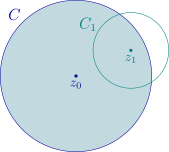
The power series method may also be used to obtain a chain of function-elements along a given are. For let be any arc extending out from a regular point and denote by the circle of convergence of the function at . We may choose a point on , expand about in a circle , then choosing a point in but not in (if this is possible), expand about , etc. We can ultimately reach any point on the arc with a finite number of these circles, provided each circle has a part outside the previous circle and the circles do not nest down to a point. If the circles do nest down to a point, this point must be a singularity of the function in the large, and no further extension is possible.
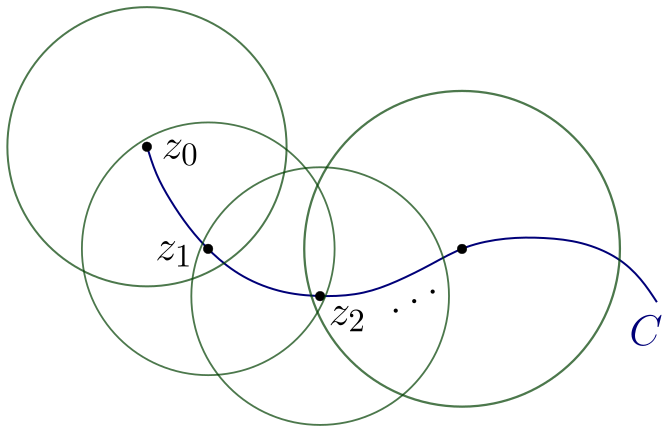
This construction shows, if we know beforehand where the singularities of the function lie, that it is always possible to continue analytically along any path avoiding them. For, if is the distance from to the nearest singularity or boundary point, we may expand in a circle of radius about any point along ; choosing points at distance apart as centers will provide the desired chain of circles.
The Monodromy Theorem
If the function-element is an analytic continuation of but not an immediate continuation then we cannot say that is uniquely determined by since can depend on the choice of the chain leading to it. As a simple example, consider defined in a small circle about . We can extend along the upper half of the unit circle by overlapping circles until a circle about , with a corresponding power series, is obtained. But, from the multiple-valuedness of the logarithm, the same continuation process performed along the lower half of the unit circle also gives a function-element about , but differing from the first by . Of course, the same function-element would be reached if we chose two chains not including the origin between them. Two chains issuing from a given function-element will be called equivalent if they have the same values wherever they overlap.
The example of leads us to suspect that every instance in which two different paths give two different continuations may be accounted for by the existence of some singularity between them. This is actually so, as we see by the Monodromy Theorem:
Theorem 4.8 (Monodromy Theorem). If a function-element defined in a domain can be continued analytically along every path in a simply connected domain containing , then is single-valued in .
Proof. Let and C' be any two paths connecting a point of to any point of . We may assume that and C' have no intersections – that together they form a simple closed path , for otherwise we could consider each of the simple components of separately. We wish to prove that analytic continuation along either path gives the same value at .
Denote the smallest distance between and the boundary of by . Thus any function element defined on or in its interior must have a radius of convergence .
is a simple closed curve. It follows by a well-known theorem of topology 1 that and its interior may be mapped in a continuous one-to-one manner respectively, onto the boundary of the unit circle, , and its interior, . Suppose the transformation to be given by the mapping and inversely by . We may suppose , since we may assure this result by applying a linear transformation. By means of the mapping we may describe a continuous deformation of the curve into the curve C' through simple arcs running from to in the interior of . To do this we first deform the semicircle which is the image of into the image of , say by means of the circular arcs , .
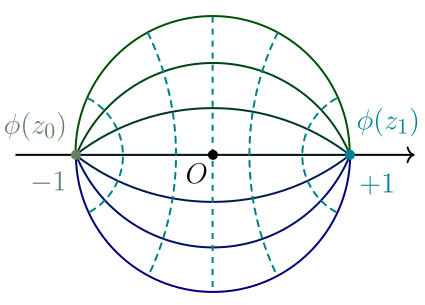
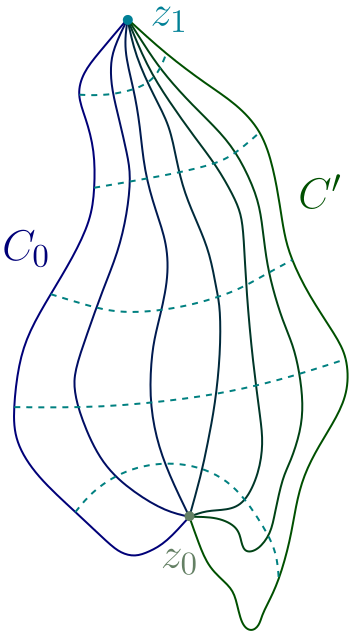
As goes from to the arcs sweep out the entire unit circle beginning at and ending at \phi(C') . It follows that the corresponding curves in the -plane, furnish a similar sweeping out of the region bounded by .
Now, since is continuous on a closed set it is uniformly continuous. Consequently, we may find a such that insures . This will certainly occur (as the reader may easily verify) if . We choose deformation curves \begin{align} z(t; \theta_{0})&=z(C_{0}),\\ z(t; \theta_{1})&=z(C_{1}),\\ &\ \vdots\\ z(t; \theta_{n})&=z(C_{n})=z(C') \end{align}so that . Further, we take cross curves \begin{align} z(t_{0}; \theta)&=z_{0},\\ z(t_{1}; \theta)&=z(\gamma_{1}),\\ z(t_{2}; \theta)&=z(\gamma_{2}),\\ &\ \vdots\\ z(t_{m}; \theta)&=z_{1} \end{align}so that . By our choice of we have thereby subdivided the interior of into meshes where any two points of a mesh lie within distance of each other.
Let us continue the function along the curves and observe what occurs. Denote by the point of intersection of with . We continue along by means of the successive function elements at the . Now the continuations on and must lead to the same value at , for they define the same function in the entire region enclosed between them. First of all, they are the same in the first mesh, the region bounded by , , and , since all points of the mesh are nearer to than and hence lie within the first function element at . Now the second function elements at and being of radius , must contain both the first and second mesh and these meshes are also contained in the function element at . The two continuations being direct analytic continuations, must agree wherever they have a common overlap in the function element about . They must therefore be identical on the second mesh. Now the third mesh together with the second lies inside the function elements about , , , and and therefore the two continuations must be identical on the third mesh.
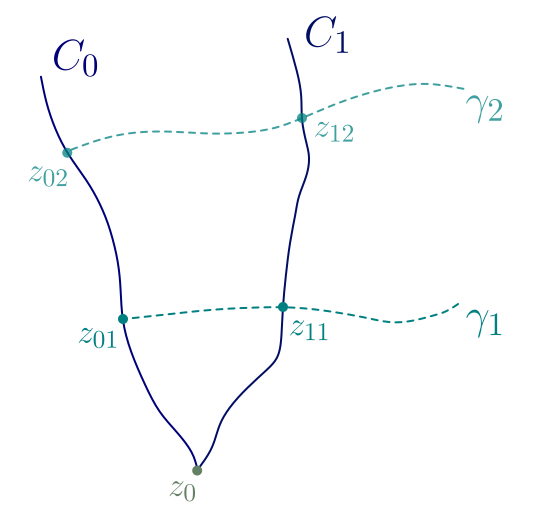
In this way we continue and in a finite number of steps we obtain two continuations which define the same function in the region bounded by and . Hence both continuations give the same value at . By the same argument it follows that C_{2}, C_{3}, C_{4}, \ldots, C_{n}=C' all give the same value at . ◻
Analytic Functions in the Large
We are now in a position to define the concept of analytic function in the large.
An analytic function in the large is the totality of the function-elements which are obtained by analytic continuation from a given function element. Any of the function elements of the analytic function could be used for the definition. It can be proved that the point set at which the analytic function exists always fulfills the properties of a domain, where, in the case of multi-valuedness of the function a couple of one and the same -value and two distinct functional values are considered as two distinct points. Clearly, an appropriate notion of "neighborhood of a point" must be introduced, in order that such an abstract point set form a space. We will not go into a detailed analysis of the concept of the domain of an analytic function, but this is what we meant by a Riemann surface.
An interesting discovery in this connection was made by Poincaré and Volterra. It states that the different values that an analytic function assigns to a fixed value of can be at most denumerably infinite.
Exercises
Exercise 4.15 . The series represents a function element of in the unit circle. Applying Weierstrass’ method, obtain a chain of circles encircling and show that the opposite function element is obtained over the origin by analytical continuation around .
4.3.2 Analytic Continuation by Means Other than Power Series
The power series method of analytic continuation though useful as a theoretical means is not very useful as a practical procedure. A method that can be used in many practical cases is the reflection principle of Schwarz. It depends on the so-called Principle of continuity .
Theorem 4.9 (Principle of continuity). Let and be two function elements defined in the respective domains and which do not overlap but which share a piecewise smooth arc as a common boundary. Then, if both functions are continuous and assume the same value on the boundary each is an analytic continuation of the other.
In other words, if two analytic functions are connected continuously across an arc, they are connected analytically.
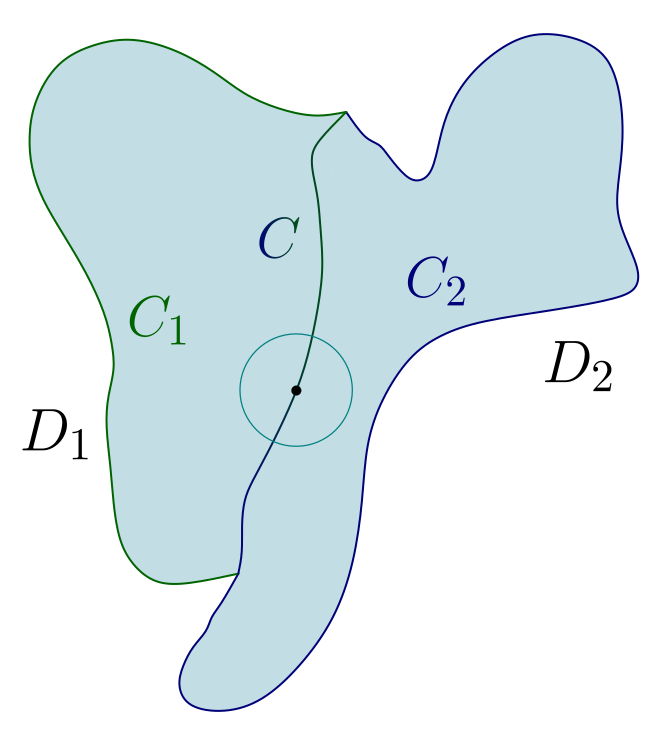
Proof. Since is smooth in the neighborhood of at least one point, it is possible to draw a circle about that point which is intersected by no more than twice.
Let be represented in the form and suppose the origin, , say, is a point contained in a smooth interval on . We may choose the interval so small that the change in the direction of is kept arbitrarily small. Setting , , we specify \tag{a} -\frac{\pi}{4}<\theta_{t}-\theta<\frac{\pi}{4}.
Let us investigate either branch of the curve proceeding from , say, through increasing values of , . The entire are must lie in the sector .
For suppose there were a point outside the sector; . By the Mean Value Theorem there must be a point \zeta'=z(\tau) on between and which has the direction of the chord joining to , . Hence , contradicting (a) .
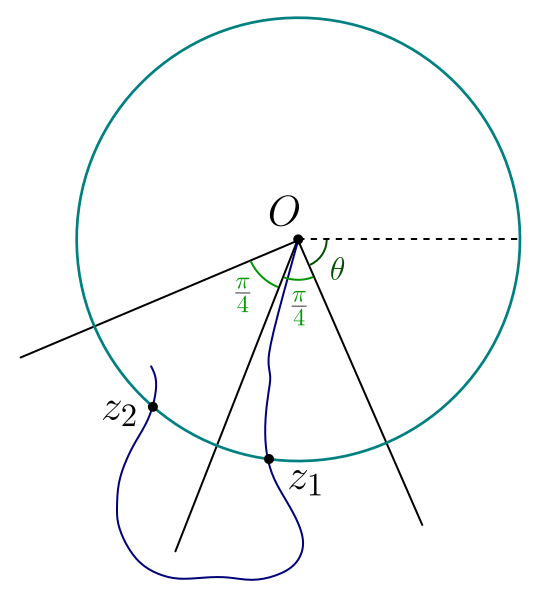
Now we may find a circle about so small that it has no points of intersection with outside the smooth interval. The arc can only have one intersection with the circle. For suppose there were two and . Since they lie on the circle without the sector we must have either \left\{ \begin{aligned} \theta - \frac{3\pi}{4}\\ \theta + \frac{\pi}{4} \end{aligned} \right\} < \operatorname{am}(z_1 - z_2) < \left\{ \begin{aligned} \theta - \frac{\pi}{4}\\ \theta + \frac{3\pi}{4} \end{aligned} \right\}. But, using the Mean Value Theorem again, there must be a point between and on which has the direction . The assertion follows at once.
Denote by the part of the circle in , the part of the circle in . The circle is divided by into two roughly semicircular subdomains and lying in and respectively. We define a function inside the circle such that \begin{align} & F(z)=f_{1}(z) \text { in } R_{1} \\ & F(z)=f_{2}(z) \text { in } R_{2} \end{align}and takes on the common values on the boundary . Clearly, is continuous in the circle. It is sufficient to prove that is analytic.
Now, by Cauchy’s Integral Formula we may express in and in by the integrals \begin{align} & I_{1}=f_{1}(z)=\frac{1}{2 \pi i} \int \frac{f_{1}(t)}{t-z} \,d t, \\ & I_{2}=f_{2}(z)=\frac{1}{2 \pi i} \int \frac{f_{2}(t)}{t-z} \,d t \end{align}where the integrals are taken around the boundaries of the respective domains. Consequently I_{1}=\left\{\begin{array}{ll} F(z) & \text { for } z \text { in } R_{1} \\ 0 & \text { for } z \text { in } R_{2} \end{array} ; \quad I_{2}= \begin{cases}0 & \text { for } z \text { in } R_{1} \\ F(z) & \text { for } z \text { in } R_{2}\end{cases}\right. or However, since the integrals are taken in opposite directions along and on , we have simply for in where is a continuous function. Hence is analytic in the entire circle. We conclude that and are analytic continuations of each other. ◻
Theorem 4.10 (The principle of reflection). Let be an analytic function of in a domain which has a straight line segment in its boundary. Suppose further that is continuous on and maps onto a straight line segment on the boundary of the image of . Let be the domain obtained from by reflection through and the domain obtained by reflecting through . If is the reflection of in the reflection of in then the function F(z)= \begin{cases}f(z) & \text { for } z \text { in } D \\ f^{*}(z^{*}) & \text { for } z^{*} \text { in } D^{*}\end{cases} is analytic in .
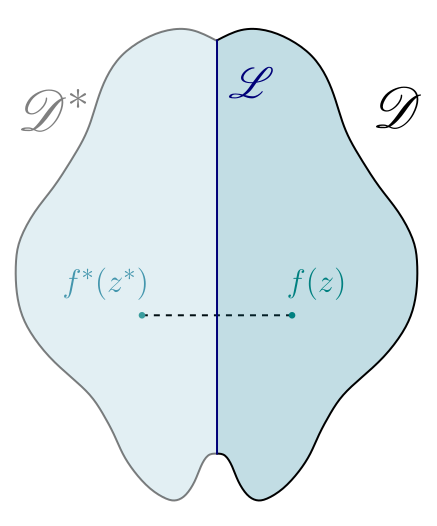
Proof. The statement is easily proved. The mapping of onto by is conformal, hence so is the mapping of onto by . and are continuous and take on the same values on . The conditions of the principle of continuity are satisfied and is an analytic continuation of in the reflected domain . ◻
The principle of reflection may also be used when the boundary of a domain contains a circular are which maps onto a circular arc. In that case, the continuation is obtained by inversion with respect to the circular arcs.
A similar reflection theorem applies to harmonic functions. Namely, if is a harmonic function whose boundary values become zero along a straight line , then it may be extended harmonically into the domain obtained by reflection across of its domain , by assigning to the image (x', y') of a point the value u(x', y')=-u(x, y). For, under the hypothesis, the analytic function is purely imaginary on , and we may apply the reflection principle to this function by reflection across the imaginary axis, yielding \begin{align} \label{4.a_2}\tag{a} f(z')&=u(x', y')+i v(x', y')\\ &=-u(x, y)+i v(x, y). \end{align}
Similarly, if is a harmonic function whose normal derivative vanishes along a straight line , it may be extended harmonically by reflection across , by assigning to the reflected point (x', y') the value {v}({x}', {y}')={v}({x}, {y}). For then the corresponding function to which is conjugate becomes constant 2 along (we can assume this constant to be zero) and we can apply (a) .
As an example of a simple application of the reflection principle, it can be shown that if maps the interior of the unit circle in a one-to-one conformal way on itself, it must be a linear function. This is left as an exercise.
Applications of the Principle of Reflection, The Function
The four elementary processes and the inversion of these processes applied to the basic function gave us the polynomials, rational functions, and important types of algebraic functions, namely those expressible in terms of a finite number of root extractions of rational functions. (For example, ). These operations are not, however, sufficient to define all the important analytic functions, for instance, the so-called transcendental functions , , etc. Introducing the process of differentiation does not extend the class of algebraic functions. On the other hand integration does, and we find that many important types of transcendental functions are representable by means of indefinite integrals of algebraic, even rational functions. This includes all of the so-called "elementary functions" and also the elliptic functions. As simple examples, we have By taking the inverse of the latter we get the function , and by simple algebraic combinations, all the other trigonometric functions.
In order that such a representation converges or remains single-valued it is generally necessary to make some restriction on its domain of definition. It frequently occurs that this domain is bounded by straight lines or segments of circles, and has an image under the function element which is bounded in a similar way. The process of reflection then becomes an important means of extending such function elements, either indefinitely, or to their natural boundaries, and of analyzing and studying the properties of the function so obtained. Many important types of functions can be studied and built up in this way. We shall illustrate by discussing in detail the function defined by the integral \tag{3.20} {w}=\int_{0}^{{z}} \frac{{d} z}{\sqrt{1-z^{2}}} It will be seen later that the reflection process considered analytically, exhibits the known periodicity of the inverse function, while considered geometrically, it is a construction of the Riemann surface for the function.
The critical points of occur at , which correspond to . If we cut the -plane along the real axis from to and from to , thereby connecting these points, it then becomes possible to extend analytically along every arc in the upper half-plane, and hence, by the Monodromy Theorem , (3.20) defines a single-valued analytic function , which maps the upper half-plane on some domain of the -plane. In order to find this domain we determine its boundary, which is the image of the real axis.
If lies on the real axis, between and , the integral (3.20) is real, and its value lies in the segment on the real axis. Let us agree that refers to the positive square root. As continues on the real axis to values or , we may write, respectively \begin{align} w&=\frac{\pi}{2}+\int_{1}^{z} \frac{d t}{\sqrt{1-t^{2}}}, && 1 \leq t \leq z; \\ \\ w&=\frac{-\pi}{2}+\int_{-1}^{z} \frac{d t}{\sqrt{1-t^{2}}}, && z \leq t \leq -1. \end{align}(The -plane is to be considered as being identical with the -plane.) Since these integrals, as written are improper, it is understood that we avoid the singularities by integrating over the upper half of a small semicircle of radius about , and consider the limit as . Both of the integrals become purely imaginary, hence lies on the vertical lines through . As the matter stands, however, ambiguity arises as to which sign is to be taken in , and this can only be settled by a closer analysis of the behavior of the function near the critical points .
We will examine the behavior of the function w'(z)=\frac{1}{\sqrt{1 + z}} \frac{1}{\sqrt{1-z}}, near the point , where it becomes infinite. Except for , w^{\prime}(z) is single-valued and regular everywhere in the upper half-plane. Cut out by a small semicircle in the upper half-plane, of radius , and let us find the image in the w'(z) -plane of the path (see figure).
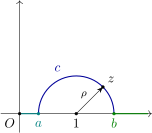
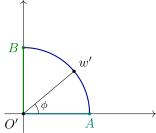
As traverses , w'(z) traverses the real axis positively, from unity to some large value . Since then turns upward through , w'(z) must also, for the regularity of w'(z) at requires that the mapping be conformal there. As traverses the angle \phi = \operatorname{am}\big(w'(z)\big) changes continuously by the amount \begin{align} \Delta \phi&=\operatorname{am}\big(w'(z)\big) \Big|_{z=a}^{z=b}\\ &=\operatorname{am}\Big(\frac{1}{\sqrt{1 + z}}\Big)\Big|_{z=a}^{z=b}+\operatorname{am} \Big(\frac{1}{\sqrt{1-z}}\Big)\Big|_{z=a}^{z=b}. \end{align}Letting we obtain \begin{align} \Delta \operatorname{am}\big((1-z)^{-1 / 2}\big) & =\Delta \operatorname{am}\big(\rho^{-1 / 2} e^{-i\theta/2}\big) \\ & =-\Delta \frac{\theta}{2}. \end{align}Since decreases by , . Thus the image of lies on the positive imaginary axis. The conformality at shows that w'(z) turns downwards, and, as , traverses the positive imaginary axis back to the origin. \operatorname{Im}\big(w'(z)\big)>0 \text{\ \ for\ \ } z > 1, and hence \operatorname{Im}(w)=\int_{1}^{z} \operatorname{Im}\big(w'(t)\big)\,dt > 0, \quad \text{for } 1 \leq t \leq z,\ \ t, z \text{ real.} This analysis shows that turns upwards at . A similar analysis shows that \operatorname{Im}\big(w'(z)\big)<0 for , but since also is negative, for . Thus also turns upwards at .
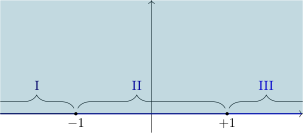
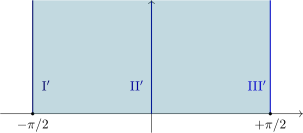
The segments I, II, III in the figure map into the respective segments I ' , II ' , III ' , dividing the -plane into two regions, one of which is the image of the upper half-plane : . Since corresponds to , the image of must be the infinite half-strip R':-\frac{\pi}{2}<\operatorname{Re}(w)<\frac{\pi}{2}, \quad \operatorname{Im}(w)>0 .
The correspondence in the straight line boundaries permits analytical extension of by reflection in three ways, viz., across I, II, or III. Reflection across II yields the lower half -plane connected to across the edge II. This still leaves the edges free along I and III in both half-planes. The image-reflection across II ' yields the full-strip \tag{a} -\frac{\pi}{2}<\operatorname{Re}(w)<\frac{\pi}{2}. Reflection across III duplicates the half-planes, thereby furnishing a new full-sheet over the -plane, and doubles the image-strip (a) . Similarly for the remaining free edge II. By such alternate reflections we succeed in simply-covering the whole -plane by vertical strips of width . The corresponding reflection in the -plane yields an infinite-sheeted Riemann surface, each sheet of which is cut along the real axis from the branch points to and to , and is mapped into a vertical strip in the -plane of width . The function becomes single-valued on the Riemann surface.
The structure of this Riemann surface exhibits the periodicity of the inverse function. For, the points ( ), which have congruent positions in each strip, correspond to a series of points on the Riemann surface lying over each other, which means that the inverse function takes on the same value there. Further, we have for ( ) and . As we have seen, the properties characterize the function . Hence we have identified the integral (3.20) with the inverse function .
Analytic Continuation by Functional Equations
Let be an analytic function in each of the separate variables for values of in a domain and values of in the domains , respectively. Suppose now that there is a neighborhood of in and functions regular at and with function values in the respective domains such that the relation \tag{3.21} f\big(z, \zeta_{1}(z), \zeta_{2}(z), \ldots, \zeta_{n}(z)\big)=0 holds in the neighborhood of . We then say that (3.21) is a functional equation in the and assert the principle of The permanence of the functional equation .
Theorem 4.11 (The permanence of the functional equation). If the analytic functions satisfy a functional equation for some domain of then they satisfy the functional equation (provided it makes sense) in the largest domain where they are all defined.
Proof. Let be a function element of which assumes only values in for points in a neighborhood of in . The function is a regular function of and satisfies the relation in the neighborhood of . The theorem is proved by showing, if the elements can be continued analytically in in such a way that the function values still fall in the respective domains , that the equation (3.21) remains valid over the continuation.
For proof, let be the largest circle about in for which all the converge and assume only values belonging to the respective . Now let be an immediate analytic continuation of and let be the largest circle in which the converge to elements in the respective . In the common part of and , at least, we have But is analytic for in and vanishes in the part of common with , hence it must be identically zero throughout the circle . Now, since any analytic continuation of the can be obtained by chains of a finite number of immediate analytic continuations, this proves our theorem. ◻
Since a functional equation is, to a certain extent, characteristic of an analytic function in the large we may apply such a functional equation to a given function element to obtain expressions with a wider domain of regularity. We shall see how this method of analytic continuation applies in the examples of The Gamma and Zeta Functions .
The Gamma and Zeta Functions
The gamma function is the well-known analytic extension of the discrete real function to values in the complex domain. For real positive values of the gamma function is defined by the integral \tag{3.22} \Gamma(x)=\int_{0}^{\infty} t^{x-1} e^{-t} \,d t, \quad x>0 which reduces for as integer to For negative values of the integral does not converge. Using integration by parts we obtain a functional equation for \tag{3.23} \Gamma({x}+1)={x}\,\Gamma({x}).
Let us see how we may extend the -function to negative and complex values. The extension to the right half-plane, , is given by the integral (3.22) which remains convergent since \begin{align} \left|\int_{0}^{\infty} t^{z-1} e^{-t} \,d t\right| & \leq \int_{0}^{\infty}\left|e^{(z-1)\log t}\right| e^{-t} \,d t \\ & =\int_{0}^{\infty} e^{(x-1)\log t}e^{-t} \,d t \\ & =\Gamma(x). \end{align}The function, , so defined is analytic in the right half-plane and clearly still satisfies the functional equation . In order to find an analytic continuation of into the left half-plane we rewrite this functional relation in the form \tag{a} \Gamma(\eta-1)=\frac{\Gamma(\eta)}{\eta-1}, \qquad \eta=z+1.
The left side of this expression is defined and regular for ; the right side, , is defined and regular for except at , where it has a simple pole. The relation (a) , therefore, gives an analytic continuation of into the strip . Putting , we obtain an expression of into the strip Repetition of this process extends the function to all values of in the left half-plane. Thus, if be any integer, repeated application of (a) gives \tag{b} \Gamma(\eta-k)=\frac{\Gamma(\eta)}{(\eta-1) \ldots (\eta - k)}, the right member of which is regular and has the simple poles . The same properties therefore hold for the left member of (b) , which extends into the strip , if we put . It is thus seen that may be analytically continued everywhere in the left half-plane, and since for , has the simple poles
Having shown that it is possible to extend the gamma function into the negative half-plane, we seek an explicit expression which defines the function in its extended domain. The difficulty with the real integral is that the integrand becomes strongly infinite at and causes the integral to diverge. But why not consider as a complex parameter and integrate along a path which avoids the origin? For every value of the parameter , is regular in the entire -plane except , but it is infinitely multi-valued because of the presence of the logarithm. We obtain a simply-connected domain by cutting the -plane along the positive real axis from to and assigning for the principal value along the upper edge of this cut. This consequently assigns the value along the lower edge and makes single-valued in for every . Let us choose a path of integration in the -plane coming from infinity, encircling the cut, and returning to infinity, as shown in Fig. (a) :
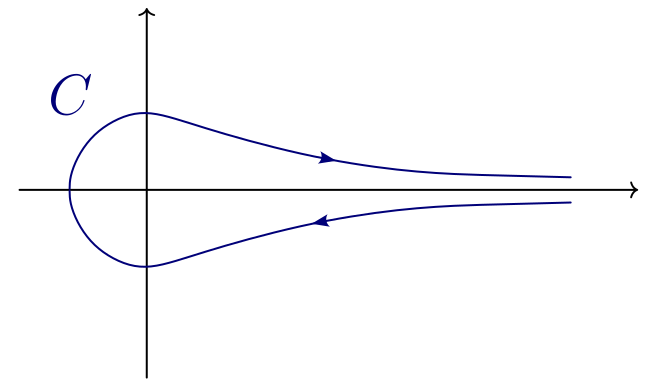
The avoidance of the singular point insures that will be regular along . The integral \tag{3.24} {H}({z})=\int_{{C}} {e}^{-t} {t}^{z-1} \,d t converges everywhere because of the factor , hence is regular for every value of and defines a single-valued analytic function for all values of . Thus is an entire function.
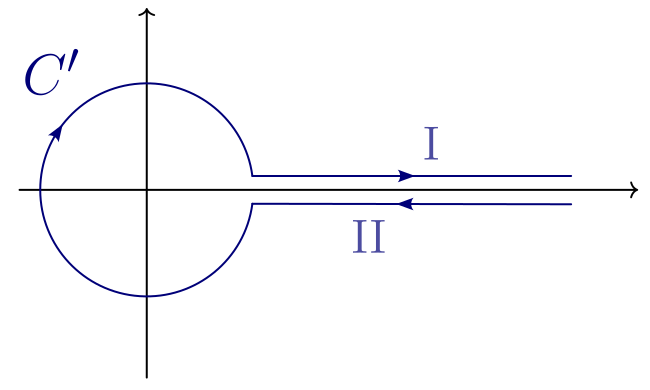
Now, by Cauchy’s Integral Theorem , the value of the integral (3.24) remains invariant if we deform the path of integration without at any time crossing the slit. It is most convenient to choose a new path {C}' consisting of the upper and lower edges of the positive real axis (denoted by I, II), and a small circle of radius about the origin connecting I and II. We then have \begin{align} H(z)=\int_{C'}&= {\int_{r_\text{I}}^{\infty}} e^{-t} e^{(z-1) \log |t|} \,d t \\ & \quad -\int_{r_\text{II}}^{\infty} e^{-t} e^{(z-1)(\log |t|+2 \pi i)} \,d t\\ & \quad +\int_{\mathrm{small\ circle}} e^{-t} t^{z-1} \,d t \\ &= (1-e^{2 \pi i z}) \int_{r}^{\infty} e^{-t} t^{z-1} \,d t+\int_{\mathrm{small\ circle}} e^{-t} t^{z-1} \,d t. \end{align}So far this expression is valid for all values of . But if we restrict ourselves to values of in the positive half-plane then the second integral of the above tends to zero. Hence we have This expression permits application of the general principle of permanence of the function equation , namely, the right member is defined only for certain values of ( ), but the left member is defined everywhere, hence the expression \tag{3.25} \Gamma(z)=\frac{H(z)}{1-e^{2 \pi i z}} defines everywhere, except at the zeros of the denominator, i.e., the points . For positive integral values of , (3.25) loses its meaning, since then is regular at the origin and the numerator For these values, however, we know For values ( ), has a pole of the order at , whose residue is . 3 Thus (3.25) shows that has simple poles at the points , the residue at being given by
4.3.2.1 The Riemann Zeta Function
The methods discussed above can be applied in a very similar fashion to obtain analytical extensions and a functional relation for the famous Riemann -function, which plays an important role in the classical theory of prime numbers. The function is originally defined by the series \tag{3.26} \zeta(z)=\sum_{n=1}^{\infty} \frac{1}{n^{z}}, \quad \operatorname{Re}(z)>1 which is convergent in the half-plane to the right of the line .
The connection between the -function and the theory of prime numbers is based on the remarkable identity where stands for the sequence of prime numbers and all the positive integers. This may be proved by expanding each of the factors of the left member of (3.26) into a geometrical series and multiplying out.
Again we seek an analytical extension of the -function in the entire plane. This will be accomplished by expressing in a complex integral which converges everywhere.
By a simple change of variable in (3.22) we note that hence \begin{align} \zeta(z) \,\Gamma(z)&=\Gamma(z) \sum_{n=1}^{\infty} \frac{1}{n^{z}}\\ &=\sum_{n=1}^{\infty} \int_{0}^{\infty} e^{-n t} t^{z-1} \,d t, \quad \operatorname{Re}(z) > 0. \end{align}Interchanging summation with integration 4 we obtain Thus has been expressed, in its original domain , in terms of the known function and an integral over the positive real axis. Just as with the -function, we regard as a complex variable in the -plane, cut along the positive real axis, and integrate the function over the same path considered in Fig. (a). Since has simple poles at the points ( ), care must be taken to choose the path so as to pass between and . No singularities then appear on the path. The integral converges for every value of , and represents an entire function. By deforming the path into the two edges of the real axis connected by a small loop around the origin, and taking care of the multiple valuedness of , we obtain, exactly as for the -function, \begin{align} S(z) &=\int_{0}^{\infty} \frac{e^{(z-1) \log |t|}}{e^{t}-1} \,d t -\int_{0}^{\infty} \frac{e^{(z-1)[\log |t|+2 \pi i]}}{e^{t}-1} \,d t \\ &= (1-e^{2 \pi i z}) \,\zeta(z) \Gamma(z), \end{align}or The right member of this expression is valid for all values of except the integers, hence we have our desired analytical extension of the -function.
We shall now apply the theory of residues to obtain a functional equation for the -function. Let us integrate the function along the dotted path C'' of Fig. (c) , consisting of a half-circle of radius about the origin and the two horizontal lines I, II: , .
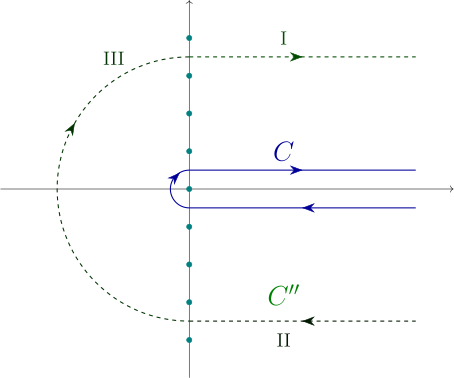
By Cauchy’s Integral Theorem \begin{align} S(z)&=\int_{C} \frac{t^{z-1}}{e^{t}-1} \,d t \\ &=\int_{C''} \frac{t^{z-1}}{e^{t}-1} \,d t-\sum_{k=-n}^{+n} R_{k}, \end{align}where is the residue of the function at , .
We shall show that as , the integral along C'' tends to zero for values of whose real part is negative. Putting on I and II we have for \begin{align} \left|\int_{I}\right|<\int_{0}^{\infty}\left|\frac{t^{z-1}}{e^{t}-1}\right| d t &\leq \int_{0}^{\infty} \frac{|u+i k|^{x-1}}{e^{t}-1} \,d u \,C_{1}\\ &=\int_{0}^{\infty} \frac{C_{1} \,d u}{\left(\sqrt{u^2 + k^2}\right)^{1-x} e^{u}\left|e^{i k}-e^{-u}\right|}\\ &=\int_{0}^{\infty} \frac{C_{1} \,d u}{|k|^{1-x}\,e^{u}\,\left|-1-e^{-u}\right|} \\ &\leq \int_{0}^{\infty} \frac{C_{1} \,d u}{k^{1-x} e^{u}}\\ &=\frac{C_{1}}{k^{1-x}}, \end{align}where . As , . The same result holds for . Along the semicircle of radius , \begin{align} \left|\int \frac{t^{z-1} \,d t}{e^{t}-1}\right| &\leq \int \frac{|t|^{x-1} C_{2}}{\left|e^{t}-1\right|} \,d t\\ &\leq k^{x-1} M \pi k\\ &=\pi M k^{x} \end{align}where along the circle may be chosen 5 independently of . Since this also tends to zero as .
As the path C'' tends to infinity we obtain These residues are given by Hence \begin{align} S(z) &=-2 \pi i \sum_{n = 1}^{\infty}\left((2 n \pi i)^{z-1}+(-2 n \pi i)^{z-1}\right) \\ &= -(2 \pi)^{z} e^\frac{i \pi z}{2}(1-e^{-i \pi z}) \sum_{n = 1}^\infty n^{z-1}, \quad \operatorname{Re} (z)<0. \end{align}Now hence \begin{align} S(z) &=\Gamma(z)\, \zeta(z)\,(1-e^{2 \pi i z}) \\ &=-(2 \pi)^{z} e^{\frac{i \pi z}{2}}(1-e^{-i \pi z}) \,\zeta(1-z). \end{align}Simplifying, we obtain the functional equation \tag{3.27} \zeta(1-z)=2 \cos \frac{\pi z}{2}\,(2 \pi)^{-z} e^{i \pi z} \,\Gamma(z)\, \zeta(z) connecting the different parts of the function.
It is possible to start with this relation and, working backwards, obtain the integral expression for the -function.
4.3.2.2 The Product Representation for the Gamma Function, Further Properties
We now return to a consideration of the gamma function, from the standpoint of the Weierstrass Product Formula . In addition, we shall find a simple relation connecting with , and another functional equation.
Since has simple poles at and is regular everywhere else, its reciprocal is an entire function, 6 having simple zeros at these points. We have seen that is such a function. We may therefore put \tag{a} \frac{1}{\Gamma(z)}=e^{h(z)} \phi(z), the problem still remaining to determine the entire function .
Instead of proceeding this way, we shall derive directly the whole product expansion for , by first obtaining an asymptotic formula for , due to Gauss. We begin with the relation 7 \begin{align} \Gamma(z) & =\int_{0}^{\infty} e^{-t} t^{z-1} \,d t \\ & =\lim _{n \rightarrow \infty} \int_{0}^{\infty}\Big(1-\frac{t}{n}\Big)^{n} t^{z-1} \,d t, \qquad \text{___MATH_BLOCK_806___, int., ___MATH_BLOCK_807___.} \end{align} By partial integration times, we have \begin{align} \int_{0}^{n}\Big(1-\frac{t}{n}\Big)^{n} t^{z-1} \,d t&=\frac{1}{n^{n}} \int_{0}^{n}(n-t)^{n} t^{z-1} \,d t \\ & =\frac{1}{n^{n}} \frac{n}{z} \int_{0}^{n}(n-t)^{n-1} t^{z} \,d t \\ & =\frac{1}{n^{n}} \frac{n}{z} \frac{n-1}{z+1} \int_{0}^{n}(n-t)^{n-2} t^{z+1} \,d t \\ & =\cdots \\ & =\frac{1}{n^{n}} \frac{n}{z} \cdots \frac{1}{z+(n-1)} \int_{0}^{n} t^{z+(n-1)} \,d t \\ & =\frac{n^{z} n !}{z(z+1)\ldots(z + n)}. \end{align}Thus From this formula we have immediately \begin{align} \frac{1}{\Gamma(z)} &=\lim_{n \rightarrow \infty} e^{-z \log n} z \prod_{\nu = 1}^{n} \Big(1+\frac{z}{\nu}\Big) \\ &=\lim_{n \rightarrow \infty} e^{-z\left(\log n-\sum_{\nu = 1}^{n} \frac{1}{\nu}\right)} z \prod_{\nu = 1}^{n}\Big(1+\frac{z}{\nu}\Big) e^{-\frac{z}{\nu}}. \end{align}The expression tends to a finite limit as , called Euler’s constant. (Its value is approximately .) We therefore have \tag{3.28a} \frac{1}{\Gamma(z)}=z \,e^{C z} \prod_{n = 1}^{\infty} \Big(1+\frac{z}{n}\Big) e^{-\frac{z}{n}}, which converges for all values of , and is the desired representation. Comparing with (a) we note that .
From (3.28a) we also have which gives Since we obtain the functional relation \tag{3.28b} \Gamma(z)\, \Gamma(1-z)=\frac{\pi}{\sin \pi z} connecting the -function with the trigonometric functions. This was known to Euler. By putting , we obtain immediately the well-known relation
Another functional equation important in the theory of the -function is the following, due to Gauss: \begin{align} \label{4.3.29}\tag{3.29} \Gamma(z) \,\Gamma\Big(z+\frac{1}{p}\Big) \ldots \Gamma\Big(z+\frac{p-1}{p}\Big)=\Gamma(p z) \,p^{\frac{1}{2}-p z}\,(2 \pi)^{\frac{p-1}{2}}; \end{align} , an integer.
From (3.28a) we have Differentiating \begin{align} \label{4.b_2}\tag{b} \frac{{d}^{2}}{{d} {z}^{2}} \log \Gamma(z)&=\frac{1}{z^{2}}+\sum_{n = 1}^{\infty} \frac{1}{(z+n)^{2}}\\ &=\sum_{n = 0}^{\infty} \frac{1}{(z+n)^{2}}. \end{align}Denoting the left member of (3.29) by , and (b) gives \begin{align} \frac{d^{2}}{d z^{2}} \log k(z)&=\sum_{\nu=0}^{p-1} \sum_{n=0}^{\infty} \frac{1}{\big(z+\frac{\nu}{p}+n\big)^{2}}\\ &=p^{2} \sum_{\nu=0}^{p-1} \sum_{n=0}^{\infty} \frac{1}{(p z+\nu+p n)^{2}}. \end{align}Since give all the non-negative integers exactly once we may write \begin{align} \frac{d^{2}}{d z^{2}} \log k(z)&=p^{2} \sum_{m=0}^{\infty} \frac{1}{(p z+m)^{2}}\\ &=p^{2} \frac{d^{2}}{d z^{2}} \log \Gamma(p z). \end{align}
We therefore have or \tag{c} k(z)=a \,\Gamma(p z)\, b^{z}.
To evaluate the constant , we note from (3.29) and (3.28b) , that or by revising the order in which the product is taken we find Hence \begin{align} a^2 &= p^2\prod_{\nu = 1}^{p - 1} \Gamma\Big(\frac{\nu}{p}\Big)\,\Gamma\Big(1 - \frac{\nu}{p}\Big)\\ &= p^2 \frac{p^{\pi - 1}}{\prod_{\nu = 1}^{p - 1}\sin\frac{\pi\nu}{p}}. \end{align}By reverting to exponentials it may be shown 8 that giving
Putting for in (c) , repeated application of the functional equation for gives \begin{align} b &= \frac{k(z + 1)\,\Gamma(pz)}{\Gamma(pz + p)\,k(z)}\\ &= \frac{\prod_{\nu = 0}^{p - 1} \big(z + \frac{\nu}{p}\big)}{\prod_{\nu = 1}^p (pz + p - \nu)}\\ &= p^{-p}\, \frac{\prod_{\nu = 0}^{p - 1} (pz + \nu)}{\prod_{\nu = 1}^p (pz + p - \nu)}\\ &= p^{-p}. \end{align}which proves (3.29) .
As a special case of (3.29) , putting for and , we have The functional equation does not uniquely characterize the -function. However, the gamma function is the only function which is differentiable and positive for positive values of , which satisfies this relation and also the functional equation (3.29) .
There are many other interesting relations and theorems involving the -function. See for instance Courant, Calculus , Vol. II, p. 323; or E. Artin, Einfuehrung in die Theorie der Gammafunktion .