In the ensuing sections we shall be concerned with the representation of an analytic function in the form of a power series. As we have seen in Chapter 1, a power series is uniformly convergent to an analytic function in any circle where the series converges on the boundary. Furthermore, a power series may be differentiated term-by-term any number of times. In this connection we prove the general
Theorem 4.1 (Weierstrass’ Convergence Theorem). Let be a sequence of regular functions in the region bounded by a simple closed curve and suppose that the series converges uniformly on . (The sum must then converge to a continuous function on .) The series will not only converge in the interior of but represents an analytic function in that domain. Furthermore, derivatives of all orders may be obtained by termwise differentiation of the series.
Proof. Let be any point in the interior domain of . Representing the by Cauchy’s Integral Formula we have But, since the sum converges uniformly for on , being a fixed point in , we may interchange the order of integration and summation. Consequently But the integrand is continuous on and therefore the Cauchy integral represents an analytic function in . The fact that the sequence may be differentiated term-by-term is proved in similar fashion by using the Cauchy representation III, (3.04) for the derivatives. ◻
Table of Contents
4.1.1 Taylor Series
In Chapter 1, we saw that a power series represents a differentiable function in its circle of convergence and may be differentiated termwise any number of times. Conversely, we show if is analytic in a domain that may be written as a power series in a circle about any point of ; \tag{1.10} f(z)=a_{0}+a_{1}(z-z_{0})+a_{2}(z-z_{0})^{2}+\cdots with the coefficients \tag{1.10a} a_{n}=\frac{f^{(n)}(z_{0})}{n !} For proof, let be any circle about which is contained in . In the interior of , may be written as the integral
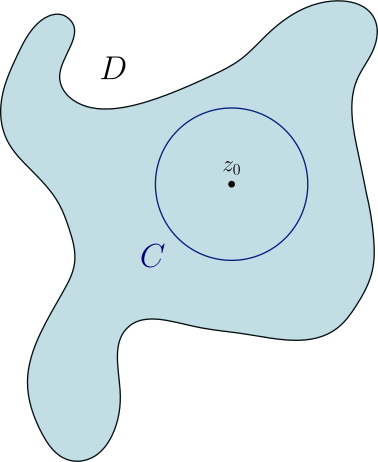
We have and, since is in the interior of , Consequently the series representation converges uniformly if is restricted to any smaller circle within . We may therefore integrate term-by-term \begin{align} f(z) & =\frac{1}{2 \pi i} \int_{C} \frac{f(\zeta)}{\zeta-z} \,d \zeta\\ &=\frac{1}{2 \pi i} \int_{C}\left(\sum_{\nu=0}^{\infty} \frac{f(\zeta)}{(\zeta-z_{0})^{\nu+1}}(z-z_{0})^{\nu}\right) d \zeta \\ & =\frac{1}{2 \pi i} \sum_{\nu=0}^{\infty}(z-z_{0})^{\nu} \int_{C} \frac{f(\zeta)}{(\zeta-z_{0})^{\nu+1}} \,d \zeta. \end{align}Using we obtain \tag{1.11} f(z)=f(z_{0})+f'(z_{0})(z-z_{0})+\frac{f''(z_{0})}{2!}(z-z_{0})^{2}+\cdots, the Taylor series for about the point . The series converges uniformly in any circle contained in .
The Taylor representation of holds for all points nearer to than the nearest boundary point of for clearly we can choose to be any circle which does not extend as far as the boundary. Hence the radius of convergence is not less than the distance of from the boundary.
Interestingly enough, the series (1.11) depends only upon the values of the derivatives at . Hence, if a complex function is analytic in a circle its values in the entire circle are completely determined by its values in the neighborhood of the center. In fact, we shall see in the section on analytic continuation that the local behavior of an analytic function is enough to determine its behavior in the most far-flung regions of its definition.
Even more strongly, we now show that a function analytic in the neighborhood of a point is completely determined if only we specify its values on a sequence of points for which is an accumulation point. In other words, if two analytic functions , have the same value on the sequence then . For proof set And by our hypothesis for all values of . Since the two functions are assumed to be different we cannot have for all . Let be the first subscript for which . We then have \begin{align} f_{1}-f_{2} & =(z-z_{0})^{\mu} \sum_{\nu=\mu}^{\infty}(a_{\nu}-b_{\nu})(z-z_{0})^{\nu-\mu} \\ & =(z-z_{0})^{\mu} P(z). \end{align}Now on Hence . But is continuous in the neighborhood of . We conclude that and hence that . Consequently we cannot assume that the coefficients in one series are not the same as those of the other. In other words . We have shown incidentally that the only power series representation of a function is the Taylor series; for two series taking on the same values would, by the above argument, be identical.
The reader will recall that certain special analytic functions (e.g., , ) were defined by means of the power series for the corresponding functions in the real domain. One might ask whether there were not other natural methods of extending these functions to complex values and whether such methods give differing results. The answer is given by the last theorem. If a real function can be extended analytically into the entire complex plane then every method of obtaining an extension gives the same result.
Of particular significance in the study of an analytic function are the points for which . If vanishes at then the first coefficient of the Taylor expansion about vanishes. Now, some of the succeeding coefficients also may vanish. We shall distinguish between cases by saying has a zero of order at or is a zero of order for if the first coefficients vanish and the does not; i.e., Clearly, there can be no point of accumulation of zeros in a domain of analyticity of unless identically. We express this fact by saying the zeros of an analytic function are isolated .
Also of great significance are the points at which f'(z) vanishes. It will be recalled that an analytic function provides a conformal map at all points where the derivative does not vanish. Let us see what happens to the mapping in the exceptional case. Let be a point at which the first derivatives vanish but the does not. Then from (1.10) we obtain where is regular in the neighborhood of and . From this relation we derive Now let and be any pair of points in the neighborhood of which subtend an angle at and denote by the angle subtended by and at . Employing our last result we find
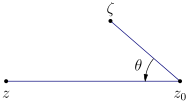
If we permit and to approach along straight lines then, in view of the fact that is well defined ( ) and continuous, we conclude that the curves traced out by and will meet at in an angle In other words, the mapping at multiplies angles by . In the terminology of Chapter II, is a branch point of order , hence in the neighborhood of the inverse to is multi-valued with sheets.
4.1.2 Laurent Series
We have seen that an analytic function may be expanded into power series about any regular point. However, at a non-regular point we still have some possibility of representing the function by a more general kind of series which permits us to express the singularity.
Theorem 4.2 . Suppose then that is regular in the ring-shaped region bounded by two circles concentric with respect to . The function may then be represented in the annular region by a uniformly convergent series of positive and negative powers of \tag{1.20} f(z)=\sum_{-\infty}^{+\infty} a_{n}(z-z_{0})^{n}.
A series of this type is called the Laurent expansion of at .
Proof. Denote the outer circle by . The inner by . If is contained in the ring domain then by the Cauchy Integral Formula (see fig.)
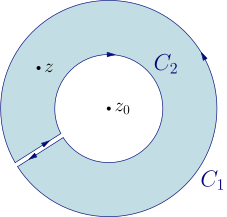
The first integral may be expanded into a series of positive powers of by the same method used in obtaining the Taylor expansion: where . We do not necessarily have since in this instance the points inside need not be regular. However, we know that the series will converge uniformly to an analytic function in the interior of .
In the second integral we expand in powers of since we have . Setting , we go by the same kind of reasoning as before to obtain where This series will converge uniformly everywhere in the exterior of . Combining these results with a single notation we obtain \tag{1.21} f(z)=\sum_{-\infty}^{+\infty} a_{n}(z-z_{0})^{n} where \tag{1.22} a_{n}=\frac{1}{2 \pi i} \int_{C} \frac{f(\zeta)}{(\zeta-z_{0})^{n+1}} \,d \zeta \quad \text {($n$ integer).} ◻
may be taken as any circle between and (or any equivalent curve for that matter). If has the radius and is bounded on , , then for all positive and negative \tag{1.23} |a_{n}| \leq \frac{M}{\rho^{n}} in correspondence with the result of III, (3.11) .
Note that the Laurent series reduces to the Taylor expansion in the event that the function is regular in the interior circle.
One further remark: if the point itself is the only non-regular point inside the inner circle then we have for the residue of at But, since the series is uniformly convergent in , we may integrate term-by-term. If the integral vanishes. Hence \tag{1.24} \frac{1}{2 \pi {i}} \int_{C} f(z)=a_{-1}. The residue at is simply the coefficient of the first negative power in the Laurent expansion.