We have stated certain criteria ( (1.20) and (1.21) ) that real line integrals be independent of the path of integration. If we employ the definition of complex integral in terms of real integrals we obtain conditions that a complex integral be independent of the path. We shall obtain these conditions in a somewhat more general form and we do not have to resort to real integrals. Corresponding to (1.20) , we have the theorem
Theorem 3.4 . A necessary and sufficient condition that the line integral of a continuous function be independent of the curve joining to for every point pair , in a domain is that there exists a function in such that F'(z)=f(z) . Note that we do not restrict ourselves to paths.
Proof. Sufficiency: Let be any curve joining to . We have \int_{z_{0}}^{z_{1}} f(z) \,dz = \lim_{\Delta z \rightarrow 0} \sum F'(\zeta_{\nu})(z_{\nu+1}-z_{\nu}). Since is continuous, the sum may be written in the form where is less than some fixed , (3.11) , Chapter 2. Thus we obtain \begin{align} &\sum\big[F(z_{\nu+1})-F(z_{\nu})\big]+\sum \varepsilon_{\nu}(z_{\nu+1}-z_{\nu}) \\ &= F(z)-F(z_{0})+\sum \varepsilon_{\nu} \Delta z_{\nu}. \end{align}Since we have in the limit
Necessity: Suppose the integral
is independent of the curve of integration. We define a function Form the difference quotient The integral from to is independent of the curve. We take the straight line path. By taking sufficiently small we may be sure that whenever . Hence \begin{align} \left|f(z)-\frac{F(z+\Delta z)-F(z)}{\Delta z}\right|&=\left|\frac{1}{\Delta z} \int_{z}^{z+\Delta z}\big[f(z)-f(\zeta)\big]d\zeta\right|\\ &<\varepsilon. \end{align}We conclude that F'(z)=f(z) . ◻
The condition (1.21) leads to another criterion in terms of the integrand itself.
Theorem 3.5 . If is a simply-connected domain the line integral will be independent of the path if and only if is continuously differentiable in .
The conditions of this theorem are far too restrictive. It is sufficient to ask that the derivative exist, its continuity need not be assumed.
Theorem 3.6 . A necessary and sufficient condition that the line integral be independent of the curve of integration in a simply-connected domain is that be analytic in .
The statement that the integral is independent of the curve of integration is equivalent to the assertion that the integral around any closed curve vanishes. For if and are any two curves connecting to then the curves and form a closed curve . Since we have Conversely, any closed curve can be broken into two arcs connected at the endpoints.
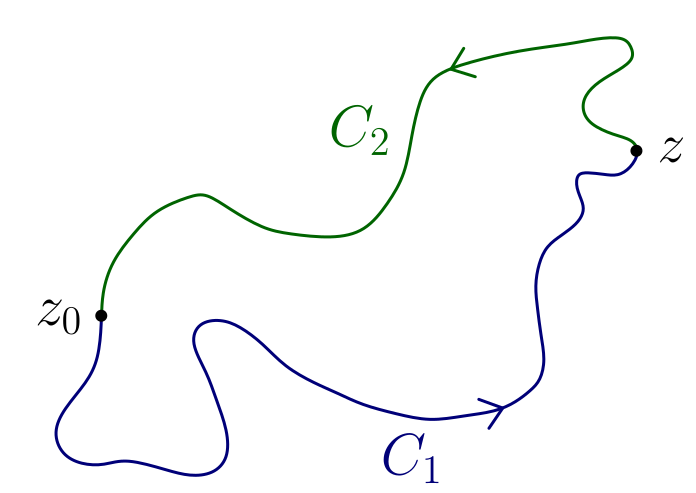
The statement of sufficiency is the fundamental Cauchy Integral Theorem .
Theorem 3.7 (Cauchy Integral Theorem). If is analytic in a simply connected domain , then \tag{2.00} \int_{C} f(z)\, d z=0 for all closed rectifiable curves in .
Proof. We give the famous Goursat proof.
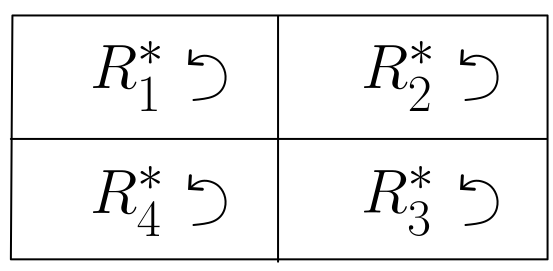
A. The theorem is true if is a rectangle. For let be any rectangle in . We partition into four equal rectangles by means of parallels to the sides. If , , , denote the rectangles of the partition then by (1.34) and (1.35) it follows that Therefore if we set It follows that Consequently for at least one of the , denote it by , we have If we repeat the process for the rectangle we obtain a rectangle with and in steps we obtain an with
In this manner we determine a sequence of rectangles where each rectangle is contained in the preceding and the maximum diameter (i.e. the diagonal) tends to zero. We refer to such a sequence as a "nested set". It is not difficult to show that there is one and only one point common to all the rectangles of a nested set. The proof is left as an exercise.
Let denote the point common to all the . Since is analytic we may approximate by a linear function at . Namely, f(z)-f(\zeta)=\big[f'(\zeta)+\eta(z, \zeta)\big](z-\zeta) where can be made arbitrarily small by taking close to . 1 That is, given any we can find a such that implies .
Choose so large that is contained in the circular domain On we have f(z)=f(\zeta)+z f'(\zeta)-\zeta f'(\zeta)+(z-\zeta) \eta. Consequently \begin{align} \int_{R_{n}} f(z) \,d z&=f(\zeta) \int_{R_{n}} \,d z+f'(\zeta) \int_{R_{n}} z \,d z\\ & \quad -\zeta f'(\zeta) \int_{R_{n}} \,d z+\int_{R_{n}}(z-\zeta) \eta \,d z. \end{align}
By equations (1.37) , (1.38) we know that the first three integrals are independent of the path and hence vanish. Thus On we have since the entire rectangle is within a -radius of . Furthermore, where is the perimeter of . Using the estimate (1.33) we obtain Combining this with our previous result we obtain Consequently Thus must be less than any positive number and therefore .
The remainder of the proof consists of an extension of the theorem to more general curves.
B. The theorem is true for "step" polygons, i.e. polygons consisting of a finite number of segments parallel to the coordinate axes. For proof let us suppose first that is a step polygon and simple. We partition into rectangles as follows:
Form the rectangular lattice obtained by extending the sides of the polygon. The interior of is certainly contained in the rectangles of this lattice since it is bounded four lines obtained from the highest side, the lowest side, and the sides farthest to the left and right. Now, the interior of every rectangle of the lattice must be completely in the interior of or completely in the exterior since no lattice rectangle contains a point of in its interior. By our orientation convention 2 is the sum of the rectangles inside . We conclude by (1.34) that the theorem is true for simple step polygons.
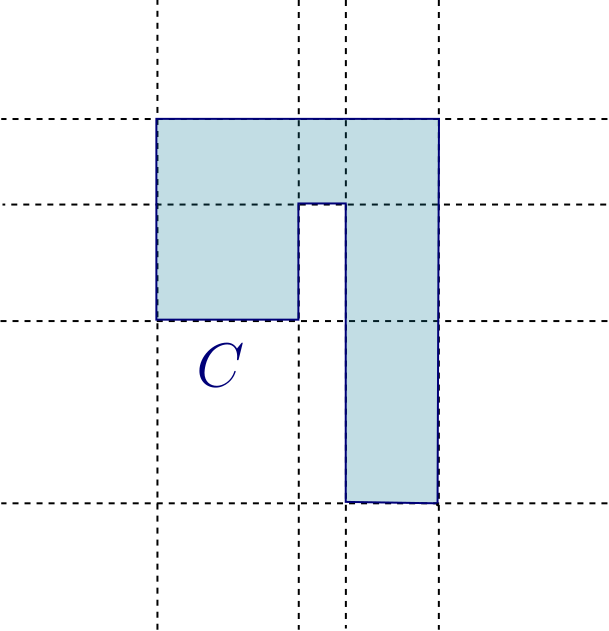
If is a step polygon and not simple, then we may decompose it into simple sections as follows: Let be any point on . Beginning from follow in any direction until the path meets itself for the first time at some point .
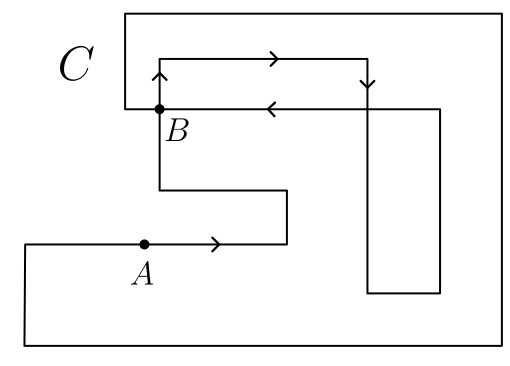
The part of the path running from the first encounter with to the second is a closed polygon, as is also the remainder of ; each of these two polygons can be further decomposed, if necessary, in a similar manner, and so forth. Since the number of self intersections of is finite, a decomposition into simple closed polygons is obtained in a finite number of steps, and the theorem then holds for by (1.34) .
C. We are now in a position to prove the theorem for arbitrary rectifiable curves. It is only necessary to show that any rectifiable curve can be approximated as closely as we please by step polygons. Since is rectifiable it can be sub-divided into arcs of arbitrarily small length. Let denote the successive points of a sub-division. In each interval we approximate by means of a "step".
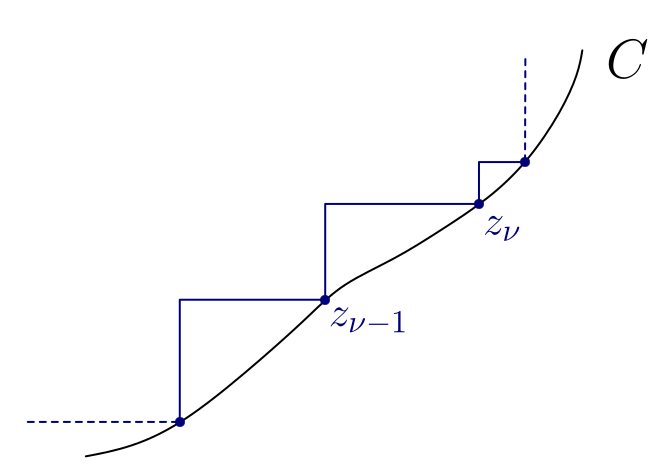
For the interval from to we take the step running from to to . Clearly the length of such a step is less than . Hence the length of such an approximating polygon is less than twice the length of . By taking the subdivision sufficiently fine we can bring the step polygon arbitrarily close to . For if the length of the arc , no point on the step between and is as far away as . The theorem follows by Lemma 3.1.10 .◻
A number of proofs of the Cauchy Theorem have been given under less restrictive conditions. The theorem remains true if we admit all curves in a simply connected region where is assumed analytic in the interior and merely continuous at the boundary.
The condition that the curve be contained in a simply connected domain of analyticity of is essential for the statement of the theorem. Consider, for example, the function . This function is analytic everywhere except at the origin. Take the integral where is the circle . Setting . we obtain The integral is not zero. However a germ of the theorem remains true. The integral is independent of the radius of the circle. This example suggests a generalization of the Cauchy Integral Theorem to multiply connected domains.
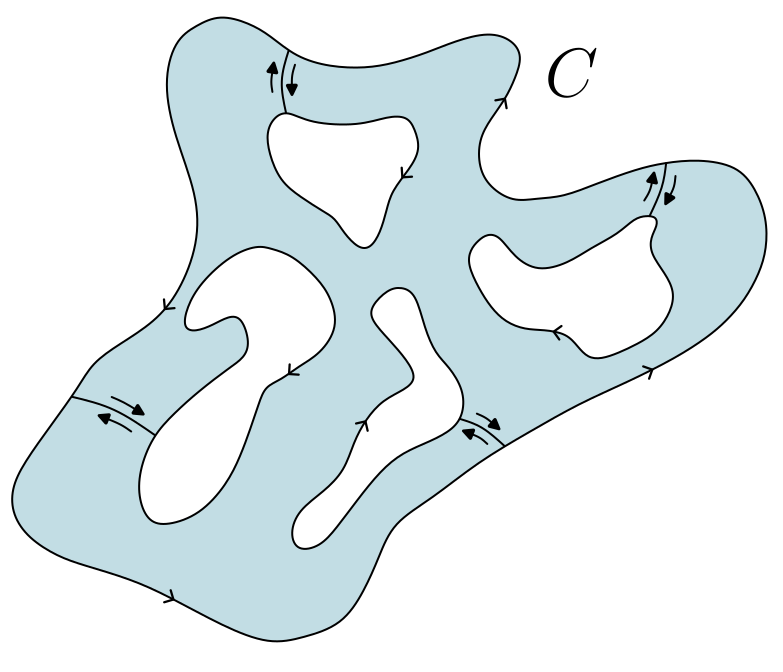
Theorem 3.8 . Let be a region contained in a domain of analyticity of . Suppose that is bounded by simply closed paths where the interiors of are contained in the interior of . If we take all the integrals in the counterclockwise sense then \tag{2.01} \oint_{C} f(z) \,d z=\oint_{C_{1}} f(z) \,d z+\cdots+\oint_{C_{n}} f(z) \,d z.
Proof. This is proved by constructing a simply-connected domain. We join each of the to by means of non-intersecting paths. If we restrict ourselves to curves which do not cross these paths the resultant domain is simply connected. Hence the integral over the new boundary curve vanishes. But the integrals over the connecting paths are taken in both directions and cancel Lemma 3.1.6 . We conclude that which proves the theorem.◻
Note that the new boundary traces the curves in the clockwise direction, as shown in the figure and indicated by the above notation.