Theorem 3.9 . Let be any simply-connected domain of analyticity of . If is any simple closed curve in , any point of its interior then \tag{3.00} f(\zeta)=\frac{1}{2 \pi i} \int_{C} \frac{f(z)}{z-\zeta} \,d z
This is a very remarkable statement. It demonstrates the strong inter-relation among the values of a regular function. In order to know the values of the function in the interior of we have only to specify the values on the boundary.
Proof. For the proof we employ any circle with at its center and interior in the interior of . The function is clearly analytic everywhere in the interior of except at . By the proof of the Cauchy theorem for multiply-connected domains it follows that the integral about any such circle is independent of the radius and equal to the integral around . We have where whenever . We choose a circle of radius . \begin{align} \int_{C} \frac{f(z)}{z-\zeta} \,d z & =\int_{C_{\rho}} \frac{f(z)}{z-\zeta} \,d z \\ & =f(\zeta) \int_{C_{\rho}} \frac{d z}{z-\zeta}+\int_{C_{\rho}} \frac{\eta \,d z}{z-\zeta} \\ & =f(\zeta) \int_{0}^{2 \pi} \frac{\rho i e^{i \theta}}{\rho e^{i\theta}} \,d \theta+\int_{C_{\rho}} \frac{\eta}{z-\zeta}\,dz \\ & =2 \pi i f(\zeta)+\int_{C_{\rho}} \frac{\eta}{z-\zeta} \,d z. \end{align}Since the absolute value of the integrand cannot exceed . By Lemma 3.1.4 we have But the integral does not depend on . Hence and ◻
Corollary 3.1 . If , are analytic in a domain containing and on then in the interior of .
The representation of an analytic function by means of the Cauchy integral enables us to obtain an integral representation for its derivative. In fact we have in general:
Lemma 3.9 . Let be any finite curve (not necessarily closed) and let be any continuous function on . The function \tag{3.01} F(\zeta)=\int_{C} \frac{\phi(z)}{z-\zeta}\,dz is analytic in the entire complex plane except on itself and has the derivative \tag{3.02} F'(\zeta)=\int_{C} \frac{\phi(z)}{(z-\zeta)^{2}} \,dz
Proof. Consider the difference quotient where is kept smaller than the distance between and the nearest point of . We have \begin{align} \frac{\Delta F}{\Delta \zeta}-\int_{C} \frac{\phi(z)}{(z-\zeta)^{2}}\,dz & =\int_{C} \phi(z)\left[\frac{1}{(z-\zeta)(z-\zeta-\Delta \zeta)}-\frac{1}{(z-\zeta)^{2}}\right]d z \\ & =\int_{C} \frac{\phi(z) \Delta \zeta}{(z-\zeta)^{2}(z-\zeta-\Delta \zeta)} \,d z. \end{align}
Since is continuous on it is bounded . Let be the minimum of the distances of and from . We then have where is the length of . It follows that has the derivative (3.02) . ◻
Since is any continuous function whatever we cannot hope that will be analytic on . However, it might be supposed that tends to as approaches a point on . But this will not generally be true. For example, let be the unit circle and take . We have, for a point inside the circle,
\begin{align} F(\zeta) =\int_{C} \frac{d z}{z(z-\zeta)}&=\int \bigg(\frac{1}{\zeta(z-\zeta)}-\frac{1}{\zeta z} \bigg)d z \\ & =\frac{1}{\zeta} \int \frac{d z}{z-\zeta}-\frac{1}{\zeta} \int \frac{d z}{z} \\ & =2 \pi i\left[\frac{1}{\zeta}-\frac{1}{\zeta}\right]\\ &=0. \end{align}Hence the limiting value of on the boundary is zero.
If is a closed path in a simply connected domain of analyticity of it follows by this lemma that \tag{3.03} f'(\zeta)=\frac{1}{2 \pi i} \int_{C} \frac{f(z)}{(z-\zeta)^{2}} \,d z, for all points in the interior of . The function (3.03) is differentiable once again and, in fact, any number of times.
Theorem 3.10 . A complex function having a derivative of first order has derivatives of all orders. The derivative is given by \tag{3.04} f^{(n)}(\zeta)=\frac{n !}{2 \pi i} \int_{C} \frac{f(z)}{(z-\zeta)^{n+1}} \,d z.
Proof. The proof goes by induction. The formula (3.04) certainly holds for . If the theorem is true for it is certainly true for . For suppose We have \begin{align} & \left|\frac{\Delta f^{(n-1)}(\zeta)}{\Delta \zeta}-\frac{n !}{2 \pi i} \int_{C} \frac{f(z) \,d z}{(z-\zeta)^{n+1}}\right|\\ & \qquad =\frac{(n-1) !}{2 \pi}\left|\int_{C} \frac{f(z)}{\Delta \zeta}\left(\frac{(z-\zeta)^{n}-(z-\zeta-\Delta \zeta)^{n}}{(z-\zeta)^{n}(z-\zeta-\Delta \zeta)^{n}}-\frac{n}{(z-\zeta)^{n+1}}\right)d z\right| \\ & \qquad =\frac{(n-1)!}{2 \pi}\left|\int_{C} f(z)\left(\frac{\sum_{r=1}^{n}(z-\zeta)^{n-r+1}(z-\zeta-\Delta \zeta)^{r-1}-n(z-\zeta-\Delta \zeta)^{n}}{(z-\zeta)^{n+1}(z-\zeta-\Delta \zeta)^{n}}\right) d z\right| \\ & \qquad =\frac{(n-1) !}{2 \pi}\left|\int_{C} f(z)\left(\frac{\sum_{r=1}^{n}\left[\left(\frac{z-\zeta}{z-\zeta-\Delta \zeta}\right)^{n-r+1}-1\right]}{(z-\zeta)^{n+1}}\right) d z\right| \\ & \qquad <\frac{(n-1) !}{2 \pi} \frac{\varepsilon M L}{d^{n+1}} \end{align}where , and are as before and is chosen so small that the absolute value of the sum is less than . ◻
We have proved an important result:
Theorem 3.11 . An analytic function has derivatives of all orders in the domain of analyticity of . Thus the derivatives of an analytic function are analytic.
In these proofs we have avoided the assumption that the first partial derivatives of the real and imaginary parts of are continuous. The continuity of these derivatives – and even the existence of derivatives of higher order – is assured if only they exist and satisfy the Cauchy-Riemann equations.
The converse of the Cauchy Integral Theorem , the second half of Theorem 3.2.3 , is generally known as Morera’s Integral Theorem .
Theorem 3.12 (Morera’s Integral Theorem). If is continuous in a domain and for every closed curve in then is analytic in .
The hypothesis of the theorem is equivalent to the assertion that takes on the same value on all possible paths joining to . If a function has this property it is said to be integrable . We have proved ( Theorem 3.2.1 ) that an integrable function is the derivative of an analytic function. We conclude that an integrable function must in turn be analytic.
We see now that we could have defined an analytic function in terms of integrability instead of differentiability, the one property implying the other in contrast with the more complicated situation in the theory of real functions.
Table of Contents
3.3.1 Consequences of the Cauchy Integral Formula
An immediate and interesting result is the Mean Value Theorem .
Theorem 3.13 (Mean Value Theorem). For any circle in the domain of analyticity of the function value at the center is equal to the average of its values on the circumference.
Proof. We have \begin{align} f(\zeta)&=\frac{1}{2 \pi i} \int_{C_{\rho}} \frac{f(z)}{z-\zeta} \,d z\\ &=\frac{1}{2 \pi i} \int_{0}^{2 \pi} \frac{i \rho e^{i \theta}}{\rho e^{i \theta}} f(z) \,d\theta. \end{align}Denoting the arclength by we have whence \tag{3.10} f(\zeta)=\frac{1}{2 \pi \rho} \int_{C_{\rho}} f(z)\,ds. ◻
An important consequence of the formula (3.04) is the fact that the derivatives of are bounded in a very definite way in terms of the bound of the original function. There is of course no analogous statement for real functions.
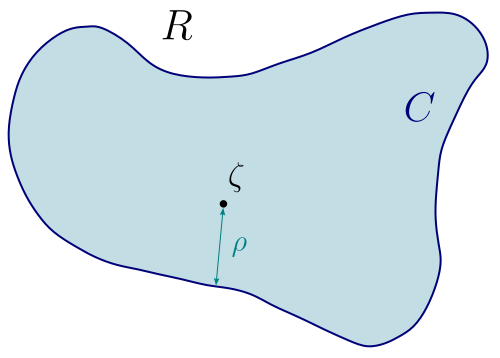
Let be a region of analyticity of bounded by a simple closed curve . If is any point in the interior of , the nearest distance any point of approaches , then we have by (3.04) Note that this bound does not depend on but only on its distance from the boundary. More specially, let be the circle of radius about . We then have \tag{3.11} \left|f^{(n)}(\zeta)\right| \leq n ! \frac{M(\rho)}{\rho^{n}} where is now the maximum value of on . In particular, for itself we have \tag{3.12} |f(\zeta)| \leq M(p).
This last result could have been obtained as a direct consequence of the mean value theorem. From the special result (3.12) it is easy to prove the Maximum Modulus Theorem .
Theorem 3.14 (Maximum Modulus Theorem). If is analytic in a region the maximum value of is attained on the boundary. 1 Further, if the maximum is attained at any interior point then .
Proof. Let be any interior point of . We may then find a circle about which lies completely in the interior of . Now, in (3.12) , unless everywhere on the circle, we must have the strict inequality Suppose now, that the maximum of is attained at the interior point . It will follow that is constant throughout and from this the theorem follows.
First, if then the above argument insures that on every circle in about . In other words, in the largest circle that can be drawn about in .
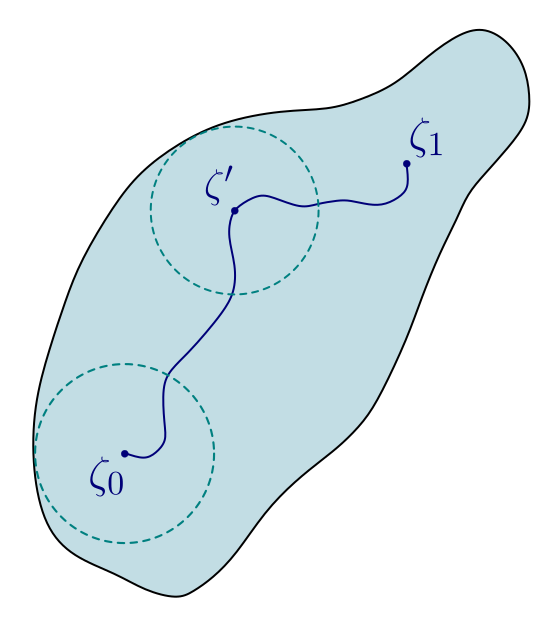
Now, let \zeta' be any point of . We can find a path in the interior of which connects to . Suppose that . By the continuity of there must be a first point \zeta' on the path for which \left|f(\zeta')\right|=M and immediately following, . But, since in some circle about \zeta' , this implies a contradiction. Hence everywhere in . It follows from the Cauchy-Riemann equations that a function whose modulus is constant everywhere in a domain of regularity must itself be constant. For, setting , , we have Differentiating with respect to and we obtain By the Cauchy-Riemann equations we obtain whence Thus, the first partial derivatives must vanish. The only possibility is that . ◻
Another consequence of the formula (3.11) is Liouville’s Theorem .
Theorem 3.15 (Liouville’s Theorem). If is analytic and bounded in the entire plane, , then is constant.
Proof. The proof consists in showing that f'(z) \equiv 0 . At any point of the -plane we have by (3.11)
\left|f'(\zeta)\right| \leq \frac{M}{\rho} where is now the radius of any circle about . Since can be chosen arbitrarily large it follows that f'(z) \equiv 0 . This can be true only if is constant. ◻
Liouville’s Theorem figures importantly in many ways. Consider, for example, the following proof of The Fundamental Theorem of Algebra :
Theorem 3.16 (The Fundamental Theorem of Algebra). Every polynomial of positive degree has a root in the complex domain.
Proof. For proof suppose on the contrary that has no root. It follows that the function is analytic in the entire plane. But must be bounded since as . Hence, by Liouville’s Theorem must be constant. But this contradicts the hypothesis that . ◻
3.3.2 Residues, Evaluations of Integrals
Let be a regular function in a simply-connected domain with the possible exception of a single point . Then if is any simple closed curve containing we define the residue of at to be the integral \tag{3.21} \frac{1}{2 \pi i} \oint_{C} f(z) \,d z This integral is certainly independent of the curve containing .
More generally, if is contained in a domain of analyticity of and is regular everywhere in the interior of except at a finite number of points , then is equal to the sum of the residues at these points. The proof is evident. The notion of residue is a very useful tool for the evaluation of complex integrals.
As an example, let us determine the residue of the function , an integer. Setting and integrating around a circle of radius about the origin we obtain Since we conclude that the residue is zero if and if the residue is .
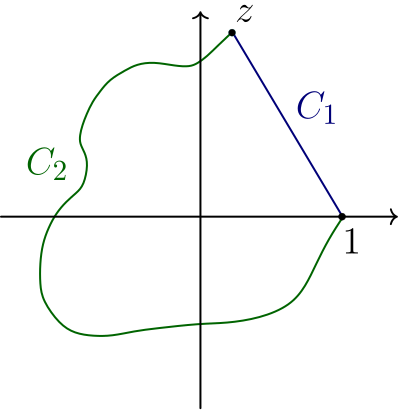
From the fact that , we have \tag{3.22} \log {z}=\int_{1}^{{z}} \frac{{d} \zeta}{\zeta} This characterization displays the multivalued character of the logarithms. If we join to the point by means of two non-intersecting curves which enclose the origin then the two values obtained by (3.22) will differ by . Clearly there are an infinite number of values of , the difference of any two of them being a multiple of .
By means of residues we can evaluate a large class of infinite integrals in the real domain:
Theorem 3.17 . Suppose to be regular in the upper half plane except for a finite number of non-real values . Then if tends to zero faster than , \tag{3.23} \lim _{z \rightarrow \infty} z f(z)=0, we have \tag{3.24} \int_{-\infty}^{\infty} f(x) \,d x=2 \pi i \sum r_{\nu} where is the residue of at .
Proof. Take so large that the are all contained in the circle .
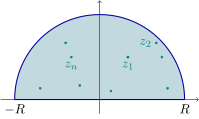
Consider the integral around the semicircle in the upper half-plane: \begin{align} \int_{\text{\tiny{semicircle}}} f(z) \,d z&=\int_{-R}^{R} f(x) \,d x+\int_{0}^{\pi} i R e^{i \theta} f(R e^{i \theta}) \,d \theta\\ &=2 \pi i \sum r_{\nu}. \end{align}The integral on the curved part of the path can be made arbitrarily small by increasing sufficiently. For we have and by (3.23) the right hand side must go to zero. We conclude that ◻
This result may easily be generalized to the case where there is a denumerable infinity of points for which is not regular, provided only that the have no point of accumulation. The summation is taken in the order of increasing .
Examples
The function with , , , real and is regular for with the exception of the point , where the sign in front of the radical is to be the same as that of . Clearly, satisfies the condition (3.23) . Hence by the preceding theorem is equal to times the residue of at . But, setting , we have \begin{align} r_{1} & =\frac{1}{2 \pi i} \int_{C_{\rho}} f(z) \,d z\\ &=\lim_{\rho \rightarrow 0} \frac{1}{2 \pi i} \int_{C_{\rho}} \frac{d z}{a(z-z_{1})(z-\bar{z}_{1})} \\ & =\lim_{\rho \rightarrow 0} \frac{1}{2 \pi i} \int_{0}^{2 \pi} \frac{i \rho e^{i\phi} \,d \phi}{a \rho e^{i\phi}(\rho e^{i\phi}+z_{1}-\bar{z}_{1})} \\ & =\frac{1}{a(z_{1}-\bar{z}_{1})}\\ &=\frac{1}{i \sqrt{4 a c-b^{2}}}. \end{align}We conclude that
The method used in the above theorem may be adapted to other improper integrals. Take, for example, To evaluate this integral we consider We choose a semicircular domain of integration as before but we cut out a small piece of radius about the singular point at the origin.
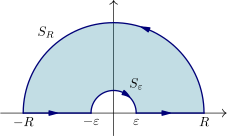
Denote the integral over the large semicircle by , over the small semicircle by , and the part of the integral over the real axis exclusive of the interval by . Then, by Cauchy’s Integral Theorem , It is easily verified that We have only to evaluate the integrals over and as and . Hence By choosing sufficiently large we can make as small as we please. We consider the integral in two parts We have for and by taking sufficiently large we may be sure that in the interval . Thus we have the estimate
On the other hand we have Since the integrand is uniformly continuous in and we may take the limit as inside the integral sign. We conclude that Hence we obtain
As a second example we propose to evaluate the Fresnel integrals and . To this end we introduce the function and integrate around a circular sector of radius and central angle .
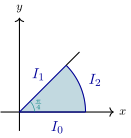
Setting we have \begin{align} \int_{0}^{R} e^{-x^{2}} \,d x+\int_{0}^{\pi / 4} e^{-R^{2}} e^{2 i \theta} R i e^{i \theta} \,d \theta+\int_{R}^{0} e^{-r^{2} e^{i\pi/2}} e^{i \pi/4} \,d r=0. \end{align}We shall now show that the second integral tends to zero as . We have \begin{align} \left|I_{2}\right|&=\left|R i \int_{0}^{\pi / 4} e^{-R^{2}} e^{2 i \theta} e^{i \theta} \,d \theta\right|\\ &\leq R \int_{0}^{\pi / 4}\left|e^{-R^{2} \cos 2 \theta}\right| \,d \theta \\ &= \frac{R}{2} \int_{0}^{\pi / 2} e^{-R^{2} \sin \phi} \,d \phi. \end{align}Now , whence it follows that the sine function is convex in the interval and therefore lies above the straight line between the endpoints; thus Thus and this clearly goes to zero as tends to infinity. Consequently we have Now is a well known integral. Its value is . 2 Thus we have whence
As a last example we propose to evaluate the following integral which plays a role in the study of the -function: To this end we consider the closed path as in the adjoining figure and the integral where is the residue of at .
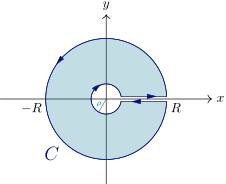
Clearly . Thus \begin{align} \int_{C} \frac{z^{\alpha-1}}{1+z} \,d z &=\int_{\rho}^{R} \frac{x^{\alpha-1}}{1+x} \,d x\\ & \quad +i \int_{0}^{2 \pi} \frac{R^{\alpha} e^{i \alpha \theta}}{1+R e^{i \theta}} \,d \theta \\ & \quad +\int_{R}^{\rho} \frac{x^{(\alpha-1)} e^{2 \pi i(\alpha-1)}}{1+x} \,d x\\ & \quad -i \int_{0}^{2 \pi} \frac{\rho^{\alpha} e^{i \alpha \theta}}{1+\rho e^{i \theta}} \,d \theta\\ &=2 \pi i e^{i \pi(\alpha-1)}, \end{align}or \begin{align} \left[1-e^{2 \pi i(\alpha-1)}\right] \int_{\rho}^{R} \frac{x^{(\alpha-1)}}{1+x} \,d x&=2 \pi i e^{\pi i(\alpha-1)}\\ & \quad -i \int_{0}^{2 \pi} \frac{R^{\alpha} e^{i\alpha \theta}}{1+R e^{i\theta}} \,d \theta \\ & \quad +i \int_{0}^{2 \pi} \frac{\rho^{\alpha} e^{i \alpha \theta}}{1+\rho e^{i \theta}} \,d \theta \end{align}But as , for Similarly as , for we have a singular inequality Hence \begin{align} \int_{0}^{\infty} \frac{x^{\alpha-1}}{1+x} \,d x & =\lim _{\substack{R \rightarrow \infty \\ \rho \rightarrow 0}} \int_{\rho}^{R} \frac{x^{(\alpha-1)}}{1+x} \,d x\\ & =\frac{2 \pi i e^{i \pi(\alpha-1)}}{1-e^{2 \pi i(\alpha-1)}}\\ &=\frac{2 \pi i}{e^{-i \pi(\alpha-1)}-e^{i \pi(\alpha-1)}}\\ & =\frac{\pi}{\sin (\pi-\alpha \pi)}\\ &=\frac{\pi}{\sin \alpha \pi}. \end{align}
Exercises
Exercise 3.1 . Evaluate the following integrals:
- over the ellipse .
- over the circle .
- over the circle .
Exercise 3.2 . Prove by using Cauchy’s Integral Formula that if is regular in a region bounded by a simple closed curve , and if is real on , then in and on .
Exercise 3.3 . Evaluate the integral where is real for each of the following curves:
- If is a closed path circling the origin.
- If is a straight line parallel to the -axis: , and .
- If is and .
Exercise 3.4 . Show that .
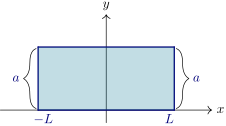
Exercise 3.5 . By integrating over the following rectangle evaluate .
Exercise 3.6 . Evaluate
- ;
- .
Exercise 3.7 . Show that , , by considering the integral over the unit circle.
Exercise 3.8 . Prove that if is a polynomial of degree having simple roots then for any function regular at these points the residue at is given by \dfrac{P(z_{i})}{Q'(z_{i})} .
Exercise 3.9 . Let be a polynomial of degree with real coefficients and having simple non-real roots and let be a polynomial of degree . Evaluate .
Exercise 3.10 . Evaluate
- ;
- .
Exercise 3.11 . Evaluate ; .