Table of Contents
3.1.1 Geometrical Notions
A curve, or rather a continuous curve in the -plane, is any collection of points whose coordinates , are continuous functions of a single parameter in some interval . In complex notation such a curve is described in the form If the initial point of the curve coincides with the end point, the curve is said to be closed and if it does not intersect itself elsewhere, i.e. if z(t') \neq z(t'') for any t' , t'' satisfying t_{1}
It will sometimes be necessary to approximate to a piecewise smooth simple curve by a sequence of paths . Namely, if is given by a function then the curves given in the parametric form must satisfy the relation uniformly in . The directions of the approximating curves need not approximate the direction of the limiting curve ; but, if that is the case, if in addition to we have uniformly in , then the sequence is said to approximate smoothly . 2 In particular, any path can be smoothly approximated by a sequence of polygonal paths consisting either of its tangents or of its chords. By means of the latter approximation it is not difficult to prove if a sequence of paths forms a smooth approximation to then the lengths of the approximating curves converge to that of the limit curve.
There is a famous theorem of Jordan which states that every continuous simple closed curve subdivides the -plane into two non-overlapping domains, an infinite domain, the exterior, and a bounded domain, the interior. It is by no means an easy theorem to prove although it has a deceptive appearance of simplicity, a complete proof having been achieved only in comparatively recent years. For theorems of this kind one should be very suspicious of the promptings of an undisciplined intuition. It might be supposed for example that the boundary of a simply-connected domain is a continuous curve. However, plausible this assertion may appear it can be easily confuted by various counter examples:
In the square , , erect vertical lines of height at the points . The region consisting of the interior of the rectangle minus the points on these lines is such a simply-connected domain. Its boundary, however, is made up of a curve plus an infinite number of branches.
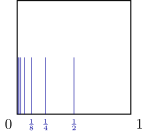
One might also suppose that every boundary point of a domain could be "reached" from the interior of the domain, i.e., by a polygon which, except for its end point on the boundary, lies entirely in the interior of the domain. This, however, need not be true, as one may verify for the points , in the above example.
The following example illustrates a domain, part of whose boundary is a simple closed curve, yet no point of this curve is accessible from the interior.
Let be the unit circle, and consider a spiral domain encircling an infinite number of times as its thickness tends to zero. Every point of the unit circle is a limit point of the spiral. The interior of is certainly a domain in our sense and the boundary contains the unit circle. However, any polygon drawn in the interior of towards encircles an indefinite number of times and cannot stop on . The unit circle is therefore completely inaccessible from the interior.
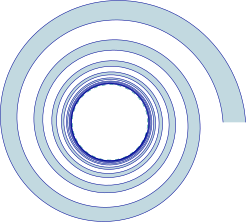
The proof of the general Jordan curve theorem is too long to have any proper place here. However, the reader may find it amusing the instructive to attempt to prove a special result. 3
A simple closed polygon divides the -plane into two disjoint domains. More exactly, if the polygon is deleted from the plane the remainder consists of two non-overlapping open connected point sets.
From the Jordan theorem for polygons we conclude that the interior and exterior of a simple closed polygon are both domains in the function theoretical sense. By means of this theorem we may now distinguish between domains which have "holes" in them and those which do not. The latter are said to be simply connected and we define a domain to be simply connected if for each simple closed polygon in , the domain contains its interior. The domains of Fig. 1 , 2 for example are simply connected. The ring domain , on the other hand, is not.
Next is the simply-connected domain from which a single point, or a simply-connected sub-domain has been cut – the so-called "ring domain". [See Fig. 3. ]
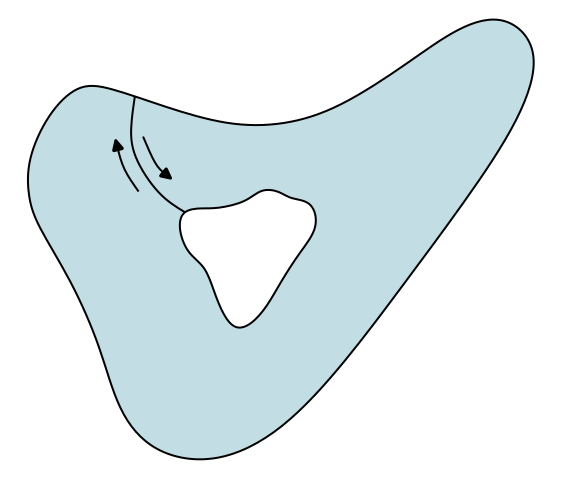
Such a domain is called doubly-connected . In general, an -tuply connected domain is one in which holes have been cut out of a simply connected domain. If the domain is bounded by piecewise-smooth arcs then an -tuply connected domain has closed boundary curves .
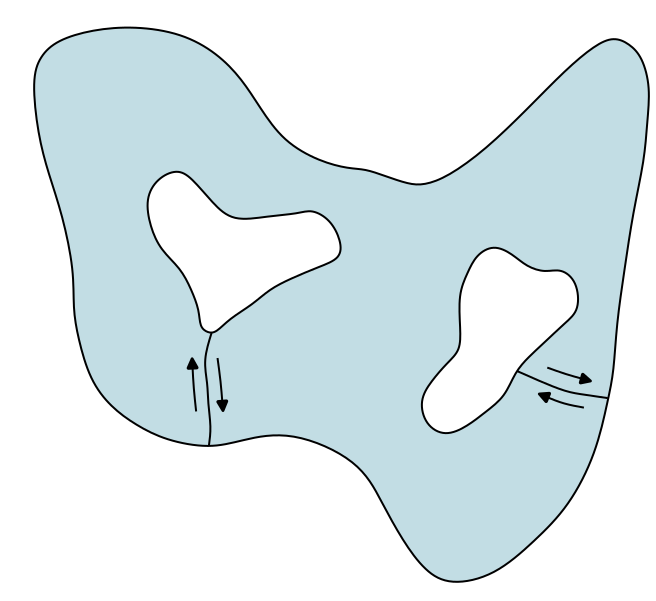
An -tuply connected domain can always be made simply connected by introducing “cross cuts”, i.e., paths which run through the domain and connect each of the interior boundary curves to the exterior. These cuts we add to the boundary of the domain, and agree not to take any path in the domain which crosses a cut. This automatically excludes any closed path which encircles one of the holes; the cut domain is therefore simply-connected.
Another theorem, needed later, is the following:
Theorem 3.1 . The interior of any simple, closed polygon can be decomposed into a finite number of triangles.
To prove this theorem, we define the property of convexity . A point-set is said to be convex if for every two points , of the set, the whole line segment between and is also contained in the set. The simplest example of a convex set is the infinite region on one side of a straight line, a half-plane .
It follows directly from the definition that the points common to a finite number of convex sets also form a convex set. For if and are two points of , the line segment lies in each one of the sets , , , and hence in . As a special case we have: The intersection of any finite number of half-planes is convex. [See Fig. 5 .]
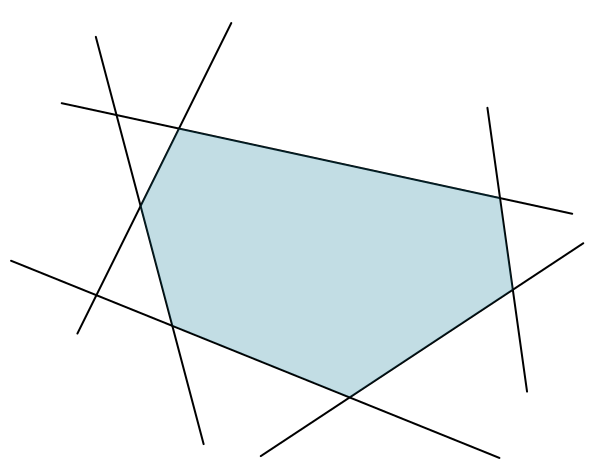
A convex polygonal region may easily be subdivided into triangles by choosing any interior point and joining it to the vertices. In general for any polygon the subdivision is accomplished as follows:
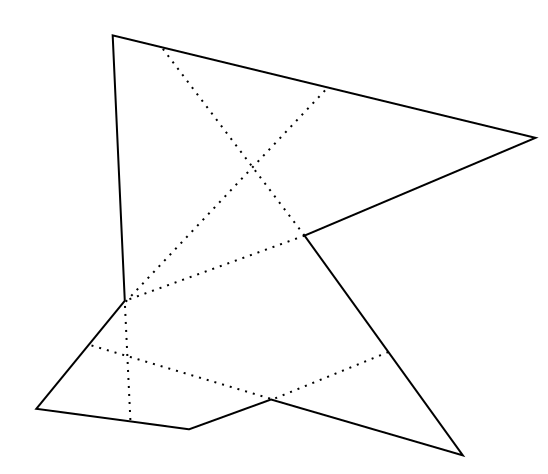
Extend each side of the polygon indefinitely in both directions. The interior of will then be split into a finite number of polygonal domains. [See Fig. 6 .] Each of these is the intersection of half planes and is therefore convex. The subdivision into triangles may then be carried out in each of the convex subdomains.
3.1.2 Line Integrals
A line integral as defined in calculus, 4 is an expression of the form where and are continuous functions of and in a domain of the -plane which contains the path . The value of the integral is defined by the ordinary Riemann integral I=\int_{t_{0}}^{t_{1}}\left(a[x(t), y(t)] x'(t)+b[x(t), y(t)] y'(t)\right) d t where is any parameter for . and
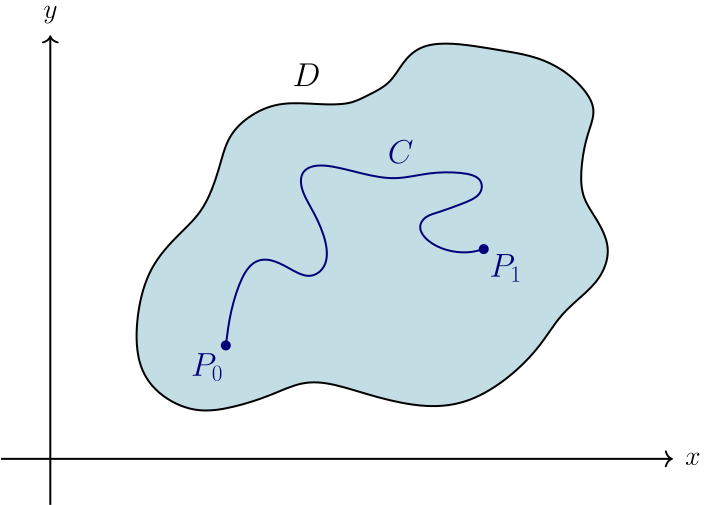
Keep the endpoints and fixed and join them by another path C' lying in . In general the integral along the path C' will be different from that along . But we are most interested in integrals whose values depend only upon the endpoints and not on the particular path which joins them.
Theorem 3.2 . A necessary and sufficient condition that the line integral shall be independent of the path joining to for each point pair , in is that there exist a function in such that \tag{1.20} \frac{\partial F}{\partial x}=a(x, y); \quad \frac{\partial F}{\partial y}=b(x, y).
The expression is the differential of and is called a total or an exact differential.
In this form the theorem is not applicable to specific cases since it does not give any criterion in terms of the given functions and for the existence of . However, by introducing further assumptions concerning the domain and the functions we arrive at a more directly applicable theorem.
Theorem 3.3 . If is a simply connected domain and , are differentiable functions, then the line integral will be independent of the path if and only if \tag{1.21} a_{y}=b_{x}.
This condition is known as the integrability condition . for two variables. It is a necessary and sufficient condition that the differential be exact.
3.1.3 Complex Integrals
The definite integral of a function of a complex variable may be defined in terms of the integrals of the real and imaginary parts. Setting we define \begin{align} \tag{1.30} \int_{z_0}^{z_1} f(z)\,dz = \int_{x_0, y_0}^{x_1, y_1} u\,dx - v\,dy + i\int_{x_0, y_0}^{x_1, y_1} v\,dx + u\,dy. \end{align} Hence for a simply connected domain and differentiable , the condition that these integrals be independent of the path is equivalent to the requirement that but these are none other than the Cauchy-Riemann equations. Clearly, then, for a function with differentiable real and imaginary parts in a simply-connected domain , a necessary and sufficient condition that be independent of the path joining to for all , in is that be analytic.
In introducing the notion of definite integral we need not refer to the real and imaginary parts of the integrand. It is possible to define a complex integral completely in complex terms in a manner somewhat analogous to that of the ordinary Riemann integral for real functions of a single variable.
Let be a continuous single-valued function on a curve . We need not require that be a path but only that be rectifiable, say of length . Subdivide into arcs and denote the successive points of subdivision by .
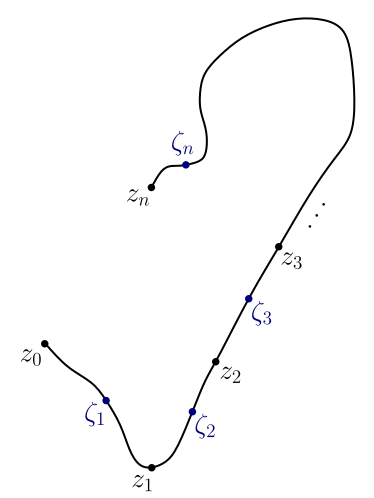
On each of the successive arcs of the subdivision choose a point arbitrarily and denoting the successive choices by form the sum \tag{1.31} \sum_{\nu=1}^{n} f(\zeta_{\nu}) \Delta z_{\nu}=f(\zeta_{1}) \Delta z_{1}+f(\zeta_{2}) \Delta z_{2}+\cdots+f(\zeta_{n}) \Delta z_{n} where . Allow the number of subdivisions to increase indefinitely in such a way that the largest value of tends to . We shall prove that the sum (1.31) will then converge to a limit and that this limit is independent of the particular mode of subdivision of . Hence we may define \tag{1.32} \int_{C} f(z)\,dz=\lim _{\max \left|\Delta z_{\nu}\right| \rightarrow 0} \sum_{\nu = 1}^{n} f(\zeta_{\nu}) \Delta z_{\nu}.
Since is a closed set, being continuous on is uniformly continuous. It follows from the rectifiability of that, given any , it is possible to find a so small that for any pair of points z' , z'' on the curve which are joined by an arc of length less than we have \left|f(z')-f(z'')\right|<\frac{\varepsilon}{2L}, being the length of . Take any two subdivisions in which the lengths of the arcs are all less than and denote the successive points of one subdivision of the other by . Now consider the subdivision which results from taking all the points of the first and second subdivision together. We shall denote the successive points of this subdivision by z_{0}', z_{1}', z_{2}', \ldots . The new subdivision is a finer one and contains all the points of the first two subdivisions. Thus any can be expressed in the form \Delta z_{\nu}=\Delta z_{\mu}'+\Delta z_{\mu+1}'+\cdots+\Delta z_{\mu+\rho}' where z_{\mu-1}'=z_{\nu-1} and z_{\mu+\rho}'=z_{\nu} . A similar result holds for the . For each subdivision we may construct a sum of the form (1.31) . In particular, we write with corresponding expressions for the other sums. The terms of are of the form T_{\nu}=f(\zeta_{\nu}) \Delta z_{\nu}=f(\zeta_{\nu})\left(\Delta z_{\mu}'+\Delta z_{\mu+1}'+\cdots+\Delta z_{\mu+\rho}'\right) and this corresponds to a part of the sum S' for the third subdivision T_{\nu}'=f(\zeta_{\mu}') \Delta z_{\mu}'+f(\zeta_{\mu+1}') \Delta z_{\mu+1}'+\cdots+f(\zeta_{\mu+\rho}') \Delta z_{\mu+\rho}'. From this we derive the inequality \left|T_{\nu}-T_{\nu}'\right| \leq\left|\Delta z_{\mu}'\right|\left|f(\zeta_{\nu})-f(\zeta_{\mu}')\right|+\cdots+\left|\Delta z_{\mu + \rho}'\right|\left|f(\zeta_{\nu})-f(\zeta_{\mu + \rho}')\right|. But the points \zeta_{\mu}', \zeta_{\mu+1}', \ldots, \zeta_{\mu+p}' are all on an arc which has a length less than . Hence we have
\left|f(\zeta_{\nu})-f(\zeta_{\mu+\lambda}')\right|<\frac{\varepsilon}{2L}\quad \text {for } \lambda=0, 1, \ldots, \rho. It follows that \left|T_{\nu}-T_{\nu}'\right|<\frac{\varepsilon}{2 L}\left(\left|\Delta z_{\mu}'\right|+\cdots+\left|\Delta z_{\mu+\rho}'\right|\right). Hence, for the entire sum we have \left|S-S'\right|<\frac{\varepsilon}{2L} \sum_{\lambda=1}^{n'}\left|\Delta z_{\lambda}'\right|. Furthermore, since \left|\Delta z_{\lambda}'\right| is not greater than the length of the arc \overset{\LARGE \frown}{z_{\lambda-1}' z_{\lambda}'} we have \sum\left|\Delta z_{\lambda}'\right| \leq L and therefore \left|S-S'\right|<\frac{\varepsilon}{2}. The same reasoning shows that \left|S^{*}-S'\right|<\frac{\varepsilon}{2}, whence We conclude that the limit (1.32) exists and is independent of the subdivision.
A number of simple properties of integrals derive directly from the definition:
Lemma 3.1 . If the function is bounded, , then \tag{1.33} \left|\int_{C} f(z)\,dz\right| \leq ML, being the length of .
Lemma 3.2 . If the curve consists of two consecutive rectifiable segments and then \tag{1.34} \int_{C_{1}} f(z)\,dz + \int_{C_{2}} f(z)\,dz = \int_{C} f(z)\,dz.
Lemma 3.3 . If the direction of integration is reversed, the value of the integral is changed in sign. Thus, if we denote the reverse orientation of by we have \tag{1.35} \int_{-C} f(z)\,dz=-\int_{C} f(z)\,dz For a closed path we adopt the convention that the positive sense is the mode of description for which the interior lies on the left.
Lemma 3.4 . Integration is a linear operation, i.e., if are constants we have
\tag{1.36} \int_{C}[\alpha f(z)+\beta g(z)]\,dz=\alpha \int_{C} f(z)\,d z+\beta \int_{C} f(z)\, d z.
More generally, we have
Lemma 3.5 . The integral of a uniformly convergent series is the same as the sum of the integrals of the separate terms.
Proof. Suppose we have a series uniformly convergent on a curve . Then for sufficiently large we have where is the partial sum, . From (1.33) it follows that where is the length of . Consequently ◻
Lemma 3.6 . The integral of a constant is independent of the curve of integration. More precisely, we have \tag{1.37} \int_{z_{0}}^{z_{1}}\,dz = z_{1}-z_{0} independently of the curve connecting to .
Similarly, we have \tag{1.38} \int_{\zeta_{0}}^{\zeta_{1}} z\,ds = \frac{1}{2}\left(\zeta_{1}^{2}-\zeta_{0}^{2}\right) independently of the curve of integration.
For we may approximate the integral by either sum S=\sum z_{\nu}\left(z_{\nu}-z_{\nu-1}\right) \text {\ \ or\ \ } S'=\sum z_{\nu-1}\left(z_{\nu}-z_{\nu-1}\right). Adding term by term we obtain \begin{align} S+S' &=\sum\left(z_{\nu}+z_{\nu-1}\right)\left(z_{\nu}-z_{\nu-1}\right)\\ &=\sum\left(z_{\nu}^{2}-z_{\nu-1}^{2}\right)\\ &=\zeta_{1}^{2}-\zeta_{0}^{2}. \end{align}The statement follows at once.
Lemma 3.7 . Let be a continuous function in a region . If there is a sequence of curves of bounded length approximating a given rectifiable curve then \tag{1.39} \lim_{n \rightarrow \infty} \int_{C_{n}} f(z)\,dz = \int_{C_{0}} f(z)\,dz
Proof. Denote the integral over by . By taking a sufficiently fine subdivision we can obtain a uniform approximation of . Denote the curve in parametric form by , . We show first that it is possible to make a subdivision of the parameter interval so that we obtain a uniformly small subdivision on all .
From the rectifiability of the curves we can always determine such a subdivision for a finite number of them. However, the statement can be proved for all. Namely, given any there is a such that whenever , and is independent of . Suppose on the contrary that for any there is always an with for some , with . Let be a sequence of ’s tending to zero. Denote by the first for which there is a , with and . Clearly the are unbounded. Now we can find an so large that for all we have uniformly in . Furthermore, since is rectifiable there is a such that implies Choose a for which and . We have for all , with \begin{align} \left|z_{n_{k}}(t)-z_{n_{k}}(\tau)\right| &=\Big|\left[z_{n_{k}}(t)-z_{0}(t)\right]\\ & \quad +\left[z_{0}(t)-z_{0}(\tau)\right]\\ & \quad +\left[z_{0}(\tau)-z_{n_{k}}(\tau)\right]\Big|\\ &<\frac{\delta}{3}+\frac{\delta}{3}+\frac{\delta}{3}\\ &=\delta. \end{align}Contradiction.
Since is continuous in the region it is uniformly continuous. Hence, given any there is a such that for all , in with . Choose a subdivision of the parameter interval so small that for all . Set and form the sum From (1.37) it follows that since is a constant in each term. We conclude that \begin{align} \left|I_{n}-S_{n}\right|&=\left|\sum_{\nu=1}^{m} \int_{z_{n, \nu-1}}^{z_{n, \nu}}\left[f(z)-f(z_{n, \nu})\right] d z\right|\\ &\leq \varepsilon L \end{align}where the integration is along , and where is an upper bound for the curve lengths.
Now choose a value of so large that uniformly in . Consider the difference ; \begin{align} &\sum_{\nu = 1}^{m}\Big(f(z_{n, \nu})\left(z_{n, \nu}-z_{n, \nu-1}\right)-f(z_{0, \nu})\left(z_{0, \nu}-z_{0, \nu-1}\right)\Big)\\ = &\sum_{\nu=1}^{m}\Big(f(z_{0, \nu})\big[\left(z_{n, \nu}-z_{0, \nu}\right)-\left(z_{n, \nu-1}-z_{0, \nu-1}\right)\big]\\ &\quad+\big[f(z_{n, \nu})-f(z_{0, \nu})\big]\left(z_{n, \nu}-z_{n, \nu-1}\right)\Big). \end{align}Thus where is the bound of on . We conclude that \begin{align} \left|I_{n}-I_{0}\right| & \leq\left|I_{n}-S_{n}\right|+\left|S_{n}-S_{0}\right|+\left|S_{0}-I_{0}\right| \\ & \leq \varepsilon(2 m M+m L+2 L). \end{align}The proof is complete. ◻
Lemma 3.8 . If the curve of integration is a path the two definitions of integral (1.30) and (1.32) are equivalent.
Proof. Let the path be given in parametric representation, , . Take any subdivision of where the points of discontinuity of the derivative are included among the subdivision points. The sum (1.32) may be replaced by sums of real terms \begin{align} \sum_{\nu=1}^{n} f(\zeta_{\nu}) \Delta z_{\nu} & =\sum_{\nu=1}^{n}(u_{\nu}+i v_{\nu})\big[(x_{\nu}-x_{\nu-1})+i(y_{\nu}-y_{\nu-1})\big] \\ & =\sum_{\nu = 1}^n u_{\nu} \Delta x_{\nu}-\sum_{\nu = 1}^n v_{\nu} \Delta y_{\nu}+i\left(\sum_{\nu = 1}^n v_{\nu} \Delta x_{\nu} + \sum_{\nu = 1}^n u_{\nu} \Delta y_{\nu}\right) \end{align}where , . Consider any of these sums, say . Since is uniformly continuous on each smooth arc of it is certainly continuous in every subdivision. Therefore we have where is some value between and . Set . From the uniform continuity of it follows that there is a such that whenever . Hence by choosing a subdivision so that we may ensure that . Consequently, we may write where the second term can be made as small as we please. For let be a bound of . We have We conclude that \begin{align} \max \lim _{\Delta x_{\nu} \rightarrow 0} \sum u_{\nu} \Delta x_{\nu} & =\int u(x, y) \dot{x}(t)\, d t \\ & =\int_{C} u\, d x \end{align}and similar results hold for the other integrals. We conclude that or in brief notation \begin{align} \int_{C} f(z)\, d z&=\int_{C}(u+i v)(d x+i\, d y)\\ &=\int f(z) \dot{z}(t)\, d t. \end{align}◻