Table of Contents
3.4.1 The Boundary Value Problem
As we have seen, the values of an analytic function in the interior of a simple closed curve depend completely upon the values on the boundary. In this section we shall discuss the close relation of this result to the boundary value problem of potential theory.
A function is harmonic in a domain if it has continuous derivatives up to second order and satisfies the Laplace equation The equation is linear. Thus any linear combination of harmonic functions is again a harmonic function.
From the Cauchy-Riemann equations it is clear that the real and imaginary parts of an analytic function are harmonic functions in and . Conversely, given any harmonic function , there exists another harmonic function , determined to within an additive constant by the integral \tag{4.10} {v}({x}, {y})=\int-{u}_{{y}} \,{dx}+{u}_{{x}} \,{dy}, such that is an analytic function of the complex variable . The so-defined function is said to be conjugate to . The function will then be conjugate to . Every harmonic function can then be made to appear as the real or imaginary part of an analytic function. With this fact, we have established the equivalence of the theory of harmonic functions with the theory of analytic functions.
A number of properties of analytic functions may be carried over at once. Since analytic functions have continuous derivatives of all orders it follows that a harmonic function has continuous derivatives of all orders with respect to and .
A number of major theorems carry over, notably
Theorem 3.18 (The Mean-Value Property). If is a harmonic function regular in a circle of radius about , then \tag{4.11} u(x_{0}, y_{0})=\frac{1}{2 \pi r} \int_{0}^{2 \pi} u(x_{0}+r \cos \theta, y_{0}+r \sin \theta) \,d \theta.
Proof. This follows immediately from the mean-value property for analytic functions, namely, if is the conjugate to and we put , Separating real and imaginary parts gives (4.11) . ◻
Theorem 3.19 (The Maximum-Minimum Principle). If is a harmonic function regular in a domain and on its boundary then takes on its maximum and minimum value on the boundary of . If furthermore, the maximum or minimum is also attained at any interior point, then reduces to a constant.
The proof for the maximum is, step by step, the same as the corresponding theorem for analytic functions. For the minimum, we have merely to note that attains a minimum where attains a maximum.
From this it follows that a harmonic function is uniquely determined by its boundary values , i.e., if and are both harmonic in and have the same values on the boundary of , then inside . For, the function is harmonic in and vanishes everywhere on the boundary of . Hence, by the maximum-minimum principle, in .
An analytic function is also determined uniquely, given its boundary values, by Cauchy’s Integral Formula . This does not mean, however, that there is complete freedom of choice for the boundary values of an analytic function – in fact we are free only to prescribe the boundary value of its real (or imaginary) part. For the boundary values of the real part determine the real part of uniquely and by (4.10) , its imaginary part also. 1 In fact we shall actually find an explicit expression for given the boundary values of the real part.
It is an interesting problem to discover how much freedom there is in specifying a harmonic function with given boundary values. This question has been deeply investigated in recent years. But under the rather restrictive conditions that we employ here, that the boundary is a path and the boundary values are continuous, the problem always has a unique solution.
We shall now show, for the simple domain of the circle, that it is possible to express a given harmonic function as an integral involving only its boundary values, analogous to Cauchy’s Integral Formula . This same integral expression, we shall show, for given boundary values, actually sets up a harmonic function in the domain having these boundary values, and thus solves the boundary value problem for such a domain. For more complicated domains the problem is considerably more difficult.
We may, without loss of generality, consider simply the unit circle about the origin. Let be harmonic in , and denote by the boundary values of on the circumference of . Let be the analytic function in having as its real part. Then by Cauchy’s Integral Formula , where denotes the complex variable along . In polar coordinates on , giving If we can separate real and imaginary parts in this formula we will have succeeded in expressing and in terms of their respective boundary values. Let us see how this may be done:
From the fact that the conjugate of the inverse of with respect to lies outside , it follows that hence \tag{a} 2 \pi f(z)=\int_{0}^{2 \pi} f(t)\left[\frac{t}{t-z} \pm \frac{t}{t-\frac{1}{z}}\right] d \theta. Since , which is real. Hence, writing , we can immediately separate (a) into its real and imaginary parts, giving \tag{b} 2 \pi u(r, \phi)=\int_{0}^{2 \pi} u(\theta) \frac{1-|z|^{2}}{|t-z|^{2}} \,d \theta where is a point inside and . Evidently , representing the distance from a fixed point to the variable point , is given by
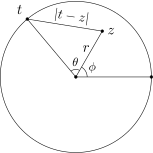
We thus obtain the important formula \tag{4.12} \boxed{u(r, \phi)=\frac{1}{2 \pi} \int_{0}^{2 \pi} u(\theta) \frac{1-r^{2}}{1-2 r \cos (\theta-\phi)+r^{2}} \,d \theta} This expression, known as Poisson’s Integral Formula , is part of the desired result, namely, the representation of a function harmonic in the unit circle in terms of an expression in which its boundary values, and only these, appear explicitly. We shall see below that the Poisson formula also solves the boundary value problem for the unit circle:
It is convenient to obtain similar formulas expressing and in terms of the boundary values of . We have
\begin{align} \frac{t}{t-z}+\frac{t}{t-\frac{1}{z}} & =\frac{t}{t-z}-\frac{\bar{z}}{\bar{t}-\bar{z}}\\ &=\frac{t \bar{t}+z \bar{z}-t \bar{z}-\bar{t} z+(\bar{t} z-t \bar{z})}{|t-z|^{2}} \\ & =1+\frac{\bar{t} z-\overline{(\bar{t} z)}}{|t-z|^{2}}=1+\frac{2 i \operatorname{Im}(\bar{t}z)}{|t-z|^{2}} \end{align}hence, using the upper sign in (a) which gives \tag{c} 2 \pi v(r, \phi)=\int_{0}^{2 \pi} v(\theta) \,d \theta+2 \int_{0}^{2 \pi} u(\theta) \frac{\operatorname{Im}(\bar{t} z)}{|t-z|^{2}} \,d \theta. By the mean value property , the value at the origin, and , hence \tag{4.13} \boxed{v(r, \phi)=v(0)+\frac{1}{\pi} \int_{0}^{2 \pi} u(\theta) \frac{r\sin (\phi-\theta)}{1-2 r \cos (\phi-\theta)+r^{2}} \,d \theta} This formula determines uniquely, except for the arbitrary additive constant .
Combining (b) and (c) gives \begin{align} u(r, \phi)+iv(r, \phi)&=f(z)\\ &=i v(0)+\frac{1}{2 \pi} \int_{0}^{2 \pi} u(\theta)\left[\frac{1-z \bar{z}}{|t-z|^{2}}+\frac{2 i \operatorname{Im} (\bar{t}z)}{|t-z|^{2}}\right] d\theta. \end{align}Since , this reduces to \tag{4.14} \boxed{f(z)=i v(0)+\frac{1}{2 \pi} \int_{0}^{2 \pi} u(\theta) \frac{t + z}{t - z} \,d\theta} which expresses a function analytic in the unit circle in terms of the boundary values of its real part. is determined uniquely except for the arbitrary constant .
Poisson’s formula (4.12) is easily extended to a circle of radius . We have merely to replace by in (4.12) : \begin{align} \tag{4.15} u(r, \phi)=\frac{1}{2 \pi} \int_{0}^{2 \pi} u(\theta) \frac{R^{2}-r^{2}}{R^{2}-2 Rr \cos (\theta-\phi)+r^{2}} \,d \theta, \quad 0 \leq r \leq R. \end{align}
Fourier Expansion of a Harmonic Function
Instead of expressing a harmonic function as an integral taken over the boundary values, it is possible by suitably transforming these formulas, to express it as a Fourier series whose coefficients depend only on the boundary values. \begin{align} \frac{t+z}{t-z}&=1+\frac{2 z}{t-z}\\ &=1+2 \frac{z}{t} \frac{1}{1-\frac{z}{t}}\\ &=1+2\sum_{n = 1}^{\infty} \frac{z^{n}}{t^{n}}. \end{align}This series converges inside the unit circle, since . Hence (4.14) becomes Since the convergence of the series is uniform in any smaller circle we may interchange summation with integration: Separating into real and imaginary parts gives the two series \begin{align} \tag{4.16} \left\{ \begin{array}{l} \displaystyle u(r, \phi)=\frac{\alpha_{0}}{2}+\sum_{n=1}^{\infty} r^{n}\left(\alpha_{n} \cos n \phi+\beta_{n} \sin n \phi\right) \\ \displaystyle v(r, \phi)=v(0)+\sum_{n=1}^{\infty} r^{n}\left(\alpha_{n} \sin n \phi-\beta_{n}\cos n \phi\right) \end{array} \right. \end{align} where \begin{align} \alpha_{n}&=\frac{1}{\pi} \int_{0}^{2 \pi} u(\theta) \cos n \theta \,d \theta, \quad n = 0, 1, 2, \ldots \\ \beta_{n}&=\frac{1}{\pi} \int_{0}^{2 \pi} u(\theta) \sin n \theta \,d \theta, \quad n=1,2, \ldots. \end{align} , are called the Fourier coefficients of the function . Since the two series converge uniformly inside the unit circle.
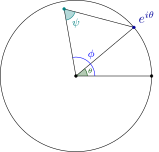
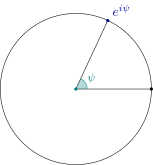
Another method of deriving the Poisson formula, depending on the Mean Value Theorem , is as follows: The transformation \tag{d} w(z)=e^{i \phi} \frac{z-r}{r z-1} maps the interior of the unit circle of the -plane into a unit circle in the -plane, and takes the point into the point . We then have where is a variable point on the circumference. If is the corresponding point of the -plane, then or being the angle shown in the figure.
From (d) we find
Solution of the Boundary Value Problem for the Unit Circle
We now show that Poisson’s formula not only represents a given harmonic function in terms of its boundary values, but solves the boundary value problem for the unit circle, namely:
Theorem 3.20 . Given any real continuous function , having period with respect to and defined on the unit circle of the -plane, there exists a harmonic function which is regular in the unit circle and takes on prescribed values on the boundary of the unit circle, given by
Since differentiation with respect to and under the integral sign is permissible where is the Poisson kernel \begin{align} \lambda(r, \phi ; \theta)&=\frac{1-r^{2}}{1-2 r \cos(\phi-\theta)+r^{2}}\\ &=\frac{1-|z|^{2}}{|t-z|^{2}}, \qquad z=r e^{i \phi} ; \quad t=e^{i \theta} \end{align}and is the Laplace operator That follows immediately from the fact that . But because and , being the real part of the analytic function , must be harmonic.
Thus we have shown that (4.12) is actually a harmonic function. It takes on certain boundary values on the unit circle, and our problem is solved if we show that
Proof. If is a given point on the unit circle and , then we must show that The function , being a harmonic function, may be represented by Poisson’s integral: \tag{e} c=\frac{1}{2 \pi} \int_{0}^{2 \pi} c \cdot \lambda(r, \phi ; \theta) \,d \theta Hence \tag{f} u(r, \phi)-c=\frac{1}{2 \pi} \int_{0}^{2 \pi}(f(\theta)-c)\, \lambda(r, \phi; \theta) \,d \theta. We cannot pass to the limit directly in this expression since the Poisson kernel becomes indeterminate as . We use, instead, a reasoning which is typical in such cases; we break the integral into two parts, and apply a separate estimate to each. A small circle of radius drawn about divides the unit circle into the small arc and a large arc . By continuity of we can take so small that \tag{g} |f(\theta)-c|<\frac{\varepsilon}{2} \text{ on } C_{1}. Draw another circle {k}' about having a radius and let , which we regard as fixed throughout the argument, be an arbitrary point inside the circle {k}' , but not on .
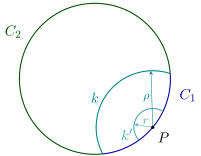
Then, from (f) From (e) and (g) \tag{h} \frac{1}{2 \pi} \int_{C_{1}}|f(\theta)-c| \lambda \,d \theta \leq \frac{\varepsilon}{4 \pi} \int_{0}^{2 \pi} \lambda(r, \phi ; \theta) \,d \theta=\frac{\varepsilon}{2}. We have seen that represents the (variable) distance from the point to the boundary. Hence, if denotes the smallest distance from to the arc , we have Letting , and noting that for inside {k}' , \begin{align} \frac{1}{2 \pi} \int_{C_{2}}|f(\theta)-c| \lambda \,d \theta &\leq \frac{M}{2 \pi m^{2}} \int_{0}^{2\pi}(1-r^{2})\, d \theta\\ &\leq \frac{2M}{\rho^{2}}(1-r^{2}). \end{align}We can evidently take k' so small that for all points within it. Hence, combining this with (h) , for any point in a sufficiently small neighborhood k' of , which proves the theorem. ◻
An alternate method of solution of the boundary value problem for the unit circle is given by the Fourier expansion (4.16) for a harmonic function. Suppose a function which is continuous and has a piecewise continuous derivative in is prescribed on the boundary of the unit circle. Then \tag{i} u(r, \phi)=\frac{\alpha_{0}}{2}+\sum_{n = 1}^{\infty} r^{n}(\alpha_{n} \cos n \phi+\beta_{n} \sin n \phi), where \left\{\begin{aligned} \alpha_{n}=\frac{1}{2 \pi} \int_{0}^{2 \pi} f(\theta) \cos n \theta \,d \theta;\\ \quad \beta_{n}=\frac{1}{2 \pi} \int_{0}^{2 \pi} f(\theta) \sin n \theta \,d \theta, \end{aligned}\right. \qquad (n = 0, 1, 2, \ldots) is the harmonic function, regular in the unit circle, which has the boundary values . For, under the above restrictions, is equal to its Fourier series hence the series (i) converges everywhere in the unit circle to a function , which has the boundary values . That is harmonic follows from the fact that each term of the series is harmonic, and, since the series is uniformly convergent in any subcircle
By considering its conjugate function and reversing the steps used to obtain (4.16) we may transform the expression (i) into Poisson’s integral.
3.4.2 Physical Application of the Theory of Analytic Functions, Two-dimensional Flows
Besides the various characterizations of analytic functions we have considered up to the present, there is yet another viewpoint, of great physical significance. Namely, to every analytic function, as we shall see, there corresponds a certain type of two-dimensional flow.
A two-dimensional flow is a motion which is characterized and defined mathematically by a vector , representing the velocity, defined at every point of a domain by its and components which are single-valued, given functions of and in . The third component of velocity is zero. We suppose and to be differentiable functions of and and that the flow is steady, or stationary, i.e., that and do not vary with the time. Such a flow may be realized physically by an incompressible liquid, or a flow of heat or electricity in a flat plate.
Let us consider first some elementary concepts in connection with such flows. By a "source" we mean a point where fluid appears, by a "sink", a point where fluid disappears. To make these concepts precise, consider any domain of the -plane, having boundary . 2 If is an element of arc of taken in the positive direction around , then , where denotes the component of normal to , gives the amount of fluid flowing across ds out of in unit time. (If is negative, the fluid is understood to flow across into .)
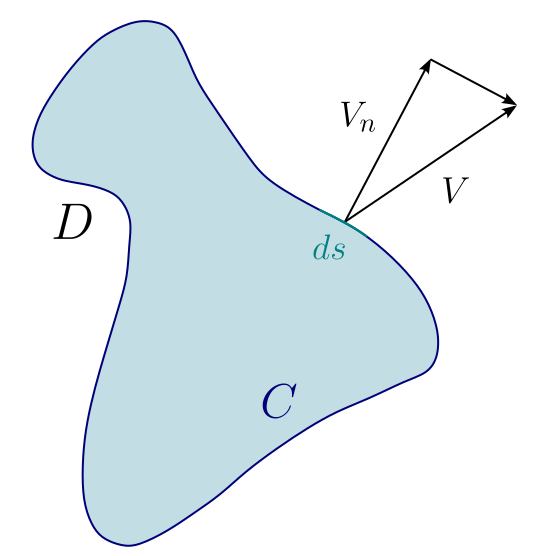
Denoting by the components of , are the components of the normal to pointing out from . Projecting on this normal gives Hence the total excess of fluid leaving over that entering is given by \tag{4.20} \int_{C} V_{n}\, d s=\int_{C} p \,d y-q \,d x
taken over the boundary . This integral is usually called the flux of fluid over the curve . If there are no sources or sinks in and the fluid is incompressible, this integral vanishes over , or any closed curve in . We call such a flow "divergence free" and take the vanishing of the flux integral (4.20) as the mathematical expression of this fact.
There remains the consideration of so-called "vortex-motion". If we think of the flow as represented by a family of curves, called "streamlines," along which the flow streams, then it may occur that a streamline is a closed loop, in which case the fluid circulates around the curve indefinitely. The flow is then said to have vortex motion. It is convenient to define the measure of this circulation by along the streamline. If is not a streamline, then we readily define the circulation along by considering the component of along , , and integrating this around : If the flow is vortex free in a domain then the circulation vanishes along every closed curve in , and conversely.
With these definitions we may now prove:
Theorem 3.21 . If , are a pair of differentiable functions of and in a domain which define a vector field having , as components, and if is free of divergence and circulation, then the function is an analytic function of in .
Proof. The conditions of our theorem state that, if is any subdomain of having the boundary , then Hence the complex function has the property that for any such closed path \begin{align} \int_{g} f(z) \,d z & =\int_{g}(q+i p)(d x+i \,d y) \\ & =\int_{g}(q \,d x-p \,dy)+\int_{g}(p \,d x+q \,d y)\\ &=0. \end{align}But then, by Morera’s theorem is analytic in . ◻
This function, whose real and imaginary parts give the velocity components, is called the complex velocity , and is regular in every domain which is free of divergence and circulation. In such a domain is also regular, and determines to within a constant an analytic function , called the velocity potential , such that The equations determine a family of curves in the -plane. The direction of flow at any point is given by the curve passing through that point, for, from it follows that The curves, therefore, coincide with the streamlines, i.e., the lines of flow. The curves constitute another family which is orthogonal to the first, since We call these the equipotential lines of the flow.
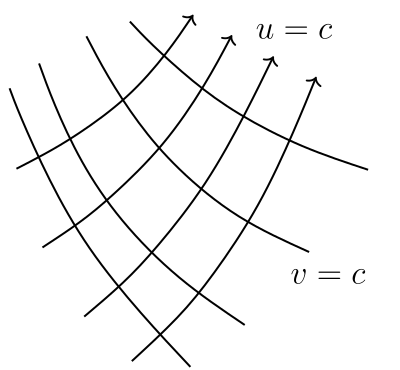
The figure illustrates a typical portion of a flow, as represented by streamlines and equipotentials.
Singularities of the Flow, Flows of Elementary Functions
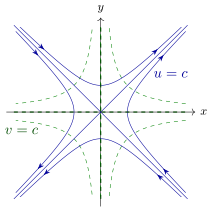
Let us examine the various kinds of singularities which appear in a flow. These will correspond to branch points or singular points of the velocity potential . Branch point singularities are typified by the behavior of the function at the origin. It will be sufficient to restrict ourselves to a study of the flow defined by this function. If , the lines , correspond, respectively, to the orthogonal net of rectangular hyperbolas (A few members of each family are shown in the figure.) The arrows along the -curves indicate the direction of flow, i.e., the direction of increasing . The limiting cases , fail to meet at right angles, but make an angle of at the origin. This is, of course, to be expected, from our previous discussion concerning the behavior of the mapping near the origin. Two streamlines come together at such a point and two leave, the flow having the choice of following either one. This picture originally suggested the name "branch point".
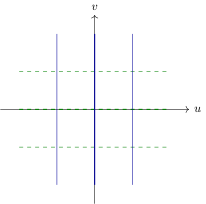
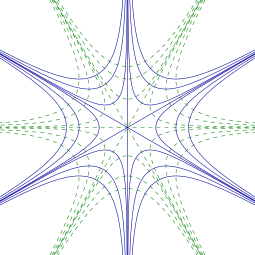
A similar situation occurs at the origin for ; streamlines come together at the same angle and streamlines leave the crossing point. The following figure pictures the case , corresponding to .
The function provides two important types of flow. We have i.e., the streamlines consist of the family of concentric circles about the origin, the flow being pictured by the adjoining figure.
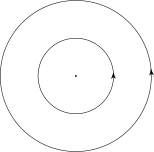
One may ask, what happens at the origin in such a flow? We should expect abnormal behavior because of the singularity of there; let us evaluate the circulation integral where , are the velocity components, along one of these circles. Since , this becomes which holds along any curve encircling the origin once in the positive direction. There is thus vortex motion about the origin. (In this flow there is no divergence along the circles, for, along a streamline , , hence .)
The function interchanges the role of and in the above, and has the streamlines whose velocity components , are There is no circulation along any closed curve around the origin. However, the flux over such a curve is This means that units of fluid per second flow out across the boundary of any domain enclosing the origin. On the other hand, the flux through any closed curve not including the origin is zero. We may therefore regard units of fluid as being manufactured at the origin per second and flowing out away from it. Such a singularity is called a source of fluid, and is typified by the adjoining figure.
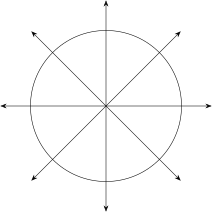
We may take the value of the flux integral (4.20) as the measure of the "strength" of the source.
By considering the function we obtain a "sink" of strength at the origin, where units of fluid disappear per second. To represent the flow, we have merely to reverse the arrows in the above figure.
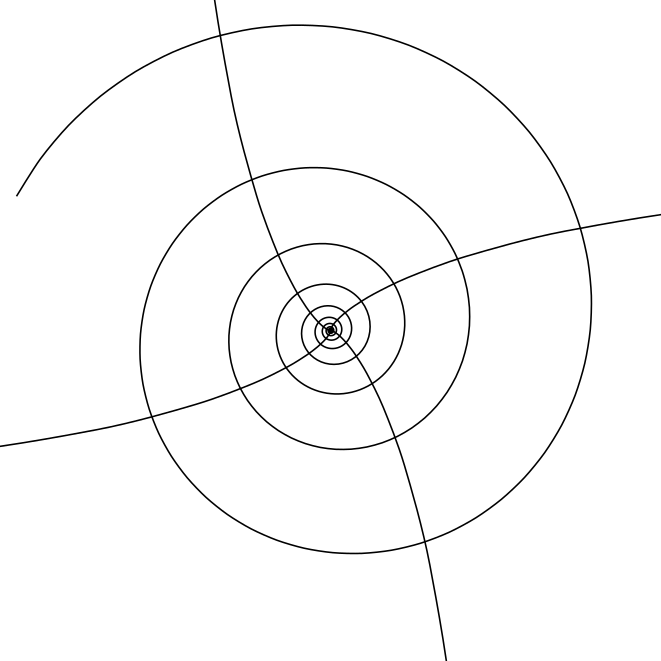
Other important types of singularities in the flow field can be obtained by combinations of logarithmic singularities. For example, one immediately combines the two types of flows above by means of the function Here the streamlines and equipotentials are given, respectively, by \begin{align} & {u}={a} \log {r}-{b} \theta={c}, \\ & {v}={a} \theta+{b} \log r={c} . \end{align}These curves constitute an orthogonal net of logarithmic spirals of the form , , suitable constants. The flow, which has both divergence and circulation in any domain enclosing the origin, is pictured below.
Another elementary type of flow is given by the function having a source of strength at and a corresponding sink at , and whose streamlines are Evidently represents the angle subtended by the segment at the point , hence the curves form a pencil of circles through and . The figure shows the flow for , .
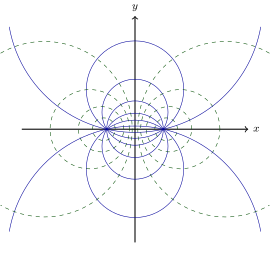
It may be obtained from the flow for a source by the linear transformation , which brings the "sink at infinity" into the finite plane.
The nature of the flow at the origin for the function may easily be visualized from the fact that where may be assumed real. The flow given by is of the type represented by the above figure having a source at and a sink at , both of strength . As , , the source and sink come together at the origin, their strengths tend to infinity, and the pencil of circles becomes tangent to the real axis. The equipotential circles pass into a similar pencil tangent to the -axis. The flow looks like this:
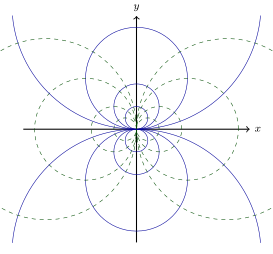
Such a combination of a source and sink infinitely close together is often referred to as a dipole , or double source. The concept is frequently met with in the theory of electricity.
The corresponding flows for , , etc. may also be obtained, using this method, by combining two or more double sources. The figure below shows the flow for near the origin.