Chapter Summary (Express)
All through the calculus we are dealing with quantities that are growing, and with rates of growth.
Two classes of all quantities:
(1) Constants: Constants are quantities which we regard of fixed values.
We often denote constants by letters from the beginning of the alphabet: , , or .
(2) Variables: Variables are quantities capable of growing or varying.
We often them denote by letters from the end of the alphabet, such as , , , , , , or sometimes .
We classify all quantities into two classes: constants and variables. Those which we regard as of fixed value, and call constants, we generally denote algebraically by letters from the beginning of the alphabet, such as , , or ; while those which we consider as capable of growing, or (as mathematicians say) of “varying,” we denote by letters from the end of the alphabet, such as , , , , , , or sometimes .
We are usually dealing with more than one variable at once, and thinking of the way in which one variable depends on the other.
For example, consider the height and slope of a ladder. Any variation in the slope will change the height of the latter.
Moreover, we are usually dealing with more than one variable at once, and thinking of the way in which one variable depends on the other: for instance, we think of the way in which the height reached by a projectile depends on the time of attaining that height. Or we are asked to consider a rectangle of given area, and to enquire how any increase in the length of it will compel a corresponding decrease in the breadth of it. Or we think of the way in which any variation in the slope of a ladder will cause the height that it reaches to vary.
Suppose we have two variables, and , and depends on . If we cause to become (by adding to it to a bit, which we call ), because of the dependence of on , will also change and become , where can be positive or negative and in general (except by a miracle)
Suppose we have got two such variables that depend one on the other. An alteration in one will bring about an alteration in the other, because of this dependence. Let us call one of the variables , and the other that depends on it .
Suppose we make to vary, that is to say, we either alter it or imagine it to be altered, by adding to it a bit which we call . We are thus causing to become . Then, because has been altered, will have altered also, and will have become . Here the bit may be in some cases positive, in others negative; and it won’t (except by a miracle) be the same size as .
Take two examples
Example 3.1. Let and be respectively the base and the height of a right-angled triangle (the following figure), of which the slope of the other side is fixed at . If we suppose this triangle to expand and yet keep its angles the same as at first, then, when the base grows so as to become , the height becomes . Here, increasing results in an increase of . The little triangle, the height of which is , and the base of which is , is similar to the original triangle; and it is obvious that the value of the ratio is the same as that of the ratio . As the angle is it will be seen that here
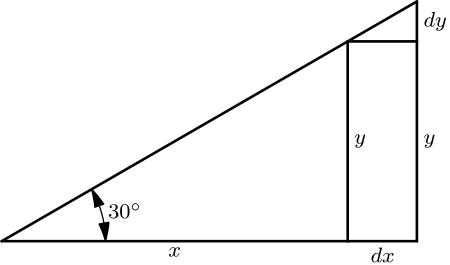
Fig. 3.1
Example 3.2. A fixed-length ladder leans against a wall, with representing the horizontal distance from the wall to the ladder's base and the vertical height it reaches. Initially, when inches, inches (15 feet), and the ladder's length is inches by the Pythagorean theorem. If the base is moved out by inch to inches, the new height becomes inches, yielding a decrease of inches. This demonstrates that increasing by a small amount results in a small negative change in , with the ratio , highlighting how increments in lead to decrements in of different magnitudes.
Example 3.2. Let represent, in the following figure, the horizontal distance, from a wall, of the bottom end of a ladder, , of fixed length; and let be the height it reaches up the wall. Now clearly depends on . It is easy to see that, if we pull the bottom end a bit further from the wall, the top end will come down a little lower. Let us state this in scientific language. If we increase to , then will become . If then ; that is, when receives a positive increment, the increment which results to is negative.
Yes, but how much? Suppose the ladder was so long that when the bottom end was inches from the wall the top end reached just feet from the ground. Now, if you were to pull the bottom end out inch more, how much would the top end come down? Put it all into inches: inches, inches. Now the increment of which we call , is inch: or inches.
How much will be diminished? The new height will be . If we work out the height by the Pythagorean theorem,1 then we shall be able to find how much will be. The length of the ladder is Clearly then, the new height, which is , will be such that \begin{align} (y + dy)^2 &= (181)^2 - (20)^2 = 32761 - 400 = 32361, \\ y + dy &= \sqrt{32361} \approx 179.89 \text{ inches}. \end{align} Now is , so that is approximately inches.
So we see that making an increase of inch has resulted in making a decrease of approximately inches.
And the ratio of to may be stated thus:
It is also easy to see that (except in one particular position) will be of a different size from .
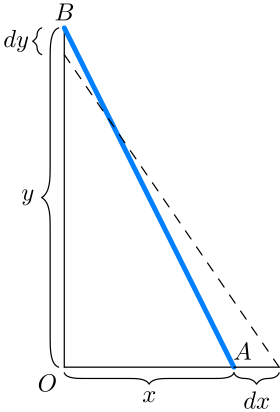
Fig. 3.2
Now right through the differential calculus we are hunting, hunting, hunting for a curious thing, a mere ratio, namely, the proportion which bears to when both of them are indefinitely small.
We can only find the ratio when there is a relationship between the variables and in which changes in correspond to changes in . Such a relationship is called a function.
There are two types of functions: implicit and explicit.
Implicit functions are equations that contain the relationship between variables without distinctly indicating how to express one variable in terms of the other(s). They are mathematical expressions that do not explicitly show the means of expressing one variable in terms of the other(s). For example, equations such as and represent implicit functions. These equations establish the relationship between and without explicitly showing how to express in terms of or vice versa.
Explicit functions explicitly state the value of one variable in terms of the other(s). They represent a direct and explicit relationship between variables. The expressions and are explicit functions.
Implicit functions can be transformed into explicit functions by rearranging the equations to explicitly express one variable in terms of the other. For example is an implicit function in and ; it may be written (explicit function of ) or (explicit function of ).
When one variable is expressed in terms of other variable(s), it is referred to as the dependent variable because its value depends on the values of the other variable(s). The other variable(s) are called independent variables. For instance, in the equation , the variables and are considered independent variables, while is the dependent variable.
It should be noted here that we can only find this ratio when and are related to each other in some way, so that whenever varies does vary also. For instance, in the first example just taken, if the base of the triangle be made longer, the height of the triangle becomes greater also, and in the second example, if the distance of the foot of the ladder from the wall be made to increase, the height reached by the ladder decreases in a corresponding manner, slowly at first, but more and more rapidly as becomes greater. In these cases the relation between and is perfectly definite, it can be expressed mathematically, being and (where is the length of the ladder) respectively, and has the meaning we found in each case.
If, while is, as before, the distance of the foot of the ladder from the wall, is, instead of the height reached, the horizontal length of the wall, or the number of bricks in it, or the number of years since it was built, any change in would naturally cause no change whatever in ; in this case has no meaning whatever, and it is not possible to find an expression for it. Whenever we use differentials , , , etc., the existence of some kind of relation between , , , etc., is implied, and this relation is called a “function” in , , , etc.; the two expressions given above, for instance, namely and , are functions of and . Such expressions contain implicitly (that is, contain without distinctly showing it) the means of expressing either in terms of or in terms of , and for this reason they are called implicit functions in and ; they can be respectively put into the forms and
These last expressions state explicitly (that is, distinctly) the value of in terms of , or of in terms of , and they are for this reason called explicit functions of or . For example is an implicit function in and ; it may be written (explicit function of ) or (explicit function of ).2 We see that an explicit function in , , , etc., is simply something the value of which changes when , , , etc., are changing, either one at the time or several together. Because of this, the value of the explicit function is called the dependent variable, as it depends on the value of the other variable quantities in the function; these other variables are called the independent variables because their value is not determined from the value assumed by the function. For example, if , and are the independent variables, and is the dependent variable.
Sometimes the exact relation between quantities , , is not explicitly known or stated, but it is understood that changing one variable affects the others. This is indicated by (implicit function) or by , , or (explicit function). The notations , , and all imply that the value of depends on in some way which is not stated.
Sometimes the exact relation between several quantities , , either is not known or it is not convenient to state it; it is only known, or convenient to state, that there is some sort of relation between these variables, so that one cannot alter either or or singly without affecting the other quantities; the existence of a function in , , is then indicated by the notation (implicit function) or by , or (explicit function). Sometimes the letter or is used instead of , so that , and all mean the same thing, namely, that the value of depends on the value of in some way which is not stated.
We call the ratio “the derivative of with respect to .”
We call the ratio “the derivative of with respect to .” It is a solemn scientific name for this very simple thing. But we are not going to be frightened by solemn names, when the things themselves are so easy. Instead of being frightened we will simply pronounce a brief curse on the stupidity of giving long crack-jaw names; and, having relieved our minds, will go on to the simple thing itself, namely the ratio .
The process of finding the value of is called “differentiating.” But, remember, what is wanted is the value of this ratio when both and are themselves indefinitely small. The true value of the derivative is that to which it approximates in the limiting case when each of them is considered as infinitesimally minute.
In ordinary algebra which you learned at school, you were always hunting after some unknown quantity which you called or ; or sometimes there were two unknown quantities to be hunted for simultaneously. You have now to learn to go hunting in a new way; the fox being now neither nor . Instead of this you have to hunt for this curious cub called . The process of finding the value of is called “differentiating.” But, remember, what is wanted is the value of this ratio when both and are themselves indefinitely small. The true value of the derivative is that to which it approximates in the limiting case when each of them is considered as infinitesimally minute.
Let us now learn how to go in quest of .
How to Read Derivatives
does NOT mean times for is not a factor—it means “an element of” or “a bit of” whatever follows.
It will never do to fall into the rookie mistake of thinking that means times , for is not a factor—it means “an element of” or “a bit of” whatever follows. One reads thus: “dee-eks.”
is read “dee-wy by dee-eks,” or “dee-wy overdee-eks.”
Similarly
is read “dee-you by dee-tee.”
In case the reader has no one to guide him or her in such matters it may here be simply said that one reads derivatives in the following way. The derivative
is read “dee-wy by dee-eks,” or “dee-wy over dee-eks.”
is read “dee-you by dee-tee.”
Second derivative will be met with later on. They are like this:
; which is read “dee-two-wy over dee-eks-squared,”
and it means that the operation of differentiating with respect to has been (or has to be) performed twice over.
Another way of indicating that a function has been differentiated is by putting an accent to the symbol of the function. Thus if , which means that is some unspecified function of , we may write F^\prime(x) instead of . Similarly, F^{\prime\prime}(x) will mean that the original function has been differentiated twice over with respect to .
Full Chapter
All through the calculus we are dealing with quantities that are growing, and with rates of growth. We classify all quantities into two classes: constants and variables. Those which we regard as of fixed value, and call constants, we generally denote algebraically by letters from the beginning of the alphabet, such as , , or ; while those which we consider as capable of growing, or (as mathematicians say) of “varying,” we denote by letters from the end of the alphabet, such as , , , , , , or sometimes .
Moreover, we are usually dealing with more than one variable at once, and thinking of the way in which one variable depends on the other: for instance, we think of the way in which the height reached by a projectile depends on the time of attaining that height. Or we are asked to consider a rectangle of given area, and to enquire how any increase in the length of it will compel a corresponding decrease in the breadth of it. Or we think of the way in which any variation in the slope of a ladder will cause the height that it reaches to vary.
Suppose we have got two such variables that depend one on the other. An alteration in one will bring about an alteration in the other, because of this dependence. Let us call one of the variables , and the other that depends on it .
Suppose we make to vary, that is to say, we either alter it or imagine it to be altered, by adding to it a bit which we call . We are thus causing to become . Then, because has been altered, will have altered also, and will have become . Here the bit may be in some cases positive, in others negative; and it won’t (except by a miracle) be the same size as .
Take two examples
Example 3.1. Let and be respectively the base and the height of a right-angled triangle (the following figure), of which the slope of the other side is fixed at . If we suppose this triangle to expand and yet keep its angles the same as at first, then, when the base grows so as to become , the height becomes . Here, increasing results in an increase of . The little triangle, the height of which is , and the base of which is , is similar to the original triangle; and it is obvious that the value of the ratio is the same as that of the ratio . As the angle is it will be seen that here
Fig. 3.1
Example 3.2. Let represent, in the next figure, the horizontal distance, from a wall, of the bottom end of a ladder, , of fixed length; and let be the height it reaches up the wall. Now clearly depends on . It is easy to see that, if we pull the bottom end a bit further from the wall, the top end will come down a little lower. Let us state this in scientific language. If we increase to , then will become . If then ; that is, when receives a positive increment, the increment which results to is negative.
Fig. 3.2
Yes, but how much? Suppose the ladder was so long that when the bottom end was inches from the wall the top end reached just feet from the ground. Now, if you were to pull the bottom end out inch more, how much would the top end come down? Put it all into inches: inches, inches. Now the increment of which we call , is inch: or inches.
How much will be diminished? The new height will be . If we work out the height by the Pythagorean theorem,1 then we shall be able to find how much will be. The length of the ladder is Clearly then, the new height, which is , will be such that \begin{align} (y + dy)^2 &= (181)^2 - (20)^2 = 32761 - 400 = 32361, \\ y + dy &= \sqrt{32361} \approx 179.89 \text{ inches}. \end{align} Now is , so that is approximately inches.
So we see that making an increase of inch has resulted in making a decrease of approximately inches.
And the ratio of to may be stated thus:
It is also easy to see that (except in one particular position) will be of a different size from .
Now right through the differential calculus we are hunting, hunting, hunting for a curious thing, a mere ratio, namely, the proportion which bears to when both of them are indefinitely small.
It should be noted here that we can only find this ratio when and are related to each other in some way, so that whenever varies does vary also. For instance, in the first example just taken, if the base of the triangle be made longer, the height of the triangle becomes greater also, and in the second example, if the distance of the foot of the ladder from the wall be made to increase, the height reached by the ladder decreases in a corresponding manner, slowly at first, but more and more rapidly as becomes greater. In these cases the relation between and is perfectly definite, it can be expressed mathematically, being and (where is the length of the ladder) respectively, and has the meaning we found in each case.
If, while is, as before, the distance of the foot of the ladder from the wall, is, instead of the height reached, the horizontal length of the wall, or the number of bricks in it, or the number of years since it was built, any change in would naturally cause no change whatever in ; in this case has no meaning whatever, and it is not possible to find an expression for it. Whenever we use differentials , , , etc., the existence of some kind of relation between , , , etc., is implied, and this relation is called a “function” in , , , etc.; the two expressions given above, for instance, namely and , are functions of and . Such expressions contain implicitly (that is, contain without distinctly showing it) the means of expressing either in terms of or in terms of , and for this reason they are called implicit functions in and ; they can be respectively put into the forms and
These last expressions state explicitly (that is, distinctly) the value of in terms of , or of in terms of , and they are for this reason called explicit functions of or . For example is an implicit function in and ; it may be written (explicit function of ) or (explicit function of ).2 We see that an explicit function in , , , etc., is simply something the value of which changes when , , , etc., are changing, either one at the time or several together. Because of this, the value of the explicit function is called the dependent variable, as it depends on the value of the other variable quantities in the function; these other variables are called the independent variables because their value is not determined from the value assumed by the function. For example, if , and are the independent variables, and is the dependent variable.
Sometimes the exact relation between several quantities , , either is not known or it is not convenient to state it; it is only known, or convenient to state, that there is some sort of relation between these variables, so that one cannot alter either or or singly without affecting the other quantities; the existence of a function in , , is then indicated by the notation (implicit function) or by , or (explicit function). Sometimes the letter or is used instead of , so that , and all mean the same thing, namely, that the value of depends on the value of in some way which is not stated.
We call the ratio “the derivative of with respect to .” It is a solemn scientific name for this very simple thing. But we are not going to be frightened by solemn names, when the things themselves are so easy. Instead of being frightened we will simply pronounce a brief curse on the stupidity of giving long crack-jaw names; and, having relieved our minds, will go on to the simple thing itself, namely the ratio .
In ordinary algebra which you learned at school, you were always hunting after some unknown quantity which you called or ; or sometimes there were two unknown quantities to be hunted for simultaneously. You have now to learn to go hunting in a new way; the fox being now neither nor . Instead of this you have to hunt for this curious cub called . The process of finding the value of is called “differentiating.” But, remember, what is wanted is the value of this ratio when both and are themselves indefinitely small. The true value of the derivative is that to which it approximates in the limiting case when each of them is considered as infinitesimally minute.
Let us now learn how to go in quest of .
How to Read Derivatives
It will never do to fall into the rookie mistake of thinking that means times , for is not a factor—it means “an element of” or “a bit of” whatever follows. One reads thus: “dee-eks.”
In case the reader has no one to guide him or her in such matters it may here be simply said that one reads derivatives in the following way. The derivative
is read “dee-wy by dee-eks,” or “dee-wy over dee-eks.”
is read “dee-you by dee-tee.”
Second derivative will be met with later on. They are like this:
; which is read “dee-two-wy over dee-eks-squared,”
and it means that the operation of differentiating with respect to has been (or has to be) performed twice over.
Another way of indicating that a function has been differentiated is by putting an accent to the symbol of the function. Thus if , which means that is some unspecified function of , we may write F^\prime(x) instead of . Similarly, F^{\prime\prime}(x) will mean that the original function has been differentiated twice over with respect to .