Table of Contents
- 26.1 INTRODUCTION
- 26.2 LECTURE
- 26.2.1 Integration of Scalar Fields over Parametrized Surfaces
- 26.2.2 Transforming Integrals from One Surface to Another
- 26.2.3 Special Cases in Lower Dimensions
- 26.2.4 Parametrization Applications in Surface Integral Calculations
- 26.2.5 Volumes and Surface Areas of n-Dimensional Spheres using Hyperspherical Coordinates
- 26.3 EXAMPLES
- EXERCISES
26.1 INTRODUCTION
26.1.1 Flux Integrals over Parametrized Surfaces
We have looked at maps in the context of coordinate changes and also in full generality, in the case when is a subset of and is a subset of . We have learned that the Jacobian matrix allows to quantify the distortion . If is a subset of , then describes a -dimensional surface. We usually write a point in as but other variables can be used. If , that is if we deal with a surface in three dimensional space, then the distortion factor is and the surface area is the double integral . This topic is therefore a great opportunity to practice more double integrals.
26.2 LECTURE
26.2.1 Integration of Scalar Fields over Parametrized Surfaces
A map has an image which is a parametrized surface. What is its surface area? We have seen that the distortion factor is now where was the first fundamental form of the surface. Of course, it is more convenient to use , which is the same as .
Theorem 1. The surface area of is .
26.2.2 Transforming Integrals from One Surface to Another
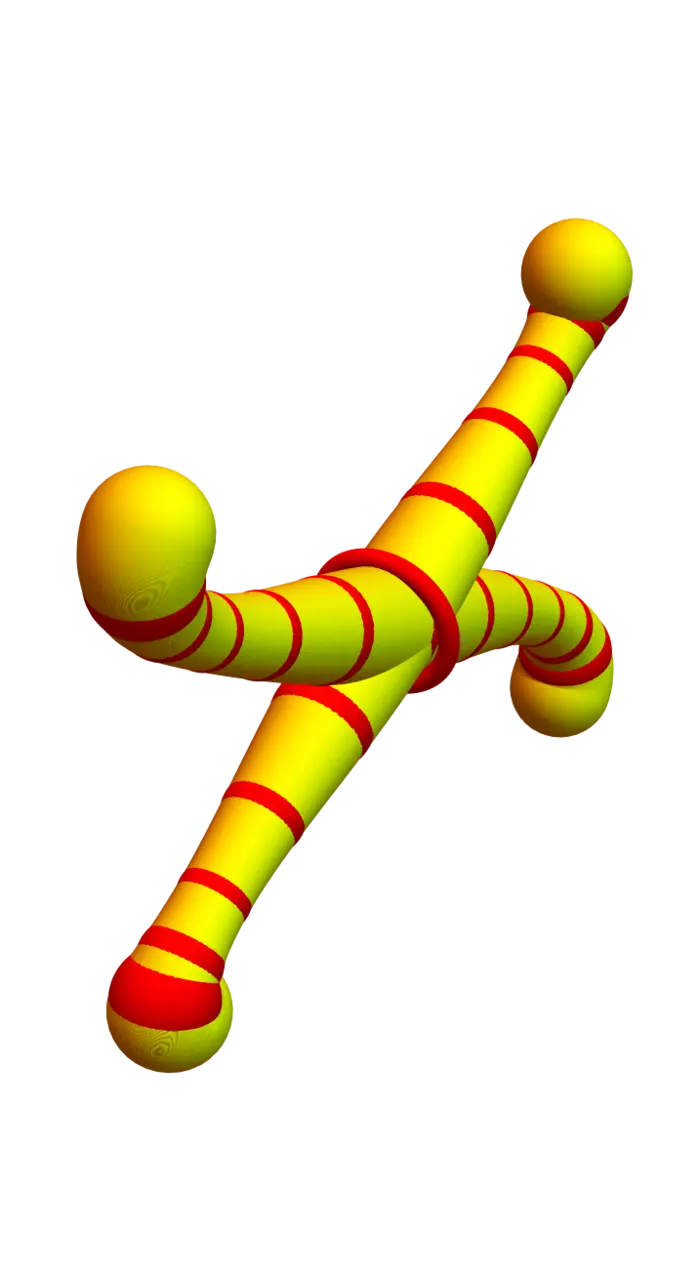
More generally if is a function which describes something like a density then is an integral which is abbreviated as and called a scalar surface integral. For example, if is a density on the surface then this is the mass. Again, we have to stress that in this integral, the orientation of the surface is irrelevant. The distortion factor is always non-negative. It is better to think of as a A circle moving in space time produces a two dimensional surface. The surface area of this surface is of interest in physics. The surface area is the Nambu-Goto action. generalizing area .1
26.2.3 Special Cases in Lower Dimensions
Here is the most general change of integration formula for maps , with distortion factor . The formula holds for too, is then a pseudo determinant. If is the image of a solid under a map and is a function, then the mother of all substitution formulas is
Theorem 2.
Proof. The proof is the same as seen in the two-dimensional change of variable situation. Just because is used for the target space , we use the basic size . We chop up the region into parts with cubes of size and estimate the difference and by leading to an overall difference bounded by , where is the maximal value of on and is the Heine-Cantor function modulus of continuity of . Adding everything up gives an error where is the boundary of . There is one new thing: we have to see why is the volume of the parallelepiped spanned by the column vectors of the Jacobian matrix . We will talk about determinants in detail later but if is in row reduced echelon form then is the identity matrix and the determinant is , agreeing with the volume. Now notice that if a column of is scaled by producing a new matrix , then and . If two columns of are swapped leading to a new matrix , then and . If a column of is added to another column, then this does change . The only row reduction step which affects the is the scaling. But that is completely in sync what happens with the volume. ◻
26.2.4 Parametrization Applications in Surface Integral Calculations
The last theorem covers everything we have seen and we ever need to know when integrating scalar functions over manifolds. In the special case it leads to:
Theorem 3. .
26.2.5 Volumes and Surface Areas of n-Dimensional Spheres using Hyperspherical Coordinates
Here are the important small dimensional examples:
- If , , then \int_{a}^{b}|r^{\prime}(t)| \,d t is the arc length of the curve .
- If , , then is the area of the region .
- If , , then is the surface area of .
- If , , then is the volume of the solid .
26.3 EXAMPLES
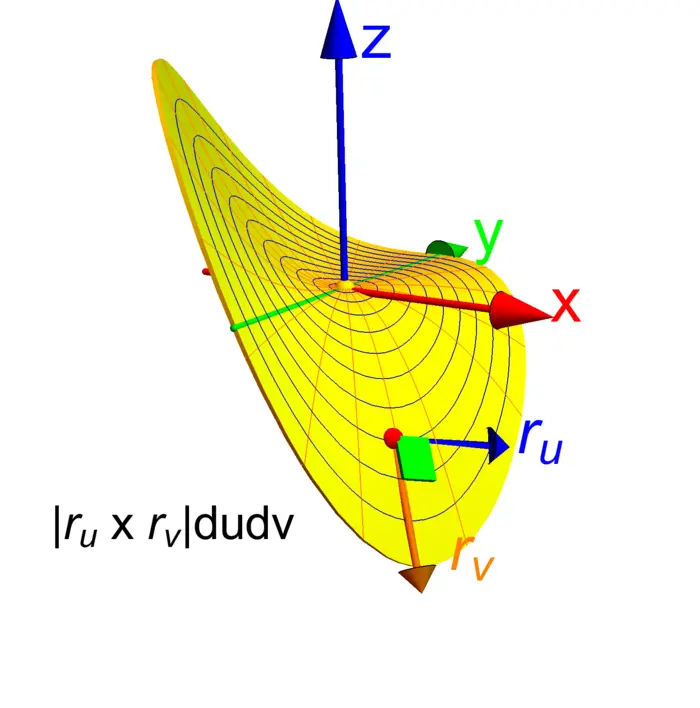
Example 1. In all the examples of surface area computations, we take a parametrization , then use use that the distortion factor is .
Example 2. Problem: find the surface area of a sphere .
Solution: Parametrize the surface The distortion factor is . The surface area is .
Example 3. Problem: find the surface area of surface of revolution given in cylindrical coordinates as , .
Solution: Parametrize the surface The distortion factor is g(z) \sqrt{1+g^{\prime}(z)^{2}}. As an example, we can look at the surface of revolution , . The volume of the solid enclosed by the surface is . The surface area is infinite.
Example 4. Problem: find the surface area of the graph of a function , .
Solution: Parametrize the surface as . The distortion factor is
Example 5. Problem: what is the surface area of the intersection of , ?
Solution: The surface is a plane but also a graph over in the -plane. The simplest parametrization is It gives . The surface area is
Example 6. The following hyperspherical coordinates parametrize the -dimensional sphere in . with , , . The distortion factor is so that the surface area of the hypersphere is
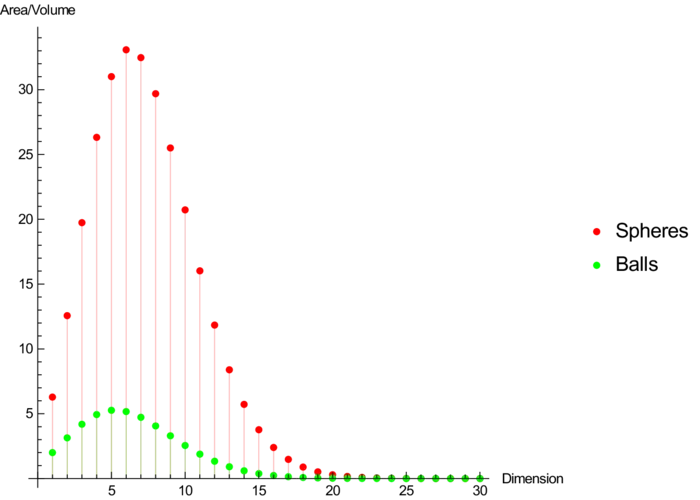
Example 7. In dimension what is the volume of the -dimensional unit ball in and the volume of the -dimensional unit sphere in ? It starts with , as is a point and , as consists of two points. The -ball of radius has the volume and the -sphere of radius has the volume . Because , we have . Because can be written as a union of products -spheres with leading to We know now all: just start with , , , and
Theorem 4. , .
The -ball has maximal volume among all unit balls. The -sphere has maximal surface area among all unit spheres. The volume of the -ball is only The surface area of the -sphere for example is only . Compare with an -unit cube of volume and a boundary surface area . High dimensional spheres and balls are tiny!
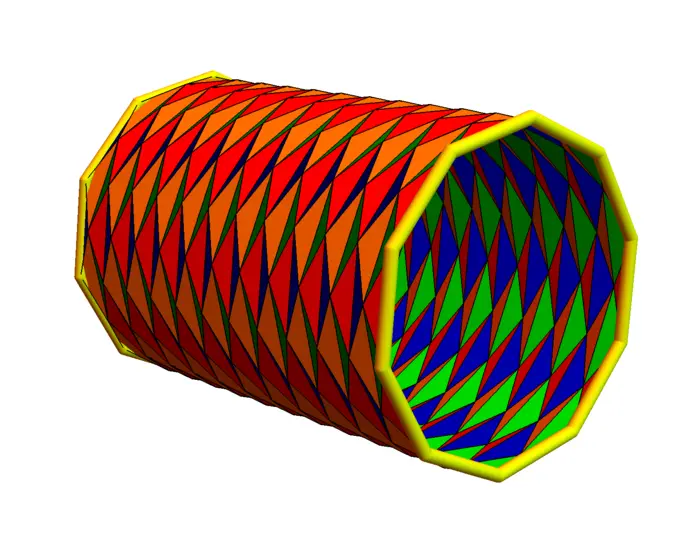
Example 8. If is a cylinder , , triangulated with each triangle smaller than , does the area converge to the surface area ? No! A counter example is the Schwarz lantern from 1880. The cylinder is cut into slices and points are marked on the rim of each slice to get triangles like , , of area The triangles have area . For , the triangulated area diverges.
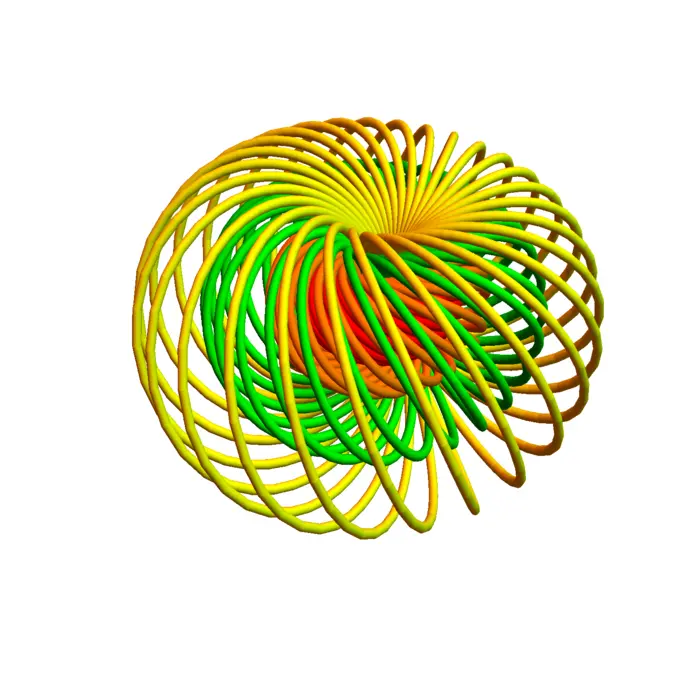
Example 9. The three dimensional sphere is in . The Hopf parametrization is is We compute If we fix , we see a two dimensional torus. Their union with is the Hopf fibration. We can now compute the volume of the three dimensional sphere:
EXERCISES
Exercise 1. Find the moment of inertia where is the double cone.
Exercise 2. Evaluate the triple integral where is bounded by the parabolic cylinders and and the planes and .
Exercise 3. We have seen the problem in the movie "Gifted" to compute the improper integral of . Here is another approach: verify Use this as in the "Gifted" computation to find . You can do that without knowing that the later is .
Exercise 4. Find the surface area of the Einstein-Rosen bridge where and 1. Tunnels connecting different parts of space-time appear frequently in science fiction.
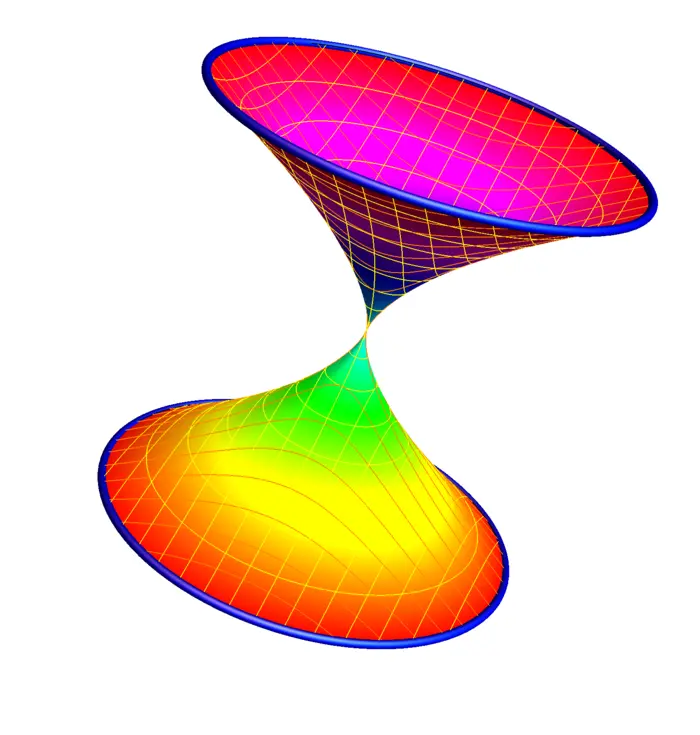
Exercise 5. Find the area of the surface given by the helicoid with , .
- Unfortunately, scalar integrals are often placed close to the integration of differential forms (like volume forms). The later are of different nature and use an integration theory in which spaces come with orientation. So far, if we replace with gives the same result (like area or mass).↩︎