Table of Contents
25.1 INTRODUCTION
25.1.1 Beyond Surfaces: 3D Solids
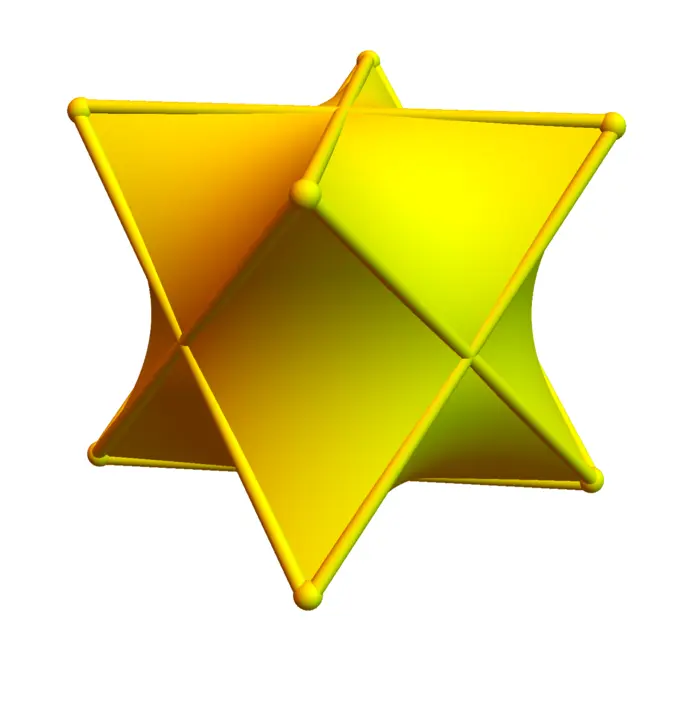
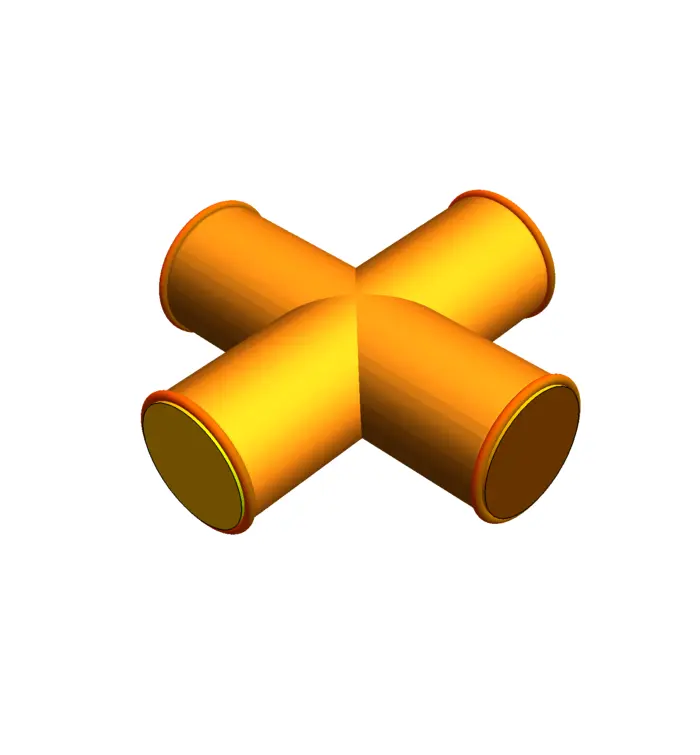
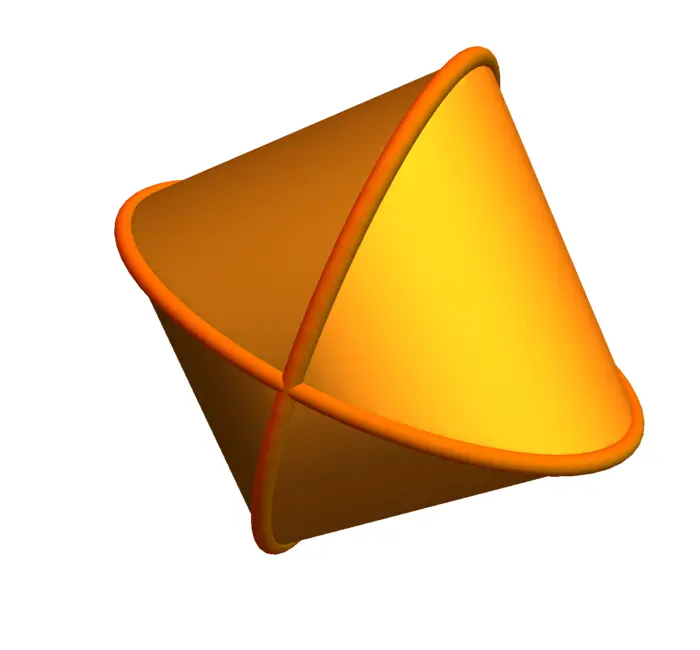
-dimensional objects are curves and -dimensional objects are regions or surfaces. In dimension , we deal with solids. The simplest solids imaginable are the cube or the spherical ball. Solids in three dimensional space are usually drawn by plotting their boundary surfaces. A solid polyhedron for example is bound by planes. The first figure shows the solid bound by hyperboloids. It is quite a challenge to compute its volume.1
25.1.2 Building Dimensions: Length, Area, and Now Volume
While curves have length and regions have area, three dimensional solids have volume. We will in the next lecture look at surface area . In this lecture we look at volume .
25.2 LECTURE
25.2.1 From Basic Solids to Triple Integrals
A basic solid in is a bounded region enclosed by finitely many surfaces . A solid is a finite union of such basic solids. We focus here mostly on . A D integral is defined in the same way as a limit of a Riemann sum which for a given integer is defined as The convergence is proven in the same way. The boundary contribution can be neglected in the limit . If is a parametrization of the solid, then
Theorem 1.
25.2.2 Computing Volumes with 3D Integrals and Change of Variables
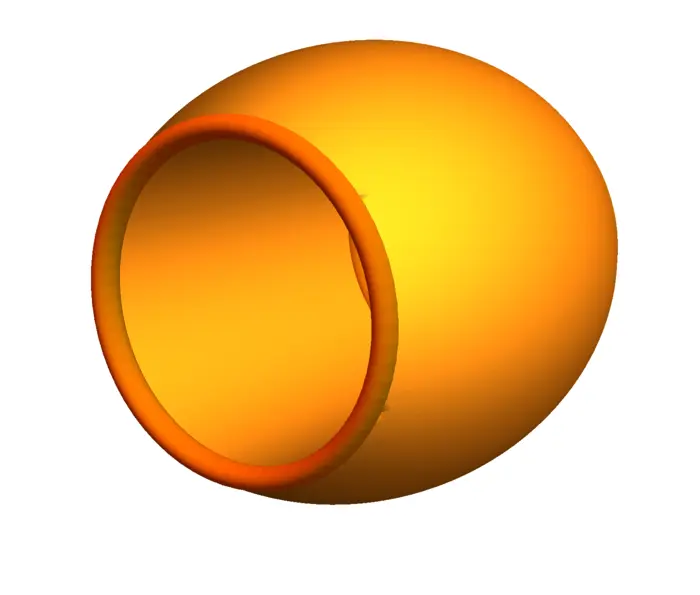
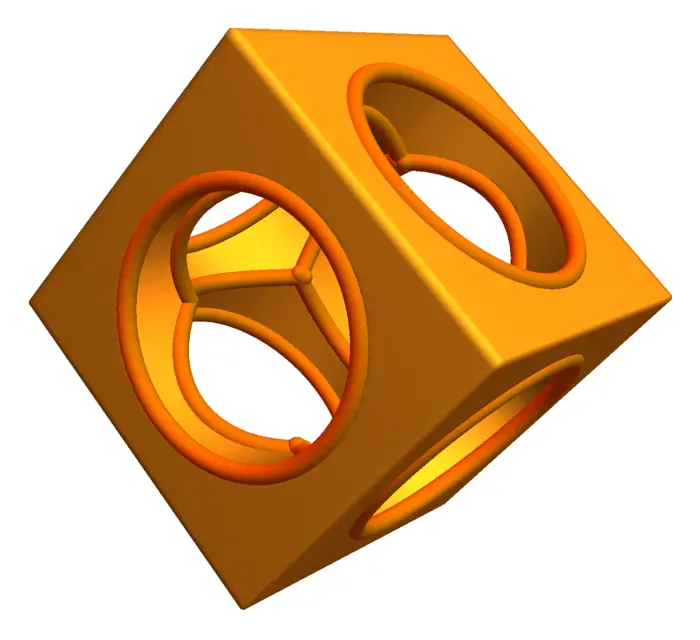
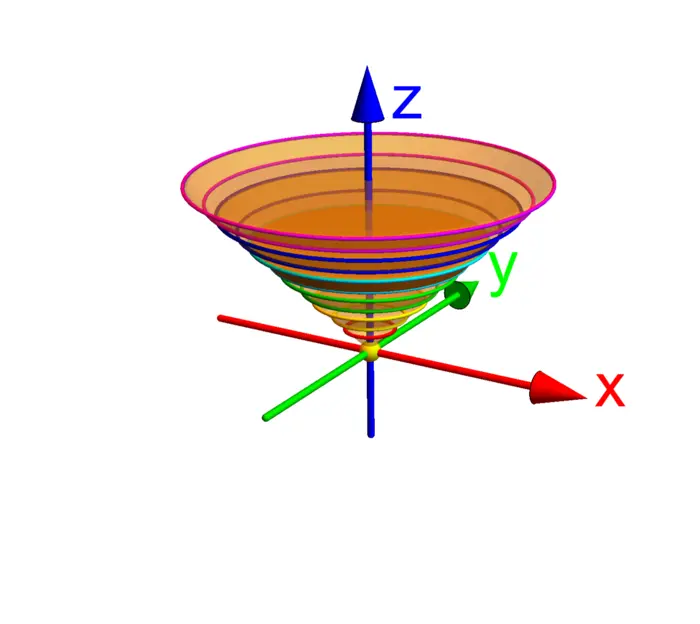
If is constant , then is the volume of the solid . For a cone we can write where is the unit disc. Its volume is . For the unit sphere for example, we can write where is the unit disc . In polar coordinates, we get We can also use spherical coordinates where . The volume is
25.2.3 Two Key Approaches to 3D Integration
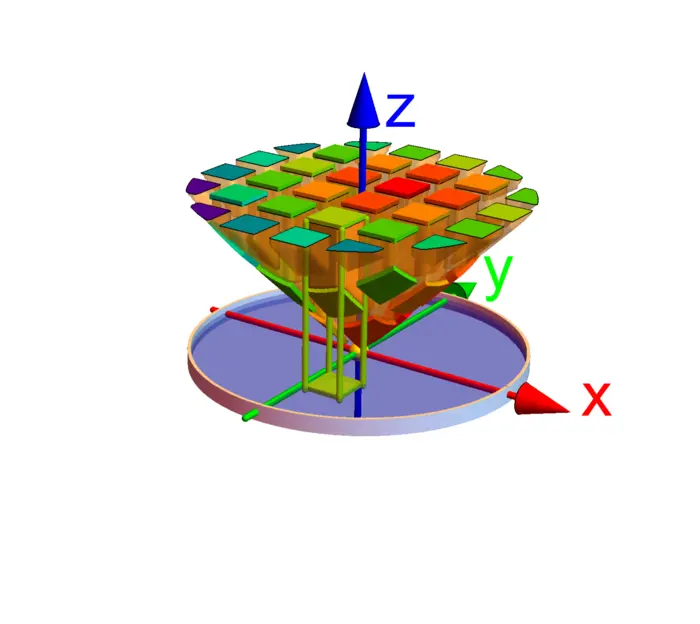
There are two basic strategies to compute the integral: the first is to slice the region up along a line like the -axis then form . To get the volume of a cone for example, integrate . The inner double integral is the area of the slice which is . The last integral gives . A second reduction is to see the solid sandwiched between two graphs of a function on a region , then form . In the cone case, we have for the disc of radius . The lower function is the upper function is . We get , a double integral which best can be computed using polar coordinates: Burgers and fries!
25.2.4 Jacobians for Spherical and Cylindrical Coordinates
We have seen in the theorem the coordinate change formula if is given. For spherical coordinates we have . For cylindrical coordinates, the situation is the same as for polar coordinates. The map produces .
25.2.5 Ellipsoid Volume
Let us find the integral , where is a solid ellipsoid. The most comfortable way is to introduce another coordinate change which maps the solid sphere to to the solid ellipsoid . Then take the spherical coordinate map , where Now is a coordinate change which maps to the ellipsoid. By the chain rule, the distortion factor is . The integral is
25.2.6 Solid Torus Volume: A Special Coordinate System
In order to compute the volume of a solid torus, we can introduce a special coordinate system The solid torus is then the image of the cuboid The determinant is . Integration over the cuboid gives the volume .
25.3 EXAMPLES
Example 1. To find for set up the integral . Start with the core , then integrate the middle layer, and finally handle the outer layer: .
Example 2. To find the moment of inertia of a sphere , we use spherical coordinates. We know that and the distortion factor is . We have therefore We will see some details in class. If we rotate the sphere around the -axis with angular velocity , then is the kinetic energy of that sphere. For example, the moment of inertia of the earth is . With an angular velocity of , this rotational kinetic energy is
Example 3. Problem: Find the volume of the intersection of , and .
Solution: look at ’th of the body given in cylindrical coordinates , . The roof is because above the "one eighth disc" only the cylinder matters. The polar integration problem has an inner -integral of . Integrating this over can be done by integrating by parts (using \tan^{\prime}(x)=\sec ^{2}(x)) leading to the anti-derivative of . The result is .
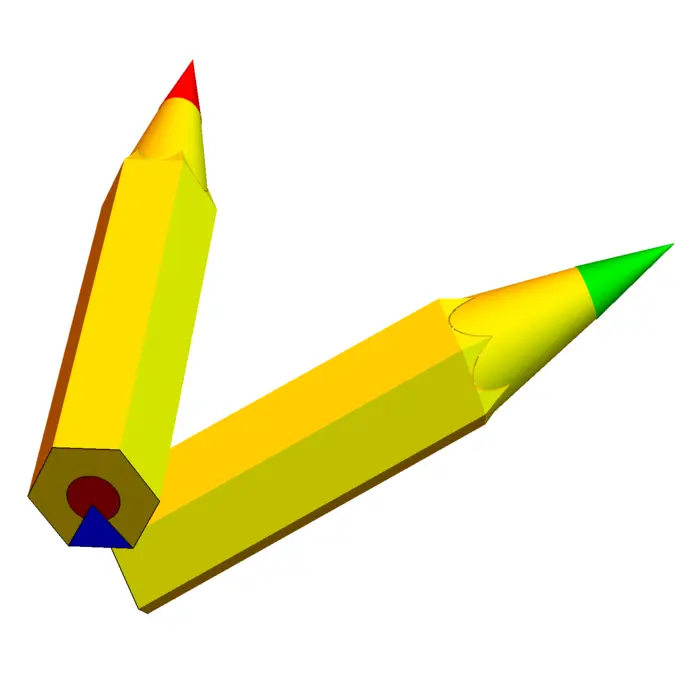
Example 4. Problem: A pencil , a hexagonal cylinder of radius above the -plane is cut by a sharpener below the cone . What is its volume?
Solution: we consider one sixth of the pen where the base is the polar region and . The pen’s back is and the sharpened part is . The integral can be computed and is a bit messy .2