Table of Contents
2.1 INTRODUCTION
2.1.1 The Evolution of Solving Linear Equation Systems
Systems of linear equations have already been tackled four thousand years ago by Babylonian mathematicians.1 They were able to solve simple systems of equations of two unknown like
2.1.2 Gaussian Elimination
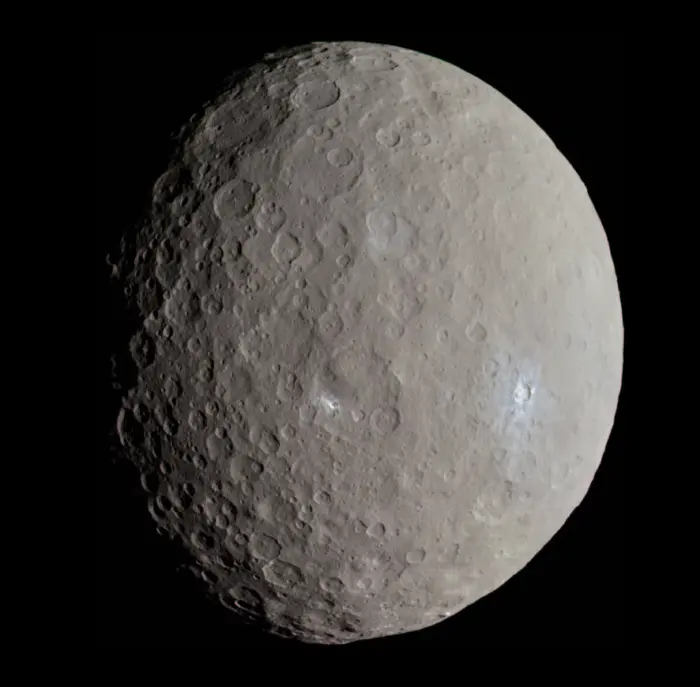
Elimination was of course used long before Gauss. We learn it early on as ordinary elimination. For example, solve for one variable and put it into the rest to have a system with less unknown. What Gauss did was to write down a formal elimination process. This was around 1809. He called the ordinary elimination "eliminationem vulgarem". The process came not out of the blue. The work on rather applied problems must have led to it. For example, Gauss in 1801 was able in a few weeks to predict the path of the minor planet Ceres from
2.2 LECTURE
2.2.1 Linear Transformations and Equations
If an
2.2.2 Augmented Matrices and Row Reduction
The best way to solve the system is to row reduce the augmented matrix
- every row which is not zero has a leading one,
- every column with a leading
has no other non-zero entries besides the leading one. The third condition is - every row above a row with a leading one has a leading one to the left.
2.2.3 Uniqueness of Row Reduced Echelon Form
We will practice the process in class and homework. Here is a theorem
Theorem 1. Every matrix
Proof. 4We use the method of induction with respect to the number
2.2.4 The Lemma of Matrix Partitioning in Proof Construction
A separate lemma allows to break up a proof:
If
Proof. We have to check the three conditions which define row reduced echelon form. ◻
2.2.5
It is not true that if
2.3 EXAMPLES
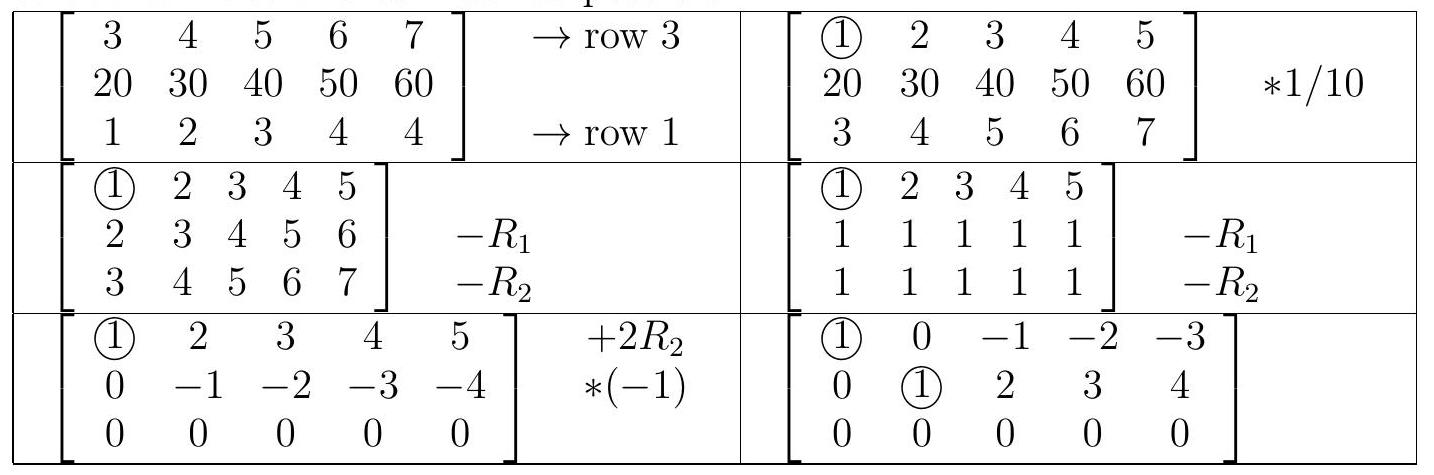
Example 1. To row reduce, we use the three steps and document on the right. To save space, we sometimes report only after having done two steps. We circle the leading
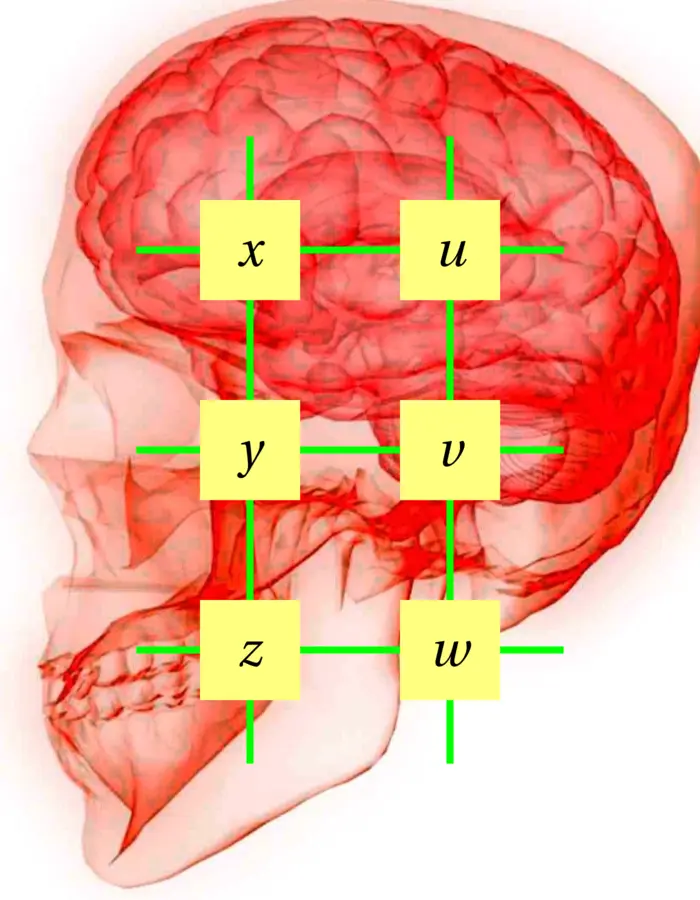
Example 2. Finish the following Suduku problem which is a game where one has to fix matrices. The rules are that in each of the four
2.4 ILLUSTRATIONS
The system of equations
is a tomography problem. These problems appear in magnetic resonance imaging. A precursor was X-ray Computed Tomography (CT) for which Allen MacLeod Cormack got the Nobel in 1979 (Cormack had a sabbatical at Harvard in 1956-1957, where the idea hatched). Cormack lived until 1998 in Winchester MA. He originally had been a physicist. His work had tremendous impact on medicine.
We build the augmented matrix
Now we can read of the solutions. We see that
EXERCISES
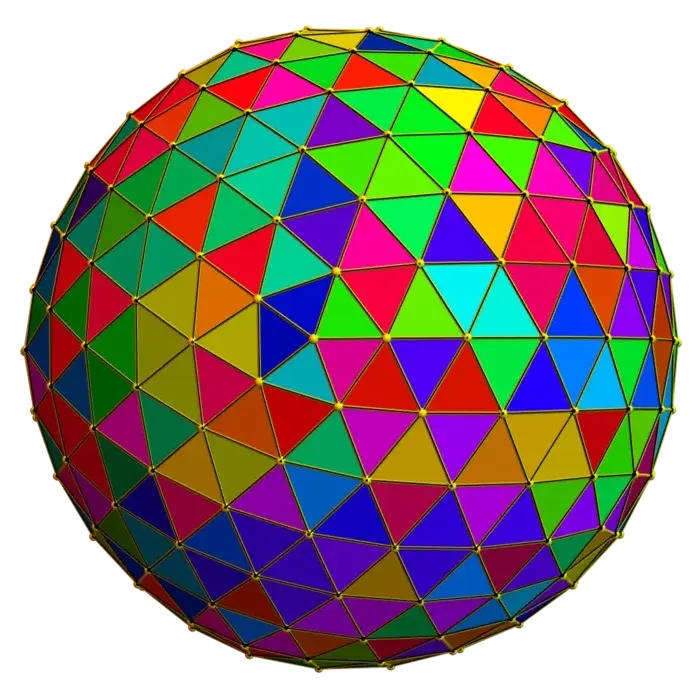
Exercise 1. For a polyhedron with
Exercise 2. Row reduce the matrix
Exercise 3. In the "Nine Chapters on Arithmetic", the following system of equations appeared
Exercise 4.
- Which of the following matrices are in row reduced echelon form?
- Two
matrices in reduced row-echelon form are called of the same type if they contain the same number of leading ’s in the same positions. For example, and are of the same type. How many types of matrices in reduced row-echelon form are there?
Exercise 5. Given
- I checked with Ajak who also hinted, that Phastos might have leaked Gauss-Jordan elimination. The opening scene in the newest Marvel’s movie shows the eternals arriving here 5000 BC.↩︎
- J.F. Grcar, Mathematicians of Gaussian Elimination, Notices of the AMS, 58, 2011.↩︎
- For more, look at the exhibit on the website of the 2018 Math 22a.↩︎
- The proof is well known: i.e. Thomas Yuster, Mathematics Magazine, 1984.↩︎