Table of Contents
22.1 INTRODUCTION
22.1.1 Beyond 1D: Area and Integrals
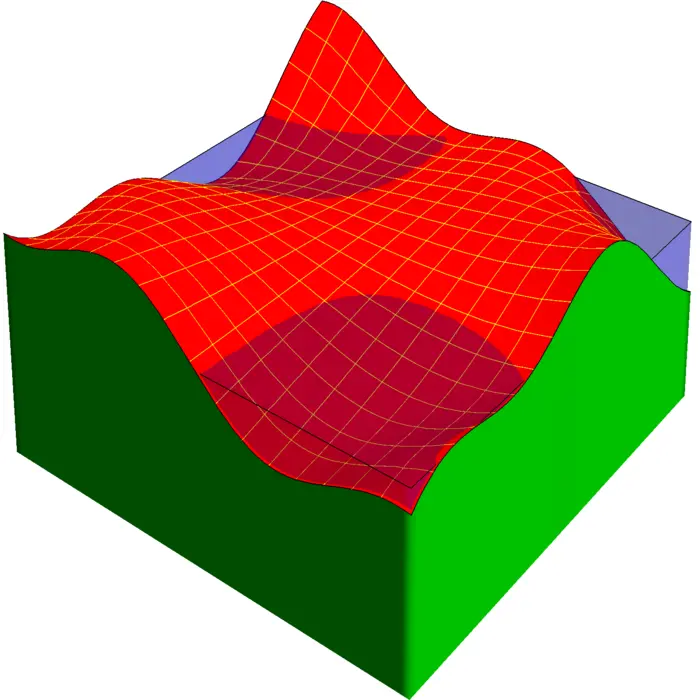
When integrating a continuous function over a two-dimensional domain , we can use Riemann sums again like in one dimensions and get . A special case of a continuous function is the function . If we integrate we get the area. Unlike in one dimensions, where a domain is just an interval, we can have much more interesting regions in two dimensions.
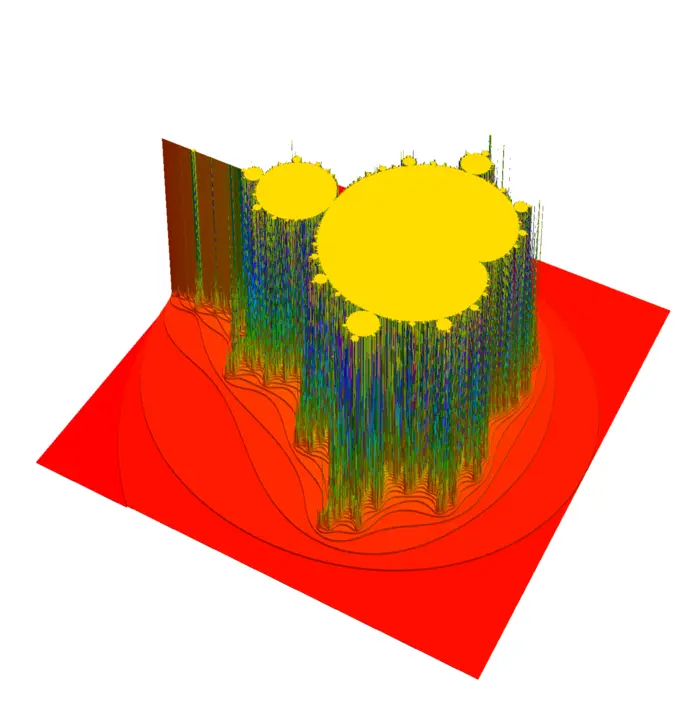
22.1.2 Higher Dimensions, More Integrals
Integration in two dimensions is a good prototype. Knowing this multi-dimensional situation, will allow also to understand how to integrate in or more dimensions. We will learn next week how to compute the area of a surface. But dimensional integrals also matter in higher dimensions: if we integrate a so called -form over a two-dimensional surface, we get double integrals. An example of a -form is the electromagnetic field also known as "light". String theorists work in higher dimensional spaces. The surface traced out by a moving string is a -dimensional surface called a "world-sheet". Its surface area is called the Nambu-Goto action which plays the role of the length in classical mechanics. This is a double integral.
22.1.3 Calculus, Integration, and The Unknown
Like particle move on shortest paths called geodesics, strings move on paths in which the surface area is minimized. Not everybody has jumped onto the string theory wagon however and the theory lead to a dead end. We do not know yet. In any case, in the quest of understanding the basic building blocks of space and time and matter is exciting. We live in an interesting time where highly successive theories like the standard model (SM), quantum mechanics (QM) or general relativity (GR) match measurements with enormous precision. There are also other interesting theories which lack experimental verifications. Without doubt however, calculus and integration theory in particular will play an important role also in the future, whatever lies ahead.
22.2 LECTURE
22.2.1 Double Integral and Its Existence
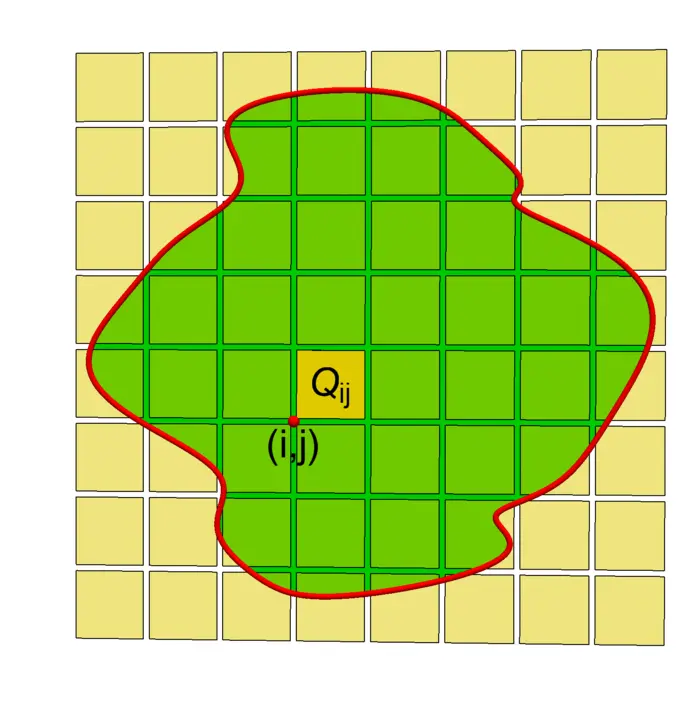
Given a bounded region in and a continuous function , define the Riemann integral as the limit of The bounded region is a defined as closed subset of bound by finitely many differentiable curves . As already in one dimension, the definition is designed to be independent of an orientation chosen on . We are integrating like summing up a spread sheet. Just add up all entries. To justify that the limit exists, we again can use the Heine-Cantor theorem which tells that is continuous on if and only if it is uniformly continuous. This means there are numbers such that if , then .
Theorem 1. For continuous on a bounded region , exists.
Proof. In each cube define and . Because the boundary was assumed to be given by a collection of curves which have finite total arc length , the number of cubes which intersect the boundary is bounded by (a curve of length 1 can maximally touch 4 squares). Define also . We have with : where and and takes care of cubes which intersect the boundary of and so only contribute partially. Let be the limsup of . We have and as well so that . ◻
∎22.2.2 Fubini’s Theorem
We rarely evaluate integrals using Riemann sums. Fortunately it is possible to reduce a double integral to single integrals. One can do that for basic regions which consist of two type of regions "bottom to top" regions or "left to right" regions By cutting a general region into smaller pieces like intersecting with sufficiently small cubes defined above, we can write any region as a union of such basic regions: for large enough , any us a basic region. Now we can define the integral in the first case as and in the second case as . Is this the same? This is answered with Fubini, which we have already used. Let be a rectangle Here is the Fubini theorem:
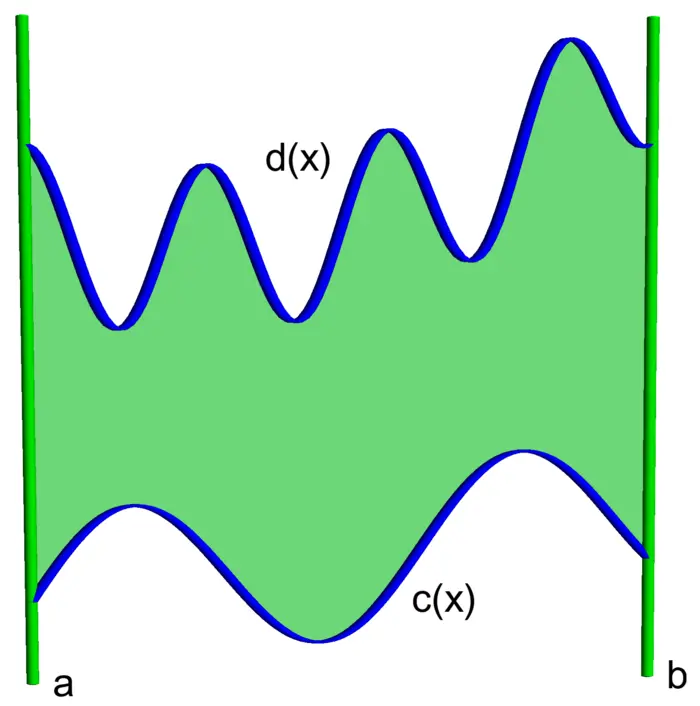
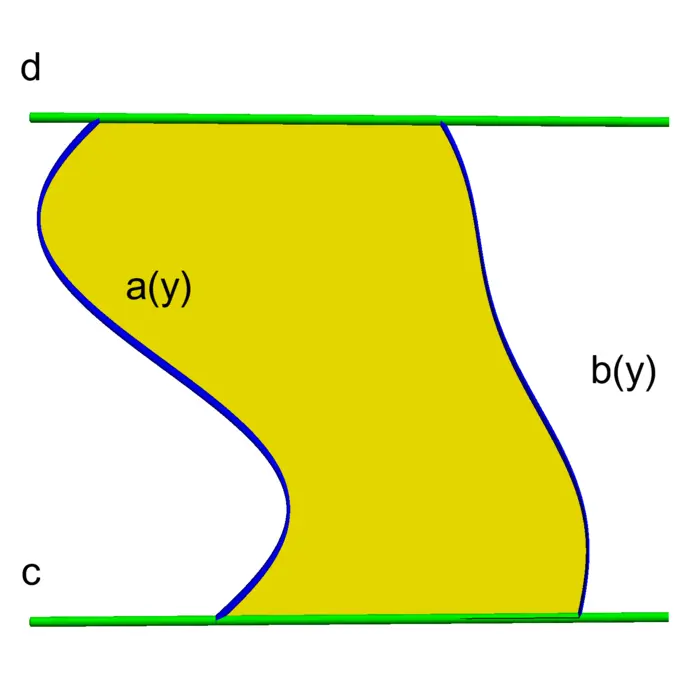
Theorem 2.
Proof. First make a coordinate change to get , then cover with cubes of side length . We have for every a uniformly continuous function and for every a uniformly continuous function and the constants work for all: there is so that if and , then . Now use the notation if and get \begin{aligned} \iint_{R} f(x, y) \,d A &\sim_{M_{n}} \frac{1}{n} \sum_{i=0}^{n-1} \frac{1}{n} \sum_{j=0}^{n-1} f(i / n, j / n)\\ &\sim_{2 M_{n}} \frac{1}{n} \sum_{i=0}^{n-1} \int_{0}^{1} f(i / n, y) \,d y\\ &\sim_{3 M_{n}}\int_{0}^{1}\left[\int_{0}^{1} f(x, y) \,d y\right] d x. \end{aligned} Similarly, we can show . ◻
∎22.2.3 When Fubini Fails
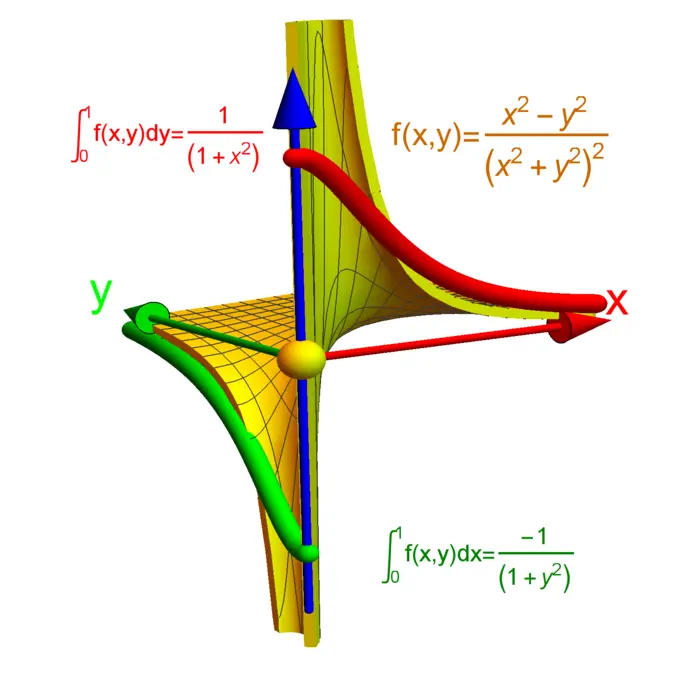
Without continuity, Fubini is false: the standard example is illustrated in Figure (22.3): \begin{aligned} \frac{-\pi}{4}=\int_{0}^{1} \int_{0}^{1} \frac{(x^{2}-y^{2})}{(x^{2}+y^{2})^{2}} \,d y \,d x \neq \int_{0}^{1} \int_{0}^{1} \frac{(x^{2}-y^{2})}{(x^{2}+y^{2})^{2}} \,d x \,d y=\frac{\pi}{4}. \end{aligned}
Proof. \begin{aligned} \int\frac{x^{2}-y^{2}}{(x^{2}+y^{2})^{2}} \,d x &= -\frac{x}{x^{2}+y^{2}},\\ \int\frac{x^{2}-y^{2}}{(x^{2}+y^{2})^{2}} \,d y &= \frac{y}{x^{2}+y^{2}}. \end{aligned} So that \begin{aligned} \int_{0}^{1} \frac{x^{2}-y^{2}}{(x^{2}+y^{2})^{2}} \,d x=-\frac{1}{1+y^{2}} \end{aligned} and \begin{aligned} \int_{0}^{1} \frac{x^{2}-y^{2}}{x^{2}+y^{2})^{2}} \,d y = \frac{1}{1+x^{2}}. \end{aligned} ◻
∎22.2.4 Multi-Index Notation and Higher Dimensional Integrals
Integrals in higher dimensions are defined in the same way. We will cover the three dimensional case in particular later. Lets just add the definition for now. Given a dimensional region in and a continuous , using the multi-index notation define A region is now a set where are smooth functions. It is called bounded if there exists such that .
22.3 EXAMPLES
Example 1. If , then is the area of . For example, if \begin{aligned} \iint_{x^{2}+y^{2} \leq 9} 8 \,d x \,d y&=8 \iint_{x^{2}+y^{2} \leq 9} 1 \,d x \,d y\\ &=8 \mathrm{Area}(R)\\ &=72 \pi. \end{aligned}
Example 2. We know from single variable calculus that is the signed area under the curve of . For , where it is the area, we can write this as . Note that as we have defined the integrals, the equivalence would be wrong if is negative somewhere. It is the double integral which is the correct notion of area. For exmaple, the area of the region bounded by the curve , the curve , the curve , and is
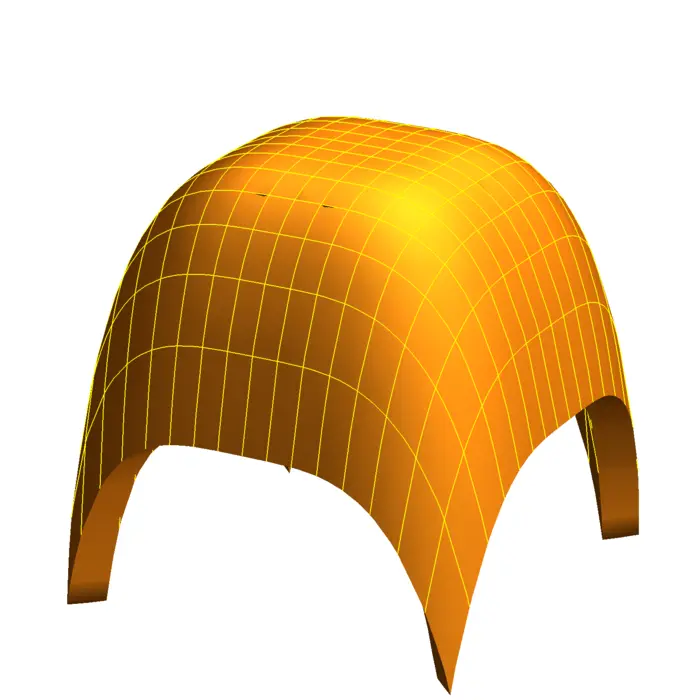
Example 3. Problem: The integral can be
interpreted as the signed volume under the graph of above the region . Find the volume of the region bound by
and and and .
Solution:
Example 4. Problem: Find the area of a disc of radius .
Solution: Use trig
substitution ,
, to get Using a double angle formula, this gives . We will next time compute this much
more effectively.
Example 5. Problem: Let
be the triangle . Evaluate .
Solution: We can not evaluate the integral directly
because has no
anti-derivative given in terms of elementary functions. But we can write
the integral as : \begin{aligned}
\int_{0}^{1}\left[\int_{0}^{x} e^{-x^{2}} \,d y\right] d x
&=\int_{0}^{1} x e^{-x^{2}} \,d x\\
&=-\frac{e^{-x^{2}}}{2}\Big|_{0} ^{1}\\
&=\frac{1-e^{-1}}{2}.
\end{aligned}
EXERCISES
Exercise 1. Calculate the iterated integral in two ways, once as a "left to right" and once as a "bottom to top" integral.
Exercise 2. Find the integral
Exercise 3.
- Compute the area of the elliptical region bound by the ellipse using trig substitution.
- Now do this in general for an ellipse .
(It is the "hardest problem in geometry", according to the comedy-drama "Rushmore", a movie from 1998).
Exercise 4. Find the integral
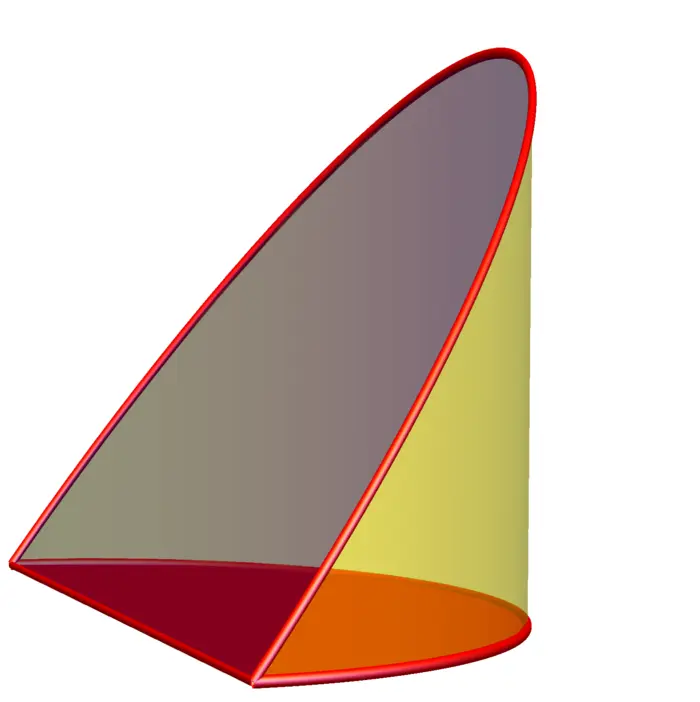
Exercise 5. Find the volume of the hoof solid , . The hoof solid was considered by Archimedes already.
Appendix: Data illustration: Monte Carlo
22.3.1 Lebesgue Integrals: A Tool for Real-World Integration
Often, when we deal with real data, we do not have analytic expressions for the region or function we want to integrate. The Riemann integral has its limitations. In other branches of mathematics like in probability theory, a better integral is needed. Its definition is close to the Riemann integral which we have given as the limit , where , . The Lebesgue integral replaces the regularly spaced grid with random points and uses the same formula.
22.3.2 The Area of a Fractal
How do we find the area of Mandelbrot set where ? In real coordinates, this is the map .
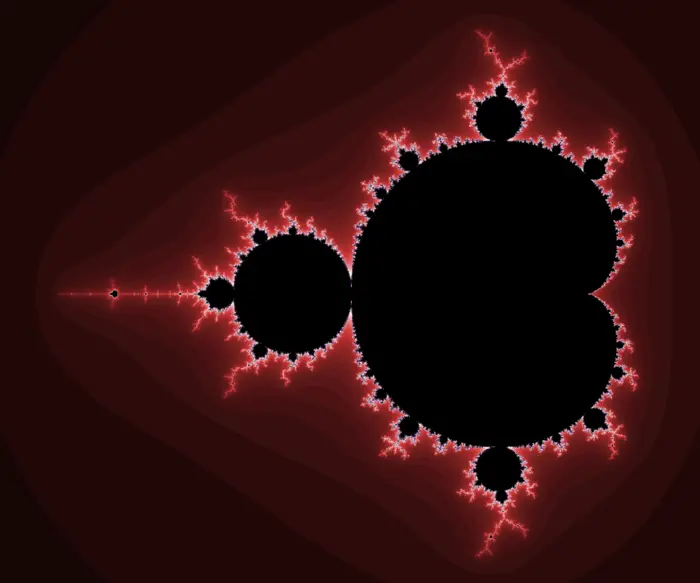
22.3.3 A Computational Approach to Mandelbrot Set Area
What is the area of the Mandelbrot set? We know it is contained in the rectangle and . We now just randomly shoot into this rectangle and see whether we are in the Mandelbrot set or not after iterations. Here is some Mathematica code which allows you to compute things. When we ran it, it gave a value of about . More accurate measurements reported hint for a slightly smaller value like . Others have given bounds .