Cross Product


4.1 INTRODUCTION

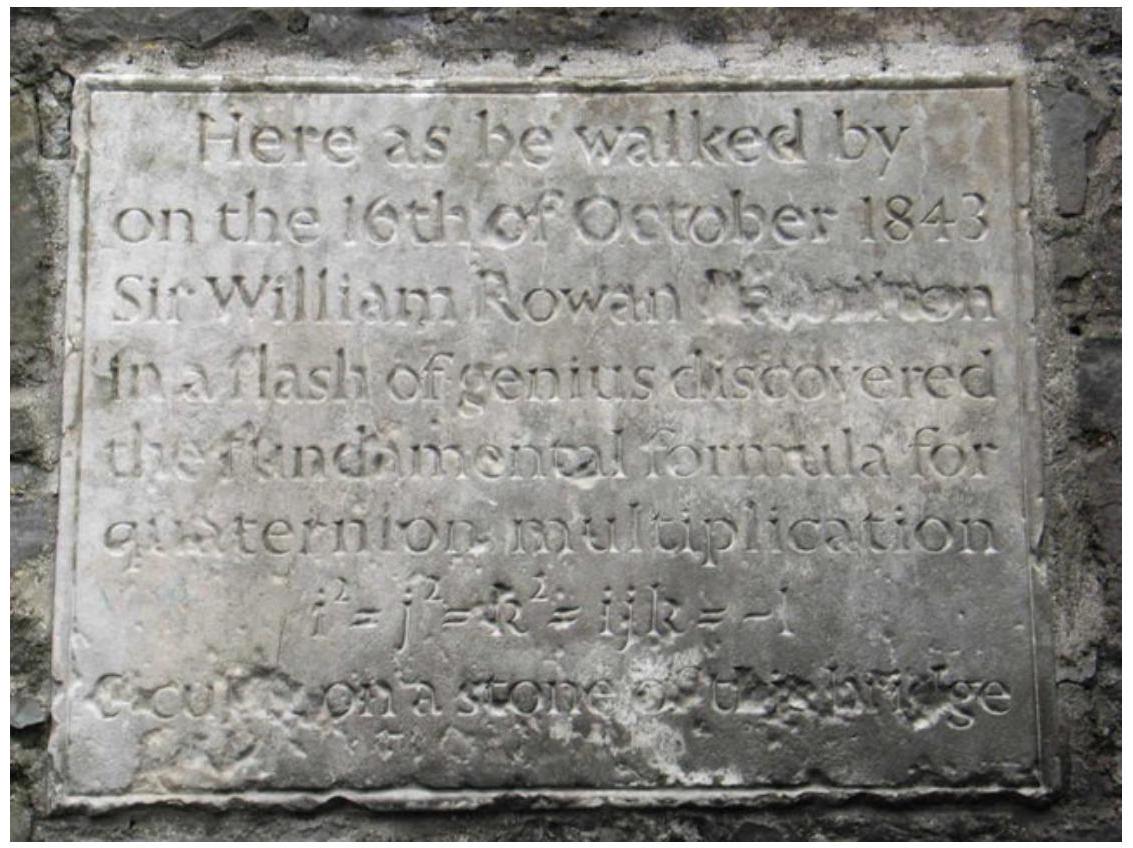
Figure 1. The quaternion plaque at the Brougham bridge: here as he walked by on the 16th of October 1843 Sir William Rowan Hamilton in a flash of genius discovered the fundamental formula for quaternion multiplication and cut it on a stone of this bridge.

4.1.1 Vector Multiplication Evolution

We have seen that we can multiply square matrices and get again a matrix. Wouldn’t it be nice if we could also multiply two vectors and get a vector back. The dot product, which is the matrix product of a row vector with a column vector gave us a number. The matrix product of a column vector with a row vector would give us a square matrix. How can we design a product of column vectors which again gives us a column vector? This was the question which William Rowan Hamilton pondered for many years. The story goes that every morning, when he would come down to the breakfast table, his young son would ask "Dad, can you already multiply triplets?" to which William answered: "No Son, I do not know how to do that yet".

4.1.2 Quaternions and Cross Product

Eventually, Hamilton succeeded. The legend goes that while walking with his wife along the Royal Canal in Dublin, while crossing the Brougham bridge, he suddenly got the inspiration: one has to multiply quadruplets! These numbers would be written as where are symbols satisfying . He was so happy that he would would devote the rest of his life with these numbers. Now it turns out that this algebra also produces a product of vectors which is called the cross product. It has a lot of nice properties like that the product of two vectors is perpendicular and that the length is related to area. It also has amazing applications in physics.

4.2 LECTURE

4.2.1 Uniqueness of

The three dimensional space is special. It is not only the only Euclidean space in which the Kepler problem is stable1, it also features a cross product which is in the same space. Such a product can be defined in but it produces a vector in . It happens that for that the result is again in . The problem of "multiplying triplets" has been pondered by William Hamilton in the first half of the 19th century and is related to the fascinating story of quaternions. The discovery of quaternions was simultaneously the birth place of the dot and cross product.

4.2.2 Cross Product Properties

The cross product of two vectors and is

Take the dot product with or to see that is perpendicular to both and . Obvious is also . The product is handy for constructions in . The vectors are oriented like the first three fingers on the right hand: if is the thumb, is the pointing finger, then is the middle finger. Let :

Theorem 1. and .

Proof. We will verify in class by brute force the Lagrange’s identity which is also called Cauchy-Binet formula. Now use to get the result with . ◻

4.2.3 Geometric Sine Applications

Given a triangle with side lengths and angles , where is opposite to etc. We have the following -formula

Corollary 1.

Proof. We can use the theorem and express the area of the triangle as or or . By equating these three quantities and dividing out the common factor, we get the -formula. ◻

4.2.4 Geometric Area Insights

This is useful in applications as to define the area of the parallelogram as . That this is justified can be seen in two dimensions and:

Corollary 2. is the parallelogram area spanned by and .

Proof. Use the formula and note that is the height of the parallelogram spanned by and . The base length is . ◻

4.2.5 Triple Scalar Product

The scalar is called the triple scalar product of . Its sign defines an orientation of the three vectors. It is also the determinant of the matrix The absolute value of defines the volume of the parallelepiped spanned by , and . Without the absolute value, we also speak of signed volume.

4.2.6 Side Remark: Cross Product in Higher Dimensions

In higher dimensions, the cross product is called exterior product. One uses rather than which is used in three dimensions. If is a choice of two elements in and are two vectors in , then . The formula still holds and the proof is the same. We only need again to verify the Cauchy-Binet formula . But this is better done using matrices. If is the matrix which contains as columns, then , where the sum on the right is over all submatrices of . The expression is called a minor. Cauchy-Binet formula is super cool2. By the way, if we have vectors and build , a matrix which has these vectors as columns. Now, is the volume of the parallelepiped spanned by these vectors. And Cauchy-Binet writes this as a sum of squares of -dimensional volumes of projections which is in some sense a generalization of Pythagoras.

4.3 EXAMPLES

Example 1. What is the area of the triangle , and ? We find the cross product between the vector going from to and the vector going from to . The cross product is Its length is . The area of the triangle is half of it: .

Example 2. Find the volume of the parallelepiped with vertices and attached corners , and . The signed volume is and take the absolute value. A negative number indicates that , , is left handed.

4.4 ILLUSTRATIONS

Figure 2. Swiss National Bank issued August 22, 2018 new 200 Frank bills. It shows the right hand rule: thumb , pointing finger , then is the middle finger.
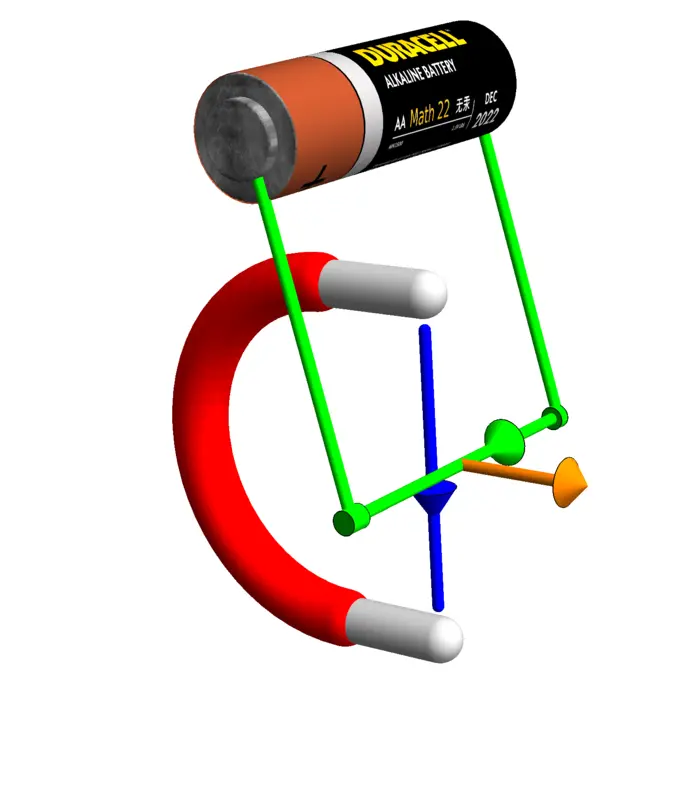
Figure 3. The Lorentz force is a vector determined by the velocity of a charged particle with charge moving in a magnetic field .
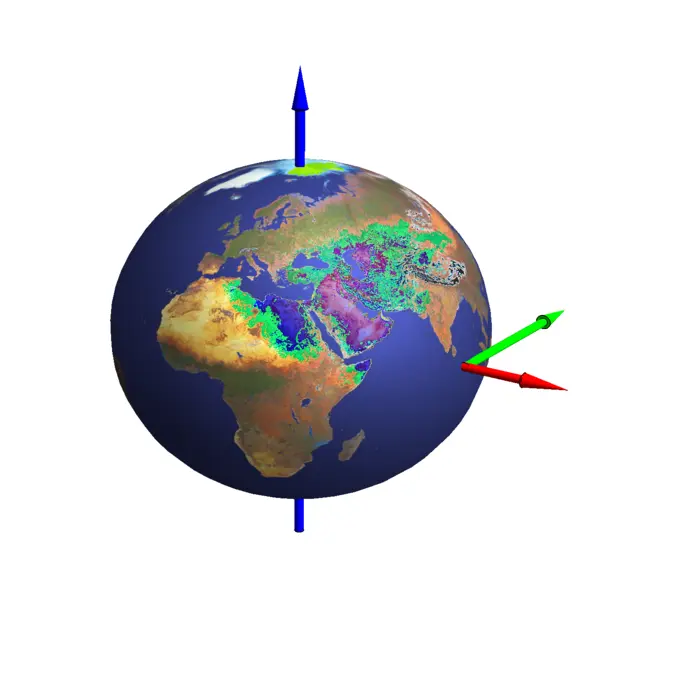
Figure 4. Given a particle of mass at position moving with the velocity then is the angular momentum.

EXERCISES

Exercise 1. Find a vector perpendicular to the vectors and . Then use this result to find a vector perpendicular to both and .

Exercise 2. A 3D scanner is used to build a 3D model of a face. It detects a triangle which has its vertices at , and . Find the area of that triangle as well as a vector perpendicular to the triangle.3

Exercise 3. Find the volume of the parallelepiped which has the vertices , , , , , , , .

Exercise 4. Investigate which of the following formulas are always true for all vectors . If it is true, either explain, cite a source (i.e. on the web), or a by hand or computer algebra verification. If it is not true, find a counter example.

Exercise 5. Given two vectors and , build the matrices Compare and . Describe what you see. Try to formulate this as a theorem.


  1. by a theorem of Joseph Bertrand of 1873 and work of Sundman-von Zeipel↩︎
  2. O. Knill, Cauchy Binet for pseudo-determinants, Lin. Alg. and its Applications 459 (2014) 522-547↩︎
  3. The STL format which is used for 3D printing, has an extremely simple form. It consists of entries like

facet normal 0.15-0.97-0.20

outer loop

vertex -1.6996-0.5597-2.8360

vertex -1.8259-0.5793-2.8374

vertex -1.7232-0.5399-2.9509

endloop

endfacet

The first line gives the normal vector, then there is a loop with three vertices giving the triangle. There is obviously some redundancy as one could get the normal vector from the points using the cross product. But there is purpose: the redundant information makes working with the data structure faster, second, one can also look at situations, where the normal vector is not perpendicular to the surface, one can change the way how the is "shaded", like how light is reflected at the surface. Third, redundancy is always good to catch errors. Our genetic information in the DNA is stored in a highly redundant way. This allows error correction.↩︎