Chapter Summary (Express)
We shall find that in our processes of calculation we have to deal with small quantities of various degrees of smallness.
We shall have also to learn under what circumstances we may consider small quantities to be so minute that we may omit them from consideration. Everything depends upon relative minuteness.
Before we fix any rules let us think of some familiar cases.
Obviously minute is a very small quantity of time compared with a whole week. Indeed, our forefathers considered it small as compared with an hour, and called it “one minute,” meaning a minute fraction—namely one sixtieth—of an hour. When they came to require still smaller subdivisions of time, they divided each minute into still smaller parts, which, in the 16th century, they called “second minutes” (i.e. small quantities of the second order of minuteness). Nowadays we call these small quantities of the second order of smallness “seconds.” But few people know why they are so called.
There are minutes in the hour, hours in the day, days in the week. There are therefore minutes in the day and minutes in the week.
Obviously minute is a very small quantity of time compared with a whole week. Indeed, our forefathers considered it small as compared with an hour, and called it “one minute,” meaning a minute fraction—namely one sixtieth—of an hour. When they came to require still smaller subdivisions of time, they divided each minute into still smaller parts, which, in the 16th century, they called “second minutes” (i.e. small quantities of the second order of minuteness). Nowadays we call these small quantities of the second order of smallness “seconds.” But few people know why they are so called.
Now if one minute is so small as compared with a whole day, how much smaller by comparison is one second!
An example about a small quantity of the second order of smallness
Again, think of a penny as compared with a ten dollar bill: it is only worth part. A penny more or less is of precious little importance compared with a ten dollar bill: it may certainly be regarded as a small quantity. But compare a penny with
Now if we fix upon any numerical fraction as constituting the proportion which for any purpose we call relatively small, we can easily state other fractions of a higher degree of smallness. Thus if, for the purpose of time, be called a small fraction, then of (being a small fraction of a small fraction) may be regarded as a small quantity of the second order of smallness.1
Or, if for any purpose we were to take percent (i.e. ) as a small fraction, then percent of percent (i.e. ) would be a small fraction of the second order of smallness; and would be a small fraction of the third order of smallness, being percent of percent of percent.
If we consider (one millionth) as “small” for a specific purpose. In this context, of , that is (one trillionth) will be a small quantity of the second order of smallness, and its impact can be completely disregarded in comparison.
Lastly, suppose that for some very precise purpose we should regard as “small.” Thus, if a first-rate chronometer is not to lose or gain more than half a minute in a year, it must keep time with an accuracy of part in . Now if, for such a purpose, we regard (or one millionth) as a small quantity, then of , that is (or one trillionth) will be a small quantity of the second order of smallness, and may be utterly disregarded, by comparison.
Then we see that the smaller a small quantity itself is, the more negligible does the corresponding small quantity of the second order become. Hence we know that in all cases we are justified in neglecting the small quantities of the second—or third (or higher)—orders, if only we take the small quantity of the first order small enough in itself.
But, it must be remembered, that small quantities if they occur in our expressions as factors multiplied by some other factor, may become important if the other factor is itself large. Even a penny becomes important if only it is multiplied by a few hundred.
Now in the calculus we write for a little bit of . These things such as , and , and , are called “differentials,” the differential of , or of , or of , as the case may be. [You read them as dee-eks, or dee-you, or dee-wy.] If be a small bit of , and relatively small of itself, it does not follow that such quantities as , or , or are negligible. But would be negligible, being a small quantity of the second order.
A very simple example will serve as illustration.
Let us think of as a quantity that can grow by a small amount so as to become , where is the small increment added by growth. The square of this is . The second term is not negligible because it is a first-order quantity; while the third term is of the second order of smallness, being a bit of, a bit of . Thus if we took to mean numerically, say, of , then the second term would be of , whereas the third term would be of . This last term is clearly less important than the second. But if we go further and take to mean only of , then the second term will be of , while the third term will be only of .
Geometrically this may be depicted as follows: Draw a square (the following figure) the side of which we will take to represent .
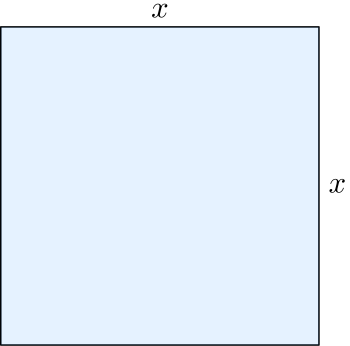
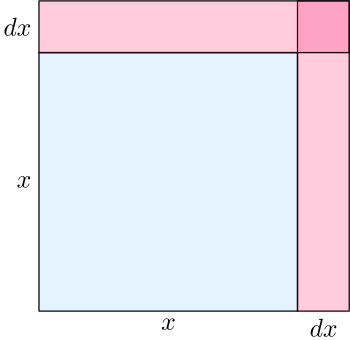
Now suppose the square to grow by having a bit added to its size each way. The enlarged square is made up of the original square , the two rectangles at the top and on the right, each of which is of area (or together ), and the little square at the top right-hand corner which is . In the next figure, we have taken as quite a big fraction of —about .
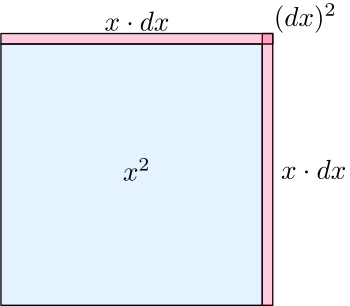
But suppose we had taken it only —about the thickness of an inked line drawn with a fine pen (the next figure). Then the little corner square will have an area of only of , and be practically invisible. Clearly is negligible if only we consider the increment to be itself small enough.
A simile
Let us consider a simile.
Suppose a millionaire were to say to his secretary: next week I will give you a small fraction of any money that comes in to me. Suppose that the secretary were to say to his boy: I will give you a small fraction of what I get. Suppose the fraction in each case to be part. Now if Mr. Millionaire received during the next week $, the secretary would receive $ and the boy cents. Ten dollars would be a small quantity compared with , Mr. Secretary would get only $, and the boy 0.1 cents!
The witty Dean Swift2 once wrote:
So, Nat’ralists observe, a Flea
Hath smaller Fleas that on him prey.
And these have smaller Fleas to bite ’em,
And so proceed ad infinitum
An ox might worry about a flea of ordinary size—a small creature of the first order of smallness. But he would probably not trouble himself about a flea’s flea; being of the second order of smallness, it would be negligible. Even a gross of fleas’ fleas would not be of much account to the ox.
Full Chapter
We shall find that in our processes of calculation we have to deal with small quantities of various degrees of smallness.
We shall have also to learn under what circumstances we may consider small quantities to be so minute that we may omit them from consideration. Everything depends upon relative minuteness.
Before we fix any rules let us think of some familiar cases. There are minutes in the hour, hours in the day, days in the week. There are therefore minutes in the day and minutes in the week.
Obviously minute is a very small quantity of time compared with a whole week. Indeed, our forefathers considered it small as compared with an hour, and called it “one minute,” meaning a minute fraction—namely one sixtieth—of an hour. When they came to require still smaller subdivisions of time, they divided each minute into still smaller parts, which, in the 16th century, they called “second minutes” (i.e. small quantities of the second order of minuteness). Nowadays we call these small quantities of the second order of smallness “seconds.” But few people know why they are so called.
Now if one minute is so small as compared with a whole day, how much smaller by comparison is one second!
Again, think of a penny as compared with a ten dollar bill: it is only worth part. A penny more or less is of precious little importance compared with a ten dollar bill: it may certainly be regarded as a small quantity. But compare a penny with : relatively to this greater sum, the penny is of no more importance than of a penny would be to a ten dollar bill. Even $10,000 is relatively a negligible quantity in the wealth of a billionaire.
Now if we fix upon any numerical fraction as constituting the proportion which for any purpose we call relatively small, we can easily state other fractions of a higher degree of smallness. Thus if, for the purpose of time, be called a small fraction, then of (being a small fraction of a small fraction) may be regarded as a small quantity of the second order of smallness.1
Or, if for any purpose we were to take percent (i.e. ) as a small fraction, then percent of percent (i.e. ) would be a small fraction of the second order of smallness; and would be a small fraction of the third order of smallness, being percent of percent of percent.
Lastly, suppose that for some very precise purpose we should regard as “small.” Thus, if a first-rate chronometer is not to lose or gain more than half a minute in a year, it must keep time with an accuracy of part in . Now if, for such a purpose, we regard (or one millionth) as a small quantity, then of , that is (or one trillionth) will be a small quantity of the second order of smallness, and may be utterly disregarded, by comparison.
Then we see that the smaller a small quantity itself is, the more negligible does the corresponding small quantity of the second order become. Hence we know that in all cases we are justified in neglecting the small quantities of the second—or third (or higher)—orders, if only we take the small quantity of the first order small enough in itself.
But, it must be remembered, that small quantities if they occur in our expressions as factors multiplied by some other factor, may become important if the other factor is itself large. Even a penny becomes important if only it is multiplied by a few hundred.
Now in the calculus we write for a little bit of . These things such as , and , and , are called “differentials,” the differential of , or of , or of , as the case may be. [You read them as dee-eks, or dee-you, or dee-wy.] If be a small bit of , and relatively small of itself, it does not follow that such quantities as , or , or are negligible. But would be negligible, being a small quantity of the second order.
A very simple example will serve as illustration.
Let us think of as a quantity that can grow by a small amount so as to become , where is the small increment added by growth. The square of this is . The second term is not negligible because it is a first-order quantity; while the third term is of the second order of smallness, being a bit of, a bit of . Thus if we took to mean numerically, say, of , then the second term would be of , whereas the third term would be of . This last term is clearly less important than the second. But if we go further and take to mean only of , then the second term will be of , while the third term will be only of .
Geometrically this may be depicted as follows: Draw a square (Fig. 2.1) the side of which we will take to represent .
Now suppose the square to grow by having a bit added to its size each way. The enlarged square is made up of the original square , the two rectangles at the top and on the right, each of which is of area (or together ), and the little square at the top right-hand corner which is . In Fig. 2.2 we have taken as quite a big fraction of —about .
But suppose we had taken it only —about the thickness of an inked line drawn with a fine pen (Fig. 2.3). Then the little corner square will have an area of only of , and be practically invisible. Clearly is negligible if only we consider the increment to be itself small enough.
Let us consider a simile.
Suppose a millionaire were to say to his secretary: next week I will give you a small fraction of any money that comes in to me. Suppose that the secretary were to say to his boy: I will give you a small fraction of what I get. Suppose the fraction in each case to be part. Now if Mr. Millionaire received during the next week $, the secretary would receive $ and the boy cents. Ten dollars would be a small quantity compared with $; but 10 cents is a small small quantity indeed, of a very secondary order. But what would be the disproportion if the fraction, instead of being , had been settled at part? Then, while Mr. Millionaire got his $, Mr. Secretary would get only $, and the boy 0.1 cents!
The witty Dean Swift2 once wrote:
So, Nat’ralists observe, a Flea
Hath smaller Fleas that on him prey.
And these have smaller Fleas to bite ’em,
And so proceed ad infinitum
An ox might worry about a flea of ordinary size—a small creature of the first order of smallness. But he would probably not trouble himself about a flea’s flea; being of the second order of smallness, it would be negligible. Even a gross of fleas’ fleas would not be of much account to the ox.
The mathematicians talk about the second order of “magnitude” (i.e. greatness) when they really mean second order of smallness. This is very confusing to beginners.↩︎
On Poetry: a Rhapsody (page 20), printed 1733—usually misquoted.↩︎