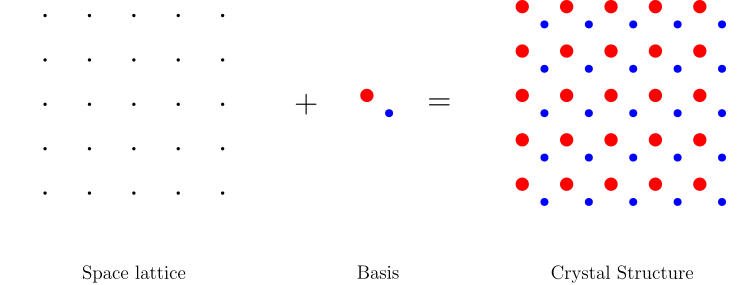
A crystal is formed by the periodic repetition of a group of atoms in all directions. That group of atoms is called the basis.
- The basis of a crystal can be one or more atoms.
- An ideal crystal consists of infinite repetitions of the basis.
- The lattice looks identical from whichever points you view the array.
- Note that lattice is not a crystal.
- In three dimensions, the lattice can be identified by three independent vectors , and .
- The position of each point can be written as a linear combination of these vectors, \mathbf{R}=n_1 \mathbf{a}_1+n_2 \mathbf{a}_2+n_3 \mathbf{a}_3 \tag{1} where , , and are integers.
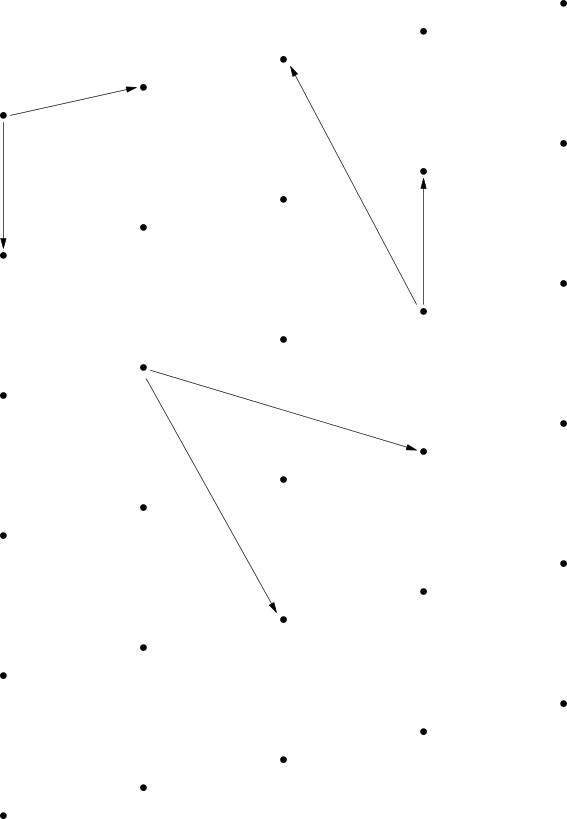
- The vectors that can generate or span the lattice are not unique. For example, see the following figure.
- Recall that the volume of a parallelepiped with axes , and is given by .
Primitive Cells vs. Unit Cells
- The unit cell may or may not be identical to the primitive cell.
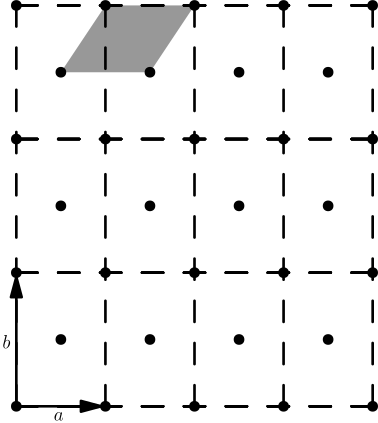
Unit cell of a face-centered cubic structure
Lattice Parameters and Packing Fraction
Lattice Parameters
Packing Fraction
- We try to pack hard spheres (cannot deform)
- The total volume of the spheres is
- The volume these spheres occupy (there are spacing)
Bravais Lattices
- Auguste Bravais, a French physicist, identified 14 distinct lattices in three dimensions.
- There are 5 Bravais lattices in two dimensions (shown below)
- In crystallography, all lattices are traditionally called Bravais lattices or translation lattices.
Five Bravais Lattices in Two Dimensions
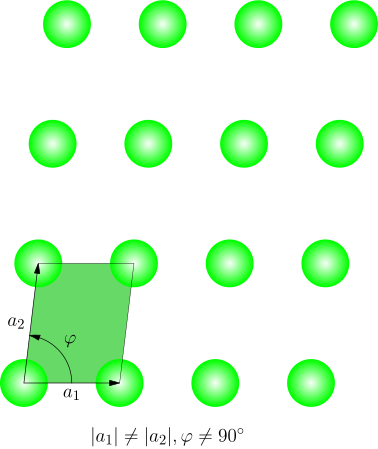 | 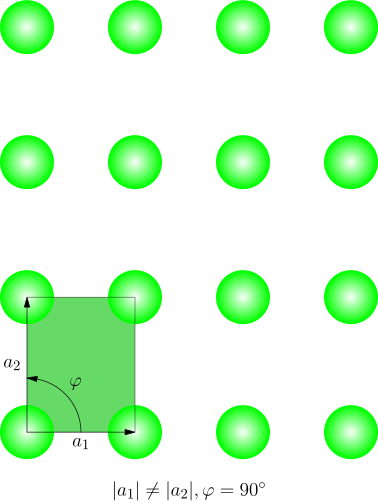 | 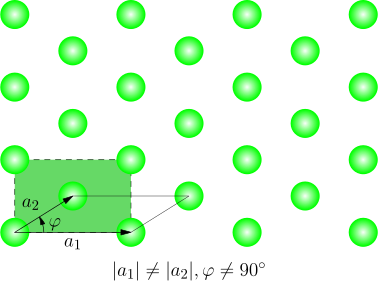 |
| Oblique | Rectangular | Centerd Rectangular |
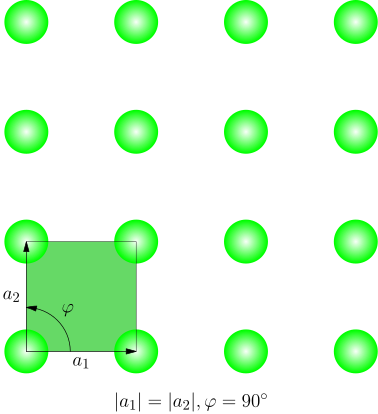 | 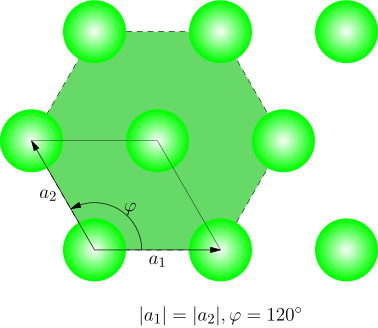 | |
| Square | Hexgonal (Rhombic) |
Seven Crystal Systems
Isometric (or Cubic) | Tetragonal | Orthorhombic | Hexagonal |
Triclinic | Monoclinic | Rhombohedral (or Trigonal) |
Cubic Lattices
| Primitive | Body-Centered | Face-Centered |
Simple Cubic (SC) Crystal
- Location of all lattice points
- Polonium (Po) is the only metal that forms a simple cubic unit cell.
- Each lattice point is shared by 8 neighboring units
- average volume occupied by each lattice point
average volume occupied by each atom in SC
Body-Centered Cubic (BCC) Crystal
- Location of all lattice points \begin{aligned} \mathbf{R}&=a(u\, \hat{\mathbf{x}}+v\, \hat{\mathbf{y}}+w\, \hat{\mathbf{z}})=a[u\ v\ w]\\ \mathbf{R}&=a((u+0.5)\, \hat{\mathbf{x}}+(v+0.5)\, \hat{\mathbf{y}}+(w+0.5)\, \hat{\mathbf{z}})=a[u+0.5\ v+0.5\ w+0.5]\end{aligned}
- average volume occupied by each lattice point
average volume occupied by each atom in BCC - Nearest neighbor distance =
The primitive translation vectors are:
- The primitive unit cell is a rhombohedron of edge
- The angle between adjacent edges is 109^\circ 28'
- Number of nearest neighbors = 8
- Number of second nearest neighbors = 6
- Second nearest neighbor distance =
Some Elements with BCC structure
| Barium | Ba | Chromium | Cr |
| Cesium | Cs | Iron | Fe |
| Potassium | K | Lithium | Li |
| Molybdenum | Mo | Sodium | Na |
| Niobium | Nb | Rubidium | Rb |
| Tantalum | Ta | Titanium | Ti |
| Vanadium | V | Tungsten | W |
Face-Centered Cubic (FCC) Crystal
- Location of all lattice points \begin{aligned} \mathbf{R}&=a[u\ v\ w]\\ \mathbf{R}&=a[u+0.5\ v\ w]\\ \mathbf{R}&=a[u\ v+0.5\ w]\\ \mathbf{R}&=a[u\ v\ w+0.5]\end{aligned}
- average volume occupied by each lattice point
average volume occupied by each atom in FCC - Nearest neighbor distance =
The primitive cell vs the unit cell
The primitive translation vectors are:
- The angle between adjacent edges is
The reference atom is red. Blue, green, and orange points are the 12 nearest neighbors of the reference atoms, and the purple points are its 6 next nearest neighbors atoms.
- Packing fraction
- Some elements with fcc structure: Ar, Ag, Al, Au, Ca, Ce, Co, Cu, Ir, Kr, La, Ne, Ni, Pb, Pd, Pr, Pt, Pu, Rh, Sc, Sr, Th, Xe, Yb
Characteristics of Cubic structure
| simple cubic | b.c.c. | f.c.c. | |
|---|---|---|---|
| volume of conventional cell | |||
| no. of lattice points per cell | 1 | 2 | 4 |
| no. of nearest neighbors (coordination number) | 6 | 8 | 12 |
| no. of 2nd nearest neighbors | 12 | 6 | 6 |
| nearest neighbor distance | |||
| 2nd nearest neighbor distance | |||
| packing fraction |
[111], [101], and [110] describe directions , , and , respectively.
Crystal Structure May Change with Temperature
- If the temperature changes, some materials might undergo a phase change.
- For example, at atmospheric pressure (105 Pa) and below 912 °C, pure iron (Fe) has a BCC structure, known as ⍺-iron. If we heat iron above 912 °C, its structure changes to an FCC structure, known as 𝛾-iron. Above 1394 °C, the structure changes back to BCC, known as 𝛿-iron. You may see the phase diagram of pure iron in the following figure.

Hexagonal Close-Packed (HCP) Structure
- 30 elements crystallize in hcp form.
- HCP crystal has a hexagonal lattice and a multi-atom basis.
- It can be viewed as two nested simple hexagonal Bravais lattice shifted by .
where
-
- average vol. occupied by each lattice point
- average vol. occupied by each atom
Comparing Close-Packed Structures
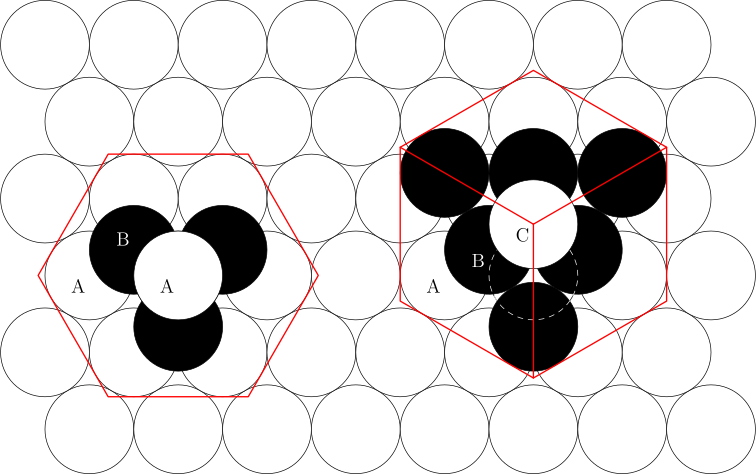
| hcp | fcc |
- In this figure, the left structure is hcp, and the right is fcc
- volume fraction = 0.74
- number of nearest neighbors (coordination number) is 12 for both hcp and fcc structures
- Although a hexagonal close-packing of equal atoms is only obtained if , the term hcp is used for any structure described previously.
Elements with hcp structures
| Element | Element | ||
|---|---|---|---|
| Ideal | 1.63 | ||
| Be | 1.56 | Cd | 1.89 |
| Ce | 1.63 | -Co | 1.62 |
| Dy | 1.57 | Er | 1.57 |
| Gd | 1.59 | He (2K) | 1.63 |
| Hf | 1.58 | Ho | 1.57 |
| La | 1.62 | Lu | 1.59 |
| Mg | 1.62 | Nd | 1.61 |
| Os | 1.58 | Pr | 1.61 |
| Re | 1.62 | Ru | 1.59 |
| Tb | 1.58 | Ti | 1.59 |
| Tl | 1.60 | Tm | 1.57 |
| Y | 1.57 | Zn | 1.59 |
[adapted from Ashcroft, Mermin, Solid State Physics]
Diamond Crystal
- It is the structure of carbon in a diamond crystal
- It can be viewed as two interpenetrating fcc lattices displaced by
- Or it can be imagined as the fcc lattice with two point basis and .
- Coordination number is 4
- Packing fraction is
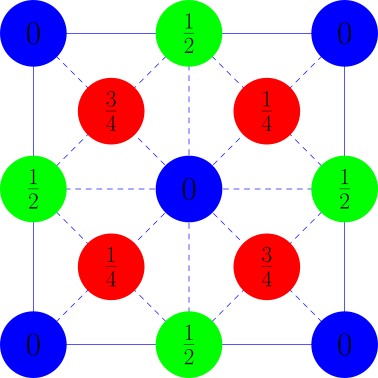 | |
| (a) Tetrahedral bond in a diamond structure | (b) Diamond structure projected on a cube face. Fractions denote the height above the base in units of |
3D Diamond Structure
- Elements with diamond structure: C (diamond), Si, Ge, -Sn (gray)
- average volume occupied by each atom:
Sodium Chloride Structure
- Na and Cl ions are placed on alternate points of a simple cubic structure
- The lattice is fcc; the basis consists of Na and Cl
NaCl structure, Blue atoms represent Na atoms and Green ones represent Cl atoms.
Some compounds with sodium chloride structure
| LiF | LiCl | LiBr | LiI | ||
| NaF | NaCl | NaBr | NaI | ||
| RbF | RbCl | RbBr | RbI | ||
| CsF | |||||
| AgF | AgCl | AgBr | |||
| MgO | MgS | MgSe | |||
| CaO | CaS | CaSe | CaTe | ||
| SrO | SrS | SrSe | SrTe | ||
| BaO | BaS | BaSe | BaTe |
[Adapted from Ashcroft, Mermin, Solid State Physics]
Cesium Chloride Structure
- Cs and Cl ions are placed at and body center position , respectively.
- The lattice is simple cubic; the basis consists of Cs and Cl
CsCl structure. Blue spheres represent Cl atoms and the big red sphere represents the Cs atom which is much larger than the Cl atoms.
- Some compounds with the cesium chloride structure:
| CsCl | CsBr | CsI |
| TlCl | TlBr | TlI |
Miller Indices
Miller Indices for Directions in Cubic Structure
- It is often required to specify certain directions and planes in crystals. To this end, we use Miller indices.
- represents the direction vector of a line passing through the origin.
- These integers , and must be the smallest numbers that will give the desired direction. i.e. we write not .
- If a component is negative, it is conventionally specified by placing a bar over the corresponding index. For example, we write instead of .
- Coordinates in angle brackets such as denote a family of directions that are equivalent due to symmetry operations, such as [123], [132], [321], [], [], etc.
[111], [101], and [110] describe directions , , and , respectively.
Miller Indices for Planes in Cubic Structure
- A crystallographic plane is denoted by the Miller indices of the direction normal to the plane, but instead of brackets we use parenthesis, i.e. ()
| $(100)$ | $(110)$ | $(111)$ |
- “Coordinates in curly brackets or braces such as denote a family of plane normals that are equivalent due to symmetry operations, much the way angle brackets denote a family of directions.”
- For a cubic system, a family consists of all the planes given by the permutations of the number , , and their negatives.
- If the symmetry of the system is lower than that of cubic, not all the planes given by the permutations necessarily belong to a family. For example, in a rhombohedral system, we have , but in an orthorhombic system family has only two members and .
Miller Indices for hcp
- Miller indices contain 4 digits instead of 3 digits
- means: and
- Directions along axes , and are of type .
- is a plane the normal direction of which is .
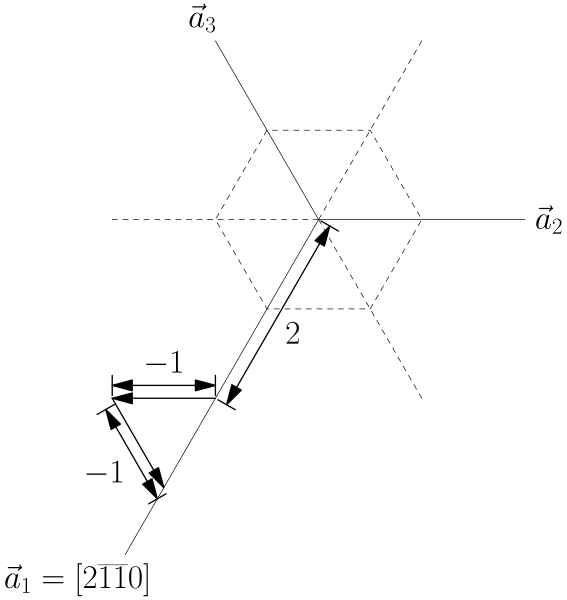 | 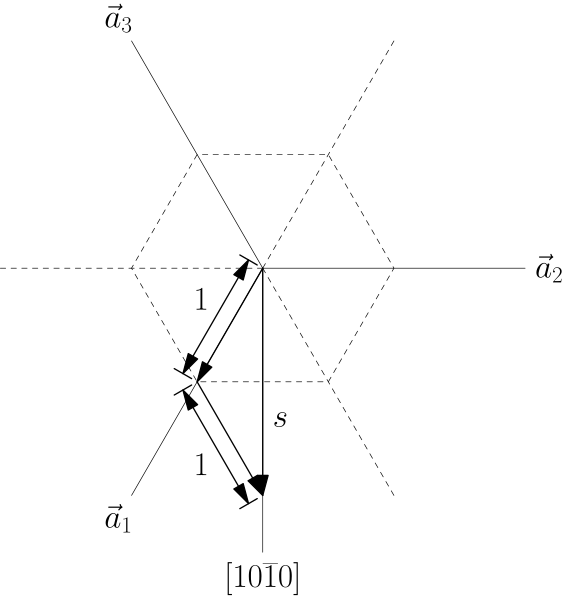 |
| Determination of indices for a digonal axis if Type I - | Determination of indices for a digonal axis if Type II - |
Further Reading
- Ashcroft, N.W., Mermin, N.D., Solid State Physics, Harcourt College Publishers, 1976.
- De Graef, M., McHenry, M.E., Structure of Materials, Cambridge University Press, 2007.
- Kittel, C., Introduction to Solid State Physics, 8th ed., Wiley, 2004.