1. Two train cars—one loaded, one empty—roll down a sorting hill. Which will travel farther on the straight track after descending? Assume the drag force is proportional to the load on the wheels and independent of speed. Neglect air resistance.
Answer
Both wagons will travel the same distance.
2. What mass of ballast must be dropped from a uniformly descending balloon to make it ascend uniformly at the same speed? The balloon's total mass is , its lift force is constant at , and drag is the same for ascent and descent.
Answer
kg.
Hint
The conditions for uniform motion of the aerostat during descent and ascent are expressed respectively: ; .
3. A mine cage of mass starts ascending at . Find:
a) the cable tension;
b) the tension when descending at the same acceleration;
c) the tension when moving up or down at constant speed.
Answer
a) H;
b) H;
c) H.
4. A person stands on a spring scale in an elevator. How do the scale readings change as the elevator moves up and down, considering changes in motion?
Answer
When the elevator moves with acceleration directed upwards (this will be at the beginning of the ascent and at the end of the descent), the scale reading is greater than ( is the mass of the person). If the acceleration is directed downwards, which will be at the beginning of the descent and at the end of the ascent, the scale reading is less than . If the elevator moves uniformly, the scale reading is equal to .
Hint
The equation of motion for the person is (equation written in projections onto the direction of ). Here is the acceleration of the elevator (algebraic quantity) and is the reaction force of the scales. In accordance with Newton's third law, the force N' acting on the scales from the person is equal in magnitude to : N' = N = m(g-a).
5. A person stands on a board and suddenly crouches. Does the board's deflection initially increase or decrease? What happens if the person was squatting and suddenly stands?
Answer
When squatting, it will decrease; when straightening up, it will increase.
Hint
When squatting, the acceleration of the person's center of mass is directed downwards, and when straightening up - upwards.
6. A box filled with balls is thrown upward. How do the forces of the balls on the box's bottom, sides, and each other change during flight? How does the answer change if the box is thrown at an angle? Neglect air resistance.
Answer
During the free movement of the box (movement in the field of gravity in the absence of other forces), the pressure force of the balls on the bottom and walls of the box, as well as on each other, is zero.
7. A heavy object is suspended from a spring attached to an elevator ceiling. How will the object move relative to the elevator if the elevator starts free-falling?
Answer
The body will oscillate on the spring, the amplitude of which is equal to the initial extension of the spring.
Hint
The problem is conveniently solved in a non-inertial coordinate system associated with the moving elevator (see 'Elementary Physics Textbook' edited by Acad. G. S. Landsberg, vol. I, ch. 6). In this reference frame, three forces act on the mass: the force of gravity , the inertial force balancing it, and also the spring tension force, equal at the initial moment to the force of gravity acting on the mass.
8. A body on a stand is suspended from a ceiling by a spring (initially unstretched). The stand is lowered at acceleration . After what time will the body lift off? The spring constant is , and the body's mass is .
Answer
.
Solution
Until the moment the body detaches from the support, it moves with acceleration under the action of three forces: the force of gravity , the spring tension force , and the support reaction force . Therefore . At the moment the body detaches from the support, the support reaction force becomes zero. Considering this and substituting the expression for into the equation of motion, we find .
9. Masses and are hung from a cord over a pulley. Neglecting friction, cord and pulley mass, and cord stretch, find the accelerations, cord tension, and dynamometer reading supporting the pulley.
Answer
m/s; H; H.
Solution
The forces acting on the weights are shown in the following figure. Let's write the equations of motion for the weights: m_1 a_1 = m_1 g - T_1,\tag{1} m_2 a_2 = T_2 - m_2 g. \tag{2} The accelerations and of the weights are numerically equal, since the string is inextensible and the displacements of the weights are always the same (the relationships between the accelerations of the bodies of the system are determined by their kinematic connection, i.e., the connection between their displacements). In the general case, the forces and applied to the ends of the string, according to Newton's third law, are numerically equal to the forces T'_1 and T'_2, are not equal to each other, i.e., the difference between these forces imparts acceleration to the string and angular acceleration to the pulley. If the mass of the string and pulley can be neglected, then and and the corresponding forces T'_1 and T'_2 applied to the weights can be considered equal to each other. Projecting the vectors included in equations (1) and (2) onto the directions and , coinciding with the accelerations of each of the weights (conventionally assume ), we obtain the following system of equations: ; . Solving this system for the unknowns and , we get ; . (If , we get , i.e., the weights move in the direction opposite to the assumed one.) The dynamometer reading is obviously equal to the sum of the string tension forces: 
10. Two masses and hang from a cord over a pulley. Initially at the same height, how long until the lighter mass is 10 cm above the heavier one? Neglect pulley and cord mass and friction.
Answer
s.
Hint
See the previous problem. Each weight will travel a path equal to 5 cm.
11. Two identical masses are hung from a cord over a pulley. A small mass is placed on one. Find the force of on and the force on the pulley's axle.
Answer
; .
Solution
In accordance with Newton's second law, let's write the equations of motion for each of the bodies (see figure): for the first body for the second body for the load ma = mg - f', where is the string tension force; is the pressure force of the load on the body, is the acceleration of the bodies; f' is the reaction force of the support. According to Newton's third law, f' and , and T' are numerically equal. The tensions on the right and left are equal, since friction and the mass of the pulley are neglected. Solving the obtained system of equations, we find The force acting on the axis of the pulley, 
12. A horizontal axis passes through the middle of a rod, about which it can rotate. Masses with and are attached to the ends of the rod. The rod is brought to a horizontal position and released without a push.
- Find the force exerted by the rod on the axis at the initial moment after its release. Neglect the mass of the rod and friction at the axis; consider the masses as material points.
- Solve the problem for the case when the axis does not pass through the center of the rod but is located at a distance of of its length from the smaller mass.
Answer
1. N.
- N.
Solution
1. The force F', acting from the axis on the rod and according to Newton's third law numerically equal to the pressure force on the axis (see figure below, a), can be replaced by two forces and , applied to each of the weights and equal to . Considering that the rod is massless, we can, using Newton's second law, write: , , whence .
- The force F' must be replaced (see figure below, b) by forces F_1 = (2/3)F' and F_2 = (1/3)F', applied to weights and respectively. The accelerations of the weights are related by , i.e., .
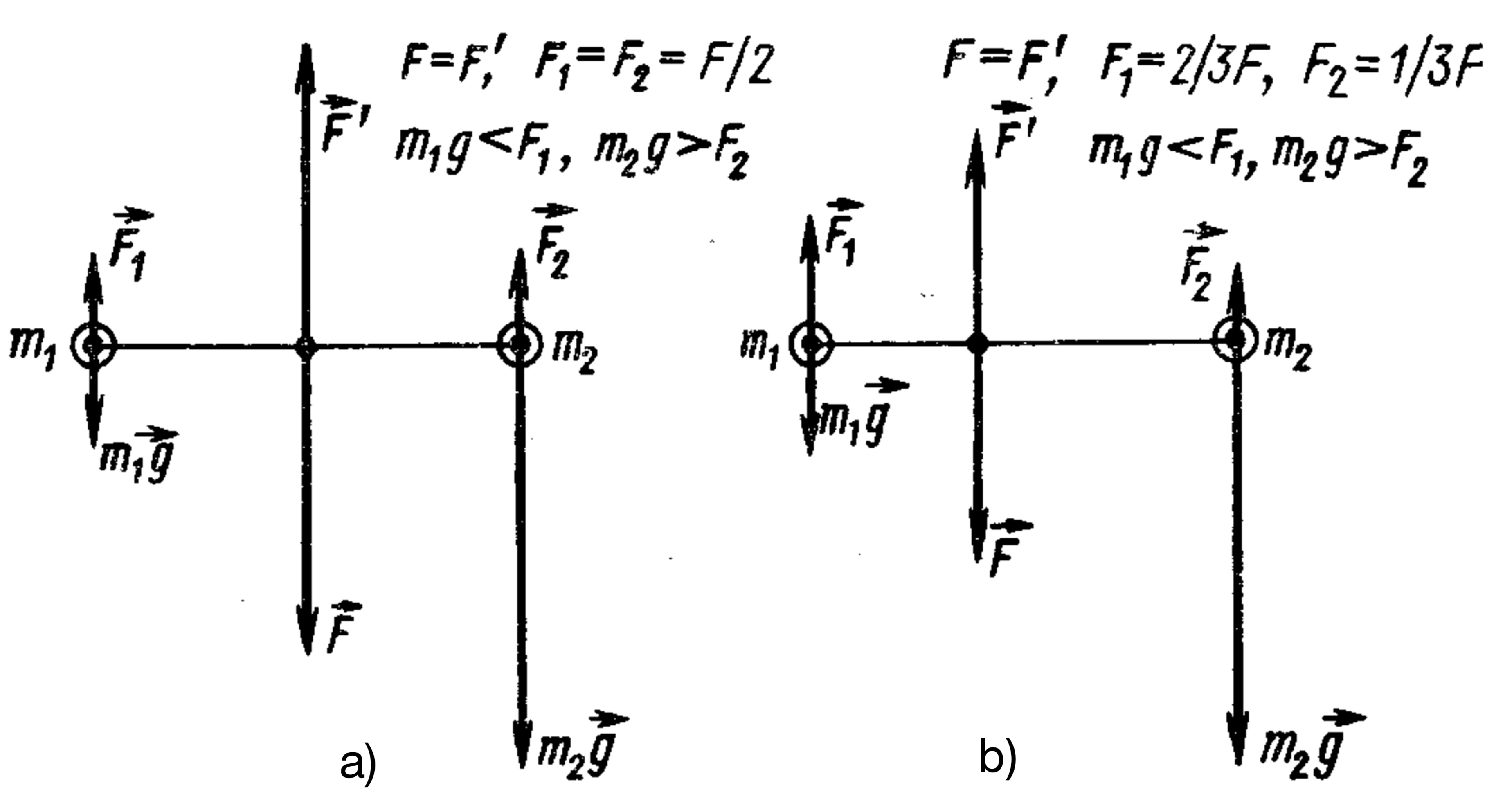

13. Masses and hang from a cord over a pulley on a prism with angles and (see figure). Find their accelerations and cord tension. Neglect friction. 
Answer
; .
Solution
Let's write the equations of Newton's second law for each of the weights, projecting the forces acting on the weights (see figure) onto the direction of possible motion of the corresponding weights, i.e., along the faces of the prism (assume that weight descends): Solving this system, we find: If, upon substitution of the numerical values of masses and angles, it turns out that , it means that the entire system moves with acceleration in the direction opposite to the chosen one. The latter follows from the fact that in the absence of friction, changing the chosen direction of motion of the weights will only change the signs of the right sides of the equations derived above. 
14. Two masses and are connected by a string and lie on a smooth table (friction is neglected). A force is applied to the first mass along the direction of the string, and a force is applied to the second mass in the opposite direction. With what acceleration will the masses move, and what is the tension force in the connecting string? Solve the problem in general form and draw a conclusion about the tension force in the string when .
Answer
m/s; H; , when .
15. Find the accelerations and of masses and and cord tension in the system shown below. Neglect pulley and cord mass and friction. 
Answer
; ; .
Hint
From the kinematic connection, it follows that the acceleration of weight is twice the acceleration of weight (when weight moves by distance , weight moves by distance ). A force equal to is applied to weight from the strings.
16. A cart with a liquid container moves horizontally at acceleration . Find the angle of the liquid's surface to the horizon in steady state.
Answer
.
Solution
Let's conditionally isolate a small part of the liquid inside. Two forces act on this element of liquid with mass : the force of gravity and the buoyant (Archimedean) force from the side of the liquid. The resultant of these forces must be directed towards the acceleration of the vessel and equal to (see figure). Therefore, the force must form an angle with the vertical. The direction of the buoyant force acting on any isolated volume inside the liquid is perpendicular to the planes of equal pressure (=const) in the liquid, is determined by them and, in particular, is perpendicular to its surface (). The requirement of perpendicularity uniquely relates to the condition of rest of the liquid relative to the vessel. Any violation of perpendicularity is 'automatically' eliminated due to the fluidity of the liquid. 
17. Find the angle of a liquid's surface in a container sliding without friction on an inclined plane.
Answer
The surface of the liquid is parallel to the inclined plane.
1st method. See solution to problem 16.
2nd method. Let's solve the problem in the reference frame associated with the moving vessel (in a non-inertial system). In this case, forces , , and the inertial force act on any element of the liquid, directed opposite to the motion of the vessel (see figure). The resultafignt of these forces must be zero (since the liquid is stationary relative to the vessel). This is possible when the force is perpendicular to the inclined plane. The surface of the liquid is parallel to it.
18. A bucket of water with a floating body is in an elevator. Does the body's submersion depth change if the elevator accelerates upward or downward?
Answer
Will not change.
Solution
When the elevator moves with acceleration , Newton's second law for a floating body is written as: m\vec{a} = m\vec{g} + \vec{F},\tag{1} where is the buoyant force; is the mass of the body.
If the volume displaced by the body were occupied by liquid, a force, also equal to , would act on it from the rest of the liquid. According to Newton's second law
m_l \vec{a} = m_l \vec{g} + \vec{F}; \tag{2}
here , where is the volume of the submerged part of the body. Substituting the expression for found from equality (1) into equation (2), we get
hence it follows that does not depend on the acceleration of the elevator, i.e., the immersion depth of the body does not change. Note. The solution to the problem becomes very simple in the reference frame associated with the elevator (see problem 17).
19. A board of mass can slide without friction on an incline at angle . A dog of mass runs on the board. What direction and acceleration must the dog have to prevent the board from sliding? What minimum friction coefficient between the dog and board is needed?
Answer
; .
Solution
The dog must run with such acceleration, directed downwards, so that the force , with which the dog pushes the board back, balances the resultant of the forces acting on the board: gravity and reaction force , i.e., equals (see figure). On the dog, therefore, in the direction of its acceleration, act the force and the force from the board, equal, according to Newton's third law, to (the direction of the dog's movement does not matter). The equation of motion for the dog will be , whence . The force , with which the dog pushes the board, by its nature, is a friction force, which cannot exceed the value . The problem has a solution (the dog stops the board) if , i.e., . Hence .
1st method. See solution to problem 16.
2nd method. Let's solve the problem in the reference frame associated with the moving vessel (in a non-inertial system). In this case, forces , , and the inertial force act on any element of the liquid, directed opposite to the motion of the vessel (see figure). The resultafignt of these forces must be zero (since the liquid is stationary relative to the vessel). This is possible when the force is perpendicular to the inclined plane. The surface of the liquid is parallel to it.
20. A cylinder of mass has a wound thread. When released, the thread is pulled upward so the cylinder's center remains at the same height. Find the thread's tension.
Answer
.
Hint
The cylinder is at rest relative to the Earth.
21. A rope over a fixed pulley has a mass on one end and a person on the other. The person pulls the rope to lift the mass while staying at the same height. How long until the mass is raised ? Neglect rope and pulley mass.
Answer
s.
Solution
Since the person is stationary relative to the Earth, the forces applied to him are balanced. Thus, the tension force is numerically equal to the weight of the person . Therefore, for the weight, Newton's second law will be written as: . Hence the acceleration of the weight and is directed upwards. The time for the weight to rise is determined from the formula :
22. 1. Two boys of equal mass on skates apart pull a rope: one at speed , the other at . When and where will they meet? Solve also for mass ratio 1:1.5.
- Two gymnasts of equal mass pull a rope over a pulley and begin ascend simultaneously: one at speed , the other at relative to the rope. How long until each reaches the pulley? The rope's length is , initially centered.
Answer
1. Both boys will reach the middle of the distance between them simultaneously after time ; if the masses of the boys are unequal, the meeting place divides the distance between them inversely proportional to the masses of the boys.
- The gymnasts will reach the block simultaneously after time .
Solution
Since the forces applied to the boys are equal, according to Newton's third law, the accelerations, and consequently, the velocities of the boys relative to the Earth are equal. The length of the rope between the boys decreases with speed and the boys will reach the middle of the distance between them after time . If the masses of the boys are different, the accelerations and paths traveled by them relative to the Earth are inversely proportional to the masses of the boys.
- Compare the solution of this problem with the solution of problem item 1.
23. A body of mass on a horizontal plane with friction coefficient is acted on by force . Find the friction force for and .
Answer
0.5 N; 1 N.
Hint
The magnitude of the static friction force cannot exceed , where is the normal pressure. If the body is at rest, the friction force is equal in magnitude to the sum of the projections of all forces acting on the body onto the direction of possible motion (i.e., onto the direction in which the body would start moving if the friction force were zero). If the force acting on the body in the direction of possible motion exceeds , the body moves with acceleration, and the friction force is constant and equal to .
24. A block of mass on a horizontal surface has sliding friction coefficient . Plot the friction force versus applied pulling force. Neglect static friction.
Answer
The graph is shown below. 
25. A block is on a plane whose angle can vary from to . Plot the friction force versus . Neglect static friction.
Answer
The graph is shown below. 
Hint
The motion of a body located on an inclined plane becomes possible if , i.e., at an angle . If , the body is at rest and the friction force is equal to (see problem 23). If , then .
26. Estimate the friction coefficient of sand on sand if the angle of a sandpile is .
Answer
.
27. A cord is thrown over a light, frictionless pulley. At one end of the cord, a mass is attached. On the other end, a ring of mass can slide along the cord (see figure).
- With what acceleration does the ring move if the mass is stationary? What is the friction force between the ring and the cord?
- The ring slides down with a constant acceleration relative to the cord. Find the acceleration of the mass , and the friction force between the ring and the cord. The mass of the cord can be neglected; assume the mass is descending.

Answer
1. ; .
- ; .
Hint
1. Since weight is stationary, the tension of the string, and consequently, the friction force of the ring on the string are equal to . [Note: Error in original text, should be based on context].
- The friction force is equal to the tension force of the string, and the acceleration of the ring relative to the block is . The equations of motion for the weights are expressed as follows:
28. A body of mass moves with acceleration on a horizontal plane under force at angle . Find if the friction coefficient is .
Answer
.
Hint
The normal pressure force is (see figure, a) or (see figure, b) depending on the direction of action of force . 
29. Board moves on a table under tension from a cord attached to board hanging over a pulley.
- Find the tension if , , and . Neglect pulley mass.
- How does the answer change if the boards are swapped? 3. Find the force on the pulley's axle in both cases.
Answer
1. H. 2. Does not change. 3. H.
30. Two masses and (see figure) are in an elevator ascending at . Find the cord tension if 's friction coefficient is . Will their motion change if the elevator's acceleration reverses? 
Answer
for ; for . The state of motion (rest) does not change.
Solution
The accelerations of the weights relative to the table are equal in magnitude (weights are connected by an inextensible string): a'_1 = a'_2 = a'. In a stationary reference frame, the acceleration of weight is directed vertically, and a_2 = a' - a. The acceleration of weight has vertical and horizontal components: , a_{1h} = a'. Applying Newton's second law, we get the system of equations: m_2(a'-a) = m_2 g - T, m_1 a' = T - kN, , where is the string tension; is the reaction force of the table. Solving this system, we find the answer. Note. This system of equations can be represented as m_2 a' = m_2(g+a) - T, m_1 a' = T - kN, . Thus, the upward movement of the elevator with acceleration is equivalent to a reference frame in which the acceleration of free fall is . If a'=0 (for ), the answer follows from the equation . In this case, the friction force is no longer equal to and the second equation is incorrect. From this note, the answer to the second question of the problem immediately follows.
31. Masses and on a smooth table are connected by a cord that breaks at . What maximum force can be applied to ? To ? How does friction affect the answer?
Answer
H; H; does not change.

32. masses are connected by massless springs (see figure). Force accelerates the system horizontally. Find and each spring's elongation if the friction coefficient is and the spring constant is . 
Answer
; .
33. Two blocks of masses and are connected by a cord on a horizontal plane. Forces and act at angles and (see figure). Find the system's acceleration and cord tension . The friction coefficient is for both blocks. The blocks remain in contact with the plane. 
Answer
; .
Hint
See problem 28.
34. 1. Blocks and with masses and are placed on a table (figure, a). A force is applied to block , directed at an angle to the horizontal. Find the accelerations of the blocks' motion if the coefficients of friction between the blocks and between the block and the table are equal to and respectively. The friction force between the surfaces is at its maximum value.
- A flat plate with mass is placed on an inclined plane with angle , and on top of it is a block with mass . The coefficient of friction between the block and the plate is . Determine for which values of the coefficient of friction between the plate and the inclined plane the plate will not move, if it is known that the block slides on the plate (figure, b).

Answer
1. ; .
- .
Hint
1. The pressure forces of block B on block A and block A on the table are respectively and .
- Since block B slides on the plate, two forces act on the plate from block B: the normal pressure force and the friction force The normal pressure force of the plate on the inclined plane is The plate does not slide on the inclined plane if i.e., if or
.
35. A body is thrown vertically upward. What is its acceleration at the peak? How does the acceleration change during motion? Consider:
- no air resistance;
- air resistance increases with speed.
Answer
1) The acceleration of the body at all times during its motion is constant and equal to ;
- In accordance with Newton's second law . When moving upwards, the resistance force is directed, like gravity, downwards and decreases as the body ascends (since the speed of the body decreases), during descent, the resistance force is directed upwards and increases. Therefore, the acceleration of the body at the beginning of the motion is maximum (and greater than ), decreases during ascent and becomes equal to at the highest point of the trajectory, then continues to decrease during descent and may even become zero.
36. Two balls fall in air. One has twice the diameter of the other. What is their speed ratio at terminal velocity? Assume drag is proportional to cross-sectional area and velocity squared.
Answer
The speed of the large ball will be times greater than the speed of the smaller ball.
Solution
Under steady motion, the air resistance force and the gravity force acting on the ball are equal, but and where is the density of the ball; is its diameter. Equating and , we find that .
37. A ball of mass falls in a liquid (density ) at terminal speed . What force is needed to pull it upward at ? The ball's volume is , and drag is proportional to speed.
Answer
.
39. A ball rises at constant speed in a liquid four times denser than the ball. Find the drag force if the ball's mass is 10 g.
Answer
0.29 N.
40. A body lies on a incline. Find:
a) the minimum friction coefficient for sliding to begin;
b) the acceleration if ;
c) the time to slide 100 m;
d) the speed at the end.
Answer
a) ;
b) m/s;
c) s;
d) m/s.
41. How long does it take for a body to slide down an incline of height and angle , if it moves uniformly on an incline of angle ?
Answer
.
42. Two blocks of equal mass are connected by a cord on an incline . The upper block's friction coefficient is twice the lower's. Find the cord tension during motion.
Answer
.
Solution
On the upper weight along the inclined plane act the component of gravity , the string tension force , and the friction force . According to Newton's second law, we get . For the lower weight, we have accordingly (the weight moves with the same acceleration, and the coefficient of friction between it and the inclined plane is half as much). Subtracting the second from the first equation, we find the string tension force .
43. A mass on an incline is connected over a pulley to a hanging mass . The friction coefficient is . Find the acceleration and cord tension . Neglect pulley and cord mass.
Answer
m/s; H.
44. A weightless pulley is fixed at the top of two inclined planes forming angles and with the horizontal. Weights of equal mass are connected by a thread passing over the pulley. Find:
a) the acceleration with which the weights move;
b) the tension force in the thread.
The coefficient of friction between the weights and the inclined planes is (see figure). Neglect friction in the pulley, as well as the mass of the thread and its elasticity.
Answer
a) m/s;
b) H.
Hint
According to Newton's second law ; (1) . (2) Solving equations (1) and (2) together, we find and .
45. An icy slope has angle . A stone is launched upward, slides back down, and takes twice as long to descend as to ascend. Find the friction coefficient .
Answer
.
Hint
From the equations of motion of the stone up and down, find that its accelerations are respectively equal: ; . (1) (2) The time of motion of the stone ; this follows from two equations: , , and , where is the distance to the highest point of ascent of the stone. Hence (according to the condition). (3) Solving equations (1), (2), and (3) together, find the value of .
46. A block is on a horizontal board with friction coefficient . What horizontal acceleration must the board have for the block to slide off?
Answer
.
Hint
The force acting on the weight from the side of the board cannot be greater than the maximum static friction force.
47. A cylinder (height 20 cm, diameter 2 cm) stands on a sheet of paper. What minimum acceleration must the sheet have to make the cylinder topple? Assume no slipping.
Answer
.
Solution
1st method. The acceleration of the body is provided by the resultant of the force and the force of gravity (see figure). The force is created by the normal pressure force , applied in the limiting case (before tipping) at point C, and the friction force . If the acceleration is greater than the limiting value, the corresponding force cannot be provided, since for this the force (which is the resultant of the distributed pressure forces on the support) would have to be applied outside the support of the body. From the similarity of triangles OAB and COD , where is the limiting acceleration at which the body does not yet tip over. Hence ; for tipping the body , i.e., .
2nd method. In the non-inertial reference frame associated with the sheet of paper, the force (see solution to problem 17) and the force of gravity act on the body at the moment of detachment. At , the sum of the moments of these forces relative to point C is zero, i.e., , hence ; for tipping .
48. A cart of mass moves without friction on a horizontal track. A block of mass lies at its rear. The friction coefficient between block and cart is . A horizontal force makes the block slide. How long until the block falls off if the cart's length is (see figure)? What is the minimum force to start sliding? 
Answer
; .
Solution
A force and a friction force act on the block. According to Newton's second law, its acceleration is determined by the equation . A force acts on the cart from the side of the block, according to Newton's third law. Its acceleration is found from the equation . The block slides relative to the cart with acceleration . It travels the length of the cart in time . The minimum value of force is determined by the condition .
49. A block of mass slides at on a long board of mass held by a cord (see figure). At , after the block has traveled , the cord is cut. Describe the subsequent motion. When does the friction force between them change? What minimum board length prevents the block from sliding off? 
Answer
; , ; .
Solution
From the condition of constant velocity of the block relative to the stationary board, it follows that the friction force between them is maximum and equal to . After cutting the cord, the block does not change its state of motion (sliding and, consequently, the equality to zero of the sum of forces acting on it is preserved). The board, however, begins to move with uniform acceleration under the action of the force : until some moment . At moment , the speed of the board equals the speed of the block, its sliding stops, and further they will move as a single unit with acceleration , and the static friction force will become equal to . The block travels a path along the board during time . Thus, the minimum required length of the board, at which the block still manages to stop on it (neglecting the size of the block), is . Plot the velocity graph for both bodies.
50. The last car (mass ) detaches from a train (mass ) moving at constant speed. The car travels distance and stops. How far is the train from the car when it stops? Assume constant engine thrust and drag proportional to weight.
Answer
.
Solution
After the wagon detaches, the train will move with acceleration imparted to it by a force equal to (the initial resistance was equal to the thrust force of the locomotive); . The wagon will move with uniform deceleration with acceleration . Relative to each other, the wagon and the locomotive move with acceleration . The distance between them will relate to the path traveled by the wagon until stopping as . Another solution see in problem 40 in Chapter: Work, Power, Energy .