Table of Contents
32.1 INTRODUCTION
32.1.1 Stokes Theorem
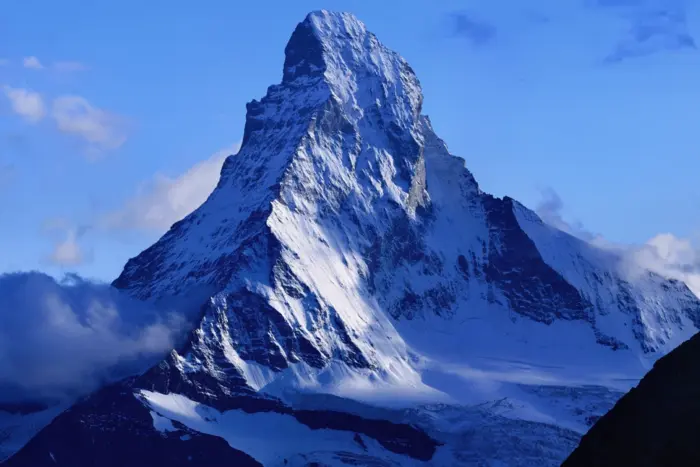
Stokes theorem is a mountain peak in mathematics. You have not really lived before having climbed that mountain. The theorem was developed first in a physics context but it is important for other reasons. First, it is a place where many multi-variable concepts come together: it involves curves, surfaces, the dot and cross products, various derivatives like Jacobean or gradient, integrals or coordinate changes. If you master this theorem you own the bulk of this course. The theorem is also a prototype for a method in science: a theorem helps to solve problems which otherwise would be inaccessible. We will see quite many integrals which are not reachable without the theorem. Also, like mountain climbing, it produces some satisfaction top-out on something that important. The theorem is also beautiful and so art.
32.1.2 Stokes’ Legacy: The Maxwell Equations
Proving the theorem was an exam problem given by George Stokes. James Clerk Maxwell who was a student there would later use it to formulate the Maxwell equations for the electromagnetic field and charge-current . When space-time is split into space and time, there are equations. One of them is . It explains how an electric potential emerges from flux changes of a magnetic field when turning a wire , allowing us to generate electricity from motion. When reversed, it turns electricity back into mechanical energy. Think about Stokes theorem next time you are using an electric motor!
32.2 LECTURE
32.2.1 Unveiling the Power of Stokes’ Theorem: Applications and Beauty
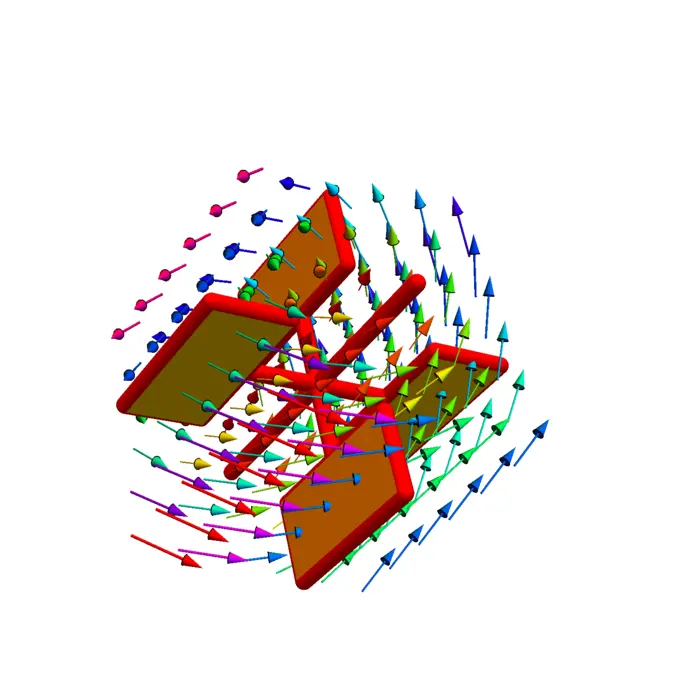
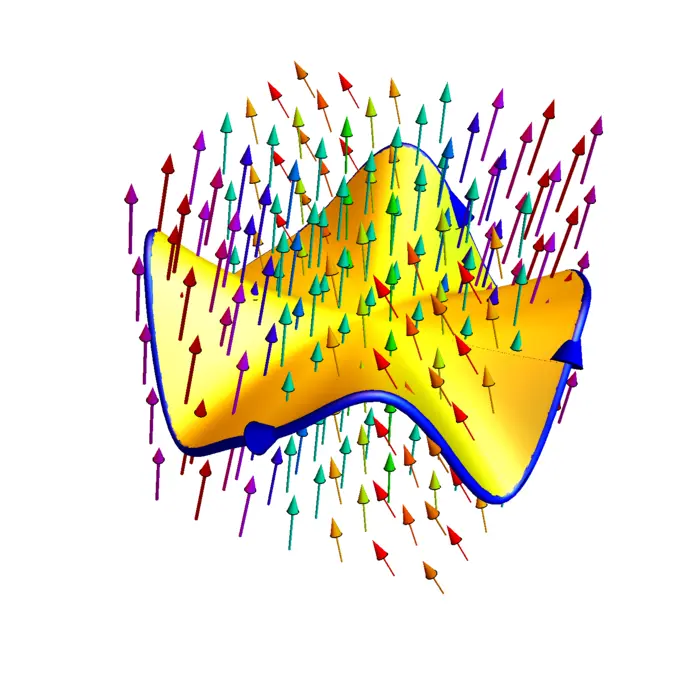
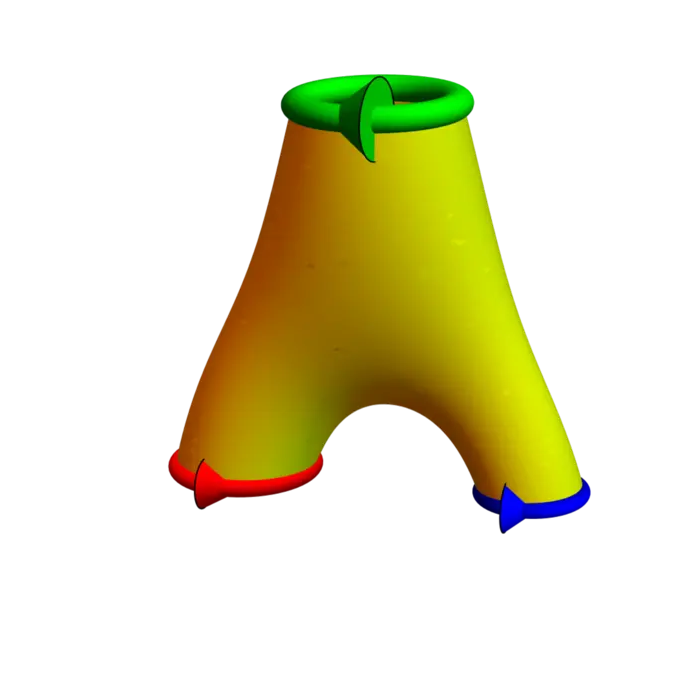
Given a surface in using a parametrization and a vector field , we can form the flux integral For , the curl is defined as The Stokes theorem tells that if is the boundary of and is oriented so that is to the left of , then
Theorem 1. .
Proof. The key is the following "important formula" This is straightforward and done in class. Now define the field in the -plane. The -dimensional curl of is as we can see by using Clairaut . The Stokes theorem is now a direct consequence of Green’s theorem proven last time.1 ◻
32.3 EXAMPLES
Example 1. Problem: Compute the flux of through the upper half unit sphere oriented outwards.
Solution: we parametrize the surface as Because , this parametrization has the wrong orientation! We continue nevertheless and just change the sign at the end. We have so that The flux integral is which is The flux with the outward orientation is . We could not use the Stokes theorem here because we don’t deal with the flux of the curl but the flux of itself.
Example 2. Problem: What is the value of if and is the unit polygon Solution: Use Stokes theorem. The curl of is . The surface with and has as boundary. Stokes allows to compute instead. Since , the flux integral is The computation of the line integral would have been more painful.
Example 3. Problem: Compute the flux of the curl of through the upper half sphere oriented outwards.
Solution: Great, it is here, where we can use Stokes theorem where is the boundary curve which can be parametrized by with . Before diving into the computation of the line integral, it is good to check, whether the vector field is a gradient field. Indeed, we see that . This means that for some potential implying by the fundamental theorem of line integrals that . But wait a minute, if the curl of is zero, couldn’t we just have seen directly that the flux of the curl through the surface is zero? Yes, we could have seen that before: for a gradient field, the flux of the curl of through a surface is always zero, for the simple reason that the curl of such a field is zero.
Example 4. Problem: What is the flux of the curl of through the lower ellipsoid given by , ?
Solution: By Stokes theorem, it is the line integral . Through the boundary . But in the -plane , the field is zero. The result is zero.
Example 5. Problem: What is the flux of the curl of through an ellipsoid ?
Solution: We can cut the ellipsoid into two parts to get two surfaces with boundary. The upper part has the boundary which matches the orientation of the surface. Stokes theorem tells that The lower part has the boundary which matches the orientation of the lower part. Stokes theorem tells that Together we have as the line integrals have just different signs. The result is zero.
32.4 REMARKS
32.4.1 Stokes Theorem in Higher Dimensions
The left hand side of the important formula (it "imports" the curl)2 is defined only in three dimensions. But the right hand side also makes sense in . It is , where rotates the -frame by degrees. The Stokes theorem for -surfaces works for if . For , we have with , the identity which is Green’s theorem. Stokes has the general structure , where is a derivative of and is the boundary of .
Theorem 2. Stokes holds for fields and -dimensional in for .
32.4.2 Integral Theorems: Simplifying Statistics in High Dimensions
Why are we interested in and not only in ? One example is that -dimensional surfaces appear as "paths" which a moving string in dimension traces. More important maybe is that statisticians work by definition in high dimensional spaces. When dealing with data points, one works in . Why would you care about theorems like Stokes in statistics? As a matter of fact, integral theorems in general allow to simplify computations. As we have seen in Green’s theorem, when computing the sum over all the curls, there are cancellations happening in the inside. Integral theorems "see these cancellations" and allow to bypass and ignore stuff which does not matter.
32.4.3 Generalizing Line Integrals and Flux Integrals: Beyond the Cross Product
The fundamental theorem of line integrals holds also in . The flux integral is the analogue of a line integral in two dimensions. Written like this, we don’t need the cross product. And not yet the language of differential forms.
32.4.4 Stokes Theorem, Geometry, and Minimization
Stokes deals with "fields" and "space". What happens if the field is space itself, that is if ? It is of interest. For , and , then is the action integral in physics. A general Maupertius principle assures that it is equivalent to the arc length in the sense that minimizing arc length between two points is equivalent to minimize the action integral (which is more like the energy one uses to get from the first point to the second). Now, in two dimensions we have We can compare this with which is called the Nambu-Goto action, which resembles the surface area also called the Polyakov action. Nature likes to minimize. Free particles move on shortest paths, minimize the arc length. Maupertius tells that minimizing the length \int_{A}^{B}|r^{\prime}(t)| \,d t of a path equivalent to minimizing \int_{A}^{B} r^{\prime}(t) \cdot r^{\prime}(t) \,d t which essentially is the integrated kinetic energy or gasoline use to go from to . For the purpose of minimizing stuff this also works for two dimensional actions. Minimizing the surface area among all surfaces connecting two one dimensional curves is equivalent to minimize . Also in higher dimensions, Nambu-Goto and Polyakov are equivalent.
EXERCISES
Exercise 1. Use Stokes to find , where and is the curve of intersection of the hyperbolic paraboloid and the cylinder , oriented counterclockwise as viewed from above.
Exercise 2. Evaluate the flux integral , where and where is the part of the ellipsoid , oriented so that the normal vector points upwards.
Exercise 3. Find the line integral , where is the circle of radius in the -plane oriented counter clockwise when looking from the point onto the plane and where is the vector field Use a convenient surface which has as a boundary.
Exercise 4. Find the flux integral , where and is the surface parametrized by with , and oriented so that the normal vectors point to the outside of the thorn.
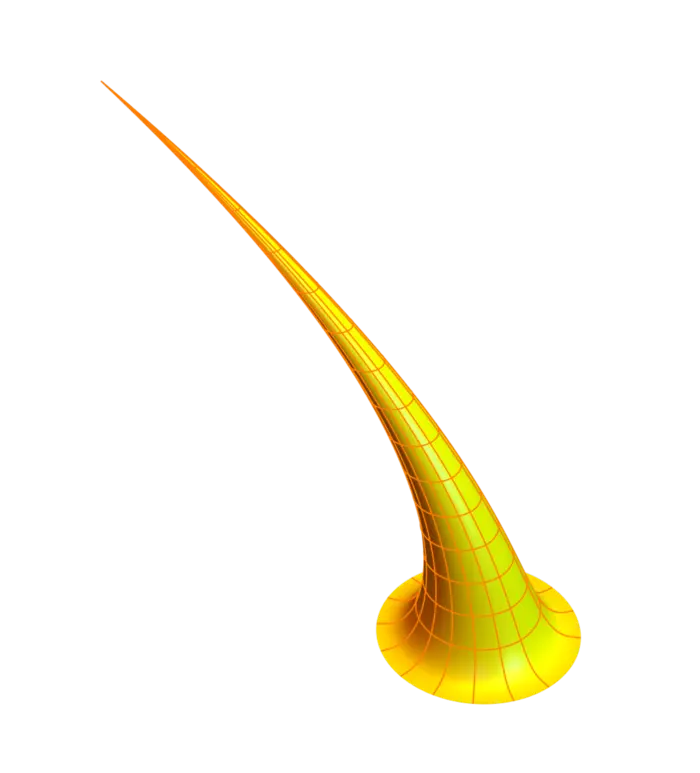
Exercise 5. Assume is the surface and Explain why .
Appendix: Applications
32.4.5 Simply Connected Regions and Conservative Fields
A region in is called simply connected if it is connected and for every closed loop in there is a continuous deformation of within such that and is a point. For example, can be deformed in to a point with as for all . Each Euclidean space is simply connected. The region is not simply connected as the circle winding around the -axis can not be pulled together to a point within . The region is simply connected, but in is not. Remember that was called irrotational if everywhere.
Theorem 3. If is irrotational on a simply connected then in .
Proof. Since is simply connected and , every closed loop can be filled in by a surface which has the boundary . Stokes theorem gives The closed loop property implies path independence. A potential can be obtained by fixing a base point in , then define for any other point a path going from to . The potential function is then defined as . ◻
32.4.6 Non-Simply Connected Domains and Conservative Fields
The field is defined everywhere except on the -axis. The domain , where is defined is not simply connected. There is no global function which is a potential for .
32.4.7 Simply Connectedness in Topology
The notion of "simply connectedness" is important in topology. The first solved Millenium problem, the Poincaré conjecture, is now a theorem. It tells that a -dimensional manifold which is simply connected is topologically equivalent to the -sphere In two dimensions, the result was known for a long time already, because the structure of -dimensional connected manifolds is known.
ELECTROMAGNETISM
32.4.8 Maxwell-Faraday and Stokes: Generating Electricity from Magnetism
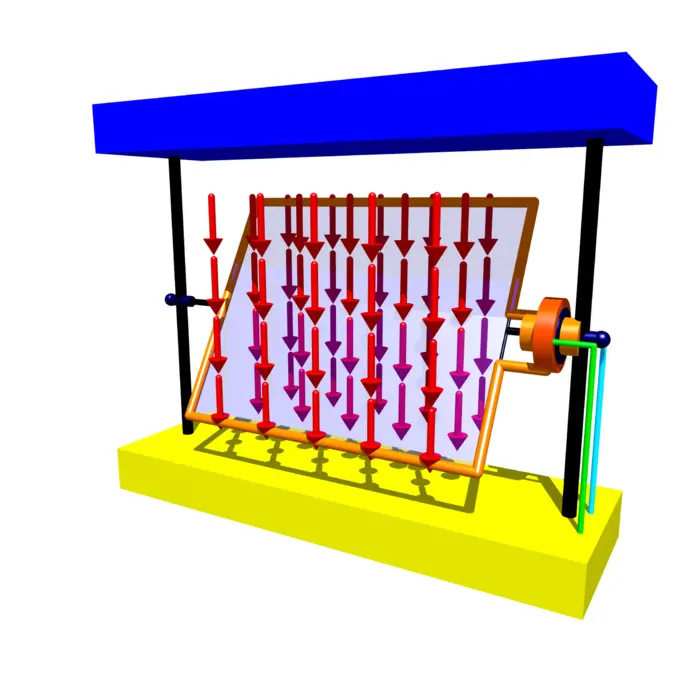
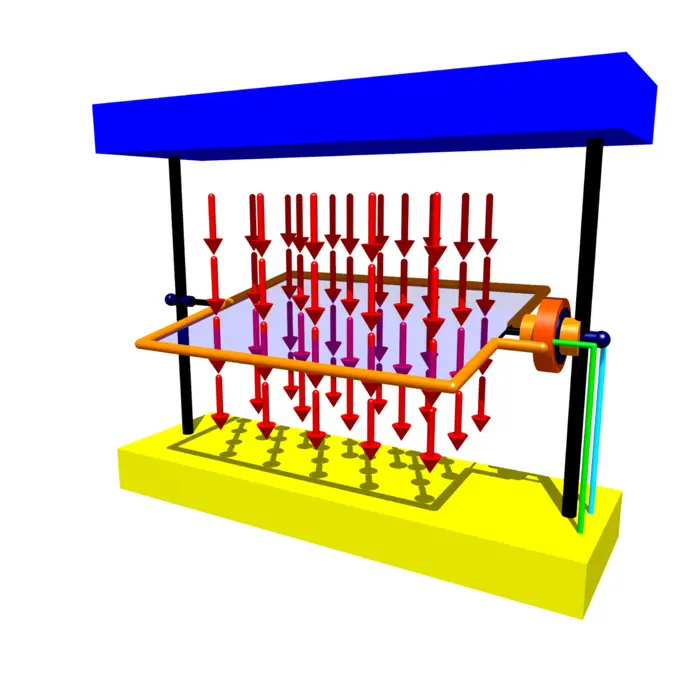
The Maxwell-Faraday equation in electromagnetism relates the electric field and the magnetic field with the partial differential equation . Given a surface , the flux integral is called the magnetic flux of through the surface. If we integrate the Maxwell-Faraday equation, we see that is equal to minus the rate of change of the magnetic flux . Stokes theorem now assures that is the line integral of the electric field along the boundary. But this is electric potential or voltage. We see:
We can generate an electric potential by changing the magnetic flux.
32.4.9 Flux Changes and Electricity Generation
Changing the magnetic flux can happen in various ways. We can generate a changing magnetic field by using alternating current. This is how transformers work. An other way to change the flux is to rotate a wire in a fixed magnetic field. This is the principle of the dynamo:
32.4.10 Stokes Theorem and Dipole Flux
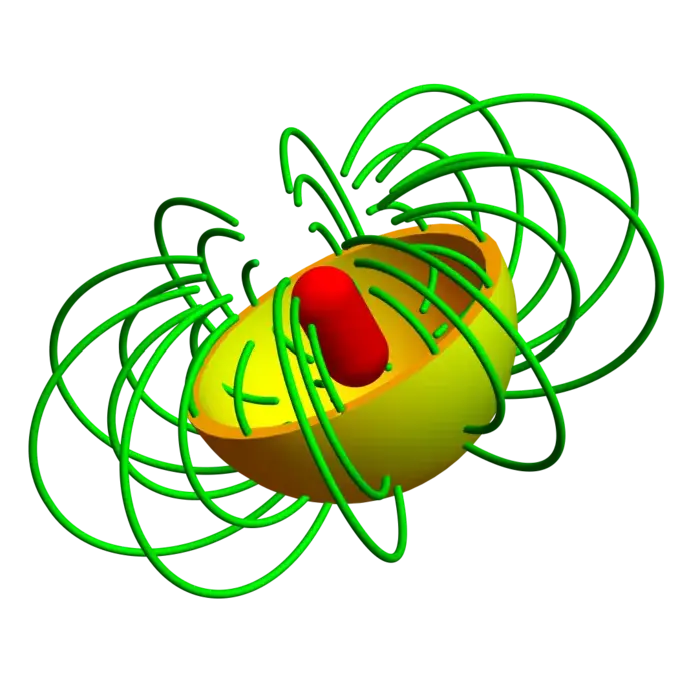
The vector field is called the vector potential of a magnetic field . The picture shows some flow lines of this magnetic dipole field .
Problem: Find the flux of through the lower half sphere , oriented downwards.
Solution: Since we have an integral of the curl of the vector field , we use Stokes theorem and integrate along the boundary curve . First of all, we have . The velocity is r^{\prime}(t)=[-\sin (t), \cos (t), 0]. The integral is .
32.4.11 E and B: Maxwell’s Equations in a Nutshell
Here are all the four magical Maxwell equations for the electric field and magnetic field related to the charge density and the electric current . The constant is the speed of light. (By using suitable coordinates, one can assume .)
FLUID DYNAMICS
32.4.12 Helmholtz’s Theorem
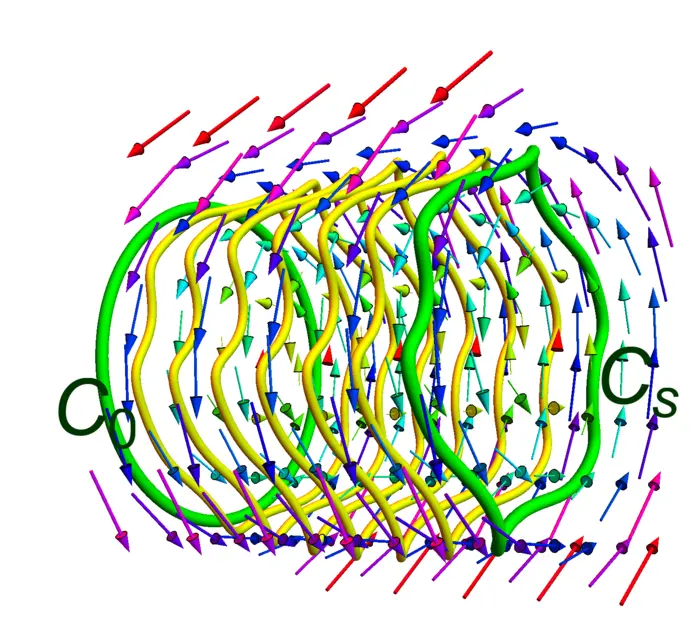
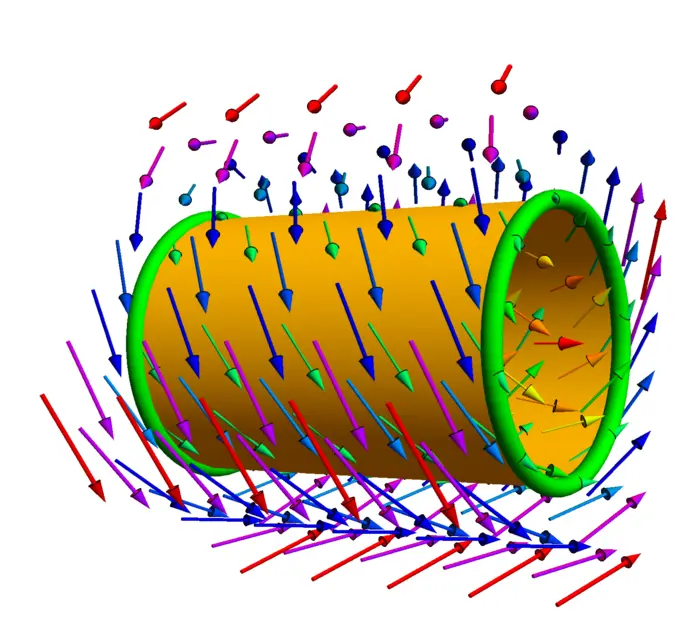
If is the fluid velocity field and is a closed curve, then is called the circulation of along . The curl of is called the vorticity of . A vortex line is a flow line of . Given a curve , we can let any point in flow along the vorticity field. This produces a vortex tube . The flux of the vorticity though a surface is the vortex strength of through . Stokes theorem implies the Helmholtz theorem.
Theorem 4. If flows along , then stays constant.
Proof. Let be a closed curve and be the curve after letting it flow using a deformation parameter . The deformation produces a tube surface which has the boundary and . Since the curl of is always tangent to the surface , the flux of the curl of through is zero. Stokes theorem implies that The negative sign is because the orientation of is different from the orientation of if the surface has to be to the left. ◻
COMPLEX ANALYSIS
32.4.13 Complex Green’s Theorem and Analytic Magic
An application of Green’s theorem is obtained, when integrating in the complex plane . Given a function from and a closed path parametrized by in , define the complex integral \int_{a}^{b} \Big(u\big(x(t)+i y(t)\big)+i v\big(x(t)+i y(t)\big)\Big)\big(x^{\prime}(t)+i y^{\prime}(t)\big) \,d t. This is \int_{a}^{b} \big(u(r(t)) x^{\prime}(t)-v(r(t)) y^{\prime}(t)\big) \,d t+i \int_{a}^{b} \big(v(r(t)) x^{\prime}(t)+u(r(t))^{\prime}(t)\big) \,d t. These are two line integrals. The real part is , the imaginary part is . Assume bounds a region , then Green’s theorem tells that the first integral is and the second integral is . It turns out now that for nice functions like polynomials, the Cauchy-Riemann differential equations hold so that these line integrals are zero. We have therefore:
Theorem 5. If is a polynomial and a closed loop, .
- Mathematicians say: "we pulled back the field from to along the parametrization".↩︎
- I learned the "important formula" from Andrew Cotton-Clay in 2009: http://www.math.harvard.edu/archive/21a_fall_09/exhibits/stokesgreen↩︎