Table of Contents
29.1 INTRODUCTION
29.1.1 Adventures in Integrating: Line Integrals Take Flight
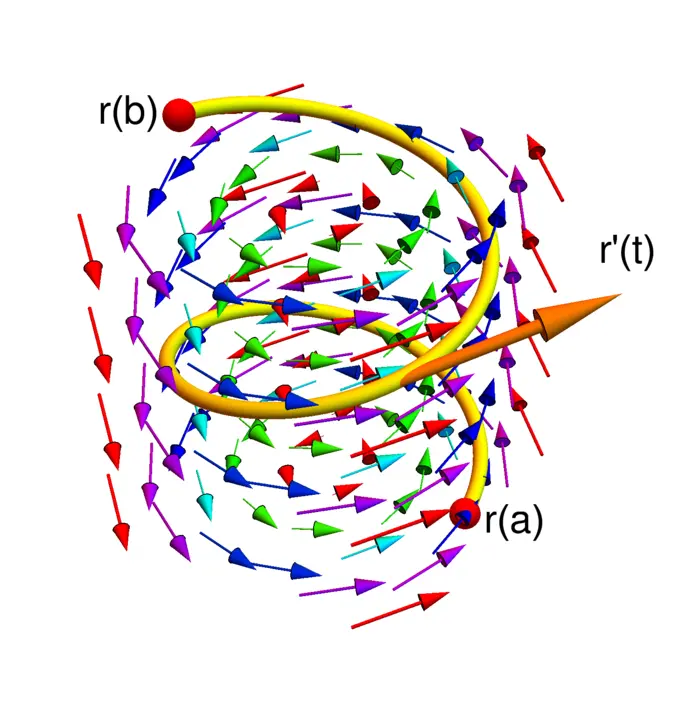
Today, we learn already how to generalize the fundamental theorem of calculus \int_{a}^{b} f^{\prime}(t) \,d t=f(b)-f(a) to higher dimensions. The interval is now replaced by a curve and the derivative f^{\prime}(t) becomes which by the chain rule is \nabla f(r(t)) \cdot r^{\prime}(t). If we integrate this from to we get the fundamental theorem of line integrals. \int_{a}^{b} \nabla f(r(t)) \cdot r^{\prime}(t) \,d t=\int_{a}^{b} \frac{d}{d t} f(r(t))=f(r(b))-f(r(a)). The gradient field can be generalized to a general vector field field , a map which assigns to every point a vector.
29.1.2 When is a Vector Field a Gradient Field?
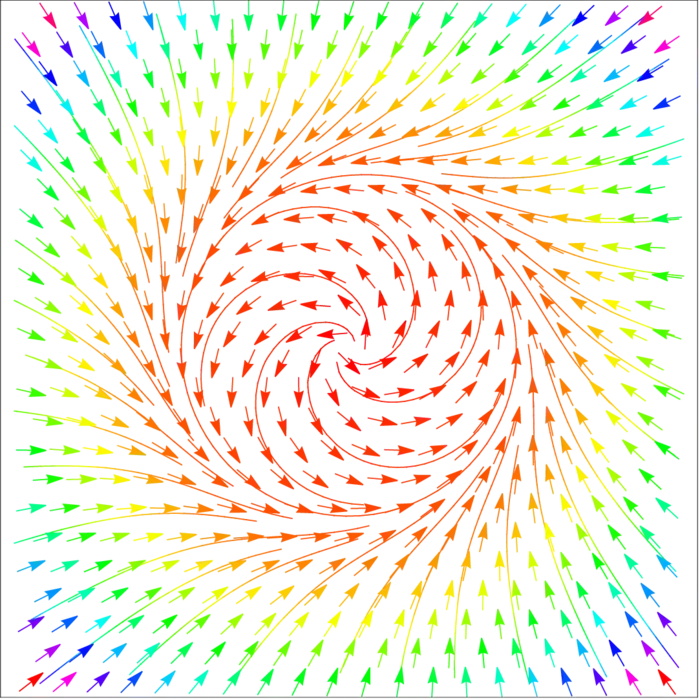
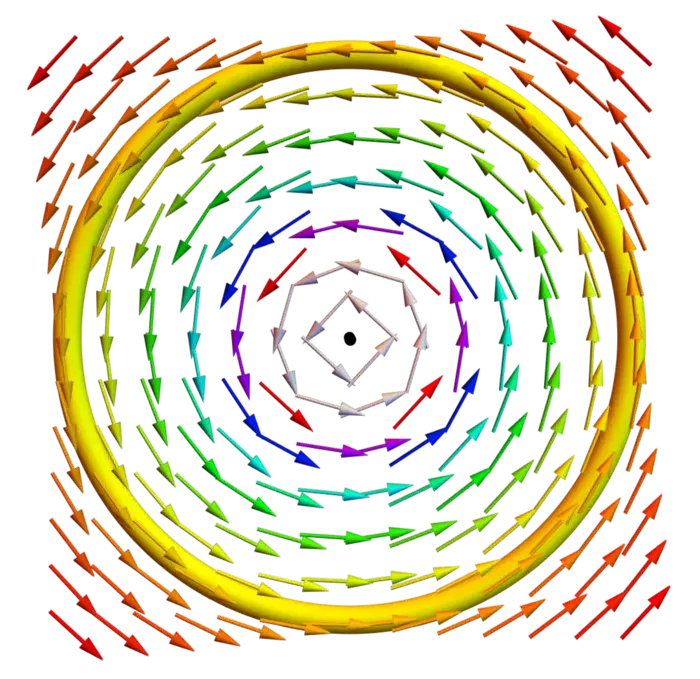
One of the questions we want to answer is under which conditions a general vector field is a gradient field . The reason is that if this is the case, then the integral \int_{a}^{b} F(r(t) \cdot r^{\prime}(t) \,d t is easy to evaluate. If is a gradient field, the result is . In general however, vector fields are not gradient fields. In the above figure we see an example. Not all hope is lost however. We will learn in the next two weeks that in some cases, like of the path is closed, we have other ways to compute the line integral.
29.1.3 Kicking Tires: Using Line Integrals to Calculate Work
A good way to think about line integral is to see it as mechanical work. The vector field then is thought of as a force field and the product of the force with the velocity F \cdot r^{\prime} is power, which is a scalar. Integrating power over a time gives work. In the case when was a gradient field , then is considered a potential energy. The fundamental theorem of line integrals now tells that the work done over some time is just the potential energy difference. It is not really necessary to adopt this picture. The set-up is purely mathematical but in order to remember it, it can be helpful to see it associated with concepts we know. If you bike for example, then both the force applied to the pedals as well as the velocity matters.
29.2 LECTURE
29.2.1 Line Integrals: Power and Work
A vector field assigns to every point a vector such that every is a continuous function. We think of as a force field. Let be a curve parametrized on . The integral \int_{C} F \cdot d r=\int_{a}^{b} F(r(t)) \cdot r^{\prime}(t) \,d t is called the line integral of along . We think of F(r(t)) \cdot r^{\prime}(t) as power and as the work. Even so and are column vectors, we write in this lecture and r^{\prime}=[x_{1}^{\prime}, \ldots, x_{n}^{\prime}] to avoid clutter. Mathematically, can also be seen as a coordinate change, we think about it differently however and draw a vector at every point .
29.2.2 Work Done in a Circle
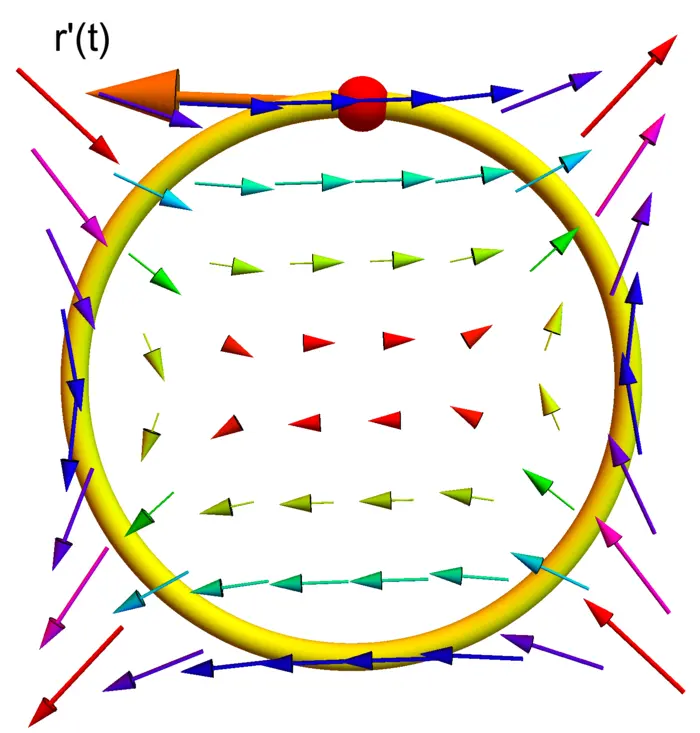
If , and a circle with , then and r^{\prime}(t)=[-\sin (t), \cos (t)] so that F(r(t)) \cdot r^{\prime}(t)=-\sin ^{2}(t)+\cos ^{4}(t). The work is Figure (29.1) shows the situation. We go more against the field than with the field.
29.2.3 Path Independence: When Does the Path Not Matter?
A vector field is called a gradient field if for some differentiable function . We think of as the potential. The first major theorem in vector calculus is the fundamental theorem of line integrals for gradient fields in :
Theorem 1. \int_{a}^{b} \nabla f(r(t)) \cdot r^{\prime}(t) \,d t=f(r(b))-f(r(a)).
Proof. By the chain rule, \nabla f(r(t)) \cdot r^{\prime}(t)=\frac{d}{d t} f(r(t)). The fundamental theorem of calculus now gives ◻
29.2.4 Path Independence and Closed Loops
As a corollary we immediately get path independence
If , are two curves from to then ,
as well as the closed loop property:
If is a closed curve and , then .
29.2.5 The Clairaut Criterion
Is every vector field a gradient field? Lets look at the case , where . Now, if this is equal to , then . We see that . More generally, we have the following Clairaut criterion:
Theorem 2. If , then .
Proof. This is a consequence of the Clairaut theorem. ◻
29.2.6 Finding the Potential
The field for example satisfies . It can not be a gradient field. Now, if everywhere in the plane, how do we find the potential ?
Integrate with respect to and add a constant .
Differentiate with respect to and compare with . Solve for .
29.2.7 Gradient Field Potential
Example: find the potential of We have Now f_{y}(x, y)=2 x^{2} y+C^{\prime}(y)=2 x^{2} y+3 y^{2} so that C^{\prime}(y)=3 y^{2} or and .
29.2.8 Line Integral Formula for Potential
Here is a direct formula for the potential. Let be the straight line path which goes from to .
Theorem 3. If is a gradient field then .
Proof. By the fundamental theorem of line integral, we can replace by a path going from to and then with to . The line integral is \begin{aligned} f(x, y)&=\int_{0}^{x}[P, Q] \cdot[1,0] \,d t+\int_{0}^{y}[P, Q] \cdot[0,1] \,d t\\ &=\int_{0}^{x} P(t, 0) \,d t+\int_{0}^{y} Q(x, t) \,d t. \end{aligned} We see that . If we use the path going to and to instead, the line integral is \begin{aligned} f(x, y)&=\int_{0}^{y}[P, Q] \cdot[0,1] \,d t+\int_{0}^{x}[P, Q] \cdot[1,0] \,d t\\ &=\int_{0}^{y} Q(0, t) \,d t+\int_{0}^{x} P(t, y) \,d t. \end{aligned} Now, . ◻
29.3 EXAMPLES
Example 1. Find for a curve with .
Answer: we found already with . The curve starts at and ends at . The solution is .
Example 2. If is an electric field, then the line integral \int_{a}^{b} E(r(t)) \cdot r^{\prime}(t) \,d t is an electric potential. In celestial mechanics, if is the gravitational field, then \int_{a}^{b} F(r(t)) \cdot r^{\prime}(t) \,d t is a gravitational potential difference. If is a temperature and the path of a fly in the room, then is the temperature, which the fly experiences at the point at time . The change of temperature for the fly is . The line-integral of the temperature gradient along the path of the fly coincides with the temperature difference.
29.3.1 Why Perpetual Motion Machines Don’t Work
A device which implements a non-gradient force field is called a perpetual motion machine. It realizes a force field for which the energy gain is positive along some closed loop. The first law of thermodynamics forbids the existence of such a machine. It is informative to contemplate the ideas which people have come up and to see why they don’t work. We will look at examples in the seminar.
29.3.2 Vector Field F and the Unit Circle Mystery
Let Its potential has the property that In the seminar you ponder the riddle that the line integral along the unit circle is not zero: \begin{aligned} \int_{0}^{2 \pi}\left[\frac{-\sin (t)}{\cos ^{2}(t)+\sin ^{2}(t)}, \frac{\cos (t)}{\cos ^{2}(t)+\sin ^{2}(t)}\right] \cdot[-\sin (t), \cos (t)] \,d t &=\int_{0}^{2 \pi} 1 \,d t\\ &=2 \pi \end{aligned} The vector field is called the vortex.
EXERCISES
Exercise 1. Let be the space curve for and let . Calculate the line integral .
Exercise 2. What is the work done by moving in the force field along the quartic from to ?
Exercise 3. Let be the vector field . Compute the line integral of along the curve with width and height . The result should depend on and .
Exercise 4. Archimedes swims around a curve in a hot tub, in which the water has the velocity Calculate the line integral when moving from to along the curve.
Exercise 5. Find a closed curve for which the vector field satisfies \int_{C} F(r(t)) \cdot r^{\prime}(t) \,d t \neq 0.