Table of Contents
34.1 INTRODUCTION
34.1.1 Divergence, Flux, and Volume
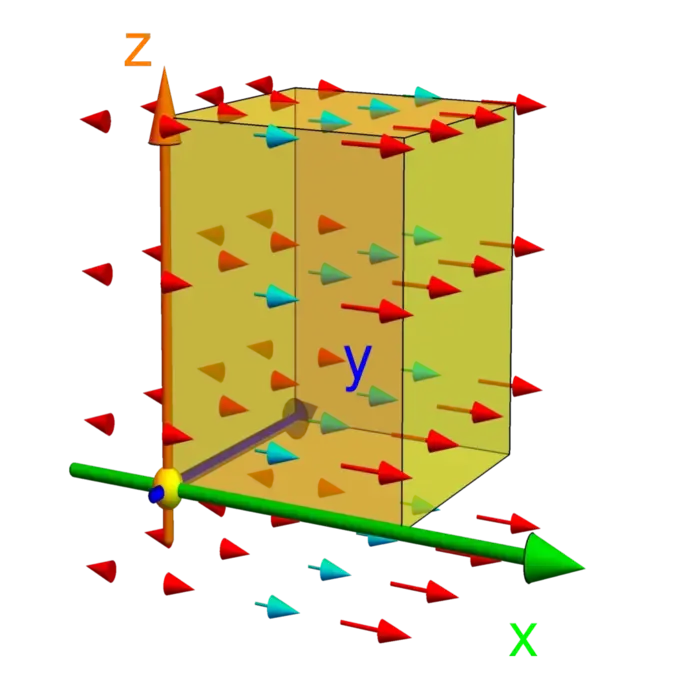
The fastest way to compute the volume of a complicated solid is to use Gauss theorem. It turns out that the flux of the vector field through the boundary surface of a solid is the volume. Gauss theorem equates this flux with the creation of the field inside. If you draw out the vector field you see that it expands things out. Look at the unit cube. The field does not flow through the , or and faces because the field is parallel there. On , the field is zero. The only face of the cuboid where some field passes is and the field is leaving there. So, something must be created inside. This creation of field is called divergence. If , then . In the case we have constant divergence . We have seen that You can also see that for fields like the total flux is zero as what comes in on one side goes out on the other side. Any linear linear field as a linear combination of fields in the class \begin{aligned} &[x, 0,0], \quad [y, 0,0], \quad [z, 0,0],\\ &[0, x, 0], \quad [0, y, 0], \quad [0, z, 0],\\ &[0,0, x], \quad [0,0, y], \quad [0,0, z] \end{aligned} for which the divergence theorem is satisfied.
34.1.2 Gauss’s Law, Laplacian, and Newton’s Law
Gauss law describes the gravitational field induced from a mass density and gravitational constant . The picture is that mass is a source for the field. We will see that with the help of the divergence theorem, this equation implies Newton’s law of gravity induced by a mass . Since the gravitational field does not to allow perpetual motion, it is a gradient field and . The combination (grad is called the Laplacian Gauss law now produces the Poisson equation which determines potential from the mass density. The inverse of also called Green function. Once we have such a description, we have now gravity on any space with a Laplacian. We can study gravity on a surface like the sphere or in , where the force is proportional to . We will see in the proof part how we can so define gravity on any finite network.
34.2 LECTURE
34.2.1 Divergence and Gauss’s Theorem: Connecting Integrals
The divergence of a vector field in is defined as Let be a solid in bound by a surface made of finitely many smooth surfaces, oriented so the normal vector to points outwards. The divergence theorem or Gauss theorem is
Theorem 1. .
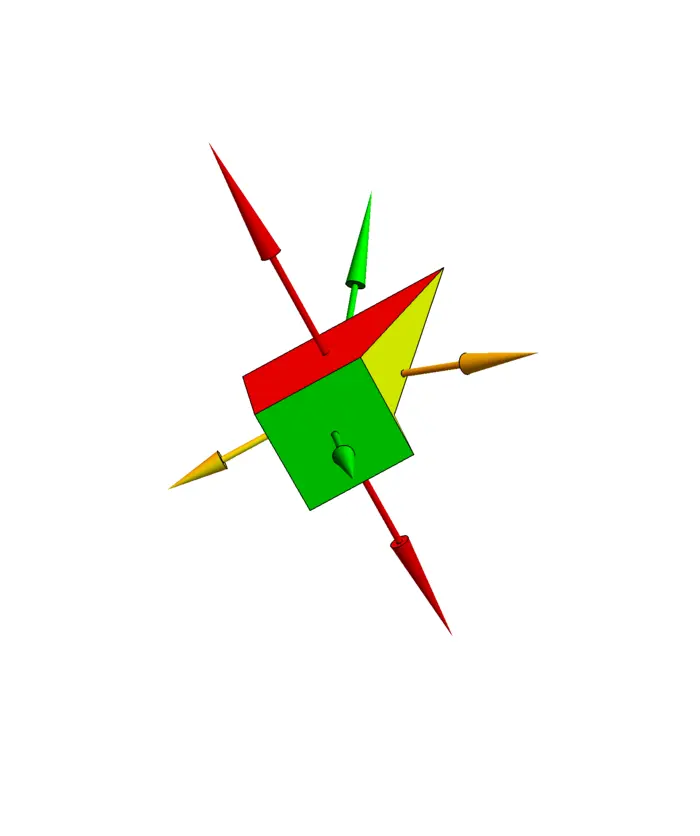
Proof. If is a solid of the form then which is The flux of through a surface is Similarly, the flux through the bottom surface is . In general, write to get the claim for solid which are simultaneously bound by graphs of functions in and , or and or and . A general solid can be cut into such solids. ◻
34.2.2 Inward or Outward? Divergence as the Measure of Field Flow
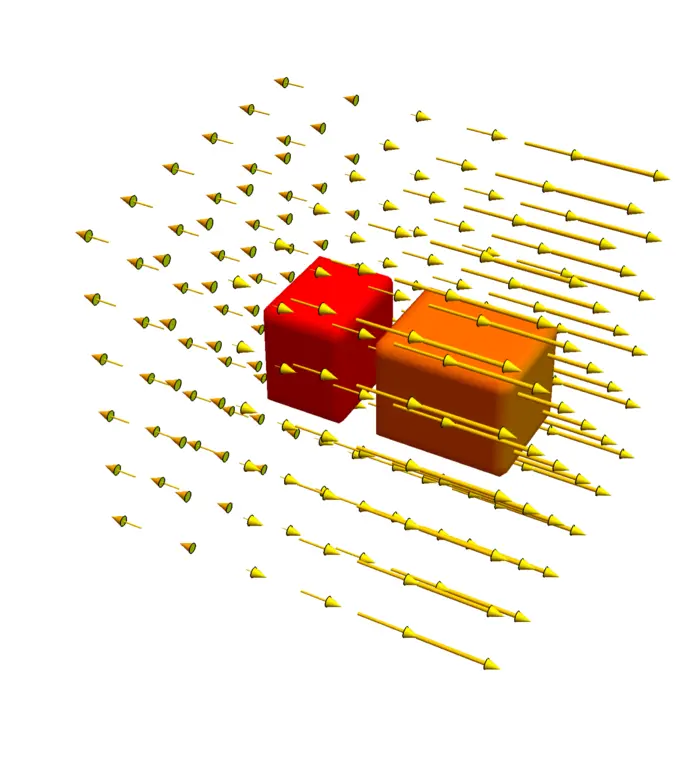
The theorem gives meaning to the term divergence. The total divergence over a small region is equal to the flux of the field through the boundary. If this is positive, then more field leaves than enters and field is "generated" inside. The divergence measures the expansion of the field. The field for example expands, while compresses. is "incompressible".
34.2.3 Generalizing Gauss’s Law: Divergence in m Dimensions
The divergence theorem holds in any dimension . If is the vector field, then is defined as the divergence of . If is an -dimensional region with boundary , then the flux of through is defined as where is a unit normal vector. This can be explained a bit better using the language of differential forms which is introduced next time.
34.2.4 Divergence, Curl, and Green’s Theorem: A Two-Dimensional Twist
The divergence of is defined as . If is the turned vector field, then is the curl of . Green’s theorem tells that which is is the line integral . The line integral for is the flux integral for . The two dimensional divergence theorem is Green’s theorem "turned".
34.3 EXAMPLES
Example 1. Problem: Compute the flux of through the sphere of radius bounding a ball , oriented outwards.
Solution: As we have The flux through the boundary is . As in spherical coordinates, the flux is also.
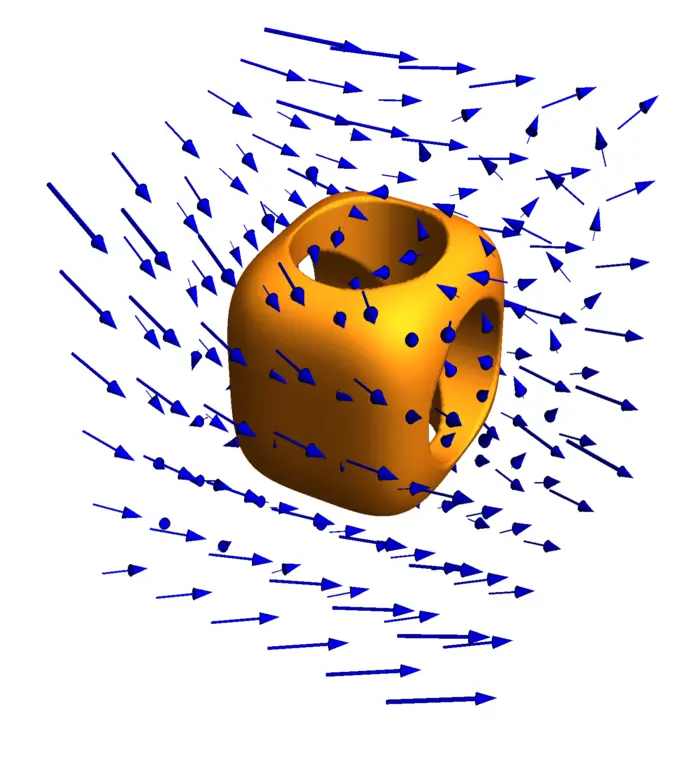
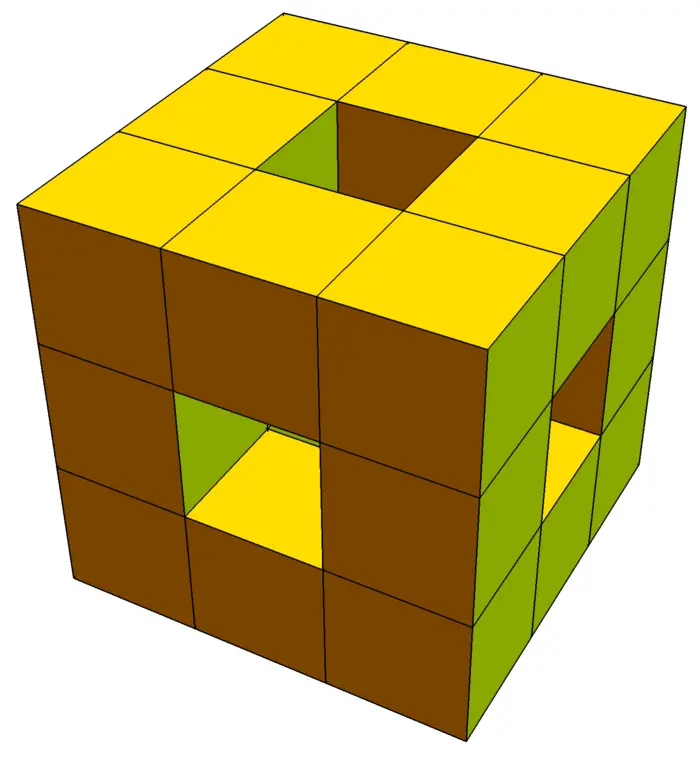
Example 2. Problem: What is the flux of the vector field through the solid which is a cube with three perpendicular cubic holes which is the first stage of the Menger sponge construction?
Solution: As , the result is times the volume of the solid which is .
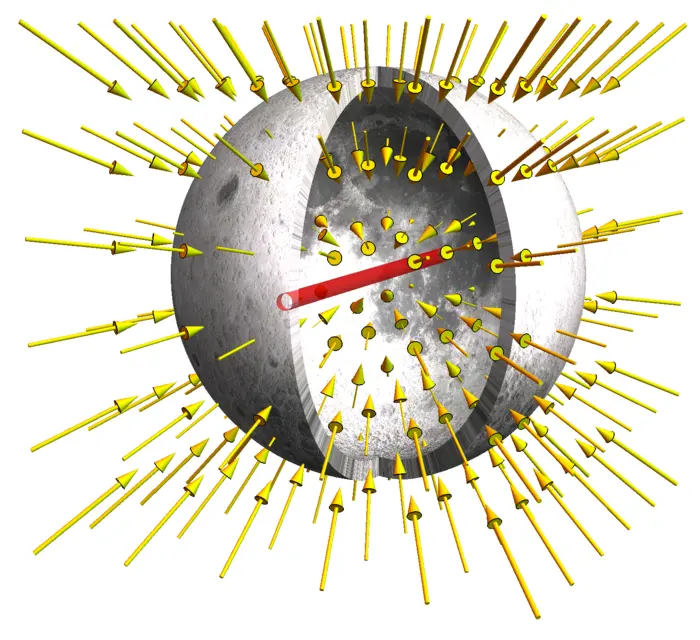
Example 3. Problem: How does the gravitational field look like inside the moon in distance to the origin?
Solution: A direct computation of summing up all the field values is difficult as we can not compute in spherical coordinates. Fortunately we have the divergence theorem. The field has constant length for on a sphere of radius and points inwards. So Gauss was able to write down the gravitational field as a partial differential equation , where is the mass density of the solid. We see then with the divergence theorem that is equal to . Assuming to be constant, we have which gives . The field grows linearly inside the body. If is bigger than the radius of the moon, then is , where is the mass of the moon. We see that in that case , which is the Newton law.
Example 4. Problem: Compute using the divergence theorem the flux of the vector field through the unit cube which is opened on the top.
Solution: the divergence of is . Integrating this over the unit cube gives . The flux through all faces is . The flux through the face is We have to subtract this and get .
Example 5. Similarly as Green’s theorem allowed area computation using line integrals the volume of a region can be computed as a flux integral: take a vector field with constant divergence like . We have For example, For an ellipsoid , where the parametrization is we have leading to .
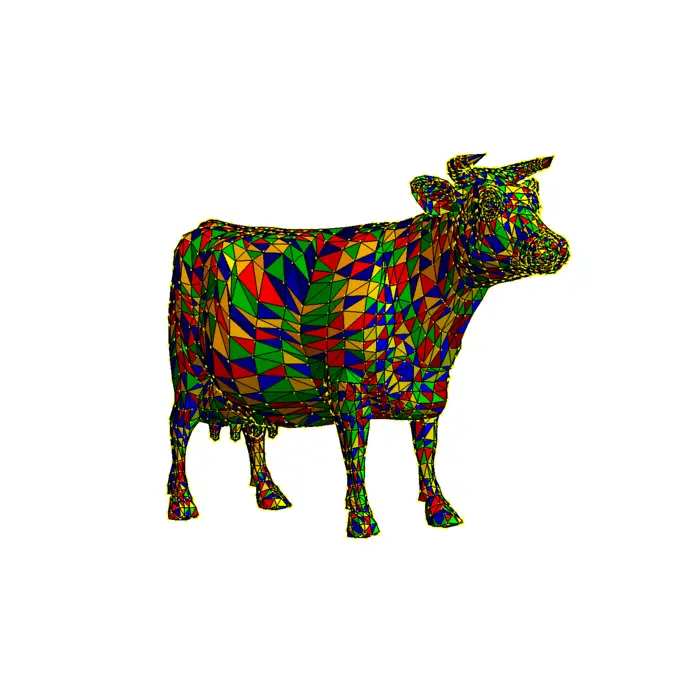
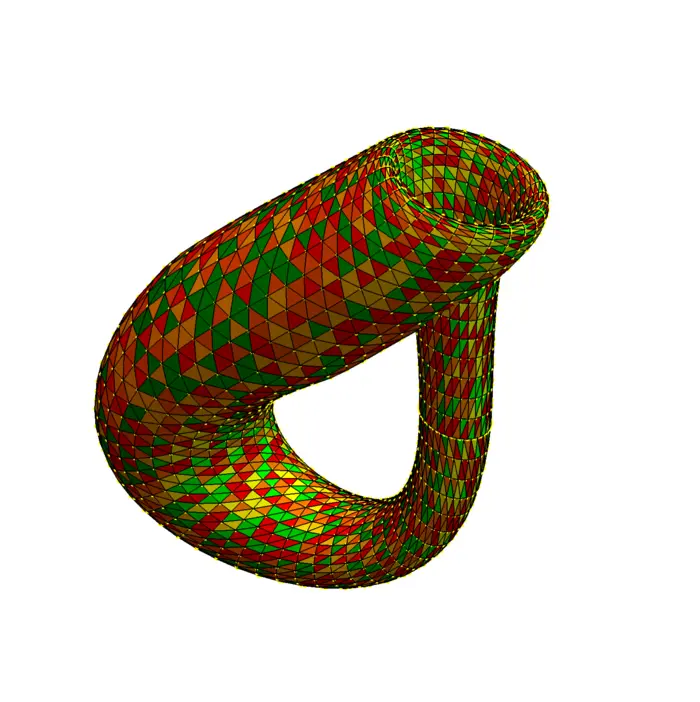
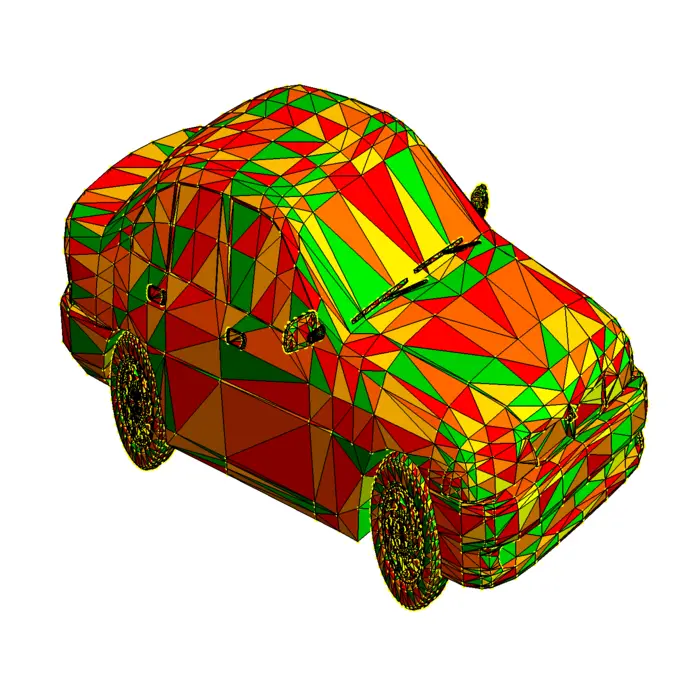
Example 6. A computer can determine the volume of a solid enclosed by a triangulated surface by computing the flux of the vector field through the surface. The vector field has divergence so that by the divergence theorem, the flux gives the volume. A computer stores a geometric object using triangles. Assume is that triangle. If points outside the region, then the flux is . A computer can now add up all these values and get the volume.
EXERCISES
Exercise 1. Use the divergence theorem to calculate the flux of through the sphere , where the sphere is oriented so that the normal vector points outwards.
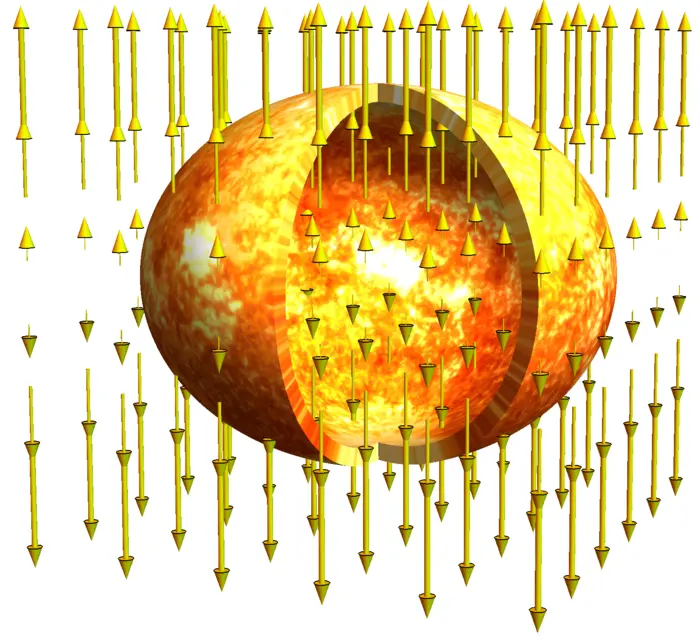
Exercise 2. Assume the vector field is the magnetic field of the sun whose surface is a sphere of radius oriented with the outward orientation. Compute the magnetic flux .
Exercise 3. Find the flux of the vector field through the solid cylinder , .
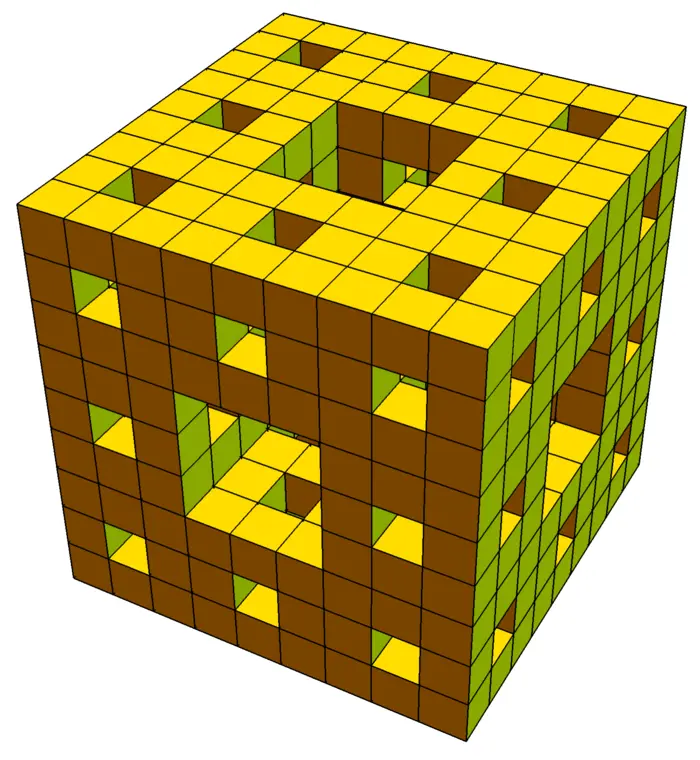
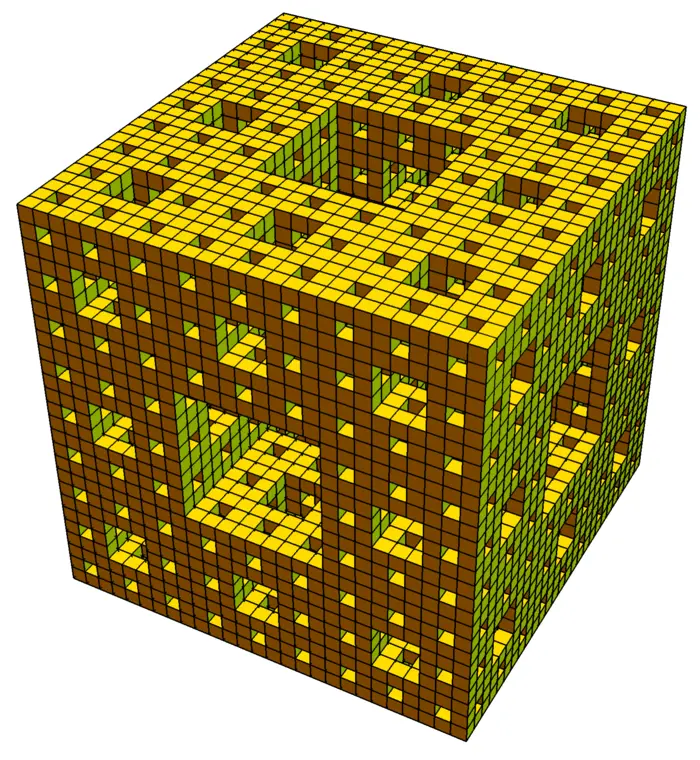
Exercise 4. Find the flux of through the Menger sponge defined in the unit cube and take the limit .
Exercise 5. Compute the flux of the vector field through the three -sphere in , oriented outwards.