Table of Contents
- 39.1 Keywords for the Final (see also Units 14+28)
- 39.1.1 Discrete Calculus
- 39.1.2 New People
- 39.1.3 Partial Derivatives
- 39.1.4 Parametrization
- 39.1.5 Partial Differential Equations
- 39.1.6 Gradient
- 39.1.7 Extrema
- 39.1.8 Double Integrals
- 39.1.9 Triple Integrals
- 39.1.10 Line Integrals
- 39.1.11 Fundamental theorem of line integrals
- 39.1.12 Green’s Theorem
- 39.1.13 Flux integrals
- 39.1.14 Stokes Theorem
- 39.1.15 Grad Curl Div
- 39.1.16 Divergence Theorem
- 39.1.17 Some topology
- 39.1.18 Some surface parameterizations
- 39.1.19 Integration for integral theorems
- 39.1.20 Differential forms
- 39.2 Final Exam (Practice A)
- Problem 39A.1 (10 points):
- Problem 39A.2 (10 points, each question is one point):
- Problem 39A.3 (10 points, each problem is one point):
- Problem 39A.4 (10 points):
- Problem 39A.5 (10 points):
- Problem 39A.6 (10 points):
- Problem 39A.7 (10 points):
- Problem 39A.8 (10 points):
- Problem 39A.9 (10 points):
- Problem 39A.10 (10 points):
- Problem 39A.11 (10 points):
- Problem 39A.12 (10 points):
- Problem 39A.13 (10 points):
- Problem 39A.14 (10 points):
- Problem 39A.15 (10 points):
- 39.3 Final Exam (Practice B)
- Problem 39B.1 (10 points):
- Problem 39B.2 (10 points, each question is one point):
- Problem 39B.3 (10 points, each problem is one point):
- Problem 39B.4 (10 points):
- Problem 39B.5 (10 points):
- Problem 39B.6 (10 points):
- Problem 39B.7 (10 points):
- Problem 39B.8 (10 points):
- Problem 39B.9 (10 points):
- Problem 39B.10 (10 points):
- Problem 39B.11 (10 points):
- Problem 39B.12 (10 points):
- Problem 39B.13 (10 points):
- Problem 39B.14 (10 points):
- Problem 39B.15 (10 points):
- 39.4 Final Exam
- Problem 39.1 (10 points):
- Problem 39.2 (10 points, each question is one point):
- Problem 39.3 (10 points, each question is one point):
- Problem 39.4 (10 points):
- Problem 39.5 (10 points):
- Problem 39.6 (10 points):
- Problem 39.7 (10 points):
- Problem 39.8 (10 points):
- Problem 39.9 (10 points):
- Problem 39.10 (10 points):
- Problem 39.11 (10 points):
- Problem 39.12 (10 points):
- Problem 39.13 (10 points):
- Problem 39.14 (10 points):
- Problem 39.15 (10 points):
39.1 Keywords for the Final (see also Units 14+28)
39.1.1 Discrete Calculus
graph with vertex set and edge set -form: function on . Discrete scalar function -form: function on oriented . Discrete vector field -form: function on oriented triangles is a function on edges defined by is a function on triangles obtained by summing along the triangle - For a
-form , is a function on vertices. Add up the attached edge values - For a
-form , is a function on edges. Add up the attached triangle values
39.1.2 New People
Mentioned: Cartan, Maxwell, Stokes, Green, Gauss, Newton, Einstein, Kirchhoff, Menger, Koch, Escher, Peirce
39.1.3 Partial Derivatives
linear approximation - Use
to estimate near . The result is - tangent plane:
with , , , - Estimate
by or near Clairaut’s theorem for functions which are in , tangent to surface parameterized by
39.1.4 Parametrization
, Jacobian first fundamental form, distortion factor important formula
39.1.5 Partial Differential Equations
, Clairaut , heat equation , wave equation , transport equation , Laplace equation , Burgers equation , , Maxwell equations , Gravity equation
39.1.6 Gradient
, , gradient directional derivative chain rule is orthogonal to the level curve containing is orthogonal to the level surface containing by chain rule tangent line tangent plane is maximal in the direction increases in the direction at points which are not critical points - if
for all , then defines , and implicit diff
39.1.7 Extrema
, critical point discriminant - Morse: critical point and
, in D looks like , , in a neighborhood of local maximum in a neighborhood of local minimum , , Lagrange equations , , Lagrange equations - second derivative test:
, , local max , , , local min, , saddle point everywhere, global maximum everywhere, global minimum
39.1.8 Double Integrals
double integral integral over rectangle bottom-to-top region left-to-right region polar coordinates surface area Fubini area of region signed volume of solid bound by graph of and -plane
39.1.9 Triple Integrals
triple integral integral over rectangular box type I region integral in cylindrical coordinates integral in spherical coordinates Fubini volume of solid mass of solid with density
39.1.10 Line Integrals
vector field in the plane vector field in space line integral gradient field potential field conservative field
39.1.11 Fundamental theorem of line integrals
- FTLI:
, - Closed loop property
, for all closed curves - Always equivalent: closed loop property, path independence and gradient field
- Mixed derivative test
assures is not a gradient field - In simply connected regions:
implies that field is conservative - Conservative field: can not be used for perpetual motion.
39.1.12 Green’s Theorem
, curl in two dimensions: - Green’s theorem:
boundary of , then - Area computation: Take
with like or - Green’s theorem is useful to compute difficult line integrals or difficult
D integrals
39.1.13 Flux integrals
vector field, parametrized surface is a -form on surface flux integral
39.1.14 Stokes Theorem
, - Stokes’s theorem:
boundary of surface , then - Stokes theorem allows to compute difficult flux integrals or difficult line integrals
39.1.15 Grad Curl Div
, , , and Laplacian - Incompressible
divergence free field: everywhere. Implies - Irrotational
everywhere. Implies
39.1.16 Divergence Theorem
- Divergence theorem: solid
, boundary then - The divergence theorem allows to compute difficult flux integrals or difficult 3D integrals
39.1.17 Some topology
- Simply connected region
: can deform any closed curve within to a point - Interior of a region
: points in for which small neighborhood is still in - Boundary of curve
: the end points of the curve - Boundary of
points on surface not in the interior of the parameter domain - Boundary of solid
: points in which are not in the interior of - Closed surface: a surface without boundary like a sphere
- Closed curve: a curve with no boundary like a knot
39.1.18 Some surface parameterizations
- Sphere of radius
: - Graph of function
:
Example: Paraboloid - Plane containing
and vectors , : - Surface of revolution: distance
of :
Example: Cylinder
Example: Cone
Example: Paraboloid
39.1.19 Integration for integral theorems
- Double and triple integral:
, - Line integral:
- Flux integral:
39.1.20 Differential forms
- A tensor of type
is a multi-linear map . - A
-form is a field, which attaches at every point a multi-linear anti-symmetric map of variables. is an example of a -form. In calculus this is identified with a vector field . - The exterior derivative of a term like
is - The General Stokes theorem tells
, where is the boundary of .
39.2 Final Exam (Practice A)
Problem 39A.1 (10 points):
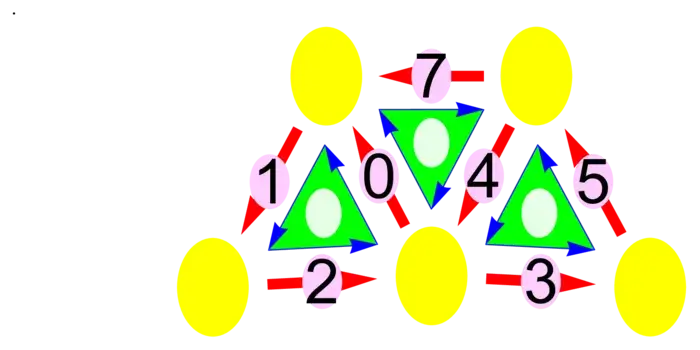
On the graph
- (3 points) Write the values of the curl
. As a -form it is a function on the set of triangles. - (3 points) Compute the "discrete divergence"
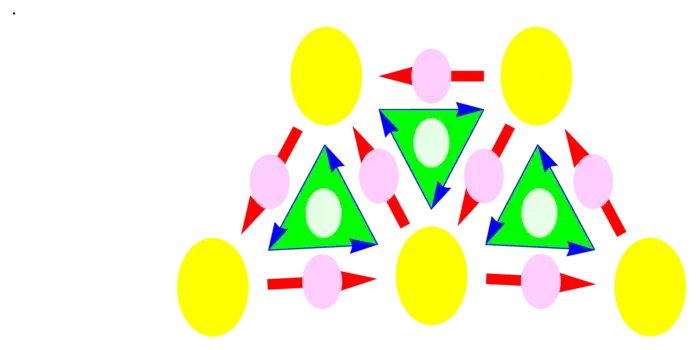
, which is a -form, a function on the vertices. - (4 points) Find the value of the Laplacian
and enter the values near the edges in Figure (39.2).
Problem 39A.2 (10 points, each question is one point):
- Who formulated the law of gravity in the form the partial differential equation
? - The expression
simplifies to - What value is
if is the unit sphere oriented outwards? - What is the distance between the point
and the -plane? - Is it true that if
everywhere, then is perpendicular to the velocity ? - What is the distortion factor
for the change of coordinates ? - If
parametrizes a surface in , is it true that tangent to the surface? - Yes or no: if
is a maximum of then . - Write down the quadratic approximation of
? - If
is oriented outwards, then the flux of through is either negative, zero or positive. Which of the three cases is it?
Problem 39A.3 (10 points, each problem is one point):
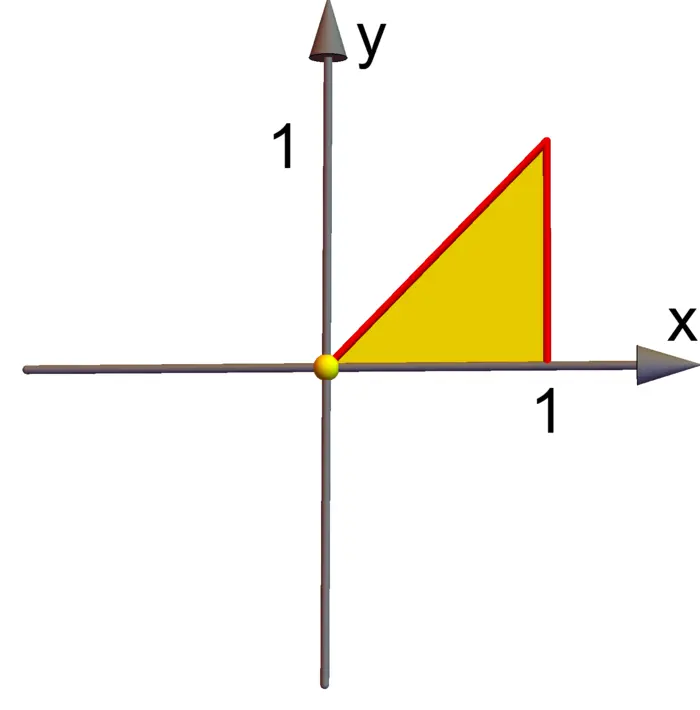
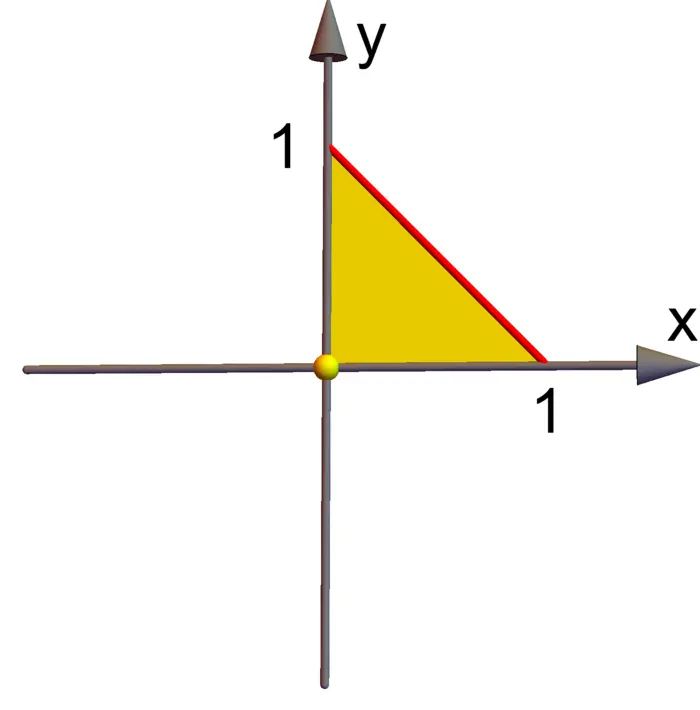
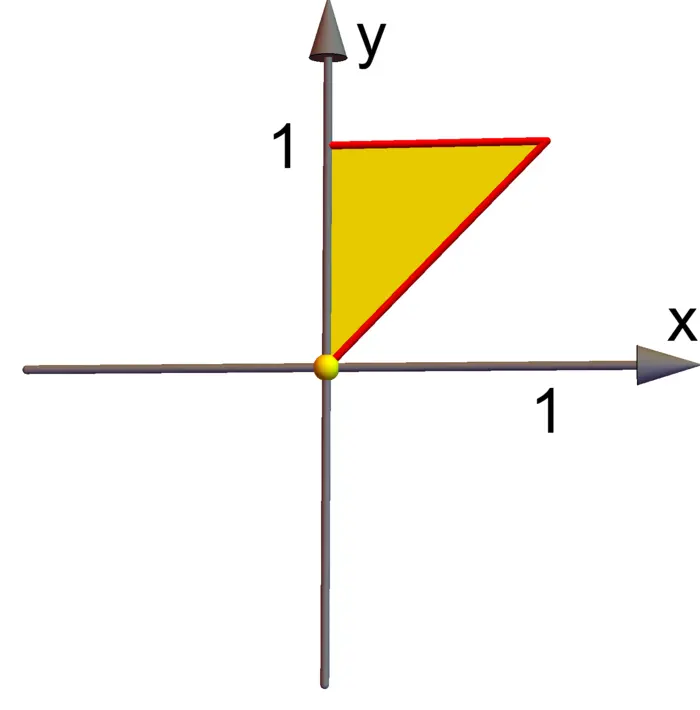
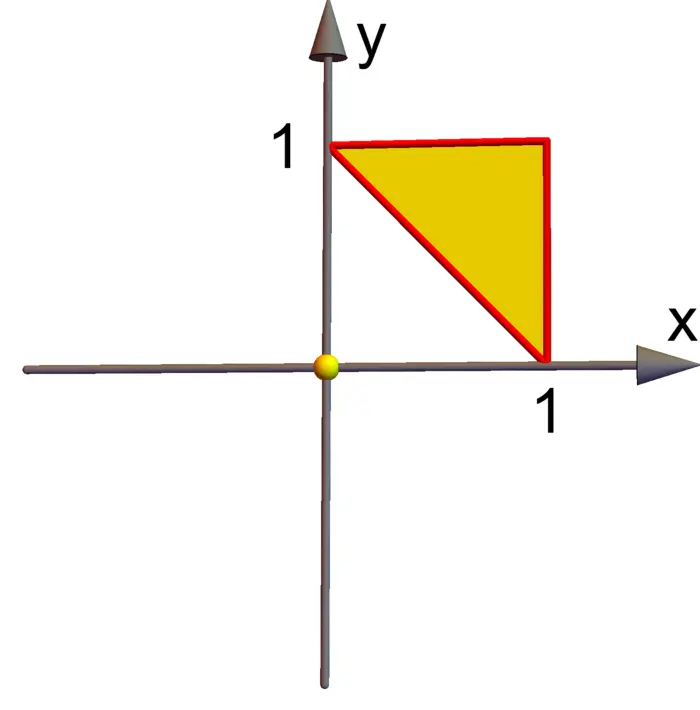
- Which of the triangles in Figure (39.3) is integrated over in
? - We have seen a counter example for Clairaut’s theorem. This function
was in but not in . The integer indicated how many times we could differentiate continuously. What was the ? - To what group of partial differential equations belongs
? - Write down the Cauchy-Schwarz inequality.
- Let
be the first stage of the Menger sponge (with cubes from cubes present). Is it simply connected? - Take a exterior derivative of the differential form
. - Parametrize the surface
. - Parametrize the curve obtained by intersecting of the ellipsoid
with the plane . - What surface is given in spherical coordinates as
? - Write down the general formula for the area of a triangle with vertices
, , .
Problem 39A.4 (10 points):
- (6 points) Find the equation of the plane which contains the line
and which is perpendicular to the plane . - (4 points) What is the angle between the normal vectors of
and the plane you just found?
Problem 39A.5 (10 points):
- (8 points) Find the critical points of the function
and classify them using the second derivative test. You can assume that . - (2 points) Does the function
have a global maximum or a global minimum?
Problem 39A.6 (10 points):
- (5 points) Use the Lagrange method to find the maximum of
under the constraint . - (5 points) The Lagrange equations fail to find the maximum of
under the constraint . Still, the Lagrange theorem still allows you to find the maximum. How?
Problem 39A.7 (10 points):
- (6 points) Find the tangent plane at the point
of the surface - (4 points) Parametrize the line
which passes through which is perpendicular to the hyper surface at that point. Then find .
Problem 39A.8 (10 points):
- Estimate
for using linear approximation. - Estimate
for using quadratic approximation.
Problem 39A.9 (10 points):
- Lets look at the curve which satisfies the acceleration
has the initial position and initial velocity . Find . - What is the curvature
of at ?
Problem 39A.10 (10 points):
- Integrate the function
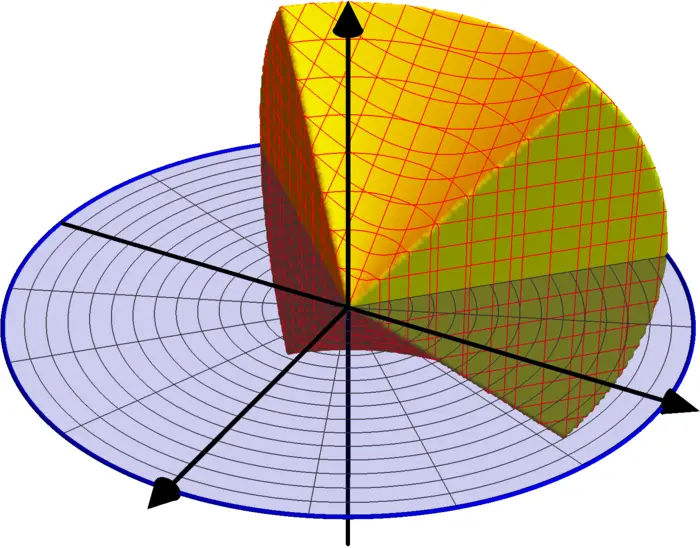
over the region , . - Find the surface area of
where and .
Problem 39A.11 (10 points):
Let
- (7 points) Integrate
- (3 points) Let
be a vector field Find the flux of through the boundary surface of , oriented outwards.
Problem 39A.12 (10 points):
What is the line integral of the force field
Hint: We have written the field by purpose as the sum of two vector fields.
Problem 39A.13 (10 points):
Find the area of the region
Problem 39A.14 (10 points):
What is the flux of the vector field
Problem 39A.15 (10 points):
Find the flux of the curl of the vector field
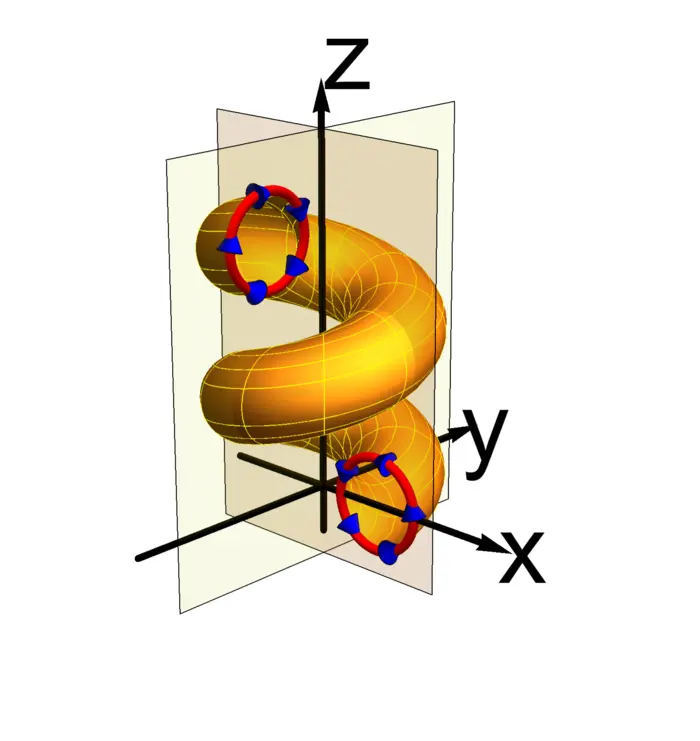
39.3 Final Exam (Practice B)
Problem 39B.1 (10 points):
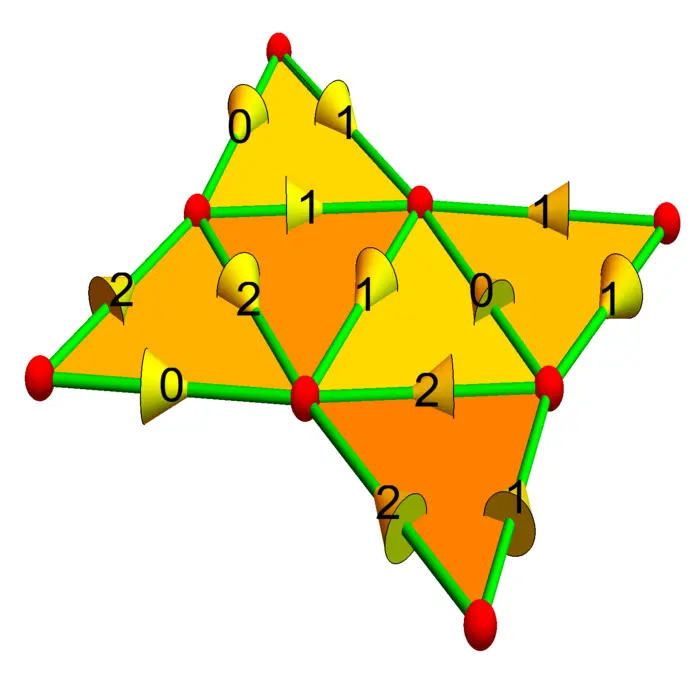
The graph
- (2 points) Find the line integral of
along the boundary curve oriented counter clockwise. - (2 points) Compute the curl
and write its values into the triangles. - (2 points) What is the sum of all curl values? Why does it agree with the result in a)?
- (2 points) Find also
and enter it near the vertices. - (1 point) True or False:
. - (1 point) True of False: we called
the Laplacian of .
Problem 39B.2 (10 points, each question is one point):
- Name the
-dimensional analogue of the Mandelbrot set. - If
is a matrix, then is a matrix. What is and ? - Write down the general formula for the arc length of a curve
with . - Write down one possible formula for the curvature of a curve
- We have seen a parametrization of the
-sphere invoking three angles , , . Either write down the parametrization or recall the name of the mathematician after whom it this parametrization is named. - The general change of variable formula for
is Fill in the blank part of the formula. - What is the numerical value of
? - We have used the Fubini theorem to prove that
functions satisfy a partial differential equation. Please write down this important partial differential equation as well as its name. (It was used much later in the course.) - What is the integration factor
for the parametrization - In the first lecture, we have defined
as the length of a matrix. What is the length of the matrix which contains everywhere?
Problem 39B.3 (10 points, each problem is one point):
- Assume that for a Morse function
the discriminant at a critical point is positive and that . What can you say about ? - We have proven the identity
, where was a map from to . For which and was this identity defined? - Which of the following is the correct integration factor when using spherical coordinates in
dimensions?
2
- Which of the following vector fields are gradient fields? (It could be none, one, two, three or all.)
2
- Which of the following four surfaces is a one-sheeted hyperboloid? (It could be none, one, two, three or all.)
2
- Parametrize the surface
as - Who was the creative person who discovered dark matter and proposed the mechanism of gravitational lensing?
- What is the cosine of the angle between the matrices
, where is the identity matrix and is the matrix which has 1 everywhere? You should get a concrete number. - We have seen the identity
, where , are vectors in . What conditions do and have to satisfy so that the identity holds? - Compute the exterior derivative
of the differential form
Problem 39B.4 (10 points):
- (4 points) Find the plane
which contains the three points - (3 points) What is the area of the triangle
? - (3 points) Find the distance of the origin
to the plane .
Problem 39B.5 (10 points):
- (8 points) Find all the critical points of the function
and classify these points using the second derivative test. - (2 points) Is any of these points a global maximum or global minimum of
?
Problem 39B.6 (10 points):
- (8 points) Use the Lagrange method to find all the maxima and all the minima of
under the constraint - (2 points) In our formulation of Lagrange theorem, we also mentioned the case, where
. Why does this case not lead to a critical point here?
Problem 39B.7 (10 points):
- (5 points) The hyper surface
defines a three-dimensional manifold in . It is poetically called a hyper-paraboloid. Find the tangent plane to at the point . - (5 points) What is the linear approximation
of at this point ?
Problem 39B.8 (10 points):
Estimate the value
Problem 39B.9 (10 points):
- (8 points) We vacation in the
-star hotel called MOTEL in -dimensional space and play there ping-pong. The ball is accelerated by gravity We hit the ball at and give it an initial velocity . Find the trajectory . - (2 points) At which positive time
does the ping-pong ball hit the hyper ping-pong table ? (The points in this space are labeled .)
Problem 39B.10 (10 points):
- (5 points) Integrate the function
over the region - (5 points) Find the area of the region enclosed by the curve
with .
Problem 39B.11 (10 points):
- (7 points) Integrate
over the solid - (3 points) What is the volume of the same solid
?
Problem 39B.12 (10 points):
- (8 points) Compute the line integral of the vector field
along the path from to . - (2 points) What is
?
Problem 39B.13 (10 points):
- (8 points) Find the line integral of the vector field
along the polygon with The path is closed. It starts at , then reaches , , , until returning to again. - (2 points) What is line integral if the curve is traced in the opposite direction?
Problem 39B.14 (10 points):
- (8 points) What is the flux of the vector field
through the sphere oriented outwards? - (2 points) What is the flux of the same vector field
through the same sphere but where is oriented inwards?
Problem 39B.15 (10 points):
- (7 points) What is the flux of the curl of the vector field
through the surface oriented upwards? - (3 points) The surface in a) was not closed, it did not include the bottom part
Assume now that we close the bottom and orient the bottom disc downwards. What is the flux of the curl of the same vector field through this closed surface obtained by taking the union of and ?
39.4 Final Exam
Welcome to the final exam. Please don’t get started yet. We start all together at 9:00 AM after getting reminded about some formalities. You can fill out the attendance slip already. Also, you can already enter your name into the larger box above.
- You only need this booklet and something to write. Please stow away any other material and any electronic devices. Remember the honor code.
- Please write neatly and give details. Except for problems 2 and 3 we want to see details, even if the answer should be obvious to you.
- Try to answer the question on the same page. There is additional space on the back of each page. If you must, use additional scratch paper at the end. But put your final result near the question and box the final result.
- If you finish a problem somewhere else, please indicate on the problem page where we can find it.
- You have 180 minutes for this final exam.
Problem 39.1 (10 points):
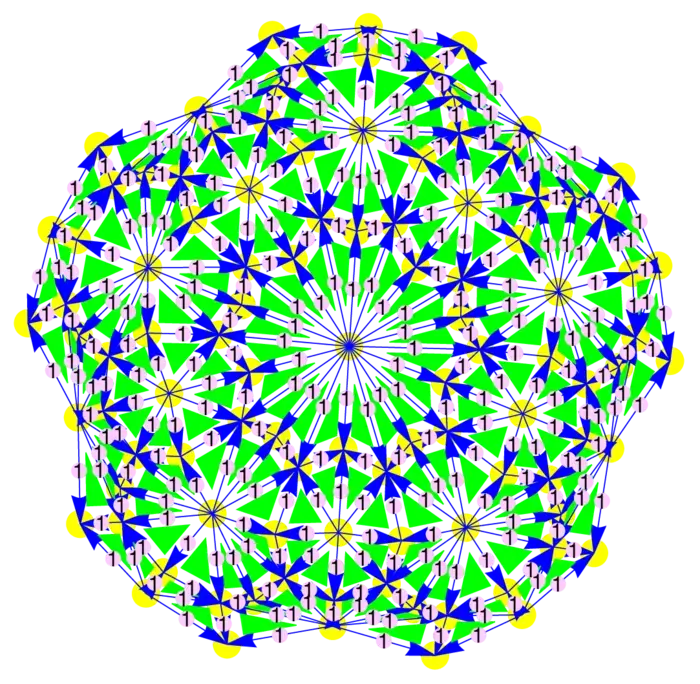
In Figure (39.8) you see a discrete two dimensional region
- (2 points) The curl
of is a function on oriented triangles. What can you say about the sum over all the curl values in the graph of Figure (39.8)? - (2 points) Is
a gradient field for some function on vertices? - (2 points) What is the sum of the natural divergence values
on vertices? - (2 points) What was the name of the matrix
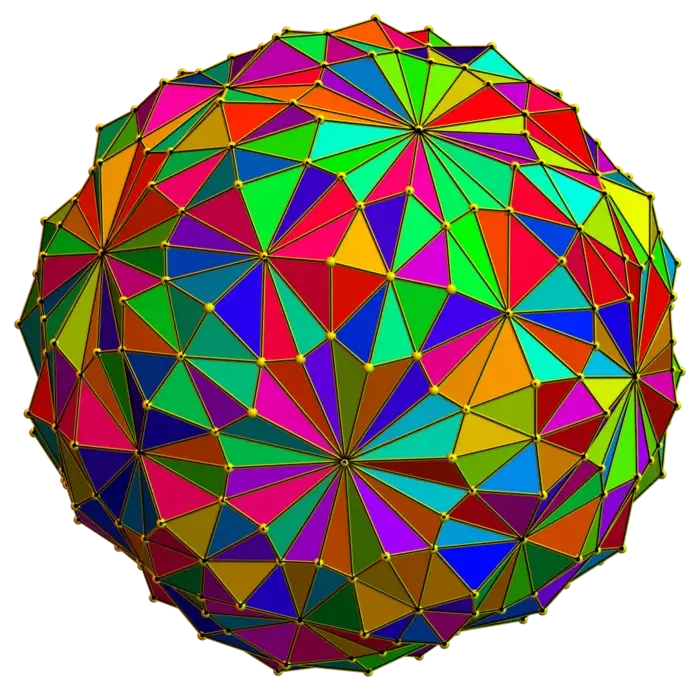
that acts on -forms. It has been defined more than years ago. - (2 points) In Figure (39.7), you saw a two-dimensional discrete sphere
. which plays the role of a closed surface in . Given a -form , a function on oriented edges of , what is the sum over all curls on ? The answer is a number but you have to justify the answer.
Problem 39.2 (10 points, each question is one point):
- Albert Einstein used the notation
for two vectors , . It is today called "Einstein notation". What did Einstein mean, when he wrote ? - If
is a two-dimensional surface parametrized by what is the relation between and ? - What is the Newton method used for? We have seen this numerical tool in a proof seminar.
- What is the curvature of a circle with radius
? - Define the
matrix . One of the two matrices , is row reduced. Which one? - What is the distortion factor of the coordinate change
? - What is the numerical value of
, if is the imaginary unit? - What is the name of the differential equation
, where is a matrix? It appears in a theory which also is called "matrix mechanics". - Why is the distance between two lines
and given by the formula - You are given a Morse function
on a -torus and you count that has maxima and minima. How many saddle points are there?
Problem 39.3 (10 points, each question is one point):
In this problem, we work in hyperspace
- Write down the exterior derivative
of the -form - Write down the exterior derivative of the
-form - Let
be the two-dimensional torus , embedded in . What does the general Stokes theorem tell about , where is the -form from a)? - What is
, where is the -form given in a)? - What is
, where is the -form given in b)? - A
tensor on can be interpreted as a . - A
tensor on can also be interpreted as a . - Is
defined if is a function? - Does
make sense for any field ? - You see
contour maps of functions , and of two variables. One of them is not Morse. Which one? The first the second or the third?
Problem 39.4 (10 points):
- (3 points) Parametrize the line
which contains the points - (3 points) Given the additional point
, find the distance between and . - (4 points) Write down the equation
of the plane containing and .
Problem 39.5 (10 points):
- (6 points) Find all the critical points of the function
and classify them using the second derivative test. - (2 points) The island theorem told us that the number of maxima plus the number of minima minus the number of saddle points of
is on an island. In the current case this fails. Why does this not contradict the island theorem? - (2 points) Does the function
have a global maximum or a global minimum?
Problem 39.6 (10 points):
- (7 points) Use the Lagrange method to find the minimum of the function
under the constraint - (3 points) You saw in a) that in this case, the Lagrange equations are a system of linear equations for a couple of unknown. This can be written in matrix form as
, where the vector encodes the unknown quantities and is a constant vector. What is the size of the matrix ?
Problem 39.7 (10 points):
- (5 points) Find the tangent plane at the point
of the hyper cone in . - (5 points) Write down the linearization
of at .
Problem 39.8 (10 points):
Estimate the value
Problem 39.9 (10 points):
- (6 points) Find the curve
which satisfies - (4 points) What is the curvature of the curve at the point
?
Problem 39.10 (10 points):
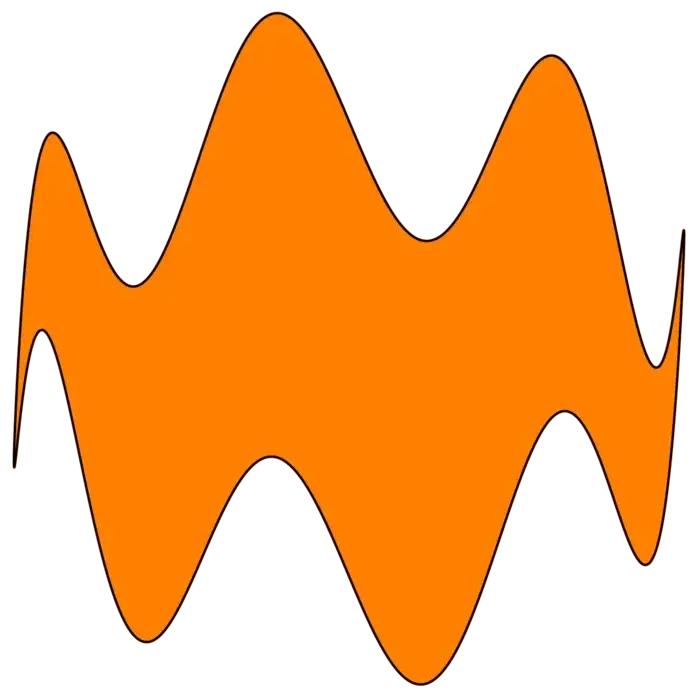
Find the area of the region enclosed by the curve
Problem 39.11 (10 points):
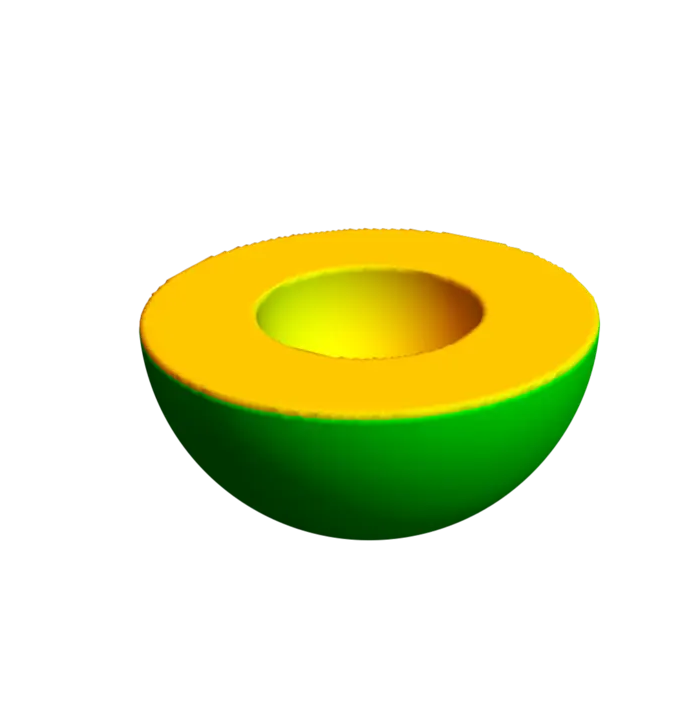
Integrate
Problem 39.12 (10 points):
Compute the line integral
Problem 39.13 (10 points):
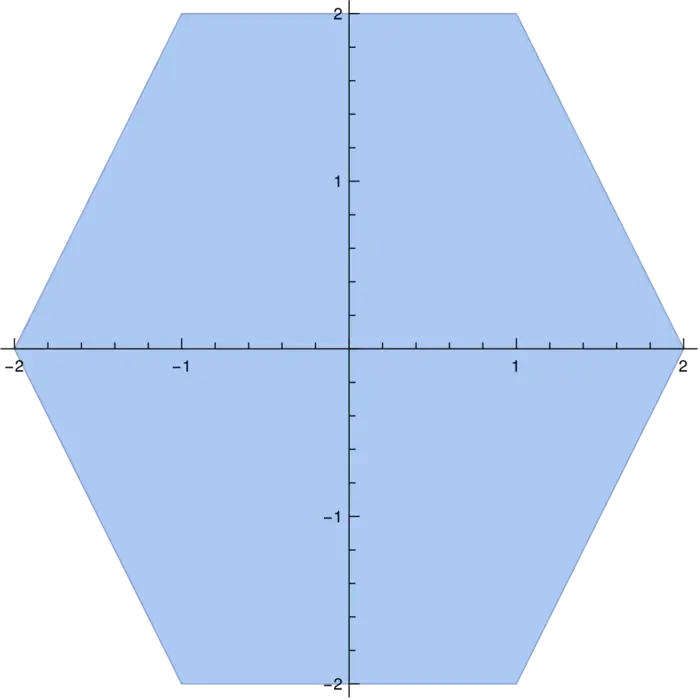
Find the line integral
Problem 39.14 (10 points):
Find the flux
Hint: The surface has two boundary curves obtained by looking at
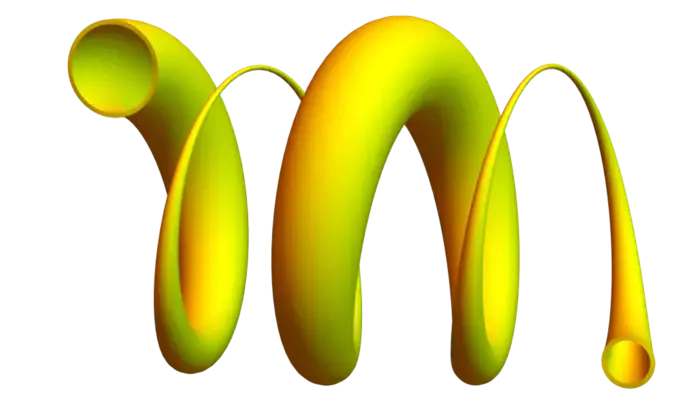
Problem 39.15 (10 points):
Find the flux of