Scalar Products

The next definition we shall make is that of scalar product, whereby two vectors are combined to give a number.

Let , . We define the scalar product by

It is left as an exercise to prove the following:

In particular, we define . Thus . But if we recall that we have

(Note that this equation makes sense, since both sides are numbers. Note also that if .)

Now let us try to express, in terms of the language we have developed, what is to be meant by saying that two vectors are perpendicular. Suppose that and of the diagram are perpendicular. In particular, this means that if we lay off a segment of length to the left of their common initial point, the two line segments marked || are of equal length. But if we consider the broken line segment as a vector directed to the left, we observe that this vector is , and that the two equal line segments, directed as indicated by the arrows, are and . Thus a necessary condition for perpendicularity is .
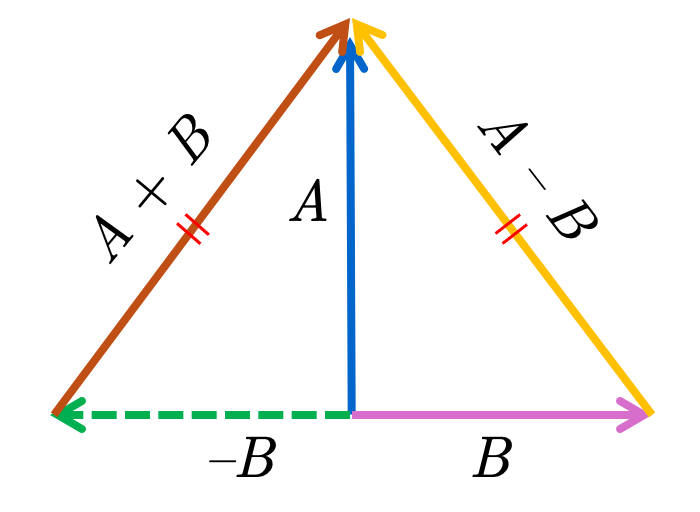
Conversely, if this is the case, then is perpendicular to in the sense of plane geometry. Squaring both sides of this equation and using the fact that for any vector , we have Using the rules developed in the exercises,

Thus , or

Conversely, if , we see that . But since both and are non-negative, this means that , or that and are perpendicular.

Thus we may regard this result as our definition of perpendicularity in dimensions:

is perpendicular to will mean simply that .

Now suppose and are non-zero vectors (recalling that the zero vector is ). Then the quantity is a vector. Therefore the number is either positive or zero, and is zero only if (vector), i.e., only if Now and this is . Since is positive, we can cancel it and get , or The two are equal only if , i.e., only if and have the same direction.

Likewise, , and is zero only if , i.e., only if and have opposite directions. But giving

Equality holds only if and have opposite directions. Combining the two results, we have in general and we know exactly when one or the other of the inequalities becomes an equality. This result is known as Schwarz’s inequality.

Dividing the inequality through by (which is positive), we have

Therefore the number can be the cosine of some angle. If we require that this angle be between and (or in radians, between 0 and ), then is uniquely determined by giving . Thus we define the angle between and to be that angle between and such that

Observe that if and only if and have the same direction, if and only if they have opposite directions. So our terminology is consistent in this respect. Plane trigonometry will provide a more complete justification of our choice of definitions. Consider the triangle shown. The law of cosines tells us that

Using what we know about vectors, this means that or i.e., and finally which agrees with our definition of .