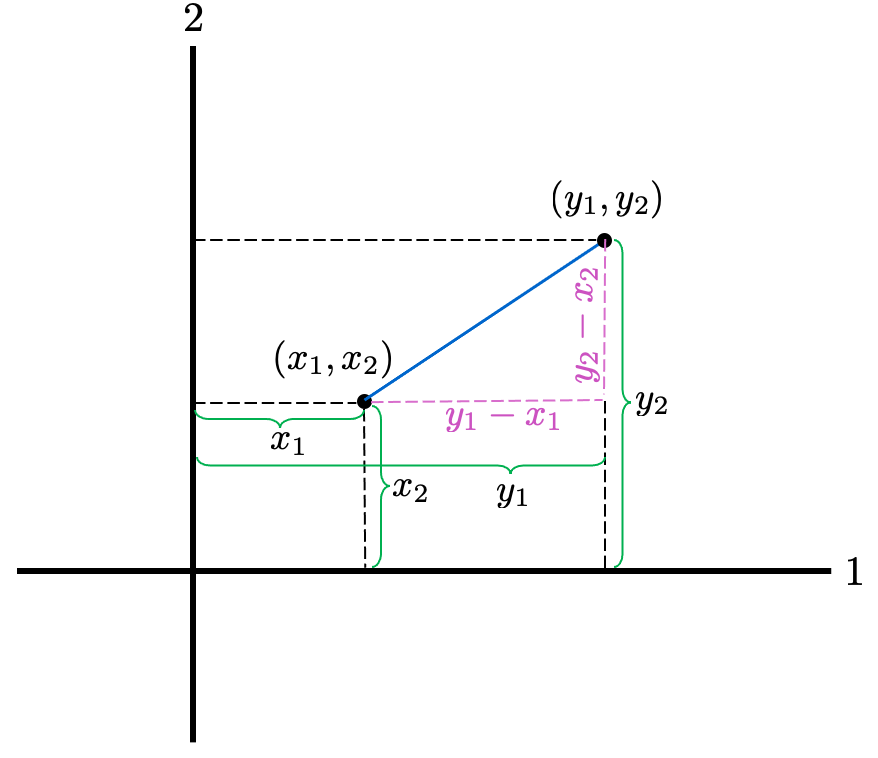
Now we return to two-dimensional space, where the notion of distance is a familiar one. In the figure below,
or
by the theorem of Pythagoras.
It is of some interest to give a very simple and often unfamiliar proof of the theorem of Pythagoras, as follows: We wish to prove that if
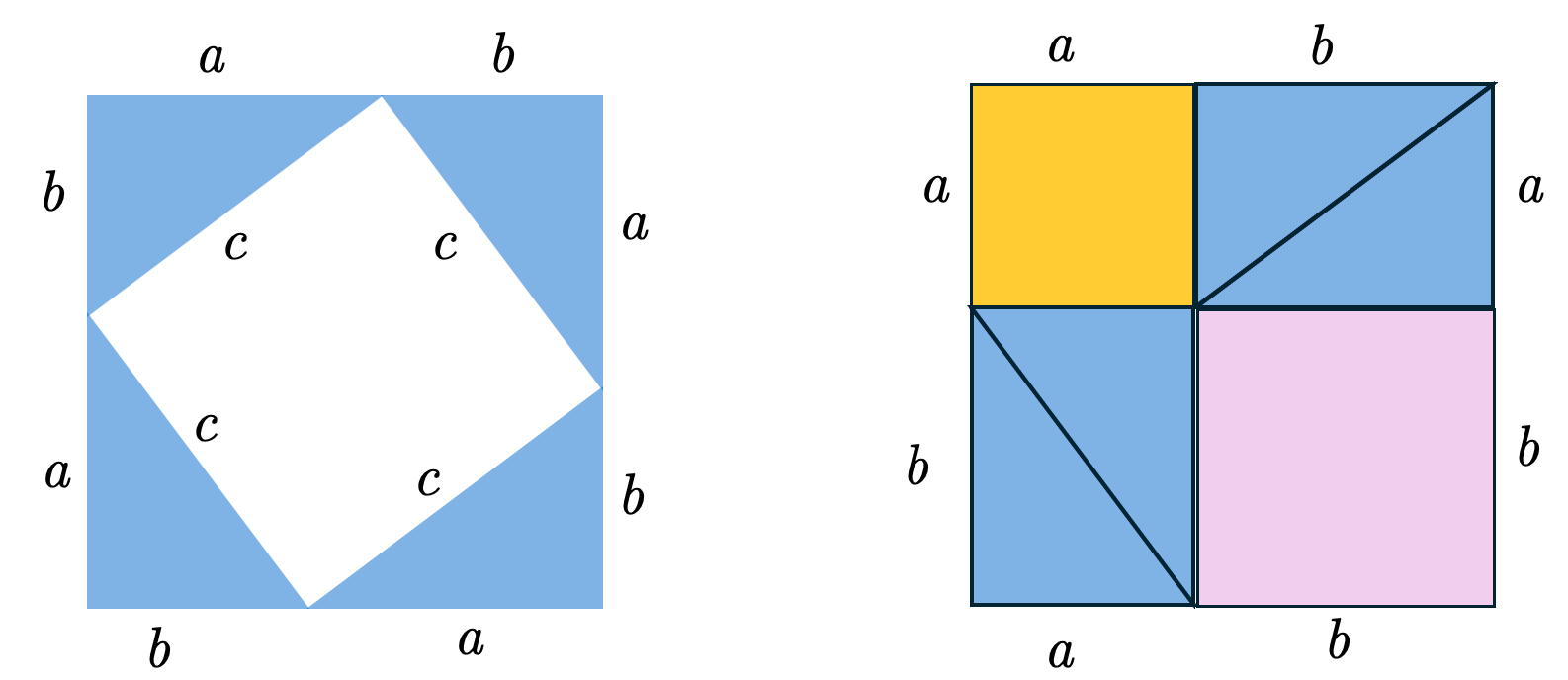
From (1), the area of the square is
where
Thus
or
which was to be proved.
By applying the theorem of Pythagoras twice, we see that the distance between two points
Thus we are led to define the distance between two points
We observe that this is equal to
We also note that the distance between two points is 0 only if the points are not actually distinct, i.e., only if