We shall present a few applications of the technique of vectors to geometry, followed by some problems of more than routine interest. This list should be supplemented by a number of the problems to be found in any of the standard texts on analytic geometry of two and three dimensions.
Intersection of Two Planes in 3-Space
Consider the problem of finding the intersection of two planes in 3-space. In general, this will be a line; we can derive its equation from those of the planes in several ways:
- We could solve simultaneously the equations of the planes.
- We could find two points which are common to both planes, for instance by choosing two different fixed values for their third coordinates. We then obtain in each case a system of two linear equations in two unknowns (the first and second coordinates), which we solve. Then we find the connecting line.
- We could find one point
common to both planes, and then find a vector parallel to the line of intersection. The latter is accomplished by observing that any such vector must be perpendicular to each of the known vectors perpendicular to the individual planes. From the exercises on vector products, we see that we can take as our vector the vector product . The formula gives the line.
Distance from a Point to a Line in n-Space
Let
If
This is a linear equation, which we solve for
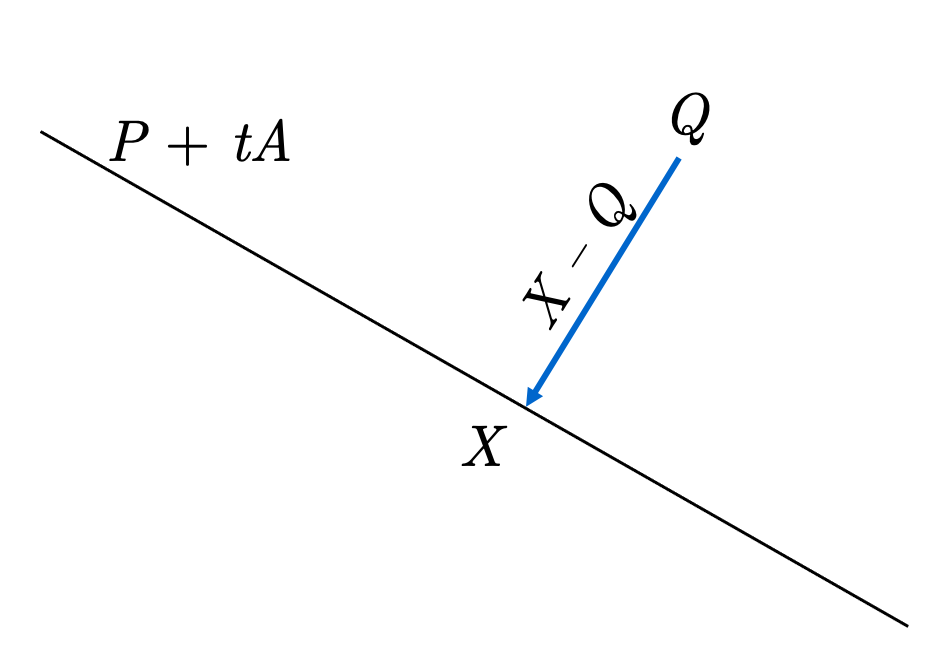
Distance Between Two Lines
Now let
Angle Between Two Planes
The angle between two planes is found by using the angle between two vectors, i.e., by reading off two vectors perpendicular to the planes from their equations and finding the angle between these vectors. Since two vectors having opposite directions determine the same plane, there are two possible answers, consisting of supplementary angles. We agree to take the angle between
PROBLEMS
1. If a is a number, define its absolute value |a| by
2. If
3. In n-space, let
4. Show by vectors that the diagonals of a rhombus are perpendicular.
5. Show that the medians of the triangle with vertices
6. What is the plane through
7. Show that the planes
8. Let
9. Prove the law of sines using vectors in 3-space.
10. What is the set of points
11. Let
is parallel to , is perpendicular to , , and Show that and are unique.
12. Let
- Given a point
on , compute the distance between and and show that it is . - Show that the distance between
and is precisely for just one , being actually for all other points . Compute the coordinates of this . - Show that the vector
is perpendicular to the vector A.
13. Keeping the results of (2) in mind, consider (in n-space) a point
- Show that there is just one point
on such that the vector is perpendicular to and compute its coordinates. - Given a point
on , compute the distance from to and show that it is . Show that the distance from to is precisely if and only if .
14. Compute (in 3-space) the equation of the plane which passes through the points
- Compute the distance
between the point and a point in this plane. - Compute the minimum distance and call it
. - Show that there is just one point
in the plane such that the distance . Compute the coordinates of . - Show that the vector
is perpendicular to the plane.
Given three vectors
A cube in n-dimensional space is a set of points (
How many vertices and edges has a cube in 2-space? in 3-space? in 4-space? in n-space? How would you define a 2-dimensional face of an n-dimensional cube (