A complex function may be considered geometrically as a transformation which maps a set of points, the domain of the independent variable , onto another set, the domain of the function values . A most illuminating example is the general linear transformation \tag{3.00} \zeta=\frac{az+b}{cz+d} where are four complex numbers with non-vanishing determinant; . The transformation (3.00) provides a one-to-one mapping of the full z-plane 1 onto the full -plane, for to each value of there corresponds a unique value of and for each value of , is given by the inverse transformation mapping \tag{3.01} z = \frac{d\zeta - b}{-c\zeta + a} which has the same determinant as (3.00) . We shall show that the mapping is conformal and, later, that the linear transformation is completely characterized by these two properties, namely, that the only one-to-one conformal mapping of the full -plane onto itself is given by the general linear transformation.
Table of Contents
1.3.1 Composition of the General Linear Transformation
The product of two transformations , is simply the transformation . The product of two linear transformations is easily seen to be another linear transformation. It will simplify our discussion to consider the transformation (3.00) as composed of several simple transformations:
- The translation \tag{3.10} \zeta = z + b simply represents a rigid displacement of the entire -plane by the vector . It follows that the image of any geometrical configuration by this transformation is a congruent configuration. The mapping is called the identity since it leaves every point unchanged. Those points which map into themselves are called the fixed points and are of special interest in any transformation. If the only fixed point of the mapping (3.10) is .
- The transformation \tag{3.11} \zeta=a z, \quad a \neq 0 is best considered in polar coordinates. Set and . We then have whence We conclude that the transformation represents a stretching by a factor along the rays from the origin plus a rigid rotation about the origin through the angle . Thus (3.11) may be considered as the product of the two transformations the first being a rotation and the second a magnification. Since the image of any configuration by either of these transformations is a similar configuration it is clear that the resultant transformation also has the same property. Note that and are both fixed points of this mapping.
- The function \tag{3.12} \zeta=\frac{1}{z} transforms the -plane in a one-to-one way except for the point . According to our convention we complete the mapping by writing at and, inversely, at .
If, as above, we write then (3.12) takes the form Thus (3.12) may be decomposed into the transformation and .
The first is simply a reflection of the -plane through the real axis and hence transforms figures into congruent configurations with angles reversed in sense. The second is an inversion with respect to the unit circle, i.e. and lie on the same line and . Two points which lie in this relation are referred to as inverse points.
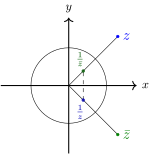
The principal properties of inversion are assumed known from elementary geometry: the transformation carries circles into circles 2 and preserves angles but reverses their sense. It follows that the resultant transformation is conformal and preserves circles.
The most important property of the general linear transformation \tag{3.13} \zeta=\frac{a z+b}{c z+d}, \quad \Delta=a d-b c \neq 0 is that
Theorem 1.7 . Under the above transformation, circles are transformed into circles.
Proof. We give two different proofs:
I . The theorem is immediately proved if the general linear transformation can be decomposed into the simple transformations a), b), c) for which the property is known to hold. If this is dones as follows: \begin{align} \zeta &= w_{3}+\frac{a}{c} \\ w_{3} &= \left(-\frac{\Delta}{c}\right) w_{2} \\ w_{2} &= \frac{1}{w_{1}} \\ w_{1} &= c z+d. \end{align}In the special case it follows from that . The transformation then takes the form
Observe that this method also furnishes a proof of the conformality of the mapping (3.13) .
II . The second proof depends upon another basic property of the linear transformation, namely, that the cross ratio of four points remains invariant under linear transformation. ◻
1.3.2 The Cross-Ratio of Four Points
In analogy with projective geometry we define the cross ratio of four given complex points as \tag{3.20} \left(z_{1}, z_{2}, z_{3}, z_{4}\right)=\frac{z_{3}-z_{1}}{z_{3}-z_{2}} \frac{z_{4}-z_{2}}{z_{4}-z_{1}}. If are the respective function values for in (3.13) then it may be confirmed by direct calculation that or that the cross ratio of four points remains fixed in any linear transformation .
Theorem 1.8 . A necessary and sufficient condition that four points lie on a circle is that their cross ratio have a real value.
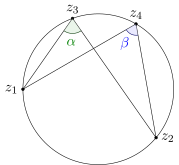
Proof. Let the four given points be and denote the distance between any two points and by . Setting , 3 and we obtain where the difference is the angle between the vectors and . Similarly where is the angle between and . (We may assume .)
The cross ratio of the four points now takes the form \begin{align} \left(z_{1}, z_{2}, z_{3}, z_{4}\right)&=\frac{z_3 - z_1}{z_3 - z_2} \frac{z_4 - z_2}{z_4 - z_1}\\ &= \frac{r_{31}}{r_{32}} \frac{r_{42}}{r_{41}}\, e(\alpha-\beta). \end{align}But the necessary and sufficient condition that lie on the circle (in the extended sense) determined by is that and the cross ratio is real if and only if . This concludes the proof. ◻
The circle preserving property of linear transformations follows from the invariance of the cross ratio.
The general linear transformation \tag{3.21} \zeta=\frac{az + b}{cz + d}, \quad \Delta = ad - bc \neq 0 actually depends on no more than three complex parameters for by multiplying the numerator and denominator by a suitable constant we may prescribe the condition which enables us to give one parameter in terms of the other three. It is therefore to be expected that a linear transformation is uniquely prescribed by the condition that three given points map into three given points . This is actually the case. The point corresponding to the independent variable must satisfy the equation \tag{3.22} \frac{\zeta_{3}-\zeta_{1}}{\zeta_{3}-\zeta_{2}} \frac{\zeta-\zeta_{2}}{\zeta-\zeta_{1}}=\frac{z_3 - z_1}{z_3 - z_2} \frac{z-z_{2}}{z-z_{1}}. It is not difficult to verify that this is a linear transformation having the requisite properties. Furthermore the transformation specified by the mapping of three given points is unique. For proof consider the fixed points of the mapping (3.21) . These satisfy the condition which is equivalent to the quadratic equation \tag{3.23} c z^{2}+(d-a) z-b=0. The two solutions of (3.23) are the fixed points of the transformation. Now if and are any two transformations which take into respectively, then , where is the inverse transformation to , is a linear transformation which leaves fixed. The quadratic equation (3.23) would then have three roots which is impossible unless the coefficients are all zero; i.e. , , . But the transformation with these coefficients is the identity . It follows from that . Thus the uniqueness of the linear transformation (3.22) is proved.
A deeper insight (due to F. Klein) into the structure of linear transformation, is obtained by considering the behavior of the family of circles through the fixed points. Let us assume first that the equation (3.23) has two distinct roots and . Since and are fixed points of the mapping the circles of map into circles of the same family. From the conformality of the mapping it follows that the orthogonal family K' also maps into itself. Three possibilities occur:
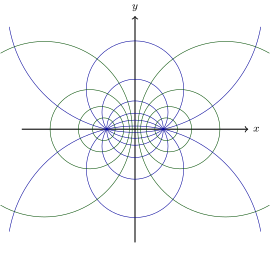
- Each circle in goes over into itself . The circles of may then be considered kinematically as the paths along which the points of the plane travel toward their images. Such a transformation is called hyperbolic .
- Each circle of the orthogonal family \boldsymbol{K'} maps onto itself . In this case the curves of K' are the paths for the points of the plane. The transformation is said to be elliptic .
- If neither of the first two cases holds the transformation is called loxodromic .
This classification leads naturally to a normal form of description for three kinds of linear transformation. Given and , the two fixed points, let and be two points on a circle through the fixed points and , and the respective images of and . The images and are the fixed points and themselves. From the invariance of the cross ratio we obtain The transformation may then be written in the normal form \tag{3.24} \frac{z-z_{1}}{z-z_{2}}=\alpha\, \frac{\zeta-z_{1}}{\zeta-z_{2}}, \quad \alpha \neq 0 where In the hyperbolic case the points are on the same circle and therefore their cross ratio is a real constant. The hyperbolic transformation takes the form \tag{3.25} \frac{z-z_{1}}{z-z_{2}}=\alpha\,\frac{\zeta-z_{1}}{\zeta-z_{2}} \quad(\alpha \text { real} \neq 0) Conversely, it follows from (3.25) that , the image of , lies on the circle through and consequently that the transformation is of hyperbolic type.
For the elliptic transformation the theorem of Apollonius in elementary geometry (see Exercises 23 , 24 ), implies the relation \tag{3.26} \frac{\left|z-z_{1}\right|}{\left|z-z_{2}\right|}=\frac{\left|\zeta-z_{1}\right|}{\left|\zeta-z_{2}\right|}. We conclude that the elliptic transformation takes the form \tag{3.27} \frac{z-z_{1}}{z-z_{2}}=\alpha\, \frac{\zeta-z_{1}}{\zeta-z_{2}} \quad(|\alpha|=1, \alpha \neq 1). Conversely, it follows from (3.27) that (3.26) holds and therefore that and lie on the same member of the orthogonal family.
The loxodromic transformation contains the remaining possibilities: \tag{3.28} \frac{z-z_{1}}{z-z_{2}}=\alpha\, \frac{\zeta-z_{1}}{\zeta-z_{2}} \quad(\alpha \text { non-real and }|\alpha| \neq 1).
Finally, if the roots of the equation (3.23) coincide, the transformation is said to be parabolic . The derivation of the normal form of the parabolic equation is left as an exercise.
Exercises
Exercise 1.23 . Show by inversion that a circle intersects a given circle orthogonally if and only if it passes through a pair of inverse points with respect to the given circle.
Exercise 1.24 . Prove the theorem of Apollonius that a circle is the locus of all points in the plane, the ratio of whose distances from two fixed points and is constant. (Hint: and are conjugate points with respect to the circle.)
Exercise 1.25 . Under inversion with respect to the unit circle what happens to the set of
- Circles tangent at the origin to a fixed line through the origin.
- Circles passing through the origin and another fixed point A. What happens to the orthogonal family of circles?
Exercise 1.26 . Determine the normal forms of the elliptic, hyperbolic and loxodromic transformations in the event that one fixed point is at infinity.
Exercise 1.27 . In the event that the two fixed points of a linear transformation coincide the transformation is said to be of the parabolic type. Find its normal form if the fixed point is finite.
Exercise 1.28 . If a linear transformation maps the interior of a circle onto itself show that it cannot be loxodromic.
1.3.3 Special Mappings
A number of the mappings given by linear transformations are of particular importance. Specifically we consider mappings of circles into circles. As we have seen, the coefficients of the general linear transformation can be picked so that three arbitrarily designated points of the -plane pass into three arbitrarily designated points of the -plane. Since circles transform into circles and a circle is determined by any three of its points it follows that there is a linear transformation which takes any given circle of the -plane into any given circle of the -plane. In the determination of specific transformations we will need the following lemma:
Lemma 1.1 . Under linear transformation points that are inverses with respect to a given circle are mapped onto points which are inverses with respect to the image circle.
This lemma follows directly from the result of Exercise 23 .
For the first example we take the general transformation which maps the real axis onto the unit circle so that the upper half-plane maps onto the interior of the circle . Let the point with be mapped onto the origin . It follows by the lemma above that the point goes over to the point . The transformation must consequently be of the form The complex constant may then be determined if we observe that the real axis maps onto the unit circle and therefore for real. It follows that . With this restriction on it is clear that for . By direct computation it may then be verified that the transformation \tag{3.30} w=k \frac{z-a}{z-\bar{a}}\quad \text{with}\quad |k|=1\quad\text{and}\quad \operatorname{Im}(a)>0 maps the upper half-plane into the interior of the unit circle and is therefore the most general linear transformation of the prescribed type.
An interesting example is that of the transformation which maps the interior of the unit circle onto itself. We arbitrarily select a point in the interior of the circle and map it on the origin . Applying our lemma we see that the inverse point must go into . The transformation can only be of the form Moreover, for we have and therefore by the theorem of Apollonius The transformation can now be written in the form \tag{3.31} \zeta=k\, \frac{z - a}{\bar{a}z - 1} \text { with } |k|=1 \text { and } |a| < 1. The verification that this satisfies the given requirements is a simple exercise.
From the form of the transformation (3.31) we conclude that in mapping the unit circle onto itself we are free to specify the mapping of any one point and, by adjusting the amplitude of , to map any direction through the chosen point into any direction through its image.
For our last example we consider the most general linear transformation of the upper half-plane onto itself. In the mapping of the real axis onto itself some point must map into and for another real value , . The transformation must therefore take the form Since is real when is real it follows that is real. We have proven that the transformation can be written in the form \tag{3.32} \zeta=\frac{a z+b}{c z+d}, \quad (a, b, c, d \text { real}) But we have not yet employed the condition that for . This condition is equivalent to the requirement ( Exercise 30 ) that the determinant \tag{3.33} \Delta=a d-b c>0. In the same manner as before we can easily show that (3.32) is the most general transformation of this type.
One of the most remarkable applications of linear transformations is the elegant example due to Poincaré of the non-euclidean geometry in the upper half plane. In order to display this application to advantage we shall first enter a brief general discussion.
1.3.4 The Poincaré Geometry
Euclidean geometry may be said to describe our experiences with pencil diagrams on paper. Non-euclidean geometry, though at first a little foreign to our sense, furnishes a better description than ordinary geometry of certain other experiences, notably the facts of optics. There are, however, certain factors common to these geometries and it will illuminate the discussion to give these in some detail.
Our geometry will deal with the notions of points, lines, distances and displacements as in ordinary geometry. In the first place we restrict ourselves to the space consisting of the upper half-plane . For points we take the ordinary euclidean points. For lines we take the circles with centers on the real axis – restricting ourselves to the semicircles in the upper half-plane. According to our convention these include the half-lines orthogonal to the real axis. For this definition of line we have the usual properties: There is exactly one line passing through any two points. Two lines intersect in no more than one point.
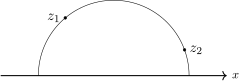
There are certain transformations of the space called displacements which have the property that lines map onto lines in such a way so that
- The order of points on a line is not changed by displacement
- Any given point may be displaced into any other point so that any ray originating at the mapped point may be transformed into any given ray at the image point.
As our displacements we take linear transformations of the upper half-plane \tag{3.40} \zeta=\frac{a z+b}{c z+d} \quad(a, b, c, d \text { real and } a d-b c>0).
It is the analogy to the ordinary distance between two points that is of the greatest interest. There are certain requirements we naturally expect a distance function to satisfy. Namely, if and denote any two points of the space and is to be the distance between them we specify the following conditions:
- for and if
- The triangle inequality where the sign of equality holds if and only if lie on the same line in that order.
Finally we ask that the distance of two points remain unchanged in any displacement.
The possibilities of defining a distance function are somewhat restricted. If is any distance function then any other distance function can be written as a single-valued function of . In other words there is a one-to-one relationship between the values of and the values of .
In proof we show if and are any pairs of points with that . First, there is a displacement which takes into and into . For there is a displacement which maps onto and transforms the ray into the ray . Now let be the image of . There are two possibilities; either lies between and or lies between and . In the first case we obtain by 3) But from the invariance of under displacement Thus which can be true only if . The second possibility yields the same result. Now, the fact that there is a displacement which carries into and into shows that The same proof may be used in the other direction to demonstrate the existence of a one-to-one correspondence between the values of and the values of .
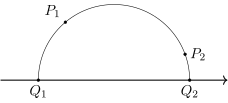
In casting about for a distance function, as invariant under the transformation (3.40) , one naturally thinks of the cross ratio of four points. But in defining the distance what two auxiliary points shall we choose to complete the cross ratio? An obvious choice is the pair of axis-points and which lie at the extremities of the semicircle joining and . These have the special virtue of being defined in a unique fashion by and and of transforming into corresponding points for the images of and by displacement.
The cross ratio, however, does not satisfy the additive property of distance; that is, if are points on the same line in that order then However, the cross ratio does satisfy a multiplicative relationship \tag{3.41} \left(P_{1} P_{2} Q_{1} Q_{2}\right)\left(P_{2} P_{3} Q_{1} Q_{2}\right)=\left(P_{1} P_{3} Q_{1} Q_{2}\right). This suggests the use of the logarithm of the cross ratio as a suitable distance function. Since a distance function must be non-negative we take the absolute values: \tag{3.42} D\left(P_{1} P_{2}\right)=k\left|\log \left(P_{1} P_{2} Q_{1} Q_{2}\right)\right| where may be fixed arbitrarily.
The formula (3.42) is the most general distance function obtainable in the Poincaré geometry.
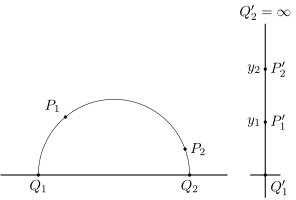
For the purposes of the proof we displace the semicircle joining the points into a ray perpendicular to the real axis. That we may do so is clear, for we have three real parameters at our disposal and this allows us to prescribe one point arbitrarily and to specify that the -coordinate of the second point be the same as the first. The cross ratio becomes simply . We then choose as our distance function D\left(P_{1}, P_{2}\right)=\left(P_{1}', P_{2}'\right)=\left|\log y_{2}-\log y_{1}\right|.
Now, if is any other expression for distance it is a single-valued function of , In particular, if are points of the line arranged in that order we have \begin{align} f\left(\left|\log \frac{y_{2}}{y_{1}}\right|\right)+f\left(\left|\log \frac{y_{3}}{y_{2}}\right|\right)&=f\left(\left|\log \frac{y_{3}}{y_{1}}\right|\right)\\ &=f\left(\left|\log \frac{y_{3}}{y_{2}}+\log \frac{y_{2}}{y_{1}}\right|\right)\\ &=f\left(\left|\log \frac{y_{3}}{y_{2}}\right|+\left|\log \frac{y_{2}}{y_{1}}\right|\right). \end{align}Hence, for any positive values , we have \tag{3.43} f(a)+f(b)=f(a+b). We shall show that must be a linear function From (3.43) it is immediately clear that for all integers . Furthermore, for any rational we observe whence The result is easily generalized to include all real numbers. If is a real number it is exactly determined by the order relationships it satisfies with the rational numbers. Suppose, for example, that where are rational. It follows that whence Thus satisfies the same inequalities with respect to the rational numbers as does the number . We conclude that
Setting we then have In particular
The Riemann Concept of Length
Suppose we have a curve in the upper half plane. How shall we define its length in the new geometry? The most natural way is to employ the method of Riemann exactly as in the euclidean case.
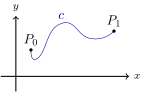
Consider a curve given in parametric representation \begin{align} \left\{\begin{array}{l} x=x(t) \\ y=y(t) \end{array} \quad 0 \leq t \leq 1\right. \end{align}or in complex notation We suppose that no point is covered by two values of the parameter, that the curve is piecewise smooth and that always z'(t)=x'(t)+i y'(t) \neq 0. In the ordinary euclidean case the length of the curve is evaluated by taking the limit of approximations to by polygonal arcs. By subdividing the interval of
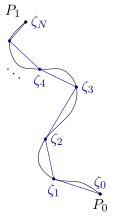
we obtain a subdivision of the curve given by the points . If we join the successive points by straight line segments we obtain an approximating polygon of length The limit of this sum as is the integral \int_{0}^{1}\left|\frac{d z}{d t}\right|\,d t=\int_{0}^{1} \sqrt{x'(t)^{2}+y'(t)^{2}}\, d t.
In the Poincaré half plane the length of the curve is defined in the same manner. We approximate the curve by polygonal lines where for the line segment joining two points we take an arc of a circle orthogonal to the real axis. The length of the curve is then defined as the limit of the sum
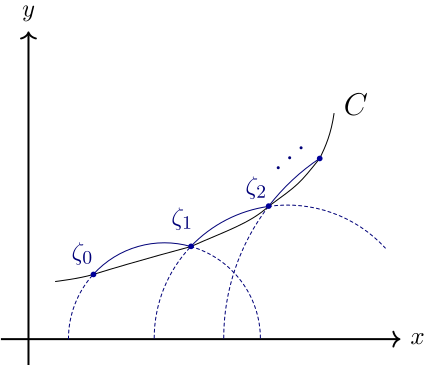
The distance between nearby points can be obtained by displacing the semi-circle connecting them onto a half line orthogonal to the real axis. Then, as before, we have \begin{align} D(\zeta, \zeta+\Delta \zeta)&=\left|\log \frac{y+\Delta y}{\Delta y}\right|\\ &=|\Delta \log y|\\ &=\frac{|\Delta y|}{y}+\varepsilon(\Delta y) \Delta y. \end{align}The differential of arc must then be of the form . In terms of the original point this becomes where . We conclude that the length of the curve is
Exercises
Exercise 1.29 . Find a linear transformation which maps the region between the unit circle and an eccentric circle in its interior onto:
- The region between the unit circle and a concentric circle in its interior.
- The region exterior to two equal circles.
Exercise 1.30 . Verify that the linear transformations of the upper half plane (3.40) actually obey the conditions for displacements in the Poincaré geometry.
Exercise 1.31 . Verify the triangle inequality for the distance function (3.42)
Exercise 1.32 . Show that the length of a curve in the upper half plane where is an invariant under displacement (i.e. under linear transformation of the upper half plane).