“Imaginaries” emerged in algebra as early as the Middle Ages when mathematicians sought a general solution of quadratic equations. The choice of the word "imaginary" is unfortunate, but it indicates the distrust in which complex numbers were held. These unwarranted suspicions were finally dispelled at the end of the 18 century when Gauss in his doctoral thesis 1 gave a simple geometrical representation to complex numbers. Imaginaries could then be handled by the intuitive devices of geometry and they soon lost their awkward artificiality. In recent years mathematicians have turned the other way, preferring to define complex numbers abstractly as symbols subject to certain algebraic operations.
Table of Contents
- 1.1.1 Definition of Complex Number
- 1.1.2 The Complex Number Plane
- Exercises
- 1.1.3 The Complex Number Sphere; Stereographic Projection
- Exercises
- 1.1.4 Point Sets
- Exercises
1.1.1 Definition of Complex Number
To the set of real numbers we adjoin a new symbol , the imaginary unit, with which we add and multiply as for ordinary real numbers with the additional provision that \tag{1.10} i^2 = -1. The set of complex numbers consists of all possible finite products and sums of with itself and with real numbers. Thus a complex number is a polynomial in with real coefficients Applying the rule we obtain Any complex number can therefore be represented in the form \tag{1.11} z=a+bi, \quad a, b \text{ real.} This mode of representation is unique, i.e., if then and . For suppose then But is the only representation of in the prescribed form. For if then . Hence . It follows that
Sums and products of complex numbers are clearly given by the formulae \tag{1.12a} (a+b i) \pm (c+d i)=(a \pm c)+(b \pm d) i \tag{1.12b} (a+b i).(c+d i)=(a c-b d)+(a d+b c) i Division is defined as follows:
If is any complex number , then possesses a unique reciprocal, a complex number such that . It is easy to show that Hence for any complex number we define the quotient, \begin{align} \tag{1.12c} \frac{\zeta}{z}=\frac{a+b i}{c+d i}&=(a+b i)\left(\frac{c-d i}{c^{2}+d^{2}}\right)\\ &=\frac{a c+b d}{c^{2}+d^{2}}+i\,\frac{b c-a d}{c^{2}+d^{2}}. \end{align}
Every complex number can be uniquely described in the form The real numbers and are said respectively to be the real and imaginary part of and are denoted by \tag{1.13} a=\operatorname{Re}(z), \quad b=\operatorname{Im}(z) after Weierstrass. The complex number \tag{1.14} \bar{z}=a-b i is called the conjugate of and has the property that both the sum and the product are real. Evidently \tag{1.15} \operatorname{Re}(z) =\frac{1}{2}(z+\bar{z}), \quad \operatorname{Im}(z)=\frac{1}{2i}(z-\bar{z}).
With every complex number we associate a real, non-negative number called the absolute value or modulus of , written , and defined as \tag{1.16} |z|=\sqrt{a^{2}+b^{2}}. We have and . It is easy to verify that and, provided , . Clearly implies and conversely.
It is possible to give a complete axiomatic definition of complex number without introducing the auxiliary symbol . 2
A complex number is defined as a pair of real numbers given in some definite order. Two complex numbers and are said to be equal if and only if and . The imaginary unit is the ordered pair . The real numbers correspond to the ordered pairs . By developing the algebra of ordered pairs of real numbers in this fashion we may introduce complex numbers without recourse to the imaginary elements which once were considered so disturbing.
1.1.2 The Complex Number Plane
The complex numbers may be represented geometrically by the points of an ordinary cartesian plane – each complex number being represented by the point with abscissa and ordinate . The representation is clearly one-to-one; that is, every point of the plane is used to represent some complex number and no two complex numbers are represented by the same point. We shall therefore adopt a certain looseness of language and use the words "point" and "complex number" interchangeably. This description of complex numbers may be regarded as an extension of the representation of the real number system by the points on a line, since here the real numbers appear simply as the points on the -axis.
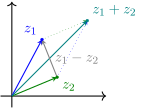
Each point of the complex plane determines a vector (directed line segment) from the origin to the point. Since addition of two complex numbers is performed by addition of their and components, it is seen that addition of complex numbers corresponds to geometric vector addition in the complex plane, according to the parallelogram law. ( Fig. 1 )
It is natural to introduce polar coordinates in the complex plane. We then have ( Fig. 2 )
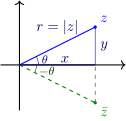
\begin{align} \tag{1.21} r = \sqrt{x^{2}+y^{2}} = |z|\ ;\\ \quad x=r \cos\theta, \quad y=r \sin\theta. \end{align} Using these relations we may write in the polar form : \tag{1.22} z=r(\cos \theta+i \sin \theta). The angle is called the amplitude of and denoted by . The polar coordinates completely define the complex number . On the other hand for a given , is only determined to within an added multiple of , while for , is undetermined.
The conjugate has a simple geometric interpretation: it is the reflection of the point in the real axis. Clearly, we have , ; hence \tag{1.23} \bar{z}=r(\cos \theta-i \sin \theta).
The product of two complex numbers is most simply expressed in polar form: \begin{align} \tag{1.24} z_{1} z_{2} &= r_{1} r_{2}\big[\left(\cos \theta_{1} \cos \theta_{2}-\sin \theta_{1} \sin \theta_{2}\right)\\ & \qquad + i\left(\cos \theta_{1} \sin \theta_{2}+\cos \theta_{2} \sin \theta_{1}\right)\big]\\ &= r_{1} r_{2}\big[\cos \left(\theta_{1}+\theta_{2}\right)+i \sin \left(\theta_{1}+\theta_{2}\right)\big]. \end{align}
This verifies the relation . The rule for multiplication may now be stated as follows: To multiply two complex numbers we multiply their absolute values and add their amplitudes . Setting we use the above relation to find \tag{1.25} e(\theta_{1}).e(\theta_{2})=e(\theta_{1}+\theta_{2}) which is known as De Moivre’s formula . This identity is similar to the addition theorem for the exponential function and, in fact, it will be established later that At present we wish merely to state a few simple properties of : is periodic with period , i.e., . Furthermore, , , , and if , then .
If and are any two complex numbers or points, then the distance between two points is given by , (see Fig. 1). Thus is the equation for points on the circle of radius about the origin, the so-called unit circle . More generally, the points for which form a circle of radius about the point .
In conclusion we prove an important inequality which we shall use very frequently; it is known as the triangle inequality : \tag{1.26} \left|z_{1}\right|+\left|z_{2}\right| \geq\left|z_{1}+z_{2}\right| \geq\big||z_{1}|-|z_{2}|\big|. Geometrically, this inequality is quite obvious, since the vectors , and define a triangle. It simply states that the length of any side of a triangle is not greater than the sum of the lengths of the other two sides and not less than their difference in absolute value. To prove (1.26) analytically set , . Then for the first inequality in (1.26) we have But by squaring both sides we see that this is equivalent to which is a direct consequence of the Schwarz Inequality 3 To obtain the right side of the inequality we note that Thus Since and occur symmetrically their roles may be interchanged in the argument. Consequently
Exercises
Exercise 1.1 . Prove by mathematical induction the following consequence of De Moivre’s formula for positive integers. Finally show that this relation is still valid if is any rational number whatever.
Exercise 1.2 . Prove the identity where are arbitrary complex numbers; interpret this result geometrically.
Exercise 1.3 . Write the following expressions in standard form :
Exercise 1.4 . In c there are three solutions , . Find the cubic equation whose roots are , , .
1.1.3 The Complex Number Sphere; Stereographic Projection
For certain purposes it is simpler to represent complex numbers by the points on a sphere rather than those of a plane. To this end we use the unit sphere : where are rectangular coordinates in space. For the complex number plane we choose the equator plane and take the real axis in the direction of , the imaginary axis in the direction of .
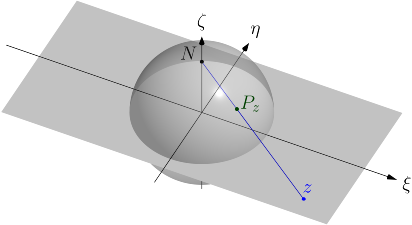
The ray which joins each point of the equator plane to the north pole, , , intersects in another point which is then taken as the geometrical representation of on the sphere. In this manner, the number plane is mapped on the unit sphere in a one-to-one way except that the north pole does not correspond to any point of the -plane. However, if on approaches the distance of the corresponding point of the plane from the origin increases without bound. Accordingly we sometimes denote by the symbol and call the point at infinity of the complex number sphere . It is advantageous to employ the notion of the point at infinity of the -plane , an ideal point which is assigned to in order to complete the one-to-one correspondence between the -plane and the -sphere. In like fashion, we speak of the value attained by a complex variable although such a value cannot be included in the complex number system without violating the ordinary rules of algebra. The purpose in introducing the phrase "point at infinity" is to obviate the necessity of differentiating special cases in certain discussions concerned with limits. It will be recalled that an analogous device is used in projective geometry where, in order to avoid special cases in discussions involving the intersection of lines, we introduce not merely an ideal point but an entire ideal line consisting of points at infinity. However, it should not be forgotten that the concept of point at infinity is a natural and convenient invention but not a logical necessity.
Stereographic Projection
This mapping of the sphere onto the plane is the familiar stereographic projection of the cartographers who, in view of its special properties, find it indispensable for navigational maps. Before we consider these properties let us formulate the analytical description of the mapping:
By elementary geometry we obtain relations between and the coordinates of , namely \tag{1.31} x=\frac{\xi}{1-\zeta} \quad \text{and} \quad y=\frac{\eta}{1-\zeta}. From (1.31) and we obtain the inverse transformation: \begin{align} \xi &= \frac{2 x}{x^{2}+y^{2}+1};\\ \eta &= \frac{2 y}{x^{2}+y^{2}+1};\tag{1.32}\\ \zeta &= \frac{x^{2}+y^{2}-1}{x^{2}+y^{2}+1}, \end{align} or, alternatively, \begin{align} \xi &= \frac{z+\bar{z}}{|z|^{2}+1},\\ \eta &= \frac{1}{i}\,\frac{z-\bar{z}}{|z|^{2}+1},\tag{1.33}\\ \zeta &= \frac{|z|^{2}-1}{|z|^{2}+1}. \end{align}
Stereographic projection is characterized by the following property:
Every circle in the -plane corresponds to a circle on the -sphere and every straight line to a circle passing through the north pole. Conversely, every circle on the -sphere is projected into a straight line or a circle (in the -plane), according to whether it passes through the north pole or not.
If a straight line is regarded as a special kind of circle, namely, a "circle" through the point at infinity, we may express the theorem simply:
Theorem 1.1 . Stereographic projection preserves circles.
Proof. Let \tag{1.34}a(x^{2}+y^{2})+b x+c y+d=0 be the equation of any circle in the -plane. To find the image of this circle, we substitute the transformation formulae (1.31) , giving Remembering that , we reduce this to \tag{1.35} a(1+\zeta)+b \xi+c \eta+d(1-\zeta)=0, the equation of a plane, which, together with that of the unit sphere, determines a circle. For the straight line case let a be zero in (1.34) . The corresponding plane (1.35) becomes , which contains the north pole , . The converse of the theorem is proved similarly. ◻
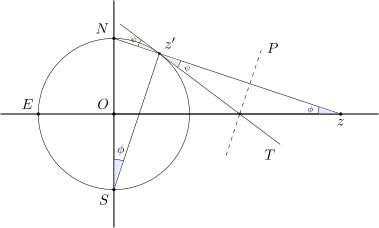
∎The mapping defined by stereographic projection is conformal or angle-preserving . By this we mean that the images on the sphere of any two intersecting curves have the same angle of intersection as the original curves. The proof of conformality can be demonstrated analytically. Here we give a simple geometrical argument.
Let be the point of intersection of the two curves, z' the corresponding projection point. It is sufficient to show that the angle between the tangent plane at z' with the projection line Nz'z is the same as that made with the equatorial plane . Denote the angle between and z' by , and zz' by . Now in the diagram \phi=\sphericalangle NSz' since they are both complementary to the same angle. But \sphericalangle NSz'=\psi since both subtend the same arc. The theorem follows from the fact that and are mirror images in the plane which bisects the angle between them.
Exercises
Exercise 1.5 . Show that the segment joining two points and on is perpendicular to the -plane if and only if their respective images and are inverse with respect to the unit circle , i.e. if and is real and positive.
Exercise 1.6 . Show that the endpoints and of a diameter of are mapped onto two points and with and real and negative.
Exercise 1.7 . Characterize the image on the sphere under stereographic projection of
- A family of parallel lines
- A pencil of lines
- A set of concentric circles
Also characterize the image in the -plane of a set of great circles through a fixed point on the -sphere.
Exercise 1.8 . Give a geometrical proof of conformality by investigating the image of the pencil of circles passing through the north pole and a fixed point on .
1.1.4 Point Sets
With the geometrical interpretation of complex numbers in mind we shall consider a number of useful concepts of point set theory.
A set of points of the complex plane is said to be bounded if can be enclosed in a circle about the origin, i.e., if there exists a positive number such that the inequality holds for all points of .
An -neighborhood of a point is the set of points for which , i.e. the set of all points within a circle of radius about . A point of will be said to be an interior point of if there is an entire neighborhood of contained in . A point will be said to be an exterior point of if it has an entire neighborhood which contains no point of . If a point is neither an interior point or an exterior point it is called a boundary point of .
An open set is a set which consists entirely of interior points. If the set of all points not in is open we say is a closed set.
A set is said to be connected if it is possible to join any pair of points in by means of a polygonal arc without leaving the set. A domain is an open connected set. A region is a set consisting of a domain plus its boundary points.
A point is said to be an accumulation point of a given set if every neighborhood of contains an infinite number of points of . In this connection we mention a fundamental result.
Theorem 1.2 (The Bolzano-Weierstrass Theorem.). Every bounded infinite set of points of the complex plane possesses at least one accumulation point.
Another important result is the Heine-Borel Covering Theorem .
Theorem 1.3 . If to each point of a bounded closed set we assign a neighborhood covering that point then it is possible to choose a finite number of such neighborhoods which completely contain .
Exercises
Exercise 1.9 . Show that a neighborhood of a point is an open set.
Exercise 1.10 . Show that a closed set contains all its accumulation points and, conversely, that any set which contains all its accumulation points is closed.
Exercise 1.11 . Prove that the boundary of any set is closed.
Exercise 1.12 . Demonstrate that a region is a closed set.