Chapter Summary (Express)
Some of the most important problems of the calculus are those where time is the independent variable, and we have to think about the values of some other quantity that varies when the time varies. Some things grow larger as time goes on; some other things grow smaller. The distance that a train has travelled from its starting place goes on ever increasing as time goes on. Trees grow taller as the years go by. Which is growing at the greater rate; a plant inches high which in one month becomes inches high, or a tree feet high which in a year becomes feet high?
This chapter focuses on the concept of "rate," which refers to a mental comparison of an event and the time it takes to occur. Examples given include the speed of a car and the spending habits of an individual, illustrating that rate often represents a ratio or proportion.
In this chapter we are going to make much use of the word rate. Nothing to do with poor-rate, or water-rate (except that even here the word suggests a proportion—a ratio—so many pence in the pound). Nothing to do even with birth-rate or death-rate, though these words suggest so many births or deaths per thousand of the population. When a car whizzes by us, we say: What a terrific rate! When a spendthrift is flinging about his money, we remark that that young man is living at a prodigious rate. What do we mean by rate? In both these cases we are making a mental comparison of something that is happening, and the length of time that it takes to happen. If the car flies past us going yards per second, a simple bit of mental arithmetic will show us that this is equivalent—while it lasts—to a rate of yards per minute, or about miles per hour.1
For example, a speed of 40 yards per second is equivalent to 2400 yards per minute and 82 miles per hour, not because the distances or times are the same, but because the proportion or ratio between the distance covered and the time taken is the same in both instances. This ratio is what’s referred to as the "rate."
Now in what sense is it true that a speed of yards per second is the same as yards per minute? Forty yards is not the same as yards, nor is one second the same thing as one minute. What we mean by saying that the rate is the same, is this: that the proportion borne between distance passed over and time taken to pass over it, is the same in both cases.
The rate of spending isn’t tied to the total amount of money one has, but rather to the speed at which it’s spent over time. For instance, if a person spends a shilling in a second, this corresponds to spending rates of £3 per minute, £180 per hour, and over £1.5 million per year.
Take another example. A man may have only a few pounds in his possession, and yet be able to spend money at the rate of millions a year—provided he goes on spending money at that rate for a few minutes only. Suppose you hand a shilling over the counter to pay for some goods; and suppose the operation lasts exactly one second. Then, during that brief operation, you are parting with your money at the rate of shilling2 per second, which is the same rate as £ per minute, or £ per hour, or £ per day, or £ per year! If you have £ in your pocket, you can go on spending money at the rate of a million a year for just minutes.
Now try to put some of these ideas into differential notation.
Let
money
time
If you are spending money, and the amount you spend in a short time is called , the rate of spending it will be , or rather, should be written with a minus sign, as , because is a decrement, not an increment.
Let in this case stand for money, and let stand for time.
If you are spending money, and the amount you spend in a short time is called , the rate of spending it will be , or rather, should be written with a minus sign, as , because is a decrement, not an increment. But money is not a good example for the calculus, because it generally comes and goes by jumps, not by a continuous flow—you may earn £ a year, but it does not keep running in all day long in a thin stream; it comes in only weekly, or monthly, or quarterly, in lumps: and your expenditure also goes out in sudden payments.
The concept of ‘rate’ is well illustrated by the speed of a moving body, such as a train from London to Liverpool. If is the whole distance, and the whole time, clearly the average rate (or the average speed) is .
However, the speed varies throughout the journey. If, during any particular element of time , the corresponding element of distance passed over was , then at that part of the journey the speed was .
The rate at which one quantity (in the present instance, distance) is changing in relation to the other quantity (in this case, time) is properly expressed, then, by stating the derivative of one with respect to the other. A velocity, scientifically expressed, is the rate at which a very small distance in any given direction is being passed over; and may therefore be written
A more apt illustration of the idea of a rate is furnished by the speed of a moving body. From London (Euston station) to Liverpool is miles. If a train leaves London at o’clock, and reaches Liverpool at o’clock, you know that, since it has travelled miles in hours, its average rate must have been miles per hour; because . Here you are really making a mental comparison between the distance passed over and the time taken to pass over it. You are dividing one by the other. If is the whole distance, and the whole time, clearly the average rate is . Now the speed was not actually constant all the way: at starting, and during the slowing up at the end of the journey, the speed was less. Probably at some part, when running downhill, the speed was over miles an hour. If, during any particular element of time , the corresponding element of distance passed over was , then at that part of the journey the speed was . The rate at which one quantity (in the present instance, distance) is changing in relation to the other quantity (in this case, time) is properly expressed, then, by stating the derivative of one with respect to the other. A velocity, scientifically expressed, is the rate at which a very small distance in any given direction is being passed over; and may therefore be written
But if the velocity is not uniform, then it must be either increasing or else decreasing. The rate at which a velocity is increasing is called the acceleration. If a moving body is, at any particular instant, gaining an additional velocity in an element of time , then the acceleration at that instant may be written but is itself . Hence we may put and this is usually written ; or the acceleration is the second derivative of the distance, with respect to time. Acceleration is expressed as a change of velocity in unit time, for instance, as being so many feet per second per second; the notation used being .
When a railway train has just begun to move, its velocity is small; but it is rapidly gaining speed—it is being hurried up, or accelerated, by the effort of the engine. So its is large. When it has got up its top speed it is no longer being accelerated, so that then has fallen to zero. But when it nears its stopping place its speed begins to slow down; may, indeed, slow down very quickly if the brakes are put on, and during this period of deceleration or slackening of pace, the value of , that is, of will be negative.
To accelerate a mass requires the continuous application of force. The force necessary to accelerate a mass is proportional to the mass, and it is also proportional to the acceleration which is being imparted. Hence we may write for the force , the expression or or
Read about the relationship between momentum and force
The product of a mass by the speed at which it is going is called its momentum, and is in symbols . If we differentiate momentum with respect to time we shall get for the rate of change of momentum. But, since is a constant quantity, this may be written , which we see above is the same as . That is to say, force may be expressed either as mass times acceleration, or as rate of change of momentum.
When a force is employed to move something, it does work, measured by the force multiplied by the distance it moves in its direction. If the force is constant, the work done () equals force () times distance in its own direction () If the force varies, we calculate work for each small length () it moves. Thus, an element of work () equals force times the small element of length Therefore, This leads to another definition of force: if used to produce a displacement in any direction, the force (in that direction) is equal to the rate at which work is being done per unit of length, where ’rate’ is clearly not used in its time-sense, but in its meaning as ratio or proportion.
Again, if a force is employed to move something (against an equal and opposite counter-force), it does work; and the amount of work done is measured by the product of the force into the distance (in its own direction) through which its point of application moves forward. So if a force moves forward through a length , the work done (which we may call ) will be where we take as a constant force. If the force varies at different parts of the range , then we must find an expression for its value from point to point. If is the force along the small element of length , the amount of work done will be . But as is only an element of length, only an element of work will be done. If we write for work, then an element of work will be ; and we have which may be written or or Further, we may transpose the expression and write
This gives us yet a third definition of force; that if it is being used to produce a displacement in any direction, the force (in that direction) is equal to the rate at which work is being done per unit of length in that direction. In this last sentence the word rate is clearly not used in its time-sense, but in its meaning as ratio or proportion.
Sir Isaac Newton, co-inventor of calculus, viewed varying quantities as `flowing,’ and their derivative as the ’fluxion’ or rate of flow. His notation for the fluxion of a variable, say ’’ or ’’, was a dot over the letter, represented as or . In physics, this notation is still used when time is the independent variable, so is , and is .
Sir Isaac Newton, who was (along with Gottfried Wilhelm Leibnitz) an inventor of the methods of the calculus, regarded all quantities that were varying as flowing; and the ratio which we nowadays call the derivative he regarded as the rate of flowing, or the fluxion of the quantity in question. He did not use the notation of the and , and (this was due to Leibniz), but had instead a notation of his own. If was a quantity that varied, or “flowed,” then his symbol for its rate of variation (or “fluxion”) was . If was the variable, then its fluxion was denoted by . The dot over the letter indicated that it had been differentiated. In physics, this notation is still in use, but exclusively where time is the independent variable. In that case, will mean and will mean ; and will mean .
Adopting this fluxional notation we may write the mechanical equations considered in the paragraphs above, as follows:
| distance | , |
| velocity | , |
| acceleration | , |
| force | , |
| work | . |
Examples
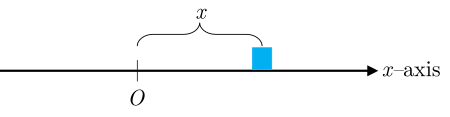
Example 8.1. A body moves so that the distance (in feet), which it travels from a certain point (see the following figure), is given by the relation , where is the time in seconds elapsed since a certain instant. (a) Find the velocity and acceleration seconds after the body began to move. (b) Find the corresponding values when the distance covered is feet. (c) Find also the average velocity during the first seconds of its motion. (Suppose distances and motion to the right to be positive.)
Solution
Now
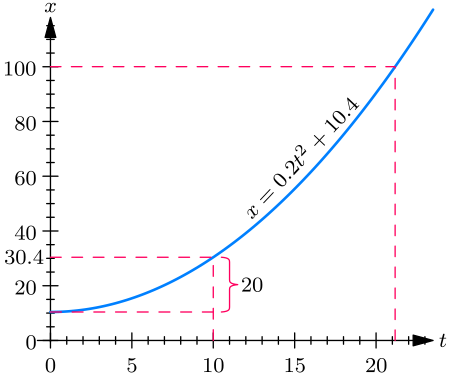
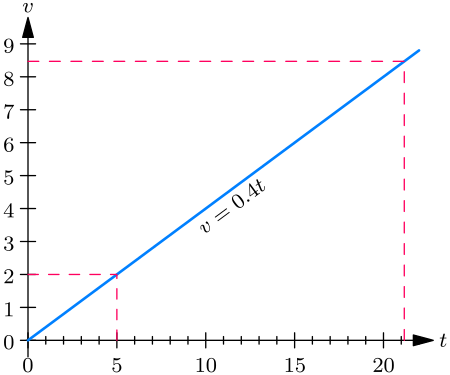
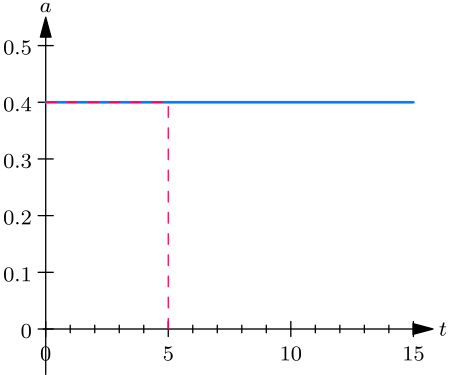
The graphs of , , and versus are shown below.
When , and . The body started from a point feet to the right of the point ; and the time was reckoned from the instant the body started.
(a) When , ; .
(b) When , , or , and ;
(c) When ,
(It is the same velocity as the velocity at the middle of the interval, ; for, the acceleration being constant, the velocity has varied uniformly from zero when to when s.)
Example 8.2. Solve the above problem if
Solution
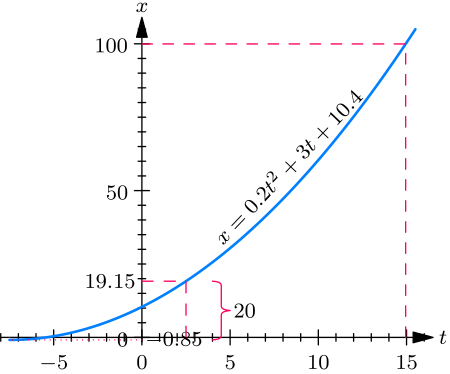
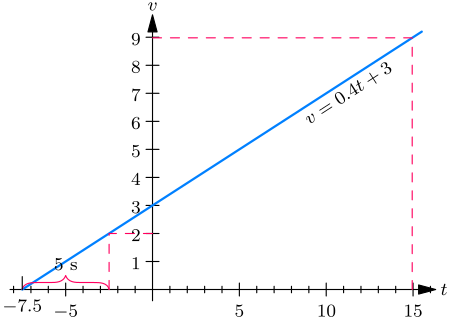
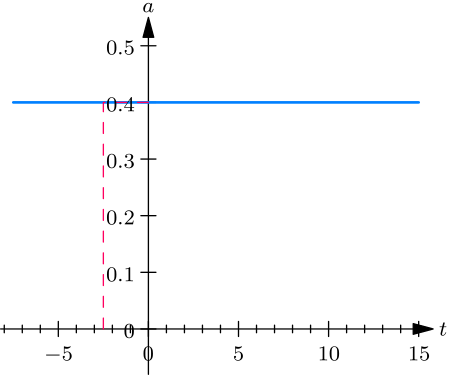
If , then The graphs of , , and versus are shown below.
When , and ft/s (feet per second), the time is reckoned from the instant at which the body passed a point ft from the point , its velocity being then already ft/s.
(a) To find the time elapsed since it began moving, let ; then , seconds. The body began moving seconds before time was begun to be observed; seconds after this gives and ft/s.
(b) When ft, hence s, ft/s.
(c) To find the distance travelled during the first seconds of the motion one must know how far the body was from the point when it started.
When , that is ft to the left of the point .
Now, when ,
So, in seconds, the distance travelled was ft, and
Example 8.3. Consider a problem similar to the previous one, but now assume that the distance is given by .
(a) Find the velocity and acceleration seconds after the body began to move. (b) Find the corresponding values when the distance covered is feet. (c) Find also the average velocity during the first seconds of its motion.
Solution
If then
The graphs of and versus are shown below.
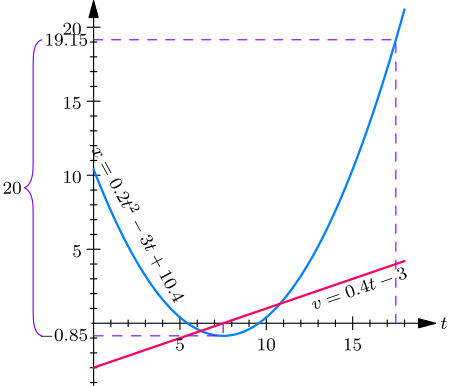
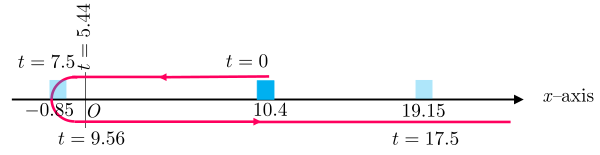
(a) When , as before, and ; so that the body was moving in the direction opposite to its motion in the previous cases (see the following figure). As the acceleration is positive, however, we see that this velocity will numerically decrease3 as time goes on, until it becomes zero, when or ; or seconds. After this, the velocity becomes positive; and seconds after the body started, , and
(b) When , \begin{align} 100 = 0.2t^2 - 3t + 10.4,\quad \text{or } t^2 - 15t - 448 = 0, \end{align} and \begin{align} t = 29.95;\ v = 0.4 \times 29.95 - 3 = 8.98~\text{ft/s} \end{align}
(c) When is zero, , informing us that the body moves back to ft beyond the point before it stops. Ten seconds later , and the average velocity is again ft/sec.
Example 8.4. Consider yet another problem of the same sort with ; ; . The acceleration is no more constant.
The graphs of , , and versus are shown below.
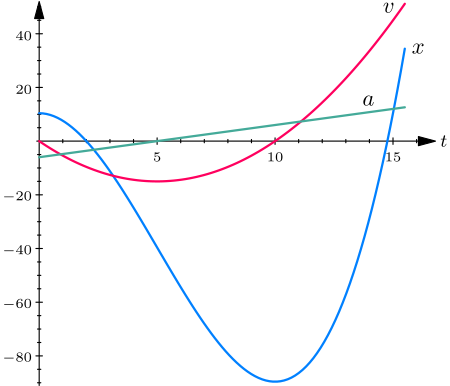
When , , , . The body is at rest, but just ready to move with a negative acceleration, that is to gain a velocity towards the point (see the following figure).

Example 8.5. If we have , then , and .
When , ; ; .
The body is moving towards the point with a speed of ft/s,4 and just at that instant the velocity is uniform (i.e. its rate of change, , is zero).
The graphs of , , and versus are shown below.
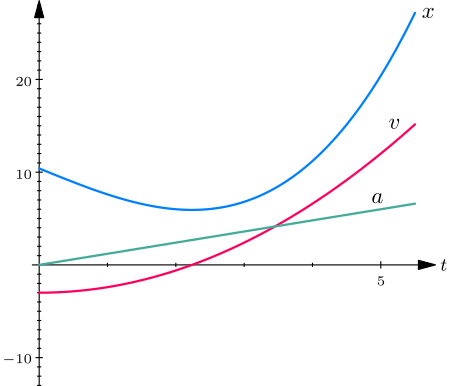
We see that the conditions of the motion can always be at once ascertained from the time-distance equation and its first and second derived functions. In the last two cases the mean velocity during the first seconds and the velocity seconds after the start will no more be the same, because the velocity is not increasing uniformly, the acceleration being no longer constant.
Angular displacement is the change in orientation or position of an object with respect to a reference point or axis. Angular displacement is typically measured in radians (rad) or degrees.
Angular velocity and angular acceleration are defined as:
Angular displacement refers to the change in orientation or position of an object with respect to a reference point or axis. It is a measure of how far an object has rotated or moved around a central axis. Angular displacement is typically measured in radians (rad) or degrees. It can be positive or negative, indicating the direction of rotation or the angle of deviation from the reference point.
Angular velocity is defined as the rate of change of angular displacement over time. It represents how quickly an object rotates or moves around a central axis. Angular velocity is typically denoted by the symbol omega () and is measured in radians per second (rad/s).
Angular acceleration, on the other hand, refers to the rate of change of angular velocity over time. It describes how the angular velocity of an object changes over time. Angular acceleration is denoted by the symbol alpha () and is measured in radians per second squared (rad/s).
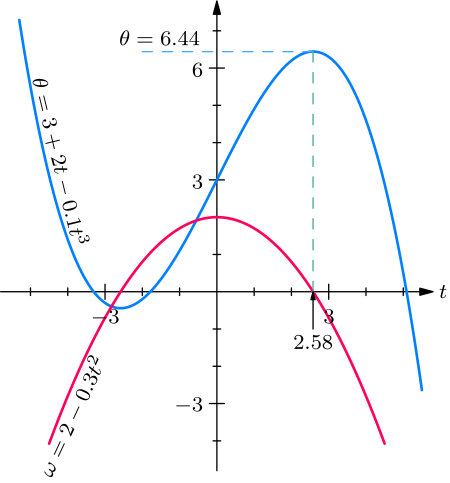
Example 8.6. The angle (in radians) turned through by a wheel is given by , where is the time in seconds from a certain instant; find the angular velocity and the angular acceleration5 , (a) after second; (b) after it has performed one revolution. (c) At what time is it at rest, and how many revolutions has it performed up to that instant?
Solution
Writing for the acceleration
When , ; rad/s; .
(a) When ,
This is a retardation; the wheel is slowing down.
(b) After revolution
By plotting the graph, (see the following figure), we can get the value or values of for which ; these are and (there is a third negative value).
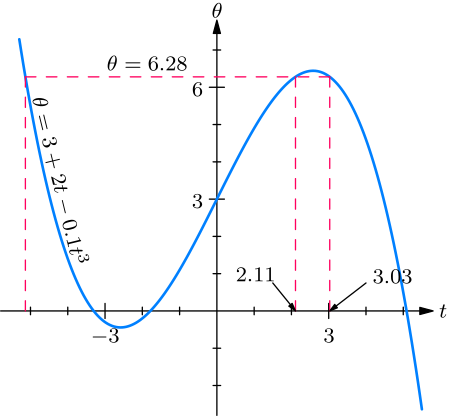
When , When ,
(c) The velocity is reversed. The wheel is evidently at rest between these two instants; it is at rest when , that is when , or when , it has performed
Plotting the graph of , we observe that at seconds, where the angular velocity is zero, the curve has a summit and the value of at that moment is locally a maximum (see the following figure).
Exercises
Exercise 8.1. If ; find and .
Answer
;.
Solution
\begin{align} & y=a+b t^{2}+c t^{4} \\ & \frac{d y}{d t}=2 b t+4 c t^{3} \\ & \frac{d^{2} y}{d t^{2}}=2 b+6 c t^{2} \end{align}
Exercise 8.2. A body falling freely in space describes in seconds a space , in feet, expressed by the equation . Draw a curve showing the relation between and . Also determine the velocity of the body at the following times from its being let drop: seconds; seconds; seconds.
Answer
64; 147.2; and 0.32 feet per second.
Solution
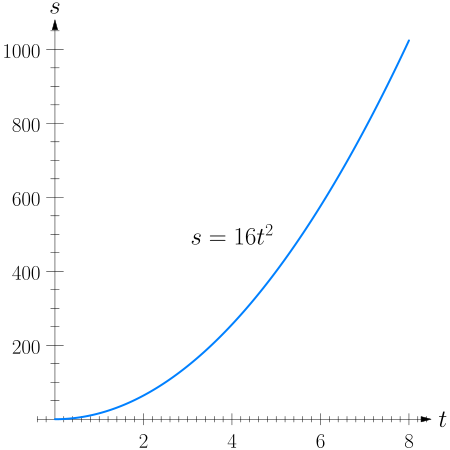
When
when
when
Exercise 8.3. If ; find and .
Answer
; .
Solution
\begin{align} & x=a t-\frac{1}{2} g t^{2} \\ & \dot{x}=\frac{d x}{d t}=a-g t \\ & \ddot{x}=\frac{d^{2} x}{d t^{2}}=-g \end{align}
Exercise 8.4. If a body move according to the law find its velocity when seconds; being in feet.
Answer
feet per second.
Solution
\begin{align} & s=12-4.5 t+6.2 t^{2} \\ & v=\frac{d s}{d t}=-4.5+12.4 t \end{align} When
Exercise 8.5. Find the acceleration of the body mentioned in the preceding example. Is the acceleration the same for all values of ?
Answer
feet per second per second.Yes.
Solution
Yes, acceleration is the same for all values of .
Exercise 8.6. The angle (in radians) turned through by a revolving wheel is connected with the time (in seconds) that has elapsed since starting; by the law Find the angular velocity (in radians per second) of that wheel when seconds have elapsed. Find also its angular acceleration.
Answer
Angular velocity radians per second; angular acceleration radians per second per second.
Solution
\begin{align} & \omega=\frac{d \theta}{d t}=-3.2+9.6 t ~ \frac{\mathrm{rad}}{\mathrm{s}} \\ & \alpha=\frac{d \omega}{d t}=\frac{d^{2} \theta}{d t^{2}}=9.6 ~ \frac{\mathrm{rad}}{\mathrm{s}^{2}} \end{align}
When seconds,
For all values of ,
Exercise 8.7. A slider moves so that, during the first part of its motion, its distance in inches from its starting point is given by the expression Find the expression for the velocity and the acceleration at any time; and hence find the velocity and the acceleration after seconds.
Answer
.. in/s, .
Solution
\begin{align} & s=6.8 t^{3}-10.8 t \\ & v=\frac{d s}{d t}=20.4 t^{2}-10.8 \\ & a=\frac{d v}{d t}=40.8 t \end{align}
When seconds, .
When seconds, .
Exercise 8.8. The motion of a rising balloon is such that its height , in miles, is given at any instant by the expression ; being in seconds.
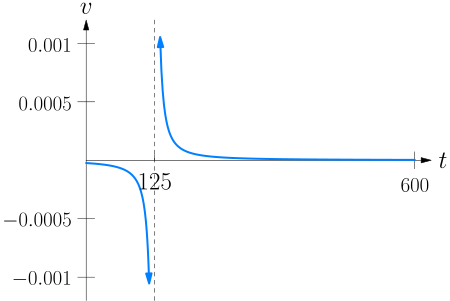
Find an expression for the velocity and the acceleration at any time. Draw curves to show the variation of height, velocity and acceleration during the first ten minutes of the ascent.
Answer
,.
Solution
If we have a shift in time (defining a new origin for time), , then . However, since this is a simple shift, we expect the rate of change of with respect to both and to be the same.
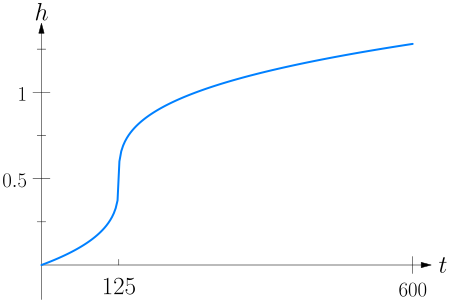
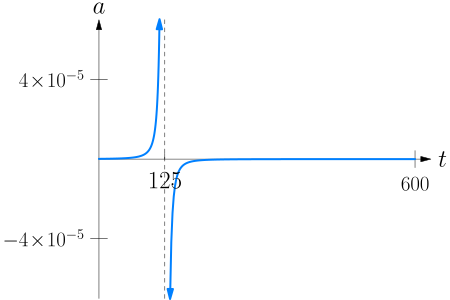
The graphs of velocity () and acceleration () as functions of time are presented below. The formulas for velocity and acceleration, along with the accompanying graphs, demonstrate that at seconds, both velocity and acceleration become infinite or "blow up." This indicates that it is not possible for a formula to exist for the height () in this scenario.
Exercise 8.9. A stone is thrown downwards into water and its depth in metres at any instant seconds after reaching the surface of the water is given by the expression
Find an expression for the velocity and the acceleration at any time. Find the velocity and acceleration after seconds.
Answer
,, and .
Solution
\begin{align} v&=\frac{d p}{d t}=\frac{-2 t \times 4}{\left(4+t^{2}\right)^{2}}+0.8 \\ & =-\frac{8 t}{\left(4+t^{2}\right)^{2}}+0.8 \end{align} \begin{align} a & =\frac{d^{2} p}{d t^{2}}\\ & =-\frac{8\left(4+t^{2}\right)^{2}-8 t \frac{d\left(16+8 t^{2}+t^{4}\right)}{d t}}{\left(4+t^{2}\right)^{4}} \\ & =-\frac{8\left(16+8 t^{2}+t^{4}\right)-8 t\left(16 t+4 t^{3}\right)}{\left(4+t^{2}\right)^{4}} \\ & =\frac{24 t^{4}+64 t^{2}-128}{\left(4+t^{2}\right)^{4}} \\ & =8 \frac{\left(3 t^{4}+8 t^{2}-16\right)}{\left(4+t^{2}\right)^{4}} \end{align}
When seconds,
When ,
Exercise 8.10. A body moves in such a way that the spaces described in the time from starting is given by , where is a constant. Find the value of when the velocity is doubled from the th to the th second; find it also when the velocity is numerically equal to the acceleration at the end of the th second.
Answer
, .
Solution
At ,
At
The velocity is doubled from the th to the th second. Thus, we have
The velocity is numerically equal to the acceleration at the end of the th second. Thus or
1. There are 1,760 yards in a mile.↩︎
2. 20 shillings 1 pound. Currently 1 pound is approximately 1.21 United States Dollars.↩︎
3. In other words, during the first 7.5 seconds, the absolute value of the velocity (which is called speed) decreases, but the velocity itself is algebraically increasing with time because it goes from to . In general, whenever the acceleration of a body is positive, its velocity algebraically increases, and whenever the acceleration is negative, its velocity algebraically decreases.↩︎
4. The absolute value of velocity is called speed; that is, speed .↩︎
5. The angular velocity is and the angular acceleration is .↩︎
Full Chapter
Some of the most important problems of the calculus are those where time is the independent variable, and we have to think about the values of some other quantity that varies when the time varies. Some things grow larger as time goes on; some other things grow smaller. The distance that a train has travelled from its starting place goes on ever increasing as time goes on. Trees grow taller as the years go by. Which is growing at the greater rate; a plant inches high which in one month becomes inches high, or a tree feet high which in a year becomes feet high?
In this chapter we are going to make much use of the word rate. Nothing to do with poor-rate, or water-rate (except that even here the word suggests a proportion—a ratio—so many pence in the pound). Nothing to do even with birth-rate or death-rate, though these words suggest so many births or deaths per thousand of the population. When a car whizzes by us, we say: What a terrific rate! When a spendthrift is flinging about his money, we remark that that young man is living at a prodigious rate. What do we mean by rate? In both these cases we are making a mental comparison of something that is happening, and the length of time that it takes to happen. If the car flies past us going yards per second, a simple bit of mental arithmetic will show us that this is equivalent—while it lasts—to a rate of yards per minute, or about miles per hour.1
Now in what sense is it true that a speed of yards per second is the same as yards per minute? Forty yards is not the same as yards, nor is one second the same thing as one minute. What we mean by saying that the rate is the same, is this: that the proportion borne between distance passed over and time taken to pass over it, is the same in both cases.
Take another example. A man may have only a few pounds in his possession, and yet be able to spend money at the rate of millions a year—provided he goes on spending money at that rate for a few minutes only. Suppose you hand a shilling over the counter to pay for some goods; and suppose the operation lasts exactly one second. Then, during that brief operation, you are parting with your money at the rate of shilling2 per second, which is the same rate as £ per minute, or £ per hour, or £ per day, or £ per year! If you have £ in your pocket, you can go on spending money at the rate of a million a year for just minutes.
Now try to put some of these ideas into differential notation.
Let in this case stand for money, and let stand for time.
If you are spending money, and the amount you spend in a short time is called , the rate of spending it will be , or rather, should be written with a minus sign, as , because is a decrement, not an increment. But money is not a good example for the calculus, because it generally comes and goes by jumps, not by a continuous flow—you may earn £ a year, but it does not keep running in all day long in a thin stream; it comes in only weekly, or monthly, or quarterly, in lumps: and your expenditure also goes out in sudden payments.
A more apt illustration of the idea of a rate is furnished by the speed of a moving body. From London (Euston station) to Liverpool is miles. If a train leaves London at o’clock, and reaches Liverpool at o’clock, you know that, since it has travelled miles in hours, its average rate must have been miles per hour; because . Here you are really making a mental comparison between the distance passed over and the time taken to pass over it. You are dividing one by the other. If is the whole distance, and the whole time, clearly the average rate is . Now the speed was not actually constant all the way: at starting, and during the slowing up at the end of the journey, the speed was less. Probably at some part, when running downhill, the speed was over miles an hour. If, during any particular element of time , the corresponding element of distance passed over was , then at that part of the journey the speed was . The rate at which one quantity (in the present instance, distance) is changing in relation to the other quantity (in this case, time) is properly expressed, then, by stating the derivative of one with respect to the other. A velocity, scientifically expressed, is the rate at which a very small distance in any given direction is being passed over; and may therefore be written
But if the velocity is not uniform, then it must be either increasing or else decreasing. The rate at which a velocity is increasing is called the acceleration. If a moving body is, at any particular instant, gaining an additional velocity in an element of time , then the acceleration at that instant may be written but is itself . Hence we may put and this is usually written ; or the acceleration is the second derivative of the distance, with respect to time. Acceleration is expressed as a change of velocity in unit time, for instance, as being so many feet per second per second; the notation used being .
When a railway train has just begun to move, its velocity is small; but it is rapidly gaining speed—it is being hurried up, or accelerated, by the effort of the engine. So its is large. When it has got up its top speed it is no longer being accelerated, so that then has fallen to zero. But when it nears its stopping place its speed begins to slow down; may, indeed, slow down very quickly if the brakes are put on, and during this period of deceleration or slackening of pace, the value of , that is, of will be negative.
To accelerate a mass requires the continuous application of force. The force necessary to accelerate a mass is proportional to the mass, and it is also proportional to the acceleration which is being imparted. Hence we may write for the force , the expression or or
The product of a mass by the speed at which it is going is called its momentum, and is in symbols . If we differentiate momentum with respect to time we shall get for the rate of change of momentum. But, since is a constant quantity, this may be written , which we see above is the same as . That is to say, force may be expressed either as mass times acceleration, or as rate of change of momentum.
Again, if a force is employed to move something (against an equal and opposite counter-force), it does work; and the amount of work done is measured by the product of the force into the distance (in its own direction) through which its point of application moves forward. So if a force moves forward through a length , the work done (which we may call ) will be where we take as a constant force. If the force varies at different parts of the range , then we must find an expression for its value from point to point. If is the force along the small element of length , the amount of work done will be . But as is only an element of length, only an element of work will be done. If we write for work, then an element of work will be ; and we have which may be written or or Further, we may transpose the expression and write
This gives us yet a third definition of force; that if it is being used to produce a displacement in any direction, the force (in that direction) is equal to the rate at which work is being done per unit of length in that direction. In this last sentence the word rate is clearly not used in its time-sense, but in its meaning as ratio or proportion.
Sir Isaac Newton, who was (along with Gottfried Wilhelm Leibniz) an inventor of the methods of the calculus, regarded all quantities that were varying as flowing; and the ratio which we nowadays call the derivative he regarded as the rate of flowing, or the fluxion of the quantity in question. He did not use the notation of the and , and (this was due to Leibniz), but had instead a notation of his own. If was a quantity that varied, or “flowed,” then his symbol for its rate of variation (or “fluxion”) was . If was the variable, then its fluxion was denoted by . The dot over the letter indicated that it had been differentiated. In physics, this notation is still in use, but exclusively where time is the independent variable. In that case, will mean and will mean ; and will mean .
Adopting this fluxional notation we may write the mechanical equations considered in the paragraphs above, as follows:
| distance | , |
| velocity | , |
| acceleration | , |
| force | , |
| work | . |
Examples
Example 8.1. A body moves so that the distance (in feet), which it travels from a certain point (see the following figure), is given by the relation , where is the time in seconds elapsed since a certain instant. (a) Find the velocity and acceleration seconds after the body began to move. (b) Find the corresponding values when the distance covered is feet. (c) Find also the average velocity during the first seconds of its motion. (Suppose distances and motion to the right to be positive.)
Solution. Now
The graphs of , , and versus are shown below.
When , and . The body started from a point feet to the right of the point ; and the time was reckoned from the instant the body started.
(a) When , ; .
(b) When , , or , and ;
(c) When ,
(It is the same velocity as the velocity at the middle of the interval, ; for, the acceleration being constant, the velocity has varied uniformly from zero when to when s.)
Example 8.2. Solve the above problem if
Solution. If , then The graphs of , , and versus are shown below.
When , and ft/s (feet per second), the time is reckoned from the instant at which the body passed a point ft from the point , its velocity being then already ft/s.
(a) To find the time elapsed since it began moving, let ; then , seconds. The body began moving seconds before time was begun to be observed; seconds after this gives and ft/s.
(b) When ft, hence s, ft/s.
(c) To find the distance travelled during the first seconds of the motion one must know how far the body was from the point when it started.
When , that is ft to the left of the point .
Now, when ,
So, in seconds, the distance travelled was ft, and
Example 8.3. Consider a problem similar to the previous one, but now assume that the distance is given by .
(a) Find the velocity and acceleration seconds after the body began to move. (b) Find the corresponding values when the distance covered is feet. (c) Find also the average velocity during the first seconds of its motion.
Solution. If then
The graphs of and versus are shown below.
(a) When , as before, and ; so that the body was moving in the direction opposite to its motion in the previous cases (see the following figure). As the acceleration is positive, however, we see that this velocity will numerically decrease3 as time goes on, until it becomes zero, when or ; or seconds. After this, the velocity becomes positive; and seconds after the body started, , and
(b) When , \begin{align} 100 = 0.2t^2 - 3t + 10.4,\quad \text{or } t^2 - 15t - 448 = 0, \end{align} and \begin{align} t = 29.95;\ v = 0.4 \times 29.95 - 3 = 8.98~\text{ft/s} \end{align}
(c) When is zero, , informing us that the body moves back to ft beyond the point before it stops. Ten seconds later , and the average velocity is again ft/sec.
Example 8.4. Consider yet another problem of the same sort with ; ; . The acceleration is no more constant.
The graphs of , , and versus are shown below.
When , , , . The body is at rest, but just ready to move with a negative acceleration, that is to gain a velocity towards the point (see the following figure).
Example 8.5. If we have , then , and .
When , ; ; .
The body is moving towards the point with a velocity of ft/s,4 and just at that instant the velocity is uniform (i.e. its rate of change is zero).
The graphs of , , and versus are shown below.
We see that the conditions of the motion can always be at once ascertained from the time-distance equation and its first and second derived functions. In the last two cases the mean velocity during the first seconds and the velocity seconds after the start will no more be the same, because the velocity is not increasing uniformly, the acceleration being no longer constant.
Example 8.6. The angle (in radians) turned through by a wheel is given by , where is the time in seconds from a certain instant; find the angular velocity and the angular acceleration5 , (a) after second; (b) after it has performed one revolution. (c) At what time is it at rest, and how many revolutions has it performed up to that instant?
Solution. Writing for the acceleration
When , ; rad/s; .
(a) When ,
This is a retardation; the wheel is slowing down.
(b) After revolution
By plotting the graph, (see the following figure), we can get the value or values of for which ; these are and (there is a third negative value).
When , When ,
(c) The velocity is reversed. The wheel is evidently at rest between these two instants; it is at rest when , that is when , or when , it has performed
Plotting the graph of , we observe that at seconds, where the angular velocity is zero, the curve has a summit and the value of at that moment is locally a maximum (see the following figure).
Exercises
Exercise 8.1. If ; find and .
Answer
;.
Solution
\begin{align} & y=a+b t^{2}+c t^{4} \\ & \frac{d y}{d t}=2 b t+4 c t^{3} \\ & \frac{d^{2} y}{d t^{2}}=2 b+6 c t^{2} \end{align}
Exercise 8.2. A body falling freely in space describes in seconds a space , in feet, expressed by the equation . Draw a curve showing the relation between and . Also determine the velocity of the body at the following times from its being let drop: seconds; seconds; seconds.
Answer
64; 147.2; and 0.32 feet per second.
Solution
When
when
when
Exercise 8.3. If ; find and .
Answer
; .
Solution
\begin{align} & x=a t-\frac{1}{2} g t^{2} \\ & \dot{x}=\frac{d x}{d t}=a-g t \\ & \ddot{x}=\frac{d^{2} x}{d t^{2}}=-g \end{align}
Exercise 8.4. If a body move according to the law find its velocity when seconds; being in feet.
Answer
feet per second.
Solution
\begin{align} & s=12-4.5 t+6.2 t^{2} \\ & v=\frac{d s}{d t}=-4.5+12.4 t \end{align} When
Exercise 8.5. Find the acceleration of the body mentioned in the preceding example. Is the acceleration the same for all values of ?
Answer
feet per second per second.Yes.
Solution
Yes, acceleration is the same for all values of .
Exercise 8.6. The angle (in radians) turned through by a revolving wheel is connected with the time (in seconds) that has elapsed since starting; by the law Find the angular velocity (in radians per second) of that wheel when seconds have elapsed. Find also its angular acceleration.
Answer
Angular velocity radians per second; angular acceleration radians per second per second.
Solution
\begin{align} & \omega=\frac{d \theta}{d t}=-3.2+9.6 t ~ \frac{\mathrm{rad}}{\mathrm{s}} \\ & \alpha=\frac{d \omega}{d t}=\frac{d^{2} \theta}{d t^{2}}=9.6 ~ \frac{\mathrm{rad}}{\mathrm{s}^{2}} \end{align}
When seconds,
For all values of ,
Exercise 8.7. A slider moves so that, during the first part of its motion, its distance in inches from its starting point is given by the expression Find the expression for the velocity and the acceleration at any time; and hence find the velocity and the acceleration after seconds.
Answer
.. in/s, .
Solution
\begin{align} & s=6.8 t^{3}-10.8 t \\ & v=\frac{d s}{d t}=20.4 t^{2}-10.8 \\ & a=\frac{d v}{d t}=40.8 t \end{align}
When seconds, .
When seconds, .
Exercise 8.8. The motion of a rising balloon is such that its height , in miles, is given at any instant by the expression ; being in seconds.
Find an expression for the velocity and the acceleration at any time. Draw curves to show the variation of height, velocity and acceleration during the first ten minutes of the ascent.
Answer
,.
Solution
If we have a shift in time (defining a new origin for time), , then . However, since this is a simple shift, we expect the rate of change of with respect to both and to be the same.
The graphs of velocity () and acceleration () as functions of time are presented below. The formulas for velocity and acceleration, along with the accompanying graphs, demonstrate that at seconds, both velocity and acceleration become infinite or "blow up." This indicates that it is not possible for a formula to exist for the height () in this scenario.
Exercise 8.9. A stone is thrown downwards into water and its depth in metres at any instant seconds after reaching the surface of the water is given by the expression
Find an expression for the velocity and the acceleration at any time. Find the velocity and acceleration after seconds.
Answer
,, and .
Solution
\begin{align} v&=\frac{d p}{d t}=\frac{-2 t \times 4}{\left(4+t^{2}\right)^{2}}+0.8 \\ & =-\frac{8 t}{\left(4+t^{2}\right)^{2}}+0.8 \end{align} \begin{align} a & =\frac{d^{2} p}{d t^{2}}\\ & =-\frac{8\left(4+t^{2}\right)^{2}-8 t \frac{d\left(16+8 t^{2}+t^{4}\right)}{d t}}{\left(4+t^{2}\right)^{4}} \\ & =-\frac{8\left(16+8 t^{2}+t^{4}\right)-8 t\left(16 t+4 t^{3}\right)}{\left(4+t^{2}\right)^{4}} \\ & =\frac{24 t^{4}+64 t^{2}-128}{\left(4+t^{2}\right)^{4}} \\ & =8 \frac{\left(3 t^{4}+8 t^{2}-16\right)}{\left(4+t^{2}\right)^{4}} \end{align}
When seconds,
When ,
Exercise 8.10. A body moves in such a way that the spaces described in the time from starting is given by , where is a constant. Find the value of when the velocity is doubled from the th to the th second; find it also when the velocity is numerically equal to the acceleration at the end of the th second.
Answer
, .
Solution
At ,
At
The velocity is doubled from the th to the th second. Thus, we have \begin{align} & 2 \times n \times 5^{n-1}=n \times 10^{n-1}=n \times 5^{n-1} \times 2^{n-1} \\ & 2=2^{n-1} \Rightarrow n=2 \end{align}
The velocity is numerically equal to the acceleration at the end of the th second. Thus or