In this section, we introduce the concept of intervals that are extensively used in calculus. The set of all real numbers that lie between two given numbers, possibly including one or both endpoints is called an interval.
Closed interval is the set of real numbers that satisfy the inequalities .
Open interval is the set of real numbers that satisfy the inequalities .
Some books denote the open interval by .
Note that the open interval does not include its endpoints and , while the closed interval include both of them.
We also have half-open intervals that include only one endpoint. In addition to finite intervals, we have infinite intervals that extend indefinitely in one or both directions. If an interval extends indefinitely in the positive direction, we write (or sometimes ) in place of the right end and if it extends indefinitely in the negative direction, we write in place of the left end. All of these cases are shown in the following table.
We always denote the inclusion of an end in an interval by square bracket and its exclusion by a parenthesis.
The symbols and (read "infinity" and "minus infinity") are not real numbers. We use these symbols to indicate that the interval extends indefinitely in a direction.
Notation
Definition
Graph
Classification
finite, closed
finite, open
finite, half-open
finite, half-open
infinite, closed
infinite, open
infinite, closed
infinite, open
infinite, open and closed
Because intervals are sets, we can calculate the union, intersection, and difference of intervals. For example the setcan be written asorSee the following figure.
Different ways to symbolically express the set shown above:
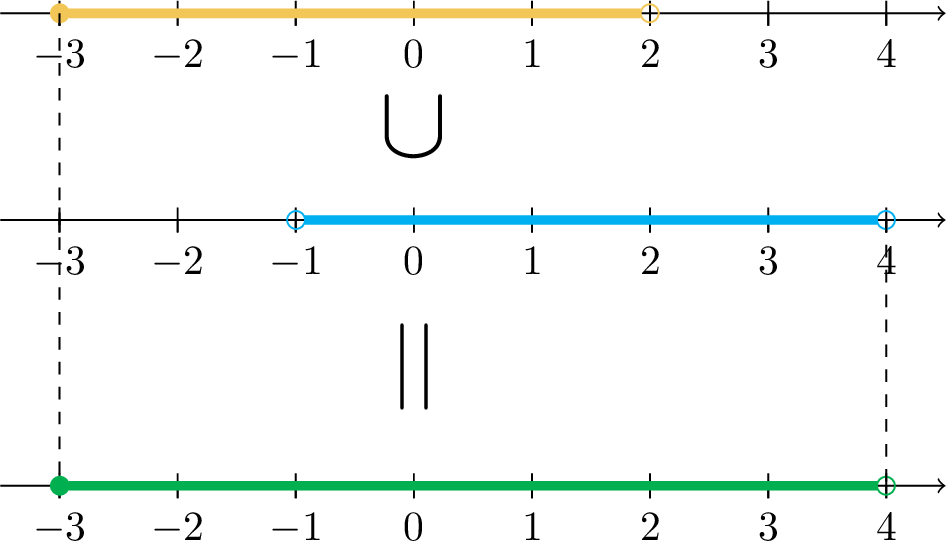
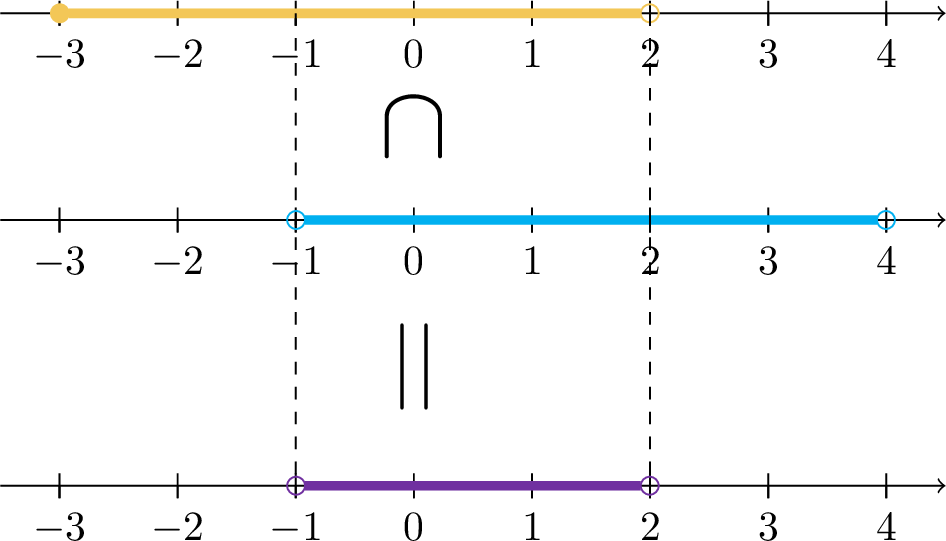
To avoid any mistakes in set calculations on intervals, you can picture them graphically.
If and then find and .
Solution
The results are explained in the next two figures.
and

.png)
.png)

.png)
.png)

.png)
.png)


-1920.webp)
-1920.webp)

-1920.webp)
-1920.webp)

-1920.webp)
-1920.webp)